Longitudinal AI Feedback in Executive Coaching
Measure observable behaviors at set checkpoints, use AI to reveal session-to-session trends, and share sponsor-safe progress.
Christian Thomas

Longitudinal AI Feedback in Executive Coaching
If you want coaching to lead to lasting behavior change, you need repeated feedback, not a one-time report.
I’d sum up the article like this: set clear behaviors at the start, measure them at fixed checkpoints, review patterns across sessions, protect private session details, and report only sponsor-safe progress. The core idea is simple: AI helps me spot patterns over time, while the coach decides what those patterns mean and what to do next.
Here’s the full article in one quick view:
- Start with observable behaviors
- Turn vague goals like executive presence into visible actions
- Use the same behaviors and data sources each time
- Measure on a fixed schedule
- Baseline at kickoff
- Mid-point around Weeks 6 to 8
- End of engagement
- Follow-up 60 to 90 days later
- Look for patterns, not one-off moments
- Consistency across settings
- Setbacks under pressure
- Recovery speed after a miss
- Less coach prompting over time
- Use AI for trend review
- Pull themes across session notes and check-ins
- Flag stalled goals and repeated friction points
- Keep sponsor reporting tight
- Share behavior trends, action-item progress, and business indicators
- Do not share private session content or personal disclosures
- Track change in 3 stages
- Adoption in the first 30 days
- Consistency over 60 to 90 days
- Impact on team or business results after repeated use
- Know where static tools stop
A few numbers stand out. The article points to a 2023 meta-analysis that found behavioral outcomes from executive coaching had an effect size of about Hedges’ g = 0.73. It also notes that many organizations track coaching impact with a mix of self-assessment, manager input, 360 feedback, engagement, and retention.
Quick comparison
| Area | Longitudinal AI feedback | One-time assessments |
|---|---|---|
| Time frame | Multiple checkpoints over months | Single point in time |
| Best use | Tracking behavior change | Starting self-awareness |
| Coach value | Session-to-session pattern review | Initial discussion input |
| Sponsor reporting | Progress and impact updates | Limited after debrief |
| Between-session help | Yes, through prompts and action tracking | No |
So if I were advising a coach or HR leader, I’d keep it plain: define the behaviors, measure them on schedule, review trends, separate private notes from sponsor updates, and use the data to decide whether to reinforce, adjust, or close a goal.
Set Up the Measurement Plan Before Coaching Begins
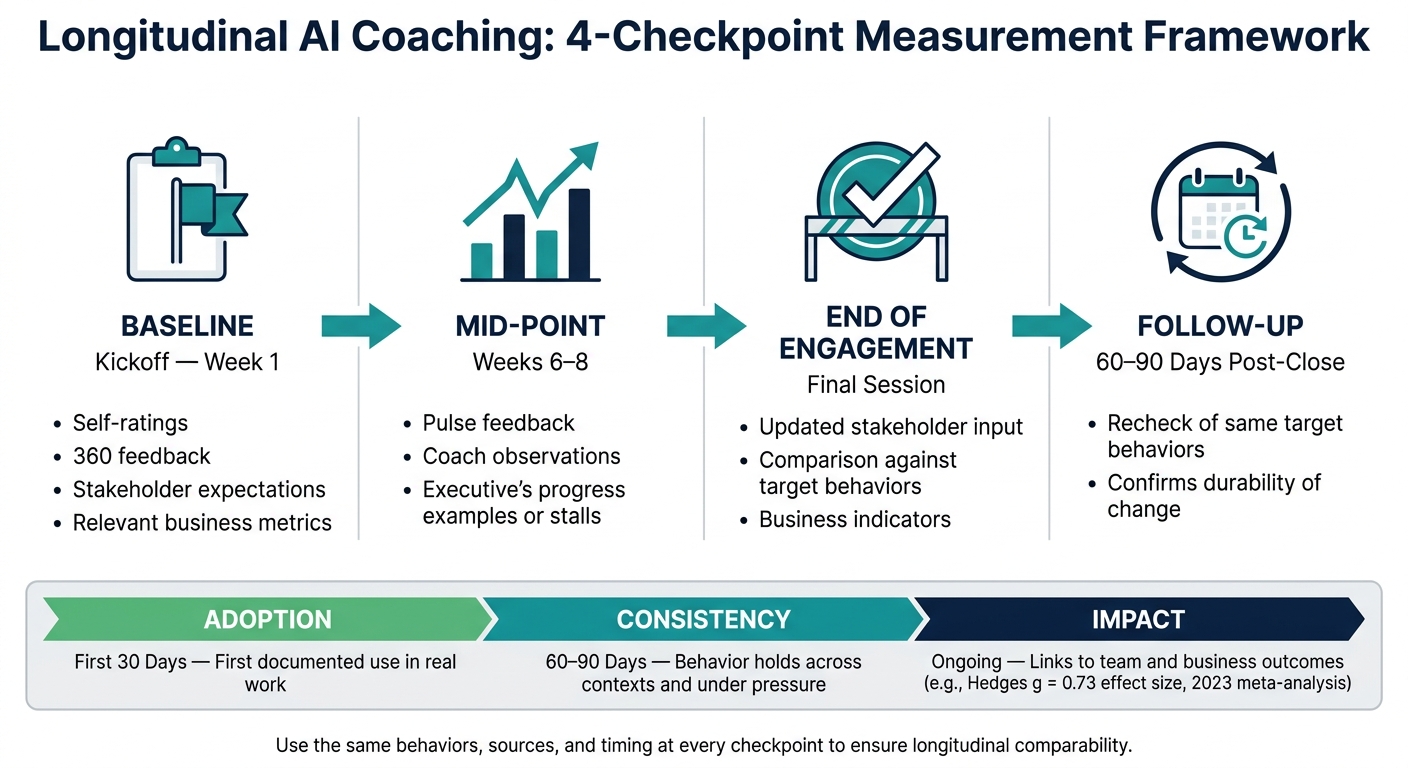
Longitudinal AI Coaching: 4-Checkpoint Measurement Framework
Build the measurement plan before coaching starts. Lock in the behaviors, data sources, and checkpoints from day one so you can review trends later and know you're comparing like with like. Keep it simple. Keep it specific.
Define Baseline Behaviors and Data Sources
Start by turning broad goals into behaviors people can actually see and rate. For example, "better executive presence" is too vague on its own. It becomes more useful when you break it into things like clearer meeting communication, tighter sponsor updates, better listening, and faster follow-through. The test is simple: two observers should be able to rate the behavior the same way.
AI can only track change cleanly when the same behaviors, sources, and timing are used at every checkpoint.
A solid baseline should come from more than one source. According to a 2021 leadership coaching report, the most common metrics organizations use to track coaching impact are self-assessment, manager input, 360 feedback, engagement, and retention. [11] In practice, that usually means using at least two sources, often a 360 and a self-assessment tied to the same behaviors. That helps separate perception from pattern.
Collect current-state data right before coaching begins, not from last quarter's review cycle. Behavior can shift early, sometimes after only a few coaching conversations. If your baseline already reflects that early movement, you'll end up understating how far the leader actually moved. [6][7]
Set a Clear Cadence: Baseline, Mid-Point, End, and 60- to 90-Day Follow-Up
Use the same behaviors at each checkpoint: baseline, mid-point, end, and 60- to 90-day follow-up. [9][13]
| Checkpoint | Timing | What to Collect |
|---|---|---|
| Baseline | Kickoff (Week 1) | Self-ratings, 360 feedback, stakeholder expectations, relevant business metrics |
| Mid-Point | Weeks 6–8 | Pulse feedback, coach observations, executive's own examples of progress or stalls |
| End of Engagement | Final session | Updated stakeholder input, comparison against target behaviors, business indicators |
| Follow-Up | 60–90 days post-close | Lighter recheck of the same target behaviors to confirm durability |
The 60- to 90-day follow-up shows whether the change sticks. [8][10] Use the same behavior labels and the same measures at every checkpoint. If the goal shifts halfway through, the record stops being longitudinal and starts looking like a pile of unrelated snapshots.
Set data ownership at kickoff. The executive owns self-reflection. The coach owns session notes. The sponsor or HR leader owns business data. Peers or direct reports give feedback only at the checkpoints everyone agreed to. Clear ownership cuts down on confusion around who collects what, who can see it, and who reports it. [3][12][14]
Once the cadence is in place, the coach can compare each session against the baseline and sort actual change from noise. With the baseline and cadence fixed, the next step is reading session-to-session trends against that benchmark.
Use Session-to-Session Trend Review to Tell Progress From Noise
One check-in can throw you off.
An executive coming off a strong week may report confidence and momentum. Someone who just got through a rough board meeting may report doubt and frustration. That's why repeated check-ins matter. They show whether change holds up under real pressure, not just during one good week or one bad one.
Once the baseline is in place, the coach can look at each new session and ask a simple question: does this session confirm the pattern, weaken it, or reverse it?
Track Consistency, Setbacks, and Recovery
Focus on three signals: consistency, setbacks, and recovery speed.
Consistency means the target behavior shows up in different settings, not just during coaching weeks. It has to appear in actual meetings, actual conflict, and moments with real pressure. If an executive is working on inviting input before stating opinions, the test is whether they did it in Monday's leadership meeting, Thursday's cross-functional call, and the tough budget conversation two weeks ago.
Setbacks are going to happen. That's not failure. It's data. What matters most is how fast the executive gets back to the target behavior after a miss. When recovery speed gets shorter over time, that's one of the clearest signs that a new habit is becoming automatic instead of something the person is just trying to perform. [3][5]
Another signal worth watching is prompt dependence. How often does the coach need to cue the behavior, and how often does the client start it on their own? As that balance shifts toward self-initiation, the habit is starting to stick. [3][5]
These signals get much more useful when AI pulls them together across sessions instead of leaving them buried in separate notes.
Use AI Summaries to Find Repeated Themes Across Sessions
Over several months of coaching, manual pattern-spotting gets hard fast. AI summaries bring session notes and check-ins into one view, which makes recurring themes easier to see. [3][4][15]
And the themes are often more specific than expected. AI may show that a leader handles peer conflict well but keeps struggling when direct reports bring up accountability concerns. Or it may show that progress jumps right after sessions, then fades during heavy workload. That's a clue the behavior hasn't stabilized yet.
Personos adds ActionBoards and contextual AI so coaches can track commitments and spot stalled goals across sessions. One direct payoff is that pattern detection leads straight to coaching action: what to reinforce, what to revisit, and what to change.
Use each trend to decide the next coaching move:
- Raise the bar when the pattern is holding
- Hold the course when progress is steady but still fragile
- Address a new barrier when the trend starts to slip
The next step is turning those trends into the right level of coach, client, and sponsor communication.
Report Progress Without Crossing Confidentiality Limits
Sponsors pay for coaching, so they want proof that it’s doing something. Fair enough. But that doesn’t mean they get access to what was said in the room. The coach’s job is to show progress without spilling private session details. Once patterns start to show up, those patterns should be turned into sponsor-safe updates that show movement without exposing the conversation behind it.
Set those rules at the very start. Each group should know what they can see, when updates will be shared, and what remains private. A contracting call between coach, client, and sponsor should set those boundaries before the first session starts. [18][17]
What Stays in Coach-Only Records and What Goes Into Sponsor Updates
A simple rule works well here: private records hold the deeper reasons and session notes, while sponsor updates stick to visible behavior and business outcomes. If a client shares something sensitive about avoiding conflict, that stays in the coach’s notes. The sponsor gets the behavior goal instead: better directness in hard conversations.
That also makes reporting easier. The same repeated measures used from session to session can be reused in sponsor updates, so the reporting setup is already part of the measurement plan.
Here’s what that split looks like across common reporting areas:
| Dimension | Coach-Only Records | Sponsor Updates |
|---|---|---|
| Goals and Milestones | Psychological drivers, personal values, internal blockers, emotional breakthroughs | Business-facing objectives and visible outcomes, such as faster decisions with less escalation or declining non-strategic projects to protect priority work |
| Risks | Personal fears, interpersonal tensions, sensitive disclosures | Behavior-only framing, such as competing priorities limiting stakeholder engagement practice |
| Progress Status | Raw session notes, verbatim reflections, draft coaching hypotheses | Trend data, behavior ratings, completion of agreed action items |
| Confidentiality | Private within the coaching agreement; protected by written agreement and data masking | Aggregated, anonymized summaries; no raw scores or personal content |
From there, the rule is simple: report only what each audience needs.
Personos helps keep that line clear with role-based views. Coach-level detail stays private, while sponsors see only summary guidance. [1]
Use 3 Reporting Layers: Compliance, Progress, and Impact
Sponsors usually want answers to three plain questions:
- Is coaching happening?
- Is behavior changing?
- Is any of this affecting the business?
A three-layer reporting model answers all three without opening up session content. [20]
Compliance shows that coaching is taking place as agreed. That means sessions are happening, tools are being used, and assessments are being completed. It gives sponsors an early signal that the engagement is active.
Progress is where over-time data starts to matter. This layer tracks movement on agreed behavior goals using sponsor-safe measures: changes in stakeholder ratings on target competencies, completion of action items, and AI-detected trends that show more steady use of target behaviors. So instead of reporting internal fears or private discussion points, the update says the client is starting difficult conversations more often, and stakeholder feedback shows better clarity when setting expectations.
Impact ties behavior change to early business indicators. Team engagement scores, project delivery timelines, escalation rates, and voluntary turnover are sponsor-safe because they reflect team-level and business-level results, not private disclosures. [19] Keep attribution careful. Don’t say coaching caused a given outcome. Say the data shows a correlation and let that stand. Personos ActionBoards track commitment completion and milestone progress over time, which gives coaches a documented record for sponsor-facing impact summaries. [2]
If a sponsor pushes for more detail than the agreement allows, go back to the original rules. State the boundary clearly and keep the update focused on what can be shared: progress is slower than planned, so the plan now centers on structured stakeholder conversations over the next 60 to 90 days.
Those sponsor-safe trend reports then serve as the evidence base for tracking adoption, consistency, and business impact, which are the three behavior-change stages covered in the next section.
Document Behavior Change and Use It to Guide Coaching Choices
Sponsor-safe trend reports matter only when they lead to a coaching move. Data should tell the coach what to do next, not just show that meetings took place. AI summaries can bring patterns to the surface, but the coach still decides what they mean and how to respond.
Measure Adoption, Consistency, and Impact as Separate Stages
Behavior change is not a one-and-done event. In executive coaching, one of the biggest errors is treating change like it happens all at once. It usually unfolds in three stages, and each stage tells the coach something different.
Adoption means first use in an actual work situation within about 30 days. One documented example is enough.[21][24]
Consistency is where things get tougher. Over 60 to 90 days, coaches should watch for the behavior showing up again and again across different situations, under pressure, and after setbacks.[21][23] If an executive can do it in easy conversations but loses it in tense ones, that is not consistency yet. The behavior has to show up across contexts, not only in safe moments.
Impact comes last, and it takes time. This stage links sustained behavior to stakeholder outcomes such as faster decisions, fewer escalations, higher trust, or stronger team engagement. A 2023 meta-analysis found that behavioral outcomes from executive coaching showed an effect size of about Hedges' g = 0.73, which was higher than outcomes measured through attitudes or personality characteristics alone.[16][22] Put simply, coaches should track behavior, not only how clients feel about their progress.
A strong final session is not enough reason to close a goal. Look at several months of trend data, including setbacks and recovery, to confirm that the change lasts.[21][24]
When the trend data becomes clear, it should lead to a specific coaching choice. If adoption is starting to show up but consistency is weak, the coach can reinforce the behavior through more practice, a simpler goal, or between-session prompts. If the behavior is steady but impact is still limited, the coach can shift the target behavior, change the stakeholder approach, or pick a different setting for applying the skill. If both consistency and impact are visible, the coach can close the goal, document the evidence, and move to maintenance or a new development objective.[2]
How Personos Supports Longitudinal Coaching Work Better Than Static Tools
After the coach sees what changed, the next step is keeping those patterns visible between sessions.
Static assessments like DiSC, Myers-Briggs, and Hogan describe a leader at a single point in time. That can help at the start of an engagement. But it does not help much when a client hits a plateau or has a high-stakes conversation coming up next week.
Personos is built for the day-to-day coaching workflow, not a one-time assessment event. Its ActionBoard tracks commitments between sessions, giving the coach a documented record of what was agreed and what was completed across the engagement.[2] That kind of record is exactly what sponsor updates need when they focus on adoption and consistency. The platform's Prompts feature sends personality-aware nudges between sessions, which helps keep the target behavior in view during the client's daily work.[1][2]
The comparison below shows where the day-to-day differences appear:
| Dimension | Personos | Static Assessments (e.g., DiSC, Myers-Briggs) |
|---|---|---|
| Longitudinal Insight | Tracks trends and behavioral shifts across sessions over time | One-time snapshot; no ongoing tracking |
| Context Awareness | Factors in job history, goals, relationship dynamics, and organizational values | Generic descriptions based on fixed types |
| Between-Session Support | AI Chat and Prompts deliver real-time, personality-aware guidance during high-stakes moments | None; assessment ends after the initial report |
| Progress Documentation | ActionBoard tracks commitments and milestones; creates a visible record for stakeholders | No structured tracking after assessment delivery |
When a coach needs to connect why a client behaves a certain way under pressure with what to do about it next week, personality context matters. Personos keeps that context active throughout the engagement instead of letting it sit in a drawer after the kickoff session.[1]
Conclusion: Use Repeated Feedback for Better Coaching and Clearer ROI
Repeated feedback turns trend data into coaching decisions and defensible ROI. Repeated measurement shows whether change held over time. That is what separates a well-run engagement from one that ends on a good session and a handshake.
For executive coaches, this means clearer choices at each stage. For HR sponsors and L&D leaders, it means a documented evidence trail that connects investment to observable behavior and business outcomes, not just participant satisfaction scores. Documented behavior change makes ROI defensible.
Start with observable behaviors. Measure at planned intervals. Review trends instead of snapshots. Protect confidentiality in sponsor reporting. Then use the evidence to decide when to reinforce, when to adjust, and when to close.
FAQs
How is longitudinal AI feedback different from a one-time assessment?
One-time assessments often sort people into fixed types, and then the results sit on a shelf.
Longitudinal AI feedback, like Personos, works differently. It acts as a continuous system that blends personality profiles with day-to-day context.
That means it changes over time, gives guidance that fits the moment better, and tracks progress through shared boards. For coaches, that makes it easier to turn insight into action and show measurable outcomes and ROI across the full engagement.
What data should we track to measure coaching progress over time?
Track clear milestones, action items, and session-to-session progress in a shared dashboard. Personos can help turn coaching insights into tasks your team can track on shared ActionBoards.
Monitor assignments, completion rates, past trendlines, and repeat task follow-through to show measurable growth, support sponsor updates, and give teams proof that the program is working between sessions.
How can sponsors see results without violating coaching confidentiality?
Sponsors can track coaching ROI and progress through shared ActionBoards without crossing lines on confidentiality. These dashboards show tasks, milestones, and growth trends, but they don't expose private session details or sensitive personality scores.
The result is simple: sponsors get a clear view of leadership development through measurable outcomes and overall progress, while coaches keep client conversations private and safe.