Leadership Style vs Team Personality: What Fits
Match your leadership approach to your team’s personality under pressure to reduce friction and boost engagement.
Rachel Johnson

Leadership Style vs Team Personality: What Fits
The short answer: the best leadership style depends on the team, not the leader’s default. I’d start by reading four signals, voice, pressure response, structure needs, and relationship health, then match the style to what the team shows under stress.
Here’s the core takeaway in plain English:
- Reserved teams need clarity and space to speak
- Reactive teams need calm, trust repair, and tight control only in a crisis
- Detail-focused teams need structure, input, and clear decision limits
- Connection-seeking teams need better trust and clearer working norms
The article’s main point is simple: fit drives results. Team climate can explain up to 31% of team-level engagement, and one cited meta-analysis says better-fit leadership styles account for up to 31.36% of the variation in work engagement. So if I use the same style with every team, I create friction that does not need to be there.
What I’d match first:
- Coaching for quiet teams that need confidence
- Light authoritative leadership when direction is unclear
- Democratic leadership for teams that improve decisions with expert input
- Brief pacesetting only for short, well-scoped pushes
- Affiliative leadership when trust is weak or conflict spreads fast
- Coercive leadership only when there is an immediate threat
Why Great Leaders Know Their Team's Personality Types
Quick Comparison
| Team pattern | Best starting style | Main upside | Main risk | When I’d switch |
|---|---|---|---|---|
| Reserved | Coaching + light authoritative | More voice, clearer priorities | Too much direction can shut people down | When confusion or drift blocks progress |
| Detail-focused | Democratic + short pacesetting bursts | Better decisions, better accuracy | Debate can drag; pace can cause rework | When timelines slip or checks get skipped |
| Highly reactive | Affiliative | Lowers tension, rebuilds trust by solving team conflicts | Soft feedback can let weak work stay | During an active crisis, use coercive briefly |
| Connection-seeking / disconnected | Affiliative + democratic | Better trust and teamwork | Poor results may go unchallenged | Add more direction when standards get fuzzy |
If I had to sum up the whole piece in one line, it would be this: <u>watch how personality and culture impact teams over time, then use the style that fixes the main problem now.</u>
How key leadership styles fit different team personalities
No single leadership style works for every team. The best fit depends on the pattern your team shows when pressure hits, not the version you see on an easy day.
Authoritative vs. coaching leadership for reserved teams
Reserved teams need clarity before anything else. That’s why authoritative leadership is often the right first move. It clears up ambiguity fast and gives people a firm sense of direction.
But there’s a catch. If that style turns into one-way communication, reserved team members tend to pull back even more. You can usually spot it fast: meetings get quiet, risks show up late, and people wait for instructions on work they could handle on their own.
That’s where coaching leadership comes in. Modern executive coaching It works through one-on-ones, stretch assignments, and feedback that builds confidence. For reserved teams, that kind of support can bring hidden skill into the open and turn quiet expertise into active participation.
The tradeoff is speed versus voice.
| Style | Best fit | Strength | Risk | Switch when |
|---|---|---|---|---|
| Authoritative | Team lacks clear direction or is stuck | Removes ambiguity quickly | Can silence quiet voices if overused | No one asks questions; risks surface late |
| Coaching | Team needs confidence and participation | Builds long-term engagement and voice | Too slow for urgent deadlines | Repeated missed deadlines or confusion about priorities |
Once clarity stops being the main issue, the next step is getting more people to speak up and contribute.
Democratic vs. pacesetting leadership for detail-focused teams
Detail-focused teams often bring deep analytical skill. The real issue is whether the leadership style makes use of that strength or ends up wasting it.
Democratic leadership tends to work well because it treats team knowledge as something worth using. Structured input, like reviews, trade-off talks, and agenda-led discussion, fits the way these teams think and work. One study found democratic leadership had the highest mean association with employee performance (mean = 3.784) compared with laissez-faire (3.416) and autocratic styles (3.404) [1]. The downside is pretty plain: decisions can drag on. If discussion never closes, delivery slows. Time-boxed conversations, followed by a clear decision, help keep things moving.
Pacesetting can help in short bursts when the team is already aligned and the deadline won’t move. In that setting, speed helps. But if pacesetting goes on too long with detail-focused teams, it often backfires. When speed sends the message that careful work takes too long, people start skipping checks. Rework starts piling up, and fatigue becomes easier to see.
The tradeoff is precision versus pace.
| Style | Best fit | Strength | Risk | Switch when |
|---|---|---|---|---|
| Democratic | Team expertise directly improves decisions | Increases buy-in and solution quality | Can slow delivery if discussion never closes | Missed deadlines due to prolonged debate or unresolved disagreement |
| Pacesetting | Short, well-defined sprints with a skilled team | Drives rapid execution | Burnout and more rework | More rework, visible fatigue, quieter team members |
When rigor starts getting in the way of execution, the leadership choice moves from discussion toward delivery.
Affiliative vs. coercive leadership for reactive or disconnected teams
Reactive or disconnected teams usually need trust repaired before performance can improve. Affiliative leadership, which puts relationships, empathy, and emotional support first, is the better place to start. It rebuilds the relational base that performance depends on. One-on-one check-ins, direct recognition, and clear norms for respectful communication can change the mood of a reactive team before any harder push on results.
Coercive leadership has one clear use: emergencies where speed and control matter more than collaboration. Outside those moments, it tends to shut down honesty and push people out the door.
The tradeoff is trust versus control.
| Style | Best fit | Strength | Risk | Switch when |
|---|---|---|---|---|
| Affiliative | Teams recovering from conflict or broken trust | Rebuilds relationships and psychological safety | Can allow poor performance to persist if feedback stays too soft | Team is stable and ready for higher performance expectations |
| Coercive | Urgent crises where reactive behavior threatens immediate outcomes | Speed and decisive control | Erodes trust and silences dissent | As soon as the immediate threat has passed |
The last check is simple: does the team need repair, or does it need immediate control?
Best-fit matrix: which leadership style works for which team
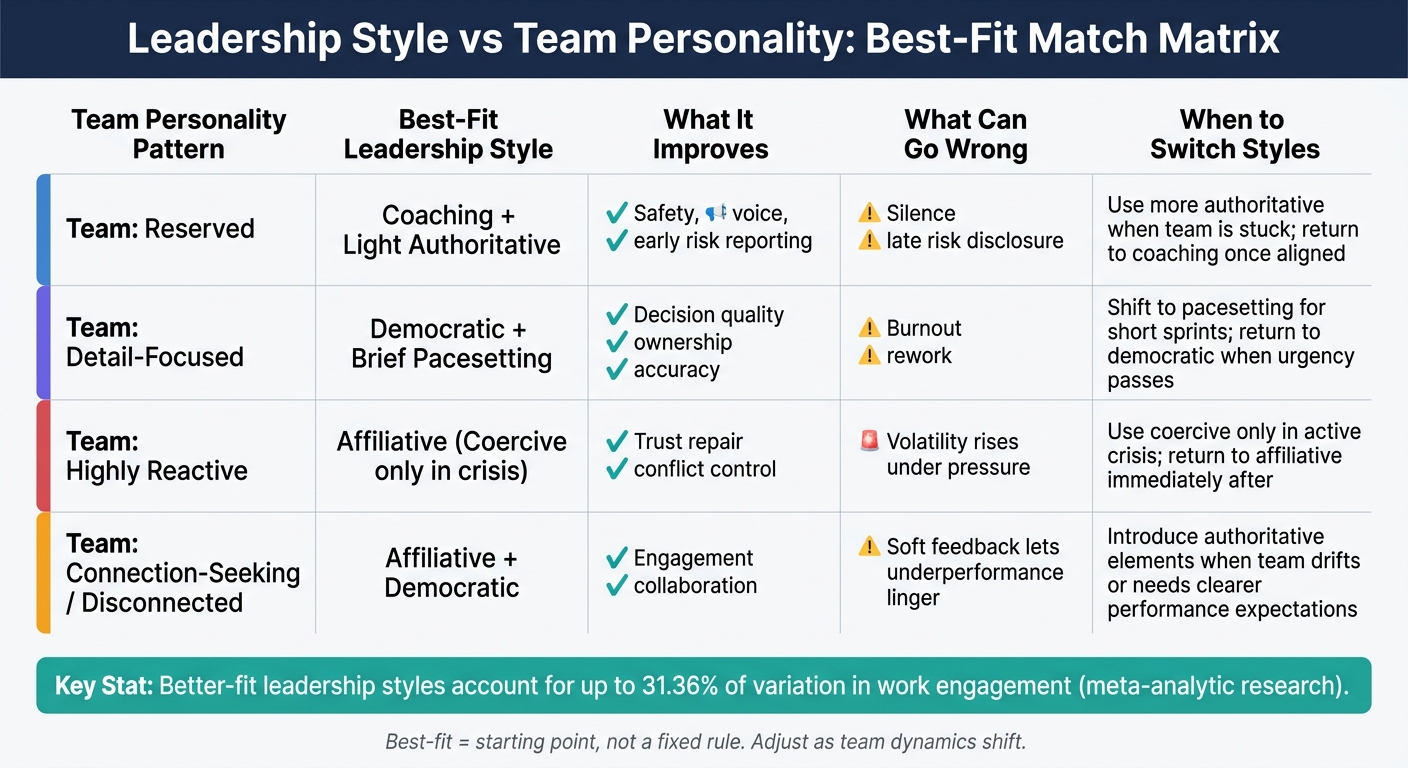
Leadership Style vs Team Personality: Best-Fit Match Matrix
Reserved, reactive, detail-focused, and connection-seeking teams each point to different leadership needs when pressure hits. The matrix below is a quick way to pick a starting style before you watch how the team acts in the moment.
Comparison table: team pattern, best-fit style, main benefit, main risk
Most teams change over time. So best-fit means your starting point, not a hard rule.
The patterns below show the best place to begin, not a fixed answer.
| Team Personality Pattern | Best-Fit Leadership Style | What It Improves | What Can Go Wrong | When to Switch Styles |
|---|---|---|---|---|
| Reserved | Coaching (with light authoritative) | Safety, voice, early risk reporting | Silence and late risk disclosure | Use more authoritative when the team is stuck or needs clearer direction; return to coaching once alignment is established |
| Detail-focused | Democratic (with brief pacesetting) | Decision quality, ownership, accuracy | Burnout and rework | Shift to pacesetting for short, well-scoped sprints; return to democratic when urgency passes |
| Highly reactive | Affiliative (with coercive only in crisis) | Trust repair and conflict control | Volatility rises under pressure | Use coercive only during an active crisis; return to affiliative as soon as the immediate threat is resolved |
| Connection-seeking / disconnected | Affiliative + democratic | Engagement and collaboration | Soft feedback lets underperformance linger | Introduce authoritative elements when the team drifts or needs clearer performance expectations |
Some teams need a blend right away. A team that is both reserved and detail-focused, for example, often does well with democratic + coaching. Structured input channels help people speak up, while one-on-ones build the confidence to use those channels.
That blend can change when workload, conflict, or org change shifts the team's main need.
The table gives you a starting point. Next comes the human part: reading the team's behavior before you choose a style.
How to choose the right fit in practice
Read team behavior before choosing a style
Start with the matrix, but don't stop there. Check it against what the team actually does. Watch the team for 2 to 4 weeks, and base your read on repeated patterns, not gut feelings.
Pay attention to a few simple signals:
- Who speaks up
- Where work gets redone
- Whether decisions keep stalling
- Whether the team seems connected or just transactional
Persistent silence usually points to a gap in safety or clarity. Frequent rework often means the team lacks precision or clear direction. Slow decisions tend to come from fuzzy ownership or low psychological safety. And when communication stays stuck on tasks while relationships stay thin, that's a sign the team needs more connection.
One distinction matters more than most: the difference between teams that are quiet but still engaged and teams that are flat-out disconnected. Reserved teams may not say much, but they're still present and involved. Disengaged teams tend to go silent, miss deadlines, and show little initiative. That difference changes the response. Reserved teams often need coaching or affiliative leadership. Disengaged teams usually need clear structure and direction first.
Use personality-aware tools when team dynamics are hard to read
Sometimes the signals don't line up neatly. Stress can blur everything. A team with recent turnover, long pressure cycles, or shifting roles may show mixed behavior that's tough to read from observation alone.
In those cases, a real-time personality tool like Personos can help. If a leader notices something like, > "my team gets very quiet before major deadlines and then rushes decisions"
they can use that input to get guidance tied to the team's personality profile and current situation, instead of forcing the team into a fixed label.
The practical aim is simple: start with a baseline assessment, then use real-time guidance as conditions shift. First, map the team's general tendencies. Then adjust your leadership response based on what's happening in the moment.
Conclusion: Match the style to the team, not the leader's default
No single leadership style works for every team. The best leaders adjust to the team in front of them, not just to their own habits.
In practice, reserved teams need clarity and confidence. Detail-focused teams need structured input and high standards. Disconnected teams need trust repair. And coercive leadership should show up ONLY in a crisis.
That fit shows up in performance. When the style matches the team, there’s less friction and better follow-through, participation, and quality. One meta-analytic study found that better-fit leadership styles accounted for up to 31.36% of the variation in work engagement.[2]
The main risk isn’t picking the wrong style one time. It’s falling back on the same style no matter what the team needs.
If team dynamics are hard to read, Personos can surface personality patterns, relationship context, and action prompts.
The most effective leaders match their approach to the people, the pressure, and the moment.
FAQs
How do I tell if my team is reserved or disengaged?
Look for shifts in motivation and communication. A reserved team may stay quiet and still be fully engaged. A disengaged team usually starts to step back from collaboration and participation.
That difference can be easy to miss. Personos helps by analyzing personality data and group context. It gives real-time guidance, points out interaction trends, and helps you see whether quietness comes from natural reserve or from active disengagement.
Can one team need more than one leadership style?
Yes. A team may need more than one leadership style because the right approach depends on the moment and on how the team is working together. Role, context, and group relationships all shape what works best.
So leadership guidance shouldn't stay broad or one-size-fits-all. Personos supports this with context-aware guidance and role- and team-specific reports built for each situation.
How often should I change my leadership style?
There’s no fixed schedule here. You adjust your leadership style based on your team’s personality mix and what the moment calls for.
Good leadership is a day-to-day practice. It depends on context, timing, and people. Tools like Personos can help with daily or weekly guidance, so you can take a more active, flexible approach as situations change.