AI and Personality Data for Leadership Feedback
Compares role-based, AI, assessment, and personality-aware feedback, showing why combining role standards with personality-aware AI improves delivery.
Christian Thomas

AI and Personality Data for Leadership Feedback
Most feedback systems tell managers what to say. Far fewer help them decide how to say it. That gap matters when only 23% of employees said they got meaningful feedback in the past week, and 47% say reviews make them feel incapable.
I see the article making one clear point: role standards are useful, but delivery changes the result. In plain terms, the four approaches differ like this:
- Role-based systems keep feedback tied to job duties and scorecards
- General AI coaching tools use more workplace data and give broad coaching at scale
- Personos uses Five Factor personality data to shape tone, timing, and wording for a specific person
- Assessment-driven tools use formal personality reports to explain behavior and guide coaching
What I’d take away is simple:
- Use role-based feedback for consistency
- Use general AI for pattern spotting and on-demand coaching
- Use assessment tools to explain trait-based behavior
- Use Personos-style guidance when message framing, stress response, and timing matter most
Quick Comparison
| Approach | Best for | Main limit | How it handles feedback |
|---|---|---|---|
| Role-based | Clear standards | Same delivery for everyone | Tied to role, goals, and observed behavior |
| General AI coaching | Scale and pattern detection | Advice can feel broad | Uses work data to suggest next steps |
| Personos | Person-specific delivery | Needs consent and manager care | Shapes tone, pacing, and wording by personality |
| Assessment-driven tools | Trait insight and coaching | Reports may sit unused | Links assessment results to behavior and growth |
If you want the short version, here it is: the strongest setup is a mix of role standards for the "what" and personality-aware guidance for the "how." That is the core idea running through the full piece.
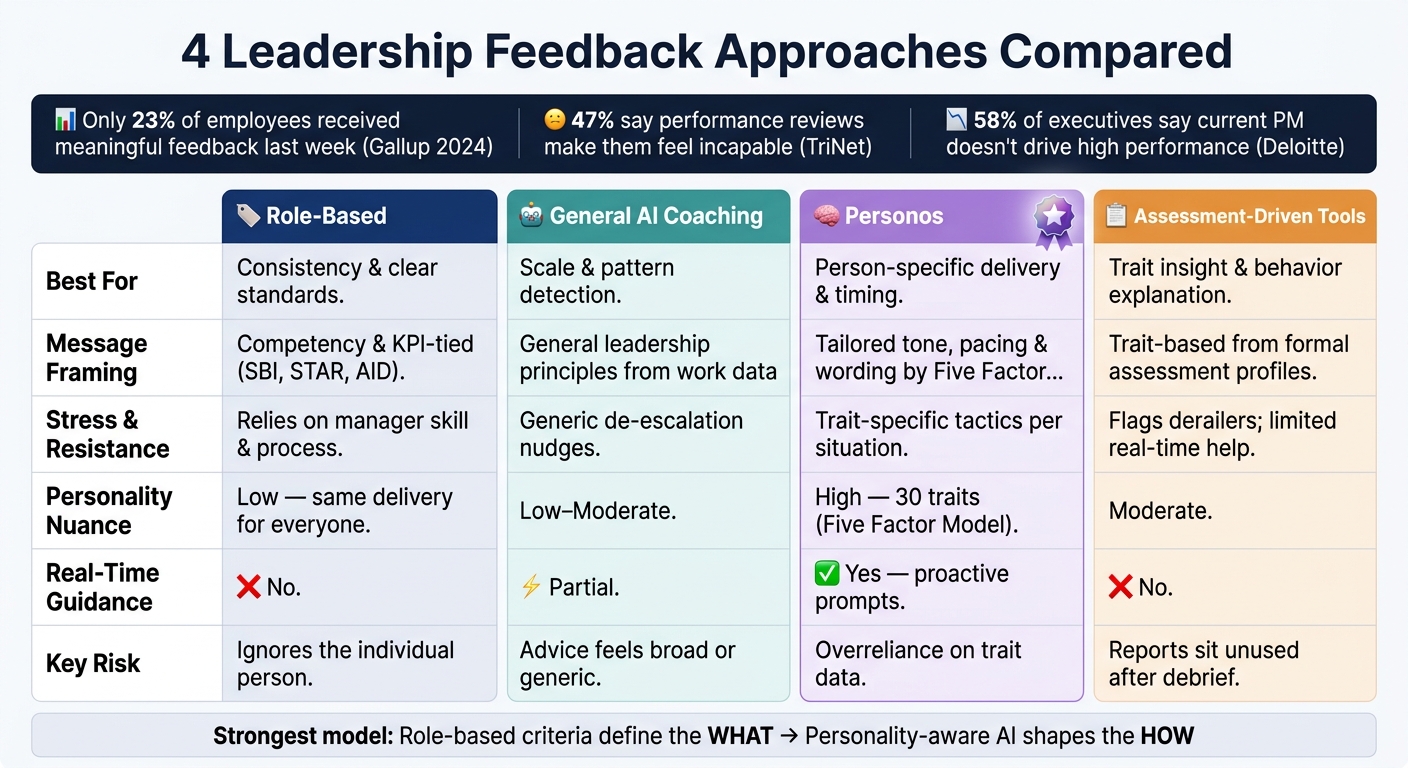
4 Leadership Feedback Approaches: Role-Based vs AI vs Personality-Aware
AI + Communication Skills = The Leader Everyone Listens To
1. Role-Based Feedback Systems
Role-based feedback systems judge leaders against a set of job duties and skills. Think Director of Operations or Team Lead scorecards tied to behaviors like strategic thinking, delegation, and communication. That kind of consistency helps. It gives people a shared standard. But it also assumes every leader in the same role takes in feedback the same way. The bar is clear, while the delivery stays the same.
Message Framing
In these systems, feedback is usually framed around behavior and role fit. A manager might hear feedback like "needs to delegate more effectively" or "should communicate clearer priorities to the team." Many teams use set frameworks like SBI (Situation-Behavior-Impact), STAR, or AID. The point is to keep feedback tied to actions people can see, not personal judgments.
That said, the framing is still one-size-fits-all for everyone in the role. A leader who is highly anxious and a leader who is highly self-assured can get the exact same message in the exact same format. The system focuses on what was done, but not on how the person on the other end is likely to take it in.
Stress Response and Resistance
When personality data is missing, these systems try to handle stress through process. That usually means scheduled reviews, fixed agendas, and manager training. On paper, that sounds orderly. In practice, people don't react to feedback in matching ways.
One leader may shut down under criticism. Another may get defensive. Someone else may brush it off and act like it doesn't matter. Role-based systems usually don't catch those differences. A TriNet survey found that 47% of employees feel a performance review makes them feel incapable, and 22% have called in sick due to review anxiety.[1] So even when the system measures performance in a neat way, it can still miss the human side of how feedback lands.
Morale and Trust
Trust in role-based systems mostly comes down to whether people think the process is fair. If the criteria are clear and used the same way across the board, leaders will often accept the system, even if they aren't thrilled by it. People can live with a tough review more easily than a fuzzy one.
The trouble starts when competency models feel far removed from day-to-day work, or when ratings seem shaped by office politics instead of actual performance. That's when morale drops fast. A Deloitte study found that 58% of executives believe their current performance management approach doesn't drive engagement or high performance.[4]
Staff Growth Personalization
In role-based systems, development plans usually follow competency gaps. That means recommendations like "Improve cross-functional collaboration" or "Strengthen strategic planning." From there, leaders may be sent to workshops, given stretch assignments, or paired with mentors.
But this kind of personalization only goes as far as the gap itself. It does not account for learning style or behavior change. An introverted, highly conscientious leader and an extraverted, impulsive leader might both be assigned the same executive presence coaching, even though they likely need very different kinds of help. Gallup data points to the same problem: only 14% of employees strongly agree that performance reviews inspire them to improve.[2][4][3]
That is where role-based feedback hits its ceiling. It can identify the gap, but it can't tailor the message to the person hearing it. Role-based systems set the standard, but they do not adjust delivery to fit the individual.
2. General AI Coaching and Feedback Analytics Platforms
General AI coaching platforms, like Culture Amp's AI Coach and CoachHub's AIMY™, pull from a much broader set of workplace signals than role-based systems. Instead of checking leaders against a fixed competency scorecard, they look at pulse surveys, 360 reviews, goal progress, manager notes, 1:1 summaries, collaboration patterns, plus email, chat, and calendar data. That gives teams feedback that feels more current and more responsive. But it doesn't solve everything.
Message Framing
Unlike role-based systems, these platforms adjust the source of feedback, but not the person on the receiving end. A manager might see guidance such as "respond faster to escalations" or "provide clearer next steps after team meetings." The wording stays focused on visible actions, not personal judgment.
Culture Amp's AI Coach, for example, lets managers ask plain-language questions about engagement or performance and get science-backed coaching plus action plans.
The catch is pretty simple. Without personality data, the platform can't shape the tone, urgency, or emotional framing for the individual. The same message that helps one leader move fast might strike another as too blunt, too vague, or just plain discouraging.
Stress Response and Resistance
Most general AI systems deal with stress in an indirect way. They may flag high-conflict language, suggest mixing critique with recognition, or recommend shorter action steps when negative sentiment shows up. Some tools also add situational coaching, role-play, or in-tool nudges so managers can prep for hard conversations.
CoachHub's AIMY™, for example, is built to help with specific workplace challenges like performance issues and difficult conversations.
That's a clear step up from static review systems. Still, pattern detection isn't the same thing as personality-aware delivery. A message can be correct on paper and still go over badly if the person reading it feels anxious, skeptical, overloaded, or highly status-sensitive.
Morale and Trust
AI feedback tools can help morale when they make the process feel more even and less tied to a manager's mood or personal bias. People tend to trust a system more when it applies expectations the same way across a team.
But there's a flip side. AI-made feedback can feel impersonal or formulaic, especially if employees think they're being watched instead of helped. Trust tends to hold up best when these tools support manager judgment rather than stand in for it.
Staff Growth Personalization
Growth suggestions from general AI platforms usually come from performance patterns and goal history. A system might spot that a high-performing team lead has trouble with delegation and point them to a fitting development resource. That helps, but it's still a broad match.
It doesn't tell you whether that person does best with structured coaching, wants more autonomy, or needs frequent reinforcement to stay motivated. In practice, general platforms are strong at spotting what needs attention. They're weaker at shaping the path forward around someone's communication style, confidence level, or emotional needs.
General AI coaching platforms are faster, more data-driven, and easier to scale than role-based systems. But they aim for broad use, not personal fit. Personos goes a step further by using personality data to adjust not only what feedback says, but how it's likely to land.
3. Personos
General AI is good at spotting patterns. Personos goes a step further and helps leaders speak to the person right in front of them. It uses Five Factor personality data to shape feedback around the individual, not just the job title. That makes a big difference when the same message needs to land in very different ways.
Message Framing
Personos' conversational AI lets a leader describe an upcoming conversation in plain English and get tailored guidance on how to handle it. That includes opening lines, tone, sequence, and what to avoid.
The message shifts based on the recipient's actual personality profile and the situation, not a one-size-fits-all script.
For example, if a team lead is conscientious and emotionally sensitive, Personos might suggest opening with specific recognition of past reliability. From there, it may recommend moving into areas for improvement with concrete, structured next steps. It would also steer the leader away from vague criticism that could trigger defensiveness.
That’s a clear shift from a system that gives everyone the same message and just hopes it works.
Stress Response and Resistance
Personos uses Five Factor personality data, including the Neuroticism dimension, to help leaders think ahead about how someone may react under pressure. That reaction could show up as withdrawal, escalation, or passive resistance.
Instead of leaning on broad sentiment scores, leaders get conversation-level guidance. The system can suggest exact wording, pacing, and timing based on how a specific person tends to respond to stress.
Take a high-neuroticism, low agreeableness staff member. Personos may suggest keeping the conversation short, structured, and low on ambiguity. It may also recommend neutral, fact-based language. A 2024 study found that high personalization and regular constructive feedback are important conditions for AI tools to help reduce burnout [7][8].
Morale and Trust
Personos keeps individual personality scores private from managers and teammates. Instead of labeling people, it surfaces framed guidance that helps people work better together.
Dynamic Reports show what tends to build or weaken trust for a given staff member. Prompts then reinforce those behaviors between reviews, whether that means consistency, autonomy, or well-timed recognition for a specific contribution.
Staff Growth Personalization
Growth planning in Personos runs through the ActionBoard, a Kanban-style system that turns AI-generated guidance into trackable tasks. A leader can set development goals for a staff member, follow progress over time, and get AI-suggested micro-actions tied to that person’s traits, not a standard competency checklist.
For a high-empathy but conflict-avoidant coordinator, a growth plan might focus on practicing clear, low-drama boundary statements with AI-drafted scripts. After that, Prompts can reinforce the behavior when it appears on the job.
Personos turns trait insight into concrete micro-actions instead of broad development categories.
Assessment-driven tools take a different path, using formal personality reports to shape feedback and development.
4. Assessment-Driven Personality Feedback Tools
Where Personos helps in live conversations, assessment-driven tools start somewhere else: with a formal trait profile. From there, they use that profile to shape feedback, coaching, and what happens next.
Message Framing
These tools frame feedback around the link between a leader’s trait profile and the behaviors other people notice. For example, a leader who scores high on Conscientiousness may take feedback better when it comes with clear next steps. Someone high in Extraversion may respond more to feedback framed around visible impact and team influence.
Tools like Hogan 360, when paired with Hogan personality inventories, connect how a leader shows up to others with why they may show up that way. That gives leaders a clearer story, which can lower defensiveness.[13][14] And it does one more thing: the same trait profile that helps shape the wording can also hint at where resistance may show up.
Stress Response and Resistance
Assessment-driven tools also include derailer scales. These point to patterns that can throw behavior off course under pressure. A leader who seems confident in normal conditions may become domineering when stressed. A cautious leader may pull back and become avoidant.
When those patterns are named in trait terms, the feedback feels less like a personal attack and more like a behavior-based explanation.[9][11][13] That shift in framing often cuts down on pushback.
Morale and Trust
When leaders understand how trait-driven behaviors like directness, emotional reserve, and risk appetite come across to different people on their team, they can make small changes that improve day-to-day consistency. And that matters.
People tend to feel safer when they can predict how a leader will respond. Psychological safety goes up when leader behavior is more steady, and assessment-driven tools that coach toward that kind of consistency help create the conditions for it.[15]
Staff Growth Personalization
In these tools, development planning is tied straight to trait profiles. A staff member with high analytical ability but low interpersonal warmth might get a plan focused on empathy and stakeholder engagement, with exercises matched to their cognitive style.[10][11][12]
One Psychometrics case study shows what this looks like in practice:
360 feedback became part of the organization's annual development planning process, and leaders were required to set SMART goals, with two to three tied directly to their assessment results. [16]
The catch is pretty simple. A strong diagnostic report does not automatically lead to day-to-day behavior change. That depends a lot on how well a coach or manager reads the results and puts them to work. Without structured follow-through, the insight can fade soon after the debrief. In practice, implementation is what makes the difference, not the diagnosis alone.
How the Differences Play Out in Practice
You see these differences most clearly when the stakes are high. Not in theory, but in the moments leaders deal with every day: performance reviews, promotion denials, conflict mediation, hybrid coordination, and development planning.
Performance reviews tend to work well in role-based systems because those systems keep the discussion tied to documented criteria and KPIs. That gives the manager a firm place to stand. General AI coaching can help in a different way by flagging biased language before the review starts. Assessment-driven tools add another layer by suggesting whether an employee may need a preview message or extra time to process the conversation. Personos goes a step further. It can suggest whether to start with a direct talk, a video call, or a written summary, based on how that person usually handles feedback and stress. [17][18][20]
Promotion denials are often where more generic methods start to struggle. Role-based feedback can explain why the decision was made through clear criteria, but it often misses the emotional side of the moment. Personos helps a leader shape the message around what the employee is most likely to need, whether that's directness, more detail, or a little time before talking about next steps. That kind of personality-aware framing helps protect dignity without muddying the decision. [19][21]
Conflict mediation changes quite a bit once personality data is part of the process. Role-based systems can set the rules and clarify boundaries. General AI coaching can suggest broad next moves. Assessment-driven tools can help explain why the conflict escalated in the first place. For example, one person may want detail while another wants fast action. That alone can change how a mediator sets up the conversation. Personos goes further by recommending specific wording and sequencing tied to each person's stress profile. [20][21][22][23]
Hybrid coordination shows a similar gap. In distributed teams, miscommunication often comes down to style, not bad intent. Personos can suggest whether to start with a private pre-call, a shared written agenda, or a live check-in based on each participant's profile. That matters because the wrong format can create friction before the real discussion even begins. [20][22]
Development planning follows the same pattern. Role-based systems connect plans to competency gaps. General AI coaching pulls broad advice from performance patterns. Assessment-driven tools link growth areas to trait profiles. Personos, by contrast, creates micro-actions through the ActionBoard that match a specific person's traits and can be tracked over time instead of being tied to the same checklist used for everyone else.
The table below sums up the five dimensions that matter most for leadership feedback quality:
| Role-Based | General AI Coaching | Personos | Assessment-Driven Tools | |
|---|---|---|---|---|
| Message Framing | Competency- and KPI-tied | General leadership principles | Tailored to personality profile and situation | Trait-based from assessment profiles |
| Stress & Resistance | Depends on leader skill | Generic de-escalation | Trait-specific tactics per situation | Flags likely resistance; limited real-time guidance |
| Morale & Trust | High fairness; lower personal empathy | Variable; can feel scripted | Privacy-first; focused on working better together | Moderate; risk of static pigeonholing |
| Staff Growth Personalization | Career ladder and skill gaps | Broad development advice | Personality-matched micro-actions via ActionBoard | General strengths and weaknesses from profile |
| Timing & Channel | Scheduled reviews | On-demand chat | Proactive Prompts at configurable cadences | Periodic reassessments |
Those tradeoffs lead straight into the pros and cons of each approach.
Pros and Cons of Each Approach
Each approach fixes a different feedback issue. And each leaves a different hole.
Role-based systems do best with consistency and calibration. If you want leaders to work from the same playbook, this approach helps. The downside is personal fit. The same message can hit one employee well and fall flat with another leader delivering it. So yes, the system is reliable, but it can also feel blunt.[28][29][30]
General AI tools help with speed and spotting patterns. But without personality context, the advice often stays generic. Suggestions like communicate more frequently or be more direct may sound right on paper, yet still miss the emotional tone of the moment. Research on AI coaching points out that these systems can struggle with emotional nuance and situational context, especially in high-stakes conversations.[25][26][27] You get scale, but not much individual fit.
Assessment-driven tools give managers a shared language for behavior. That can be useful. But these tools can turn static when the report gets read once and then ignored. They explain behavior well, yet they do less to guide the next conversation as it happens. There is also an ethical risk here: if personality scores shape promotion or performance decisions without proper governance, decisions can become skewed and trust can slip.[24]
Personos uses personality data inside the live conversation instead of producing a report and then stepping back. Its transparent reasoning shows managers the why behind a recommendation, not just the script to follow. Still, it comes with real setup needs. Consent must be in place before personality data is used. Managers need training so they can read trait-level guidance with care. And there is a real risk of overreliance if leaders start treating profiles like fixed truths instead of working hypotheses.[5][6] That difference is what makes live feedback more flexible than a report alone.
These tradeoffs stand out most when you compare consistency, nuance, speed, and follow-through.
| Role-Based | General AI Coaching | Assessment-Driven Tools | Personos | |
|---|---|---|---|---|
| Consistency | High | Moderate | Moderate | Moderate |
| Personality Nuance | Low | Low–Moderate | Moderate | High |
| Real-Time Guidance | No | Partial | No | Yes |
| Scalability | High | High | Moderate | High |
| Privacy Design | Standard HR privacy | General data privacy | Varies | Consent-based |
| Scientific Model | Organizational standards | General LLM training | Type-based (MBTI/DiSC) | Five Factor Model (30 traits) |
| Price | Varies | Varies | Varies | $9/seat/month |
| Key Risk | Ignores the person | Generic advice | Static labeling | Overreliance on trait data |
The next question is which tradeoff matters most for your team: control, scale, interpretation, or personalization.
Conclusion
Leadership feedback is not a choice between fairness and humanity. It’s a choice between consistency and being heard. Role-based standards handle the first part well, and that base matters in U.S. workplaces.
But structure by itself doesn’t mean feedback will land. Gallup found that only 23% of employees strongly agreed they received meaningful feedback in the past week in 2024 [31].
That’s where personality data comes in. It adds the missing layer by helping managers adjust tone, pacing, and framing so feedback is easier to hear and less likely to spark resistance.
The comparison boils down to a simple tradeoff: standardization versus fit. Role-based systems set the standards. Generic AI scales guidance. Assessment tools help explain behavior and team dynamics. And personality-aware AI adjusts delivery.
For U.S. leaders, the strongest model is a hybrid. Role-based criteria define the what, and personality-aware AI shapes the how. Platforms like Personos use personality data to guide real-time, situation-specific feedback on tone, pacing, and message framing, which helps those standards stick in day-to-day use.
The goal is feedback people can hear, trust, and act on.
FAQs
How is personality-aware feedback different from standard performance reviews?
Standard performance reviews often rely on generic feedback. The problem is simple: the same message doesn’t land the same way for everyone.
A person’s cognitive style and motivators shape how they hear feedback, how they process it, and whether they act on it. When reviews ignore that, even well-meant advice can miss the mark.
Personality-aware feedback takes a better route. It uses validated frameworks like the Five Factor Model to tailor communication so feedback feels easier to hear, process, and use.
Personos adds context-aware guidance on top of that. It masks identity and steers reviewers toward specific, actionable language, which can lower defensiveness and help the message land more effectively.
When should a team use personality data in feedback conversations?
Teams can use personality data in high-stakes feedback conversations, especially during performance reviews, salary discussions, or team conflict.
Why? Because the way you say something often matters just as much as what you say. Personality data helps leaders shape messages in a way people are more likely to hear, process, and act on.
Tools like Personos can help make feedback feel more personal and trust-building, instead of generic, one-size-fits-all communication.
How can managers use personality data without stereotyping employees?
Managers can avoid stereotyping when they use tools built around context and specific situations, not fixed personality labels. That matters because broad labels can stick in people’s minds and shape how managers interpret everything after that.
Platforms like Personos take a different route. Instead of giving sweeping character judgments, they offer tailored guidance tied to the moment. The focus stays on what may help in a given work situation, not on boxing someone into a type.
It also helps when individual scores are masked and the attention shifts to actionable, high-level communication cues. That approach can support psychological safety and lower the odds of biased assumptions. In practice, it keeps feedback rooted in team dynamics and each person’s goals, which is where it belongs.