5 Ways AI Scales Leadership Development Plans
AI turns feedback into tailored plans, delivers daily nudges, role-based paths, dashboards, and async support to scale leadership.
Christian Thomas

5 Ways AI Scales Leadership Development Plans
If leadership training fades after one workshop, AI can help keep it active day by day.
I’d sum up the article like this: AI helps companies scale leadership development in 5 clear ways. It can build personal plans fast, send follow-up nudges in daily work, shape learning by role, show HR and managers what’s happening, and support remote teams without adding more live sessions.
Here’s the core idea in plain English:
- AI-generated plans turn feedback and assessment data into personal development plans in minutes
- Follow-up prompts help leaders use what they learned during actual work moments
- Role-based learning paths give different guidance to first-time managers, directors, and executives
- Dashboards show usage and progress across teams
- Remote support gives leaders help across time zones and locations
The article also makes one big point: AI does the scale work, but people still do the leadership work. Empathy, judgment, and accountability still come from humans.
[For HR Directors] Scale Leadership Development with AI
Quick Comparison
| Area | Old approach | AI-supported approach |
|---|---|---|
| Development plans | Built by hand, often generic | Personal plans built fast from data |
| Follow-up | Often stops after training | Short nudges in Slack, Teams, or mobile |
| Learning path | Same content for everyone | Based on role, level, and current issues |
| Visibility | Limited to reviews or surveys | Near real-time view across many leaders |
| Remote teams | Hard to support across schedules | Help delivered when needed, across locations |
What stood out to me most is the shift from event-based training to daily support inside the flow of work. That’s the main reason AI can help leadership development reach more people without turning it into one generic program.
Why Leadership Development Is Hard to Scale
Leadership development rarely scales well across dozens or hundreds of managers because many programs still depend on static, one-size-fits-all training. That helps explain why AI can scale development in ways older programs cannot.
Hand-built development plans eat up too much time, so HR and L&D teams often fall back on generic plans or delay them altogether.
Training also fades fast when there’s no daily reinforcement. On top of that, generic assessments often miss the person’s role and day-to-day context, so the learning doesn’t always show up in actual work.
HR teams and managers also tend to lack a simple way to track progress between check-ins. That gap is one of the first places personalized AI feedback can help.
1. AI-Generated Leadership Development Plans
Building leadership plans by hand takes time. AI can turn assessments, feedback, and performance data into a tailored plan in minutes. That speed matters because teams can create plans for many managers at once without losing the personal fit.
The main upside is that these plans don't stay frozen. Instead of sitting there like a static document, an AI-driven plan can change as someone grows, moves into a new role, or gets fresh feedback. Personality-aware platforms can make each plan more specific by looking at how people communicate and how they respond in actual workplace situations.
For L&D teams working across large employee groups, AI cuts the work needed to maintain plans and helps keep them up to date. That gives HR more time for coaching, check-ins, and the human side of development.
And once a plan is in place, AI can help keep it alive with follow-up prompts and behavioral nudges.
2. AI Follow-Up Prompts and Behavioral Nudges
Once a development plan is in place, the next hurdle is follow-through. That’s the hard part. The issue usually isn’t the training content itself. It’s what happens after the session ends. AI helps keep leadership growth active by sending timely prompts right in the flow of work.
These prompts can show up in Slack, Microsoft Teams, or mobile alerts. They’re short, focused, and tied to moments that matter, like a performance conversation or a communication mismatch. The strongest systems connect each nudge to a clear situation, such as getting ready for a tough performance discussion or adjusting how you communicate with a certain team member.
Personality science can make these nudges more relevant. Tools like Personos Prompts use Five Factor Model personality data to send short, situation-specific guidance based on a person’s traits and current team dynamics. That matters because personality-based prompts tend to work better when they reflect actual interactions, not generic reminders.
The same level of personalization can also shape role-based learning paths.
3. AI Role-Based Leadership Learning Paths
Not every leader needs the same training. A first-time manager working through a peer conflict is in a very different spot than an executive handling a board-level negotiation. But many organizations still give everyone the same material and hope it lands.
AI changes that. It builds learning paths around a leader’s role, level, and current challenges, so people get the right content at the right time. Different leaders need different paths, and AI takes away the manual work of building each one from scratch. That matters even more when leaders step into new roles, inherit new teams, or run into new people issues.
As responsibilities shift, the system shifts with them. If a manager moves into a director role, they won’t keep getting entry-level material after a promotion. That’s what helps continuous learning work at scale. Leaders get guidance when they need it, instead of being stuck with a fixed curriculum that starts to feel dated. It also helps this model work across large organizations.
Platforms like Personos push role-based guidance further by adding relationship context. Built on the Five Factor Model, Personos adjusts guidance based on the specific people a leader is working with. So the guidance changes based on the other person’s communication styles.[2] Michael Walker Ed.D. described this kind of tool well:
"Instead of a workshop that feels good but tends to go stale, this tool can be used daily by teams to more deeply understand how we interact and suggest ways to frame ideas for peers in a format they are more likely to respond to." [1]
Role-based learning paths help keep development relevant as leaders move into new roles and deal with new situations. Once those paths are in place, managers and HR need visibility into whether leaders are using them.
4. AI Dashboards for Manager and HR Visibility
Learning paths and follow-up prompts only matter if someone can see whether leaders are using them.
That’s where AI dashboards help. Most LMS platforms track completion, but they don’t show behavior. AI-powered dashboards give managers and HR a clearer view of who is using the program, who is falling behind, and where intervention is needed in real time, across many leaders at once. They also make it easier to spot whether support is reaching managers who work remotely or across different locations.
At the same time, visibility has to feel safe.
If managers get full access to individual scores or detailed behavior data, trust can erode fast. Psychological safety can take a hit too. Platforms like Personos handle this by protecting individual personality data while still giving managers and HR the group-level insights and relationship patterns they need to take action.
If the tool feels invasive, people won’t use it. And when adoption drops, leadership development stalls, especially for remote and distributed teams.
5. AI Support for Remote and Distributed Teams
For teams spread across sites and time zones, visibility alone isn't enough. They also need support right when it matters. Remote, hybrid, and field teams need leadership help that works without in-person sessions. Workshops, live coaching, and role-play are much harder to scale across time zones and packed calendars.
So instead of waiting for the next scheduled session, leaders can get asynchronous guidance when live coaching just isn't practical. That might be before a tough performance conversation, during a conflict that's starting to heat up, or while adjusting to a new team dynamic. Daily AI guidance helps teams make sense of interactions and choose better responses between sessions.
Platforms like Personos take this a step further by pairing personality-aware guidance with the current situation. In plain English, managers can adjust to specific people instead of leaning on one-size-fits-all advice. That kind of consistency matters even more when leaders are spread across locations and can't rely on informal hallway conversations to stay aligned. It also keeps development available without adding more live sessions.
That gives remote teams steady guidance without extra meetings.
How AI-Supported Leadership Development Compares to the Old Way
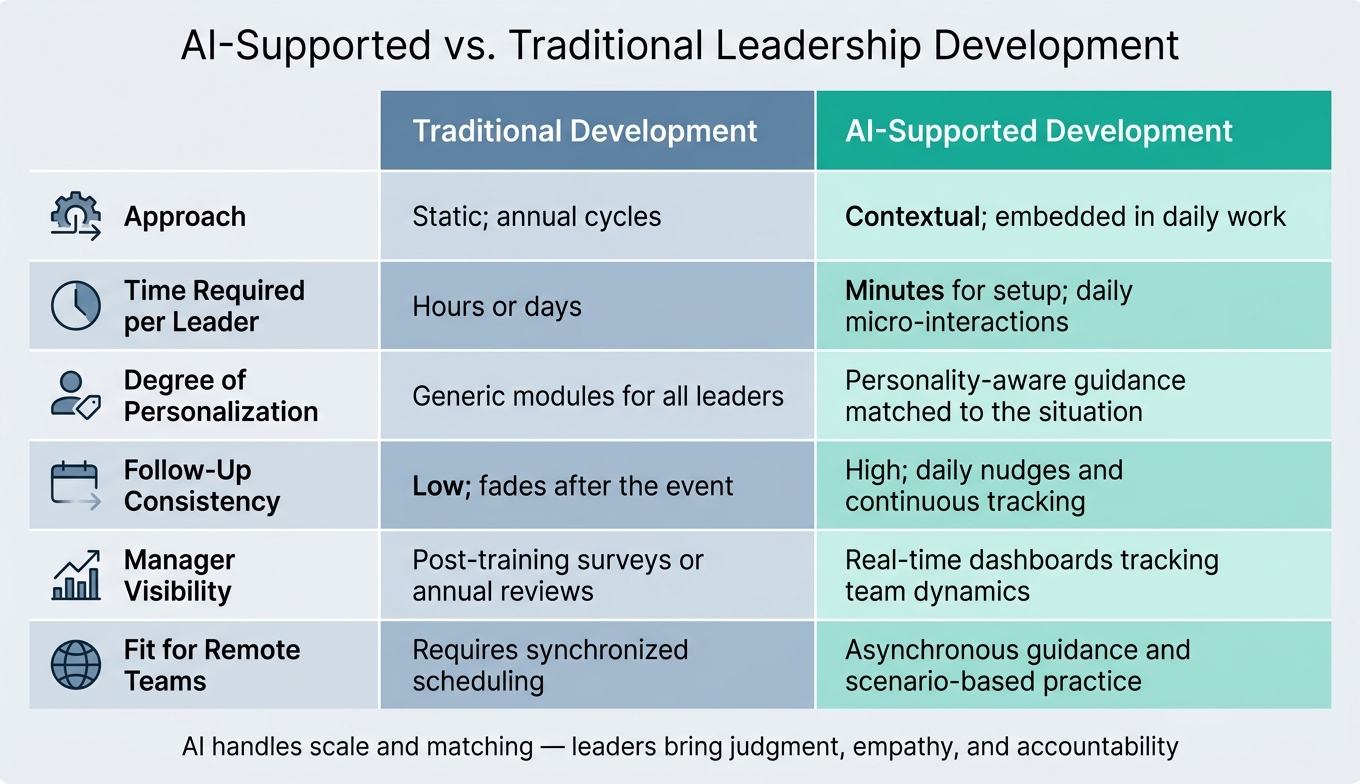
AI-Supported vs. Traditional Leadership Development: A Side-by-Side Comparison
These five approaches stand out most when you put them next to the old model. Older programs were built for the classroom, not for scale. You'd get a yearly workshop, a broad assessment, and the same content handed to everyone. Then, a few weeks later, most of it would fade. AI keeps leadership development alive between workshops, right in the flow of day-to-day work.
The table below shows why these five tactics tend to outperform workshop-only programs.
| Feature | Traditional Development | AI-Supported Development |
|---|---|---|
| Approach | Static; annual cycles | Contextual; embedded in daily work |
| Time Required per Leader | Hours or days | Minutes for setup; daily micro-interactions |
| Degree of Personalization | Generic modules for all leaders | Personality-aware guidance matched to the situation |
| Follow-Up Consistency | Low; fades after the event | High; daily nudges and continuous tracking |
| Manager Visibility | Post-training surveys or annual reviews | Real-time dashboards tracking team dynamics |
| Fit for Remote Teams | Requires synchronized scheduling | Asynchronous guidance and scenario-based practice |
That gap is the big reason AI works so well at scale without becoming generic.
"Generative AI is a tool, not a replacement. The human skills - including empathy, insight, creativity, and leadership - remain the secret sauce. When paired with AI's power, we can scale high-touch experiences..." - Tiffany Vojnovski, CPTM, SweetRush Inc. [1]
AI can handle the scale and the matching. Leaders still bring judgment, empathy, and accountability.
Conclusion
Scaling leadership development used to mean a tough tradeoff: quality or reach.
These five uses of AI help change that. Instead of relying on one-time training, teams can move toward continuous development. AI helps leadership programs scale by making plans faster to create, follow-up more consistent, learning more tied to each role, visibility more real time, and support easier to access for remote teams.
This isn't about adding more automation for the sake of it. It's about building better development across a larger group. AI does its best work when it supports human judgment, not when it tries to replace it.
Organizations that use AI as an ongoing development partner can build leadership capability at scale.
FAQs
How does AI personalize leadership plans?
AI makes leadership development feel less like a one-time assessment and more like an ongoing coach. Instead of stopping at static reports, it gives real-time, context-aware guidance that shifts with the leader’s needs. It can look at personality traits, individual goals, session notes, and organizational context to build a customized plan that changes as the leader grows.
It can also suggest specific language for high-stakes conversations, which is a big deal when the right words can calm tension or move a tough discussion forward. On top of that, it can recommend exercises that fit different working styles, so the development plan doesn’t feel generic or out of sync with how someone actually operates.
By tracking progress and behavior changes over time, AI helps keep leadership development relevant, actionable, and aligned with each leader.
Can AI improve leadership development without replacing coaches?
Yes. AI can improve leadership development without replacing human coaches.
Platforms like Personos work like a force multiplier. They extend a coach’s method with context-aware guidance shaped by the leader’s personality and the coach’s approach.
That means AI can help surface blind spots, support leaders between sessions, and track progress over time. Meanwhile, coaches stay focused on the parts of the work that need human judgment, especially ethical, complex, and high-level decisions.
What should teams track to measure AI leadership program success?
Track both engagement metrics and behavioral outcomes. Focus on signals like team engagement, psychological safety, workplace conflict frequency, and qualitative feedback over time.
If you're using Personos ActionBoard, teams can also track development commitments, completion rates, milestones, and trendlines. That makes it easier to show progress, support transparency, and demonstrate ROI to stakeholders.