How to Lead Introvert and Extravert Teams
Structure meetings, channels, feedback, and tasks so introverts and extraverts both contribute effectively without lowering standards.
Christian Thomas

How to Lead Introvert and Extravert Teams
If your team speaks well in meetings but thinks better after them, your setup is the problem, not your people.
I’d lead mixed teams with one simple rule: change the process so both styles can do good work. That means using the right channel, giving people time to think, shaping feedback to fit how they process, and assigning work by strength without boxing anyone in.
Here’s the short version:
- Introverts often think before they speak
- Extraverts often speak to think
- Fast meetings can sideline quiet staff
- Too much asynchronous work can leave talk-first staff stuck
- The fix is structure, not pressure
- The same performance bar stays in place
A few numbers help make the point. In one study, teams with balanced participation made better choices than groups where a few people did most of the talking. And Gallup has long reported that employees who get clear feedback are more likely to stay engaged at work. How you run meetings and feedback changes output.
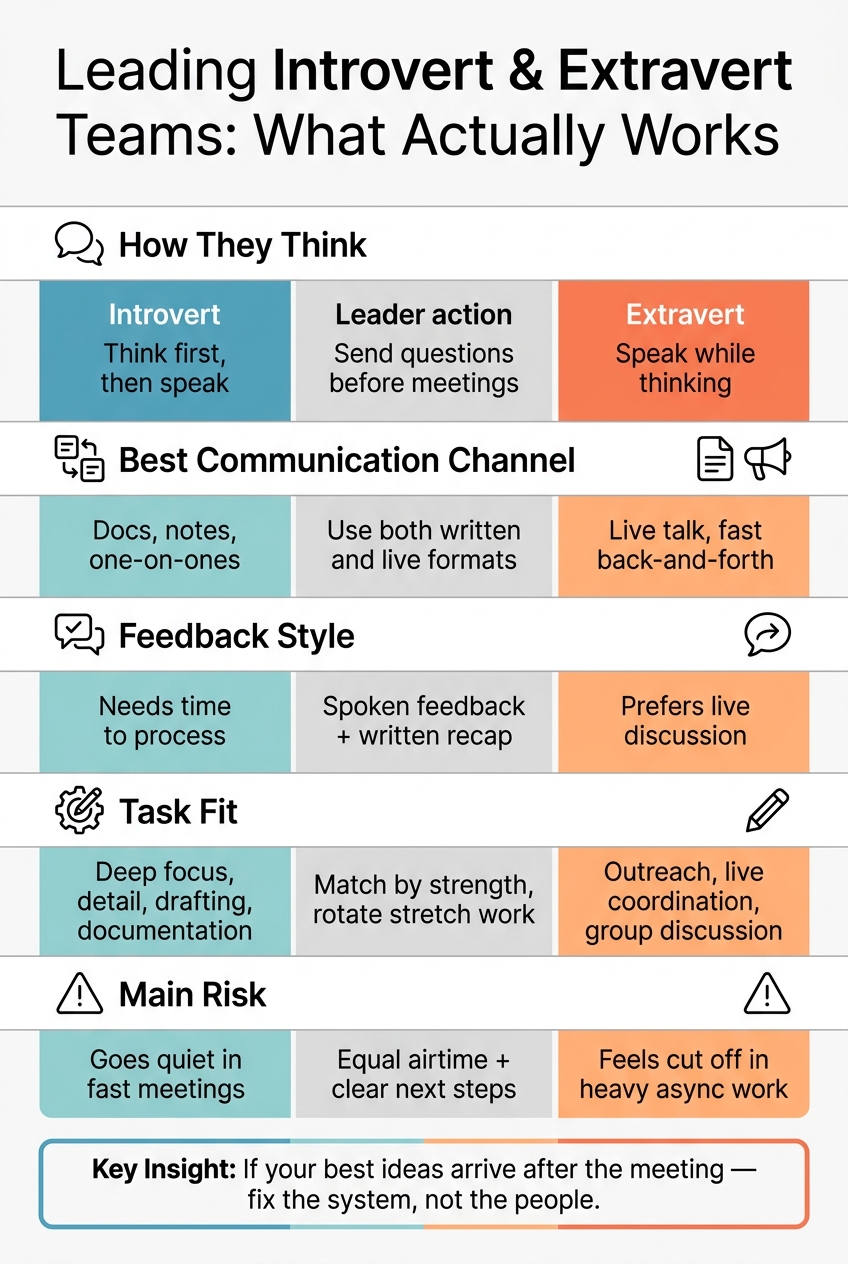
Introvert vs Extravert Team Leadership: Communication & Management Guide
Introverts Can Make Better Leaders. Here's Why.
Quick comparison
| Area | Introvert-leaning pattern | Extravert-leaning pattern | What I’d do |
|---|---|---|---|
| Idea flow | Think first, then speak | Speak while thinking | Send questions before meetings |
| Best channel | Docs, notes, one-on-ones | Live talk, fast back-and-forth | Use both written and live formats |
| Feedback | Time to process helps | Live discussion helps | Give spoken feedback, then recap in writing |
| Task fit | Deep focus, detail, drafting | Outreach, live coordination, group discussion | Match work by strength, then rotate stretch work |
| Main risk | Going quiet in fast meetings | Feeling cut off in heavy async work | Set equal airtime and clear next steps |
If I were leading this kind of team, I’d watch for one sign above all: where the best ideas show up. If they arrive after the meeting, in Slack, email, or a shared doc, I’d treat that as a cue to fix the system.
1. Identify your team's personality mix and spot signs of mismatch
Pay attention to where your team's best thinking shows up. If the strongest ideas arrive only after meetings, or in solo follow-up, your team norm may lean too hard toward one style. Once you see where that mismatch appears, you can change how people are asked to contribute.
Warning signs your communication and meeting style are off
If the most useful thinking keeps showing up after the meeting, in a Slack message, a draft doc, or some other follow-up channel, your live format may not give everyone enough room to speak up. Another sign is when the team does its best planning and drafting outside the meeting, but the meeting itself still expects instant decisions.
That kind of gap matters. It often means the format is rewarding fast reactions, even when the strongest input needs a bit more time.
Common friction points between introverts and extraverts
The biggest friction point is response timing. Live discussion tends to reward people who speak fast. Written or delayed formats tend to work better for people who think first and respond after they've had a minute to sort their thoughts.
Neither style is wrong. The problem starts when one becomes the default for everyone.
How to use personality data without turning it into a label
Use personality data to spot patterns, not to box people in. Tools like Personos can turn those patterns into situation-specific guidance for supervision. From there, use that diagnosis to shape your communication styles and meeting structure and meeting structure.
2. Adjust communication channels and meetings so both styles can contribute
Once you spot the friction, shift the communication channels and meeting setup. The point is not to push introverts to speak more or ask extraverts to hold back. The point is to make it easier for both groups to contribute. Change the process, not the people. This often starts with analyzing personality for team success to understand how different styles interact.
Match the channel to the message: docs, chat, one-on-ones, and live discussion
Pick the channel that fits the decision in front of you. Written channels like shared docs, email, or async briefs work well when people need a little time to think before they answer. Live discussion makes more sense when you need fast alignment. One-on-ones are better when the topic calls for privacy. In every case, be clear about the action, owner, deadline, and needed context.
The same idea applies to meetings. Give people time to think, then make sure everyone gets a fair turn.
Run meetings with structure, reflection time, and equal airtime
Mixed-style meetings tend to go off track when everyone is expected to think out loud on the spot. Send the objective and key questions ahead of time, give people a minute to review, and then start the discussion. During the meeting, treat written input with the same weight as spoken comments.
Ask for the next step, not just confirmation. If you need blockers fast, name the blocker in one sentence.
Style mismatch cuts efficiency [1]. A few process changes can reduce avoidable friction and improve team output.
3. Tailor feedback, coaching, and task ownership to how people work
Once meetings work for both styles, use that same approach with feedback and task ownership.
This is usually where personality differences start to show up fast. After channel choice and meeting setup, feedback and ownership are often the next friction points where personality insights can resolve conflict. The goal is simple: keep the standard the same, but change how you deliver it. When feedback and task formats match how people work, expectations stay high and the process gets smoother.
Give feedback in ways people can actually use
Some people do better when they have a little time to think. Others do better when they can talk it through on the spot.
For introverts, give advance notice and follow up with a written recap. That gives them space to process and respond with care. For extraverts, faster spoken feedback often works better because they can react in real time and work through the issue out loud.
Coaching helps here too. Ask questions instead of jumping straight to the answer, then let the employee reason through it.
For hard conversations, timing and format matter even more. Brief introverts ahead of time so they can prepare. With extraverts, keep the conversation immediate and interactive.
Assign work based on strengths without locking people into a box
Match work to style when it helps reduce friction. That doesn't mean putting people in fixed lanes forever.
Deep work and documentation often fit introverted staff well. Outreach, stakeholder engagement, and real-time coordination often fit extraverts better. That said, comfort should be the starting point, not the limit.
A good manager rotates stretch assignments on purpose. Pair introverted staff with structured facilitation. Give extraverts clearly defined analytical work. This helps people build range without pushing them into work that feels like a bad fit every day.
| Work Pattern | Better Fit | Risk of Mismatch | Leadership Adjustment |
|---|---|---|---|
| Deep work | Introverts | May find isolated work draining | Use clear reports to jumpstart the process |
| Stakeholder engagement | Extraverts | May burn out in high-social-load roles | Avoid overloading with continuous external meetings |
| Documentation | Introverts | May default to verbal over written | Use templates to keep structure consistent |
| Real-time coordination | Extraverts | Prefer structure and prep | Share the agenda and key questions ahead of time |
Use comfort as a starting point, not a ceiling. Then turn those choices into a repeatable supervision routine.
4. Turn personality data into repeatable supervision habits
Once you’ve matched work and feedback to personality, the next move is to make those patterns part of your regular supervision routine.
Use what you know about each person in the moments that shape day-to-day work most: meeting prep, one-on-ones, feedback timing, and follow-up. If you use AI, choose a tool that keeps context across check-ins so you don’t have to start from scratch every time. The goal is consistency, not boxing people into fixed labels.
People change. Stress changes them. New roles change them. Team dynamics change them too. So revisit your read on each person now and then, and adjust your approach when their situation shifts. Keep personality scores private unless the person agrees to share them in coaching. Use personality insight to guide how you lead, not to defend performance ratings or to leave someone out of certain tasks.
Where Personos fits for managers and helping professionals
Tools can make these routines easier to keep up, especially when you’re managing several people across different situations. Personos uses the Five Factor Model to turn personality data into steady supervision guidance for teams, relationships, and individuals. Dynamic Reports show group patterns and relationship friction. Prompts send regular action nudges. ActionBoard tracks follow-through. Unlike static personality tools, Personos is built for ongoing, context-aware supervision.
The payoff is simple: supervision stays steady, and both introverts and extraverts get what they need to do strong work.
Conclusion: Build team norms that give introverts and extraverts equal room to do their best work
The fix is pretty simple: change the system, not the people.
If you lead a mixed team, four moves matter most. Match the channel to the message. Set up meetings so both styles can take part. Adjust feedback to fit how each person processes it. And assign work based on strengths without putting people in a box.
Use what you know about each person to give them more options, not fewer. Personality insight should help you make better calls, not label people.
It also helps to keep checking the norms that shape meetings, feedback, and ownership. As roles change and new people join the team, your read on each person should change too.
Mixed teams don’t need a leader who leans toward one style. They need a system that gives introverts and extraverts equal room to do their best work.
FAQs
How do I know if my team meetings favor one style?
Watch who speaks, who stays quiet, and whether meetings end with clear next steps. Those small signals tell you a lot.
If the same few people do most of the talking, quieter team members wait until after the meeting to share what they think, or the conversation drags on with no decision, the meeting may be tilted toward one working style.
Personos can help spot gaps in speaking patterns and engagement. To even things out, share the agenda ahead of time and make room for quieter team members to contribute.
Can introverts and extraverts be held to the same standards?
Yes. Introverts and extraverts can be held to the same standards, but leaders should adjust how they supervise each person based on how that person processes information.
The goalposts don’t need to move. The way you help people reach them can. Extraverts may do better with immediate feedback and verbal brainstorming. Introverts often prefer written communication and a bit of time to think before they respond.
That kind of shift doesn’t lower expectations. It just gives people a fair shot at meeting the same bar. Tools like Personos can help managers tailor feedback and communication so each team member gets support in a way that fits how they work.
How can personality data help without labeling people?
Personality data works best when it points to what someone can do next, not when it pins them to a fixed label. That’s the big shift. Instead of saying, “This is just who you are,” tools like Personos help people notice patterns, reflect on how they show up in different situations, and grow from there.
For leaders, that means using these insights as a starting point, not a final verdict. Pair the data with day-to-day observation and open conversation, and it becomes much more useful. Team members feel supported through communication that fits them better, rather than squeezed into stereotypes.