Latent Change vs. Growth Models in Personality Research
Compare latent change score and latent growth models to choose the right design and reporting for personality change in counseling.
Rachel Johnson

Latent Change vs. Growth Models in Personality Research
I use latent change score models (LCSMs) for change between assessments and latent growth models (LGMs) for patterns over time. For counseling evaluation, that means separating intake-to-discharge change from progress across treatment and follow-up.
Here’s the choice in plain terms:
- LCSM: How much did personality scores change? Two comparable assessments can support one interval of change.
- LGM: How did scores change over time? Usually, you need at least three assessments to estimate a linear path, with more needed for curved patterns.
- Both: I check that measures work the same way across assessments, account for measurement error and missing data, and report estimates with uncertainty.
Quick Comparison
| Comparison | LCSM | LGM |
|---|---|---|
| Main focus | Change within an interval | A path across time |
| Main estimates | Average change and differences among clients | Starting level, rate of change, and differences among clients |
| Predictor question | Does attendance relate to change? | Does attendance relate to starting scores or change rates? |
| Two related outcomes | Do their changes move together? | Do their rates of change move together? |
| Main limit | Two waves cannot show a lasting pattern | Results depend on timing and the chosen path |
My rule: <u>choose the question and assessment schedule before the software</u>. Neither model alone shows that counseling caused change, though AI-enhanced personality psychology can help clarify these outcomes, and a change in scores is not automatically a change that matters to clients.
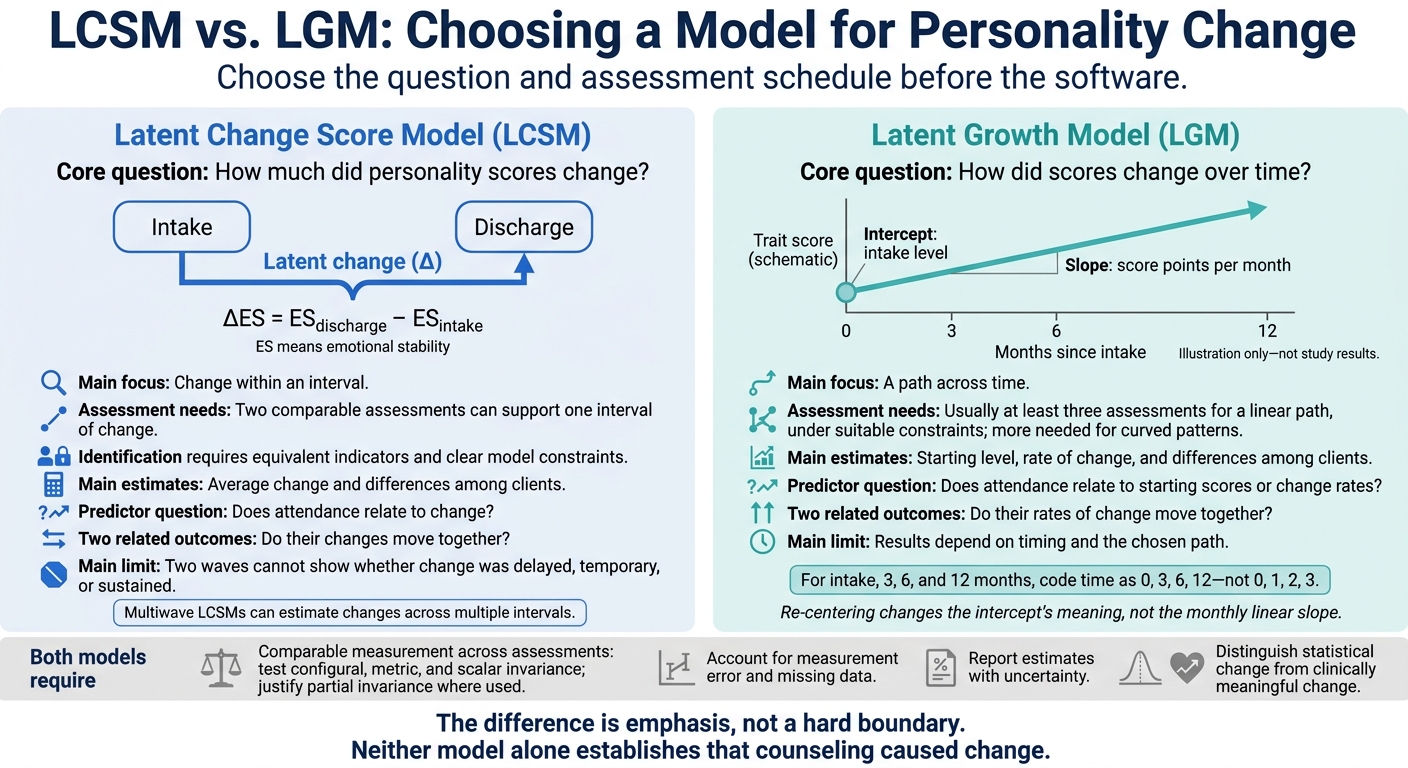
LCSM vs. LGM: Choosing a Model for Personality Change
Latent Growth vs. Change Score Models: What is the Difference?
Latent Change Score Models: Change Between Assessments
Use LCSMs to study how much change occurred and in which direction between two assessments. In counseling evaluation, a latent change score can represent intake-to-discharge emotional stability: (\Delta ES = ES_{\text{discharge}} - ES_{\text{intake}}). This measures single-interval change, not a trajectory across multiple waves.[10]
Change Amounts and Effects of Prior Scores
A constant-change component represents change independent of the previous trait level. Proportional change links expected change to that prior level. Attendance and perceived stress can also predict change, but report their effects separately from overall mean change. An effect linked to a prior score does not prove causation.[6][7]
Assessment Needs and Measurement Quality
Two waves can identify a single latent change score, but only with equivalent indicators and clear identification constraints, such as fixed factor scales or a reference indicator. Use the same or equivalent indicators and test configural, metric, and scalar invariance.
Equal factor loadings support comparable item–trait relationships. Equal item intercepts, or defensible partial scalar invariance, are especially important when comparing latent means. Without this support, pre/post differences may reflect measurement drift rather than actual client change.[7][9][12]
Separating item-level error does not automatically remove retesting effects, such as familiarity or changes in response styles. Allow same-item residual correlations when justified, record assessment intervals, and interpret changes over short intervals with caution. Two waves cannot show whether change was delayed, temporary, or sustained. Studying recurring patterns requires more assessments.[7][8][10]
Counseling Questions and LCSM Parameters
Each parameter addresses a specific counseling evaluation question.
| Evaluation question | LCSM parameter | Assessment structure | Interpretation |
|---|---|---|---|
| Did conscientiousness change from intake to discharge? | Mean latent change (\mathbb{E}[\Delta C]) | Comparable conscientiousness indicators at intake and discharge | Average trait-score units gained or lost during the program |
| Did clients with lower baseline conscientiousness change more? | Proportional-change effect or regression of (\Delta C) on (C_{\text{intake}}) | Two comparable assessments, with baseline level in the change model | Baseline-dependent change; an association, not established causation |
| Did attendance predict conscientiousness change? | Regression of (\Delta C) on attendance | Intake and discharge measures plus attendance data | Expected difference in change associated with attendance, conditional on modeled covariates |
| Did emotional stability and coping change together? | Covariance between (\Delta ES) and (\Delta Coping) | Both constructs measured at the same two occasions | Correlated change; does not show direction |
| Did earlier coping predict later emotional-stability change? | Cross-domain coupling from prior coping to subsequent (\Delta ES) | At least three ordered waves, preferably more | A temporal directional association requiring stronger assumptions than correlated change[11][6] |
When the question shifts from change within one interval to a pattern over time, growth models fit better.
Latent Growth Models: Trajectories Across Time
A latent growth model (LGM) estimates a trajectory across repeated counseling assessments. It treats intake, discharge, and follow-up as one path rather than looking at a single interval. The latent intercept estimates the level at a chosen reference time. In a linear model, the latent slope estimates the rate of change.[13][17] The assessment schedule must support the trajectory being modeled.
Intercepts, Slopes, and Trajectory Shapes
For assessments scheduled at intake, 3, 6, and 12 months, code time as 0, 3, 6, and 12. The intercept then represents intake status, and the linear slope measures scale points per month. Coding these assessments as 0, 1, 2, and 3 would incorrectly treat the intervals as equally spaced. Re-centering time changes the intercept’s meaning, not the monthly slope.[13][17]
A linear trajectory assumes a constant rate of change, even when assessment intervals differ. A quadratic trajectory lets that rate accelerate or slow. A piecewise model separates phases, such as active counseling and follow-up, when a meaningful transition is known.
Choose the shape based on theory, timing, model identification, and preplanned comparisons, not fit alone. Three waves can support a linear model under suitable constraints, but they offer weak evidence for curvature. Nonlinear models usually need more waves.[14][15][17]
Predictors and Related Trajectories
A univariate growth model tracks one trait. It estimates the mean intercept and slope, along with intercept variance, slope variance, and intercept-slope covariance. A positive average slope does not mean everyone improved. The covariance shows whether levels at the centered time point relate to rates of change.
A conditional growth model adds predictors of the intercept, slope, or both. Keep these roles separate: a predictor linked to higher starting scores is not necessarily linked to faster growth. Report estimates with uncertainty intervals.[13][17][20]
A parallel-process growth model estimates two trajectories together. In counseling studies, it can compare personality change with coping or symptom change over time, often utilizing AI and the Five Factor Model for deeper insights.
For example, personality and coping can be modeled together across treatment and follow-up.[16][17][19]
Intercept correlations describe how levels at the centered time point relate. Slope correlations describe whether rates of change move together. Correlated slopes show co-development, not causation. They do not establish that personality change caused clinical improvement or that counseling caused change in either trait. Include follow-up data when posttreatment maintenance matters; discharge data alone cannot show what happened afterward.[16][17][19]
LCSMs vs. LGMs in Counseling Evaluation
Choosing between LCSMs and LGMs depends on the evaluation question, assessment schedule, and counseling decision. The difference is emphasis, not a hard boundary. Start with what you need to learn and when you can collect assessments.
| Dimension | LCSM | LGM |
|---|---|---|
| Core question | What changed between assessments? | What trajectory describes change over time? |
| Assessment needs | At least two comparable waves for one interval | Usually three or more waves, with more needed for nonlinear patterns |
| Representation | Latent differences between adjacent assessments | Latent intercept and slope factors |
| Main parameters | Mean and variance of change; prior-score effects | Intercept and slope means, variances, and covariance; predictor effects |
| Prior scores | Prior status can predict later change | Initial status can predict trajectory differences |
| Counseling uses | Intake-to-posttest change, session-to-session shifts, or posttest-to-follow-up persistence | Symptom or trait trajectories, treatment-response patterns, and subgroup differences in change rates |
| Strengths and limitations | Best suited to interval-specific change; can become complex with many intervals | Best suited to multiwave trajectories; requires enough waves and clear time coding |
An LCSM interpretation focuses on the interval:
“The estimated latent change during this interval was…”
An LGM interpretation focuses on the trajectory:
“The estimated average slope was…, with clients differing in their rates of change…”
The next step is to match each question to the smallest design that can answer it.
Choose by Question and Assessment Schedule
Choose the contrast before choosing the model. To evaluate a defined counseling phase, compare interval-specific latent changes. To evaluate rates of improvement, compare conditional LGM slopes. The schedules below assume comparable measures and a model that can be identified.
Hypothetical evaluation question Model emphasis Minimum assessment structure* Key parameters Main limitation Did emotional stability change from pretest to posttest? Two-wave LCSM Comparable pretest and posttest measures Mean latent change and variance in change Cannot distinguish a one-time shift from a longer trajectory Do session-to-session gains differ? Multiwave LCSM Several sessions, ideally with consistent timing Interval-specific changes and prior-score effects Assessment burden and missing data Did gains persist at a 3-month follow-up? LCSM with separate posttest-to-follow-up change, or a combined change model Pretest, posttest, and follow-up Immediate change, follow-up change, and relations among changes One follow-up cannot fully describe long-term maintenance Do personality and clinical symptoms develop together? Parallel-process LGM or multivariate LCSM Several synchronized assessments of both constructs Intercepts, slopes, covariances, or cross-domain changes A temporal association does not prove mediation or causation Does the program alter the rate of improvement compared with usual care? Conditional LGM, possibly supplemented by LCSM contrasts Multiple waves for both groups with a prespecified time scale Group effect on slope, group-by-time differences, and covariate effects Depends on design quality, attrition handling, and trajectory specification
*Two waves cannot separate linear from nonlinear change. More waves improve trajectory testing, but they require explicit time coding and defensible measurement invariance.
Define Personality’s Role in the Evaluation
State whether personality is an intervention target, a moderator of response, a proposed mediator, or a contextual variable used to tailor care. Mediation requires measurements ordered in time, not just correlated changes.
Do not label symptom relief or situational confidence as trait change without repeated trait evidence. To make claims about effects, define the comparison group and address baseline imbalance, counselor or site clustering, attrition, and confounding. Neither model alone establishes causation.
Separate Practice Tools From Statistical Evidence
Implementation tools such as Personos do not replace validated, repeated trait measures for LCSM/LGM outcomes. Before using platform data, check measurement quality, consistent administration, data access, consent, and confidentiality.
Conclusion: Choose and Report the Model Clearly
Match the model to the question: In counseling evaluation, use LCSMs for interval-specific change and LGMs for multiwave trajectories. Let wave timing and measurement quality guide what the data can support.[5][6]
Report Estimates, Assumptions, and Uncertainty
Make your reporting easy to audit. Document the sample size rationale, expected attrition, exact wave timing, intercept reference time, and time codes. State the identification constraints, estimator, software, and any robust corrections.
Report measurement-invariance results, including partial invariance; missing-data patterns, assumptions, and handling; and model-fit results. Include sensitivity analyses that test plausible alternative trajectory shapes, time coding, and missing-data assumptions, rather than reporting only the best-fitting specification.[18][21][24]
Provide change- or growth-factor means, variances, relevant covariances, and predictor effects with confidence intervals. State slope units explicitly, including both score and time units. Distinguish statistical change from clinically meaningful change using prespecified benchmarks, reliable-change criteria, or client goals. Avoid labeling clients simply “changed” or “unchanged.”[22][23]
Before collecting data, consult an evaluator or statistician about sample size, timing, and measurement design. These choices determine what the analysis can answer and should come before software selection.
FAQs
How many clients do I need for either model?
The provided search results don’t specify sample size requirements for latent change score models or latent growth models. These models generally study change over time in research populations, rather than guide care for individual clients.
For immediate, client-specific support, Personos offers personality-aware guidance based on the Five Factor Model, without requiring large sample sizes.
How should I handle clients who miss assessments?
When clients miss assessments or lose motivation, use Personos to better understand their engagement. Personos Chat provides real-time guidance tailored to each client’s personality, helping you reconnect with clients who feel guarded or overwhelmed [1][2][3].
Keep in touch with reminders on configurable notification schedules. Use the ActionBoard to track progress and assign specific tasks that help clients stay accountable between sessions [1][4].
How can I tell whether personality changes matter clinically?
Look for measurable improvements in daily life, such as better performance, relationships, communication, or progress toward client goals. Academic models offer a starting point, but what matters in practice is whether personality changes lead to meaningful improvements.
Personos uses the scientifically validated Five Factor Model to measure 30 traits on an 80-point scale and offer guidance you can put into practice. That guidance helps you consider how personality shifts interact with the situation at hand.