5 Steps to Integrate Personality Data into Leadership
Five practical steps to apply personality data in leadership: pick valid tools, collect ethically, analyze traits, create tailored development plans, and embed insights.
Rachel Johnson

5 Steps to Integrate Personality Data into Leadership
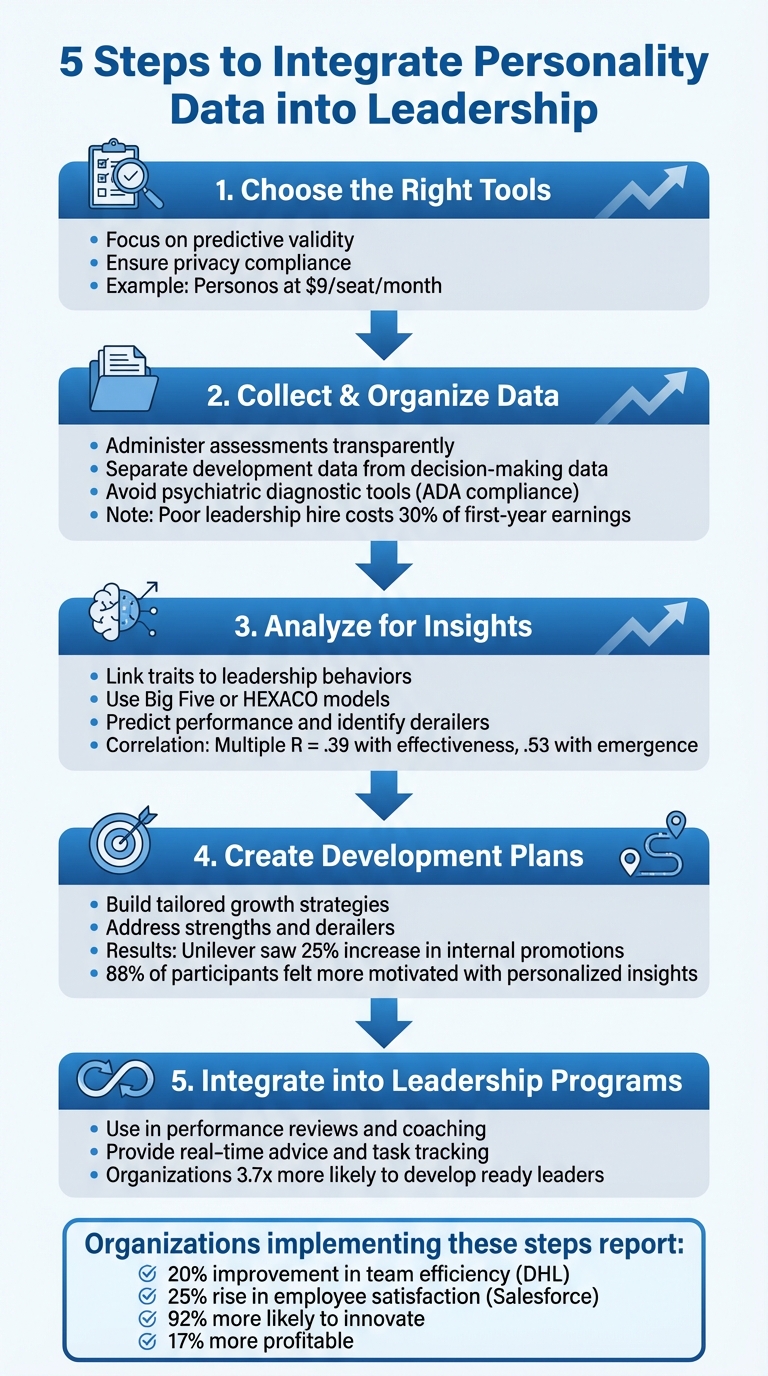
Personality data is transforming leadership development by replacing instincts with precise, data-driven decisions. Using psychometric assessments, organizations can better identify leadership traits, mitigate risks, and enhance team dynamics. Here’s how to do it in five steps:
- Choose the Right Tools: Select personality assessments designed for workplace use, focusing on predictive validity and privacy. Tools like Personos offer scalable solutions at $9 per seat/month.
- Collect & Organize Data: Administer assessments transparently, ensuring data is used for growth, not judgment. Avoid tools that diagnose psychiatric conditions to comply with regulations.
- Analyze for Insights: Link personality traits to leadership behaviors, using models like the Big Five or HEXACO, to predict performance and identify potential challenges.
- Create Development Plans: Build tailored growth strategies based on personality data, addressing strengths and derailers. Examples from companies like Unilever show success in this approach.
- Integrate into Leadership Programs: Use personality insights in performance reviews and coaching. Platforms like Personos provide real-time advice and task tracking for continuous improvement.
Organizations implementing these steps report improved financial performance, better leadership pipelines, and enhanced team efficiency. Tools like Personos simplify the process, offering dynamic insights while maintaining privacy.
5 Steps to Integrate Personality Data into Leadership Development
Step 1: Select Your Personality Assessment Tools
What to Look for in Assessment Tools
Not all personality assessments are created equal, especially when it comes to workplace applications. Tools specifically designed for organizational use tend to offer better insights into leadership behaviors compared to those meant for clinical purposes or general self-awareness [5].
The key is predictive validity. The most effective tools go beyond simply describing personality traits - they predict job performance and highlight potential "derailers." For instance, a leader's confidence might morph into domineering behavior under stress, or a detail-oriented manager could slip into micromanagement when overwhelmed [3].
"Personality data should always be paired with behavioral and skills-based assessments and performance history to evaluate leadership potential."
– Scott Bryant, Ph.D, Consulting Manager, DDI [3]
Choose tools that can scale across various leadership levels and ensure they adhere to strict data privacy standards. It's also worth auditing your current tools to eliminate redundancies and weed out those lacking scientific backing [2].
How Personos Supports Leadership Development
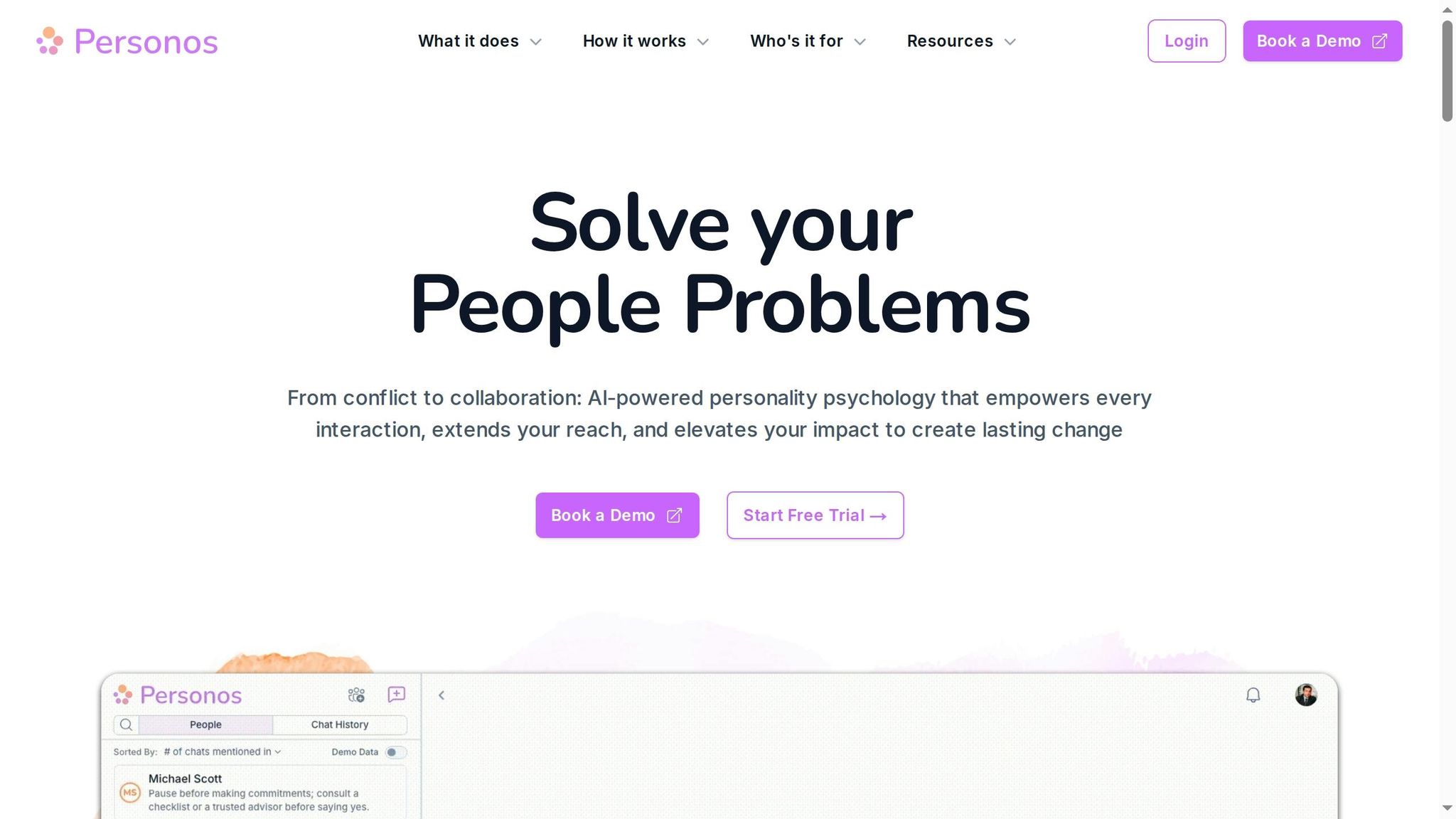
Personos (https://personos.ai) combines AI with personality psychology to create dynamic reports tailored for leadership development. Unlike traditional static assessments, Personos offers real-time, actionable insights through features like proactive communication prompts and tools for analyzing team relationships. Privacy is a top priority - individual assessment data remains accessible only to the user, while group analysis helps identify team friction points without breaching confidentiality.
At just $9 per seat per month, Personos Pro provides an affordable solution for organizations aiming to build leadership pipelines rooted in data. With the right assessment tools in place, the next step is to collect and organize your personality data effectively.
Step 2: Collect and Organize Personality Data
How to Administer Assessments
Once you've chosen your assessment tools, the next step is administering them effectively. Start by explaining the purpose of the assessments to participants. Being upfront about why you're collecting this data helps build trust and eases concerns about being "misinterpreted" [2]. It's important for leaders to understand that this process is about personal growth, not judgment. Communicating this clearly sets the foundation for transparent and ethical data handling.
From the outset, separate data collected for development purposes from data used for decision-making. Establish clear policies about who can access the results, how long the data will be valid, and what confidentiality measures are in place. When leaders know their results won't be used against them in performance reviews or promotion decisions, they're far more likely to provide honest and meaningful responses [2].
It's also crucial to avoid using medical or psychiatric screening tools. Under the Americans with Disabilities Act (ADA), tests that diagnose psychiatric conditions can only be administered after a job offer has been made [7]. Focus instead on gathering data about job-relevant traits and behaviors. After all, a poor leadership hire can cost up to 30% of an employee's first-year earnings, so it's worth getting this process right [2].
"Leadership decisions deserve the same rigor as significant capital investments. Objective data can help offset emotional bias in decision-making."
– DDI Team [2]
Using Personos for Data Collection
Personos (https://personos.ai) offers a practical solution to streamline the data collection process. Unlike traditional assessments that produce static PDFs, Personos creates dynamic personality profiles that update in real-time. These profiles cover individuals, relationships, and teams, offering a more comprehensive view of leadership dynamics.
Privacy is a core feature of the platform. Individual assessment data is accessible only to the user, while team-level analysis provides insights into group dynamics without breaching confidentiality. Additionally, its AI-driven interface offers leaders personalized, situational advice based on their results.
Personos Pro is an affordable option for scaling leadership data collection across an organization. With your personality data collected and organized, you'll be ready to dive into analysis and uncover actionable leadership insights.
Step 3: Analyze Personality Data for Leadership Insights
Connecting Personality Traits to Leadership Behaviors
Once you've gathered personality data, the next step is to turn those insights into practical leadership guidance. By linking personality traits to specific leadership behaviors, you can predict how leaders are likely to perform in various situations.
The Big Five personality traits - Extraversion, Agreeableness, Conscientiousness, Openness, and Emotional Stability - form the backbone of this analysis. Traits like Extraversion and Agreeableness often influence how leaders build relationships and show empathy. On the other hand, Conscientiousness and Openness tend to shape behaviors related to "Initiating Structure", which focuses on tasks and achieving goals [9]. Research backs this up: a meta-analysis revealed that when these traits are weighted together, they correlate at Multiple R = .39 with leader effectiveness and Multiple R = .53 with leader emergence [9].
Beyond the Big Five, consider the Honesty-Humility factor from the HEXACO model. This trait goes beyond what the Big Five can measure, providing insight into whether a leader is fair and genuine or more likely to manipulate others. It’s a critical factor in understanding how leaders interact with their teams [9][10]. Be alert for the "Three Nightmare Traits" (TNT) - low Honesty-Humility (dishonesty), low Agreeableness (disagreeableness), and low Conscientiousness (carelessness). Leaders who exhibit all three traits can significantly disrupt team dynamics [10].
"Personality reflects how you're naturally inclined to approach situations, not how well you'll perform in them."
– Scott Bryant, Ph.D., Consulting Manager, DDI [1]
The key is to translate these raw personality scores into actionable insights. For instance, a leader high in Conscientiousness might excel at planning and execution but could veer into micromanagement under pressure. The idea is to help leaders view their personality data as a tool for growth rather than a rigid label [1].
Once you've mapped individual traits, the next step is to explore how these traits influence team interactions.
Using Personos for Group and Relationship Analysis
After analyzing individual leadership traits, dive into how personalities interact within teams. While individual insights are helpful, the real value emerges when you examine group dynamics. This is where traditional assessment tools often fall short, but Personos (https://personos.ai) steps in to bridge the gap.
Personos uses AI to analyze relationships and team dynamics, leveraging the Five Factor Model to assess 30 traits on an 80-point scale. Unlike type-based or color-coded systems, this approach treats personalities as unique spectrums, avoiding the pitfalls of rigid categorization [11].
The platform also includes a relationship factoring feature. Leaders can invite team members to complete assessments, and once accepted, the AI integrates their personality profiles to offer tailored advice. This means leaders get insights not just on how they function individually but on how their traits align - or clash - with specific team members [11].
Privacy is a priority with Personos. Instead of sharing raw scores with the entire team, it provides actionable recommendations. For example, if someone scores high on Openness, the platform might suggest involving them in brainstorming sessions due to their creativity. This keeps sensitive data confidential while still offering practical advice [11].
Another standout feature is Personos Chat, which delivers real-time guidance for challenging moments. Whether preparing for a tough feedback discussion or navigating a team conflict, leaders can use the AI to get communication tips tailored to the recipient’s personality and communication style. This feature also factors in job history, organizational values, and past interactions, making the advice highly specific [11][12].
When it comes to team dynamics, research highlights that the least agreeable team member often has a disproportionately negative impact on outcomes, even more than the overall group’s average Agreeableness score [10]. Personos helps pinpoint these potential friction points early, allowing leaders to address them before they escalate.
Step 4: Build Personalized Leadership Development Plans
Designing Plans Based on Personality Data
Turn personality insights into customized leadership strategies. Forget the outdated one-size-fits-all approach - embrace Individual Development Plans (IDPs) that align a leader's traits with the organization’s goals [16][17]. This shift from gut feeling to data-driven planning ensures leaders focus their energy where it matters most [13].
Start by identifying each leader’s natural strengths and potential challenges. These "derailers" are traits that work well under normal conditions but can become problematic under stress. For instance, a leader with high Conscientiousness might excel in planning and execution but could veer into micromanagement when under pressure [3]. The aim isn’t to change a leader’s personality but to help them recognize these tendencies and develop strategies to manage them effectively [4].
Take Unilever as an example. In August 2024, they launched a data-driven leadership program that used 360-degree feedback and performance assessments to pinpoint competency gaps. By tailoring training to address these specific needs, Unilever boosted the promotion rate of internal candidates by 25% [14]. Similarly, the American National Red Cross revamped its leadership training by incorporating emotional intelligence and crisis management assessments. The result? A 30% improvement in team cohesion and disaster response effectiveness [14].
"Personality insights pinpoint precisely where leaders should focus their efforts, creating personalized plans that work with their natural strengths." – Scott Bryant, Ph.D., Consulting Manager, DDI [3]
Using personality data to map out a "team mosaic" can also reveal natural synergies and potential friction points within leadership teams. This fosters a shared understanding of growth areas and accountability. In fact, research shows that 88% of participants in leadership development programs felt more motivated to apply new skills after receiving personalized insights [15].
Using Personos for Coaching and Conflict Resolution
Once personalized development plans are in place, real-time coaching can help leaders stay on track. Enter Personos (https://personos.ai), a platform that takes leadership development to the next level by offering real-time, AI-driven coaching tailored to each leader’s personality profile.
Personos provides a chat-based interface that delivers on-the-spot advice for tricky situations. Whether it’s preparing for a tough performance review, managing team conflicts, or adjusting communication styles to suit different personalities, the platform offers practical, situation-specific guidance. For conflict resolution, it helps leaders navigate the complex dynamics of team personalities and suggests personalized strategies for intervention. Leaders can even invite team members to complete assessments, enabling the platform to offer relationship-specific recommendations.
Privacy is a top priority for Personos. Instead of revealing raw personality data, the platform focuses on actionable advice, keeping sensitive details confidential while still providing useful insights. Additional features like proactive communication prompts and task tracking ensure leaders maintain progress on their development goals, turning plans into lasting behavioral change.
sbb-itb-f8fc6bf
Step 5: Integrate Insights into Leadership Programs
Adding Personality Data to Performance Reviews
Once targeted assessments and personalized coaching are in place, the next step is weaving personality insights into everyday leadership practices. One practical way to do this is by incorporating personality data into performance reviews - not as a substitute for traditional evaluations, but as a complement to them [2] [8]. For instance, if a leader’s quarterly results highlight struggles with cross-functional collaboration, personality data can shed light on the underlying causes and offer tailored solutions that align with their natural tendencies [5].
It’s essential to keep development-focused personality data separate from the information used for promotions or terminations. Research shows that organizations using this data-driven approach are 3.7 times more likely to transform internal potential into leaders who are ready to perform [2] [8].
To make the most of these insights, align personality evaluations with key career milestones - such as incorporating 360-degree feedback after a year in a role, readiness assessments before a promotion, or pulse surveys between formal reviews [2] [8]. For example, in 2025, a hospital organization applied this strategy with their Chief Technology Officer, John, who was being considered for a Chief Operating Officer role. The assessment revealed areas where he needed further development, leading to a multi-year plan that included an MBA program and a rotation as Chief Human Resources Officer to strengthen his people-management skills. This approach delayed his promotion but ultimately prepared him to excel as COO, avoiding a premature move while retaining valuable talent [6].
"Data can inform decisions - but only people can inspire action." – DDI Team [2] [8]
To support this integration, train managers to act as coaches rather than just evaluators. Provide them with tools like conversation guides and training to interpret personality reports effectively. This empowers them to turn performance reviews into meaningful growth conversations. Considering that only 30% of leaders feel they have enough time for their own development [6], these discussions become even more critical. This approach not only strengthens individual growth but also lays the groundwork for ongoing, data-informed leadership development.
Maintaining Growth with Personos
Sustaining leadership development requires consistent support, and that’s where Personos (https://personos.ai) comes in. This platform helps organizations keep development goals front and center between formal evaluations through features like task tracking and relationship reports.
With task tracking, leaders can set specific behavioral goals - like improving delegation skills or practicing active listening - and receive timely prompts to apply these skills in real-world scenarios. This addresses a major challenge, as 53% of organizations cite "lack of action" after assessments as a key obstacle [8].
Personos also offers relationship and group analysis reports, providing ongoing insights into team dynamics. These reports help leaders adapt to changes within their teams or address new conflicts by offering guidance tailored to the personalities involved. This creates a dynamic, evolving development process rather than a one-time plan. Leaders gain the flexibility to adjust their natural tendencies to suit different situations and people.
The platform is designed with privacy in mind, ensuring sensitive data stays secure while delivering actionable insights. By combining AI-driven coaching with personality psychology, Personos transforms the traditional "Assessment → Development Plan → Check-in Cycle" [8] into a continuous learning journey that seamlessly integrates into a leader’s daily routine.
How Personality Assessments Support Leadership Development
Conclusion
Incorporating personality data into leadership development isn't just about collecting information - it's about replacing one-size-fits-all programs with tailored strategies that deliver real results. For instance, DHL reported a 20% improvement in team efficiency within a year of using personality assessments in their training, while Salesforce saw a 25% rise in employee satisfaction by leveraging personality insights to enhance communication [14].
The outlined steps - choosing the right tools, organizing data, analyzing insights, creating personalized plans, and embedding them into ongoing initiatives - work together to redefine leadership growth. Organizations that prioritize learning are 92% more likely to innovate and 17% more profitable [18]. Additionally, the consistency of personality traits (r = 0.81) makes them a reliable way to predict future potential [19].
"Personality assessments themselves don't automatically change outcomes. But when insights drive real changes in leader behavior... organizations see more effective leaders." - Scott Bryant, Ph.D., DDI [3]
Platforms like Personos (https://personos.ai) take this a step further by turning one-time assessments into continuous development. Through AI-driven coaching, relationship analysis, and task tracking, they provide real-time guidance to strengthen leadership capabilities.
The result? A leadership culture built on self-awareness, adaptability, and long-term growth.
FAQs
How does personality data enhance leadership development?
Personality data offers leaders a closer look at their core traits, values, and motivations. It helps pinpoint natural strengths - like strategic thinking or empathy - while also shedding light on areas that may need improvement, such as overconfidence or a tendency toward risk aversion. Unlike standard performance reviews, this approach provides a more detailed understanding of how leaders function and how others perceive them, encouraging greater self-awareness and accountability.
When paired with an AI-powered platform like Personos, this data becomes a real-time tool for improvement. Leaders gain access to tailored prompts that help refine communication, manage conflicts, and adjust their behavior to suit different situations. On top of that, dynamic team reports highlight group dynamics, match roles to individual strengths, and address potential points of tension before they escalate. By blending actionable insights with practical tools, personality assessments turn leadership development into a process that’s measurable and impactful.
What privacy measures should be considered when using personality assessments in leadership development?
Protecting privacy is a critical aspect of using personality assessments in leadership development. To start, organizations must obtain clear and informed consent from participants. This means explaining exactly how their data will be collected, stored, and used. Participants should also have the freedom to withdraw their consent at any time.
Securing data is just as crucial. Sensitive information should be stored and shared on secure platforms that use HTTPS encryption. Access to this data should be restricted to authorized personnel through role-based permissions. Additionally, organizations should only retain data for as long as it serves a valid business purpose, all while adhering to privacy laws like the California Consumer Privacy Act (CCPA).
For those leveraging AI-powered tools such as Personos, it’s essential to ensure these tools meet strict standards for consent, encryption, access control, and data retention. Organizations should also establish policies to monitor algorithmic transparency and address potential data bias. This approach not only protects privacy but also ensures the ethical and effective use of personality data.
How does Personos support leadership coaching in real time?
Personos uses AI to study a leader's behavior and communication style in real time. It offers tailored feedback, real-time personality insights, and customized communication suggestions designed to align with both individual and team dynamics. These features empower leaders to adjust in the moment, enhance their interactions, and encourage meaningful growth.