How to Improve Soft Skills
Practice one small, measurable behavior with a 4-step plan—choose a target, rehearse listening and feedback, then track progress.
Nick Blasi

How to Improve Soft Skills
I improve soft skills by practicing one small behavior, not trying to change my whole personality. You can start with a 3-second pause before replying, then ask a colleague for feedback on how you respond.
My practice plan covers four steps:
- Choose one target: Pick a behavior you can observe and track.
- Listen and explain clearly: Check your understanding, acknowledge feelings without guessing, and confirm next steps.
- Stay calm and work together: Rehearse hard conversations, give specific feedback, and agree on responsibilities.
- Review progress: Keep a private log, check it weekly, and review your target after 12 weeks.
I treat AI tools such as Personos as optional practice support, not a replacement for judgment or supervision. <u>I protect client privacy</u> and separate skill gaps from workload problems. Practice can change how I respond, but it cannot fix understaffing.
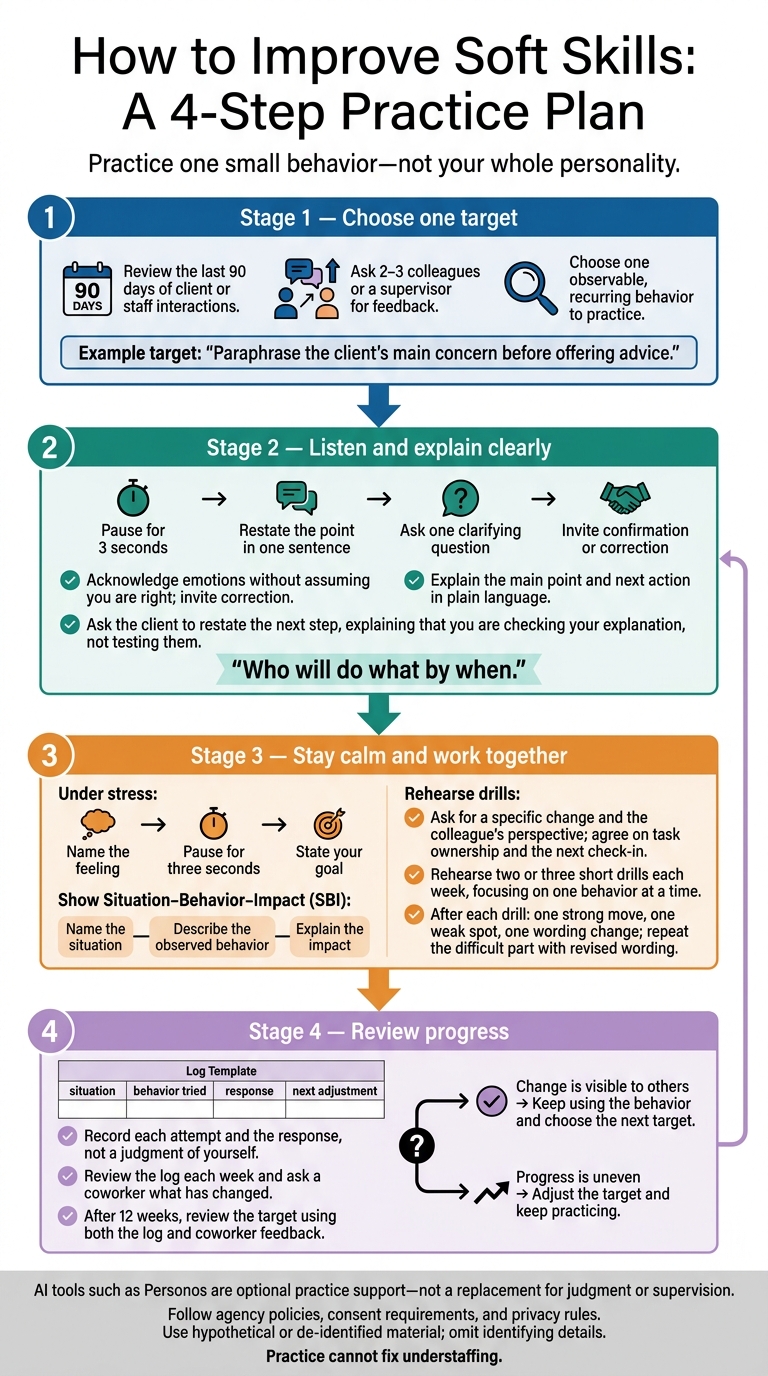
How to Improve Soft Skills: A 4-Step Practice Plan
5 Evergreen Soft Skills - We Must Keep Improving
Step 1: Choose One Skill to Practice
Pick one behavior you can change.
“Be more engaging” is too vague to practice; asking one clarifying question before you respond gives you a clear action you can measure.[3]
Review Client and Staff Interactions
Review the last 90 days of client or staff interactions. Look for conversations that stalled because of how people interacted, not technical issues.[3][1] Pay attention to situations you tend to avoid, such as disagreements or letting someone else present.[1]
Focus on what you said or did, rather than judging yourself as “bad at communication.”
Ask 2–3 colleagues or a supervisor to name one habit that makes you harder to work with or less effective. Compare their feedback with what you’ve noticed.[3] Then choose the recurring difficulty that affects the most relationships and appears in the most meetings each week.[3][1] Use that behavior as your next practice focus.
Set a Measurable Practice Target
Make your target specific enough that someone else can tell whether you did it.
For intake conversations, a useful example is paraphrasing the client’s main concern before offering advice.[3]
After each attempt, record whether you practiced the behavior and what happened.[3] Did the other person confirm your understanding or correct it? Both responses give you useful feedback.
Try this target in your next client or staff conversation.
Step 2: Practice Listening, Empathy, and Clear Communication
Put the behavior you chose in Step 1 into practice during client and staff conversations.
Paraphrase and Ask Clarifying Questions
Pause for 3 seconds, restate the client’s point in one sentence, and ask one clarifying question, such as which part has been hardest.[1][3][4] Follow the same sequence with staff. When working across cultures or meeting virtually, don’t treat eye contact as a universal sign of engagement. Pay attention to tone, context, and nonverbal cues.[6]
Hypothetical housing-services practice: “What I'm hearing is that the housing issue makes keeping appointments difficult. Did I get that right?” Wait for confirmation or correction before asking, “Which part has been hardest for you?”
Once you’ve clarified the facts, acknowledge the feeling behind them.
Acknowledge Emotions Without Making Assumptions
Suggest an emotion without assuming you’ve got it right, and invite correction. Don’t rely on tone or body language alone. Practice with a colleague, check that your reflection matches the client’s words, and revise it as needed.
Hypothetical practice phrase: “It sounds frustrating to explain this again.”
Give the client room to name their own feeling. Then explain the next step in plain language.
Explain and Confirm Next Steps
Start with the main point, then explain the next action in plain language.[5] In the housing-services conversation, link that action to the appointment difficulty the client described.
Ask the client to restate the next step in their own words. Make clear that you’re checking your explanation, not testing them. If something is unclear, try explaining it another way. For referrals or handoffs in client and staff conversations, confirm who will do what by when.[3]
Step 3: Practice Calm Responses and Teamwork
Pause Before Responding to Stress
Once you can name a skill, practice it under pressure. When tension comes up with a client or staff member, name the feeling, pause for three seconds, and state your goal before responding.
State the limit, explain it once, and invite the other person’s view. Challenge the risk, not their motives. Then use that same self-control to give clearer feedback.
Give Feedback and Agree on Responsibilities
Use Situation–Behavior–Impact (SBI): name the situation, describe the behavior you observed rather than the person’s character, and explain the impact.
Ask for a specific change and your colleague’s perspective. Agree on who owns the task and when you’ll check in again before the work stalls.
Rehearse Difficult Conversations and Review
Rehearse before the actual conversation so the skill becomes automatic. Work with a practice partner on two or three short drills each week, focusing on one behavior at a time.
Use realistic scenarios such as a refused service, a boundary issue, or a disputed task.
Ask your partner for feedback on clarity, empathy, tone, and next steps. After each drill, identify one strong move, one weak spot, and one wording change to try next time. Repeat the difficult part using the revised wording.
Step 4: Track Progress and Keep Practicing
After rehearsal, track how your behavior changes in actual interactions.
Review Practice and Feedback Each Week
Stick with the behavior you chose in Step 1. Keep a private log with four fields: situation, behavior tried, response, next adjustment. Record what happened, not your judgment of it. Track client and staff interactions separately if the setting affects the response. [3]
Review your log each week and ask a coworker what has changed. After 12 weeks, use both sources to review your target. If others can see the change, choose the next behavior. If not, keep practicing and adjust the target. [3][1]
Use Personos for Rehearsal and Goal Tracking
Personos is an optional SaaS tool that can support the behavior you’re practicing through rehearsal, pattern review, reminders, and goal tracking. Compare its AI suggestions with your log and coworker feedback.
Transparent Reasoning explains why a recommendation was made, but it doesn’t prove the recommendation is correct. Treat personality insights as questions to examine, not diagnoses or fixed labels.
Protect Privacy and Choose Your Next Skill
Before using any AI tool, follow the agency policies, consent requirements, and privacy rules that apply. Use hypothetical or de-identified material, and leave out names, contact details, and other identifying details. [3]
Keep judgment and supervision at the center of your practice. When feedback shows that your chosen behavior is becoming more consistent across actual interactions, keep using it and select another target. If progress is uneven, adjust the behavior and keep practicing rather than dropping the skill. [3][1] Return to your log and feedback to guide further changes to that behavior.
FAQs
How can I practice soft skills when I'm short on time?
Start with one small behavior in meetings you already attend. Rather than trying to improve communication across the board, practice asking one clarifying question or pausing for three seconds before you respond.
Pick a behavior that helps reduce friction at work, then practice it in a low-stakes meeting that happens regularly. After each meeting, write two lines: whether you did it and what happened. Repeat for 10 to 15 sessions, until the behavior feels automatic.
How can I show empathy while maintaining boundaries?
Keep responses brief and structured. Acknowledge the other person without taking on more than you can handle [1]. Name the emotion in one sentence:
“I can see this is worrying you.”
Then bring the conversation back to its goal [1].
Pause for two seconds before responding. If the topic falls outside your scope, state that limit clearly and offer a next step, such as a follow-up visit or referral. This keeps the conversation professional and focused [1].
How do I distinguish skill gaps from workload problems?
Look at where projects or interactions get stuck. Technical blockers or missing resources point to workload or process problems. Avoided conversations, decisions left unmade, or meetings that go in circles likely point to skill gaps [1].
Ask yourself: What has your performance cost you over the last 90 days? What do colleagues notice that you miss? Which skill would improve the most relationships [2]? If you consistently avoid delegating or bringing up issues, that also suggests a skill gap [1].