Human-Centered AI: The Future of Work Is Interpersonal
AI that applies personality psychology and emotional intelligence to help professionals strengthen relationships, improve communication, and reduce burnout.
Rachel Johnson

Human-Centered AI: The Future of Work Is Interpersonal
AI tools are transforming how professionals connect, focusing on improving relationships rather than just automating tasks. Tools like Personos use personality psychology and emotional intelligence to help users better understand others, detect subtle cues, and respond effectively in complex interactions. Unlike traditional AI, which often feels impersonal and creates "workslop" (confusing, robotic communication), these new systems prioritize emotional awareness and tailored guidance.
Key Takeaways:
- Personality-driven AI: Tools like Personos analyze 30 personality traits to offer real-time advice for better communication.
- Emotional intelligence: AI can sense emotions like frustration or disengagement, helping professionals adjust their approach.
- Practical features: Personos includes tools like Dynamic Reports, real-time coaching, and privacy-focused customization for $9/month per user.
- Comparison: Personos focuses on interpersonal relationships, unlike Salesforce Agentforce, which excels in task automation.
The goal? To make AI a partner in building stronger connections, not just a tool for efficiency.
The overlap of artificial intelligence and human synergy | Jeff Frey | TEDxBarryU
How Personality Psychology and Emotional Intelligence Power AI Tools
The magic of effective AI tools lies in their ability to decode human patterns, not just process words. Two key frameworks make this possible: the Five Factor Model from personality psychology and emotional intelligence (EQ). Together, these frameworks turn AI into a tool that enhances relationships and improves communication. For instance, tools like Personos use these principles to provide tailored insights that help users navigate real-time interactions more effectively.
Psychologist Daniel Goleman, who brought emotional intelligence into the spotlight, explains:
"As AI handles the 'hard' tasks, human workers will be left to handle the 'soft' skills - skills that require empathy, emotional insight and social understanding" [3].
These "soft" skills are especially vital in high-pressure professional environments.
The Five Factor Model in AI
The Five Factor Model maps 30 personality traits, offering a detailed understanding of how individuals think, communicate, and handle stress. Instead of boxing people into rigid categories, it highlights the subtle differences that shape real-world interactions. For example, two individuals with similar conscientiousness scores might excel in entirely different areas - one might thrive in detail-oriented tasks, while the other shines in long-term planning.
Personos taps into this model to power its conversational AI and Dynamic Reports, analyzing not just individual traits but also how different personalities interact. Imagine a social worker dealing with a resistant client: Personos considers both the worker’s communication style and the client’s unique triggers, suggesting approaches that build trust rather than defensiveness. This kind of nuanced, relationship-focused analysis sets personality-aware AI apart from standard chatbots.
Emotional Intelligence as a Foundation
While personality analysis provides a blueprint, emotional intelligence gives AI the ability to sense when someone is disengaged, frustrated, or overwhelmed. The numbers speak for themselves: the global Emotion AI market is projected to hit $9.01 billion by 2030, while the combined conversational AI and emotion detection market is expected to surpass $55 billion by 2026 [2][5].
EQ-driven AI doesn’t just react to isolated moments - it tracks evolving sentiment over time. For example, if a client’s messages show a growing tone of frustration, a case manager might get an alert to adjust their approach before the situation escalates. Léon Laulusa, Dean of ESCP Business School, highlights this integration:
"By integrating AI with EI (Emotional Intelligence), we empower students to build both soft and hard skills that foster critical thinking and discernment" [2].
In fields like social work, this means AI can spot early signs of stress or burnout, prompting action before compassion fatigue takes hold [4][5].
Of course, human oversight remains essential. Psychology consultant Bayu Prihandito underscores this point:
"AI should be used as a tool to support, not replace, human judgment in emotional intelligence needs" [5].
For instance, tone detectors might flag potentially harsh email phrasing, but it’s ultimately up to the user to decide whether to revise it, factoring in the broader relationship context and nuances that algorithms can’t fully grasp [4].
Personos: AI-Powered Personality Psychology for Helping Professionals
Personos takes personality psychology and puts it into action, offering tools designed specifically for professionals like social workers, counselors, case managers, and coaches. Unlike most AI tools that focus on increasing efficiency, Personos aims to deepen human connections during critical moments - whether it's helping a client who’s shutting down, managing team conflicts, or delivering tough feedback in a way that preserves trust.
Christian Thomas, CEO and Co-Founder of Personos, highlights this vision:
"AI has made us more efficient in how we work and communicate, but not smarter about how we connect with people. We built Personos to change that." [7]
Instead of generic advice, Personos uses 30 personality traits, your communication style, and relationship history to provide tailored guidance. For example, in 2025, Sarah Mitchell, MBA, VP of Operations, shared how her organization reduced team turnover by 45% in just six months by using Personos to build trust and resolve conflicts [6]. Similarly, Steve Huff, PhD, Founder of THRiVE Coaching, used Personos in programs supporting individuals facing trauma and housing instability, calling it a "teaching partner" that improved communication in challenging situations [7].
Here’s how Personos turns personality insights into practical strategies.
Core Features of Personos
Personos Chat offers real-time, context-aware coaching. It analyzes personality profiles and situations to provide advice tailored to the moment. Carla Mendoza, LCSW, an addiction recovery counselor, shares:
"In recovery, timing is everything. Personos helps me anticipate when a client is on the edge of shutting down and adjust my approach so we stay connected." [6]
Dynamic Reports deliver evolving insights at three levels: Personal (your growth areas), Relationship (how you interact with others, including friction points), and Group (team dynamics and blind spots). These reports adapt to changing contexts and include role-specific guidance, such as trauma response strategies for social workers [6].
The ActionBoard turns insights into actionable steps. You can convert any chat message, report, or prompt into a trackable task with one click. For professionals juggling multiple clients, this feature provides a clear view of progress and milestones, making it easier to demonstrate results to supervisors or funders [6].
Transparent Reasoning explains the logic behind every suggestion by showing the personality traits and psychological principles considered. This feature helps users understand the "why" behind the advice, building their own expertise rather than just following AI recommendations [6].
Prompts offer quick, actionable insights on a schedule you choose - daily, weekly, or monthly. These nudges keep personality insights front and center, even when you’re not actively using the platform. If a prompt doesn’t quite fit your situation, you can regenerate it instantly [6].
Privacy and Role-Specific Customization
Personos adapts its guidance based on your professional role and the relationships you manage, ensuring its advice feels relevant and actionable. Whether you’re working with clients as a social worker or managing a team as a leader, the platform customizes its reports, prompts, and chat responses to your specific needs.
Privacy is a top priority. Individual personality scores are never shared without explicit consent, addressing a key concern with traditional assessments [6]. Users can also add custom context - such as personal background, relationship notes, or organizational details - to make every AI interaction more aligned with real-world scenarios.
At $9 per seat per month, with a 7-day free trial, Personos makes these advanced insights accessible to professionals working on the frontlines [6].
Personos vs. Salesforce Agentforce and Read AI
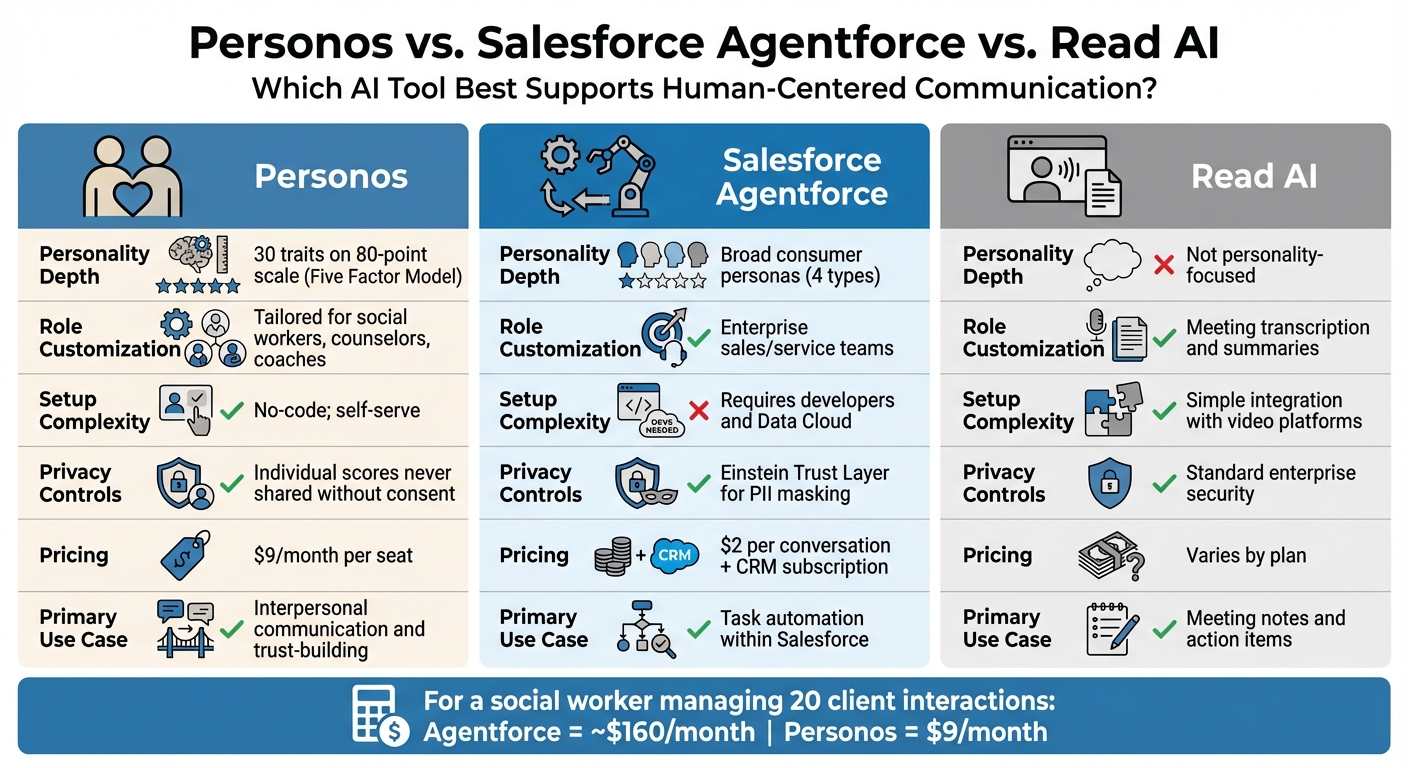
Personos vs Salesforce Agentforce vs Read AI: Feature Comparison for Human-Centered Communication
This section dives into the differences between Personos, Salesforce Agentforce, and Read AI, highlighting which tool is best suited for fostering human-centered workplace communication. When working with vulnerable populations, the choice of AI tools can have a profound impact.
Salesforce Agentforce is built for task automation, excelling at repetitive processes like order tracking or updating CRM records within Salesforce [10]. It’s tailored for large enterprise sales and service teams, not for nuanced interpersonal tasks [9]. Setting up Agentforce can be complex, often requiring developer expertise to configure tools like Data Cloud and Flow Builder [11]. For personality insights, it uses broad consumer categories, such as "The Smarty Pants" or "The Minimalist", to generalize user behavior [8]. While this approach works for brand-focused strategies, it falls short for professionals needing deeper interpersonal understanding.
Personos, on the other hand, shifts the focus entirely. Instead of automating tasks, it empowers users to engage more effectively with others. It achieves this through real-time personality insights, analyzing 30 traits on an 80-point scale. This detailed framework supports tailored communication, whether you're navigating a tense situation or coaching someone through feedback. With a no-code setup, Personos is easy to implement - no developers required [10]. Users simply input context about their clients or team, and the platform adapts instantly to provide actionable guidance.
When it comes to pricing, the contrast is stark. Agentforce charges $2 per conversation, in addition to requiring a Salesforce CRM subscription. For a social worker managing 20 client interactions, this could add up to about $160 per month. In comparison, Personos offers a flat rate of $9 per seat per month, granting unlimited access to personality-driven insights, real-time coaching, and actionable prompts - all without hidden fees or IT configuration [6][12].
Jayesh Govindarajan, Executive Vice President of Salesforce AI, explained:
"The difference is the agent's awareness of the user context, the tailoring of responses and actions based on an employee's role, and the permissions and tasks the agents are given" [9].
Personos delivers this level of awareness but focuses specifically on professionals who rely on understanding emotional and personality dynamics. While Agentforce thrives in automating workflows for sales teams, Personos is designed to deepen human connection, offering a distinct advantage for roles centered on interpersonal relationships.
Feature Comparison Table
| Feature | Personos | Salesforce Agentforce | Read AI |
|---|---|---|---|
| Personality Depth | 30 traits on 80-point scale (Five Factor Model) | Broad consumer personas (4 types) [8] | Not personality-focused |
| Role Customization | Tailored for social workers, counselors, coaches | Enterprise sales/service teams [9] | Meeting transcription and summaries |
| Setup Complexity | No-code; self-serve [10] | Requires developers and Data Cloud [11] | Simple integration with video platforms |
| Privacy Controls | Individual scores never shared without consent [6] | Einstein Trust Layer for PII masking [12] | Standard enterprise security |
| Pricing | $9/month per seat [6] | $2 per conversation + CRM subscription [12] | Varies by plan |
| Primary Use Case | Interpersonal communication and trust-building | Task automation within Salesforce [10] | Meeting notes and action items |
How to Use AI Tools in Your Daily Workflow
Let’s dive into how insights from personality-driven tools like Personos can be seamlessly woven into your daily routines. By clearly understanding its features, strengths, and boundaries, you can maximize its potential. As Natalie Petouhoff puts it:
"Empathy should be prioritized in AI transformation efforts. Understanding employee pain points and investing in upskilling... can facilitate smoother transitions." [13]
Programs like Benchmark Gensuite's "AI Everyday" and Advance HE's "AI Garage" have already shown how hands-on, low-pressure training can build confidence in using AI for high-stakes situations [13]. These initiatives set the stage for leveraging Personos to foster trust and improve teamwork.
Building Trust with Difficult Clients
Handling resistant or sensitive clients can be tricky, but Personos Chat offers tailored, real-time guidance based on both your personality and your client’s traits. For instance, before a session with a client who avoids discussing trauma or becomes defensive during check-ins, you can input the situation into the tool. It uses personality dimensions like openness and neuroticism to suggest strategies that encourage trust.
For a client who is low in openness but high in conscientiousness, structured conversations with clear agendas might work best. The Transparent Reasoning feature explains which personality traits shaped the advice, giving you a deeper understanding of the psychology behind it. Over time, these insights can be turned into actionable steps on the ActionBoard, where you can track progress - like fewer defensive reactions or more client-initiated discussions about significant goals.
Strengthening Team Dynamics
AI tools like Personos can also improve team collaboration, especially in high-pressure environments where personality differences might lead to friction. With Personos Dynamic Reports, you can uncover team strengths, blind spots, and potential areas of conflict. For example, a social work team might discover they excel in empathy but struggle with assertiveness, which could explain challenges like setting boundaries with demanding clients or advocating effectively with external organizations.
To keep these dynamics in focus, Personos Prompts can be set up for weekly check-ins on specific challenges. These prompts might help refine communication strategies for a team member who processes information differently or address how team members respond to tight deadlines. When conflicts arise, relationship-level reports can identify the root causes of friction and offer actionable solutions, such as bridging communication gaps or addressing misunderstandings before they escalate. This ensures smoother interactions and a more cohesive team.
What's Next for AI in Workplace Communication
The next wave of AI in workplace communication is all about connected intelligence. Instead of relying on separate AI tools, the focus is shifting toward seamless collaboration between people, data, and digital workers. Cisco refers to this concept as Connected Intelligence. Aruna Ravichandran, SVP & CMO for AI, Networking, and Collaboration at Cisco, explains:
"By 2026, the workplace won't evolve through more apps or digital assistants, but through Connected Intelligence - where people, data, and digital workers [AI agents] work together side by side." [17]
This shift means AI will move beyond being a tool you use to becoming more like a collaborative partner. It will handle expert recommendations and automate workflows without needing constant human input, fundamentally changing how we work.
Real-Time Emotional Insights
AI is also transforming how organizations understand and respond to employee sentiment. Traditional surveys are being replaced by deep listening tools that analyze chats and meeting transcripts in real time. These tools can detect emotions like tension, fear, or burnout with advanced natural language processing, providing leaders with actionable emotional insights [15]. However, there’s a gap in adoption - only 9% of CIOs report their organizations actively monitor behavioral or mental health effects of AI use [14]. This is concerning, especially as worries about "cognitive atrophy" grow.
Personos: Bridging Insights and Action
Personos is making strides in this space by focusing on how to respond to emotional and psychological cues. Unlike platforms that simply analyze what people say, Personos emphasizes personality psychology and emotional intelligence. Its real-time intervention feature can guide leaders during Zoom or Teams calls, helping them adjust their tone or approach to prevent conflicts before they escalate. The ActionBoard takes these insights further, translating them into specific, trackable steps that leaders can use to improve team dynamics. This blend of personality-driven insights with connected intelligence sets Personos apart, fostering more meaningful human interaction.
That said, there’s a growing risk of "workslop" - AI-generated content that overwhelms employees and erodes trust. As tech expert Alexandra Samuel points out:
"The fact that it could be AI makes us second guess our relationships." [1]
To counter this, Personos emphasizes transparent reasoning. Every recommendation it provides includes an explanation of the personality traits and psychological principles behind it, helping users trust and understand the advice.
Amplifying Human Expertise
HiBob highlights a key point:
"AI has made knowledge easier to access... What sets people apart now is their ability to interpret, question, and apply judgment." [16]
Rather than replacing human expertise, Personos enhances it. By equipping professionals with personality insights, it helps them navigate complex interpersonal situations with empathy and precision. This ensures AI remains a tool for strengthening human connections, not weakening them.
Conclusion
The future of AI lies in enhancing human connection - using technology not just to speed up tasks but to foster deeper understanding. Tools like Personos are shifting the narrative, focusing on personalized insights that ease mental strain and encourage genuine empathy, especially in high-pressure situations.
What makes Personos stand out is its grounding in personality psychology. By employing a detailed personality assessment, it provides tailored coaching for real-world scenarios, helping users navigate feedback and client interactions with precision. As Christian Thomas, CEO and Co-Founder of Personos, explains:
"AI shouldn't just help people be more efficient but help people truly listen and understand each other better to foster connection and create impact" [18].
This approach isn’t just theoretical - it’s already delivering real results. Early adopters are using Personos in transformative ways. For example, Steve Huff, PhD, Founder of THRiVE Coaching, introduced the platform into programs supporting individuals dealing with terminal illness, trauma, and housing instability in early 2026. He describes it as a "teaching partner" that elevates communication in critical situations. Meanwhile, executive leadership coach Mike Walker relies on Personos to help business leaders manage overwhelming information and make decisions aligned with their team’s values.
For professionals burdened by burnout and heavy workloads, tools like these are invaluable. They lighten the cognitive load, allowing space for authentic empathy and meaningful connection. The real advantage isn’t just productivity - it’s becoming smarter about people.
Start small: apply personality-driven insights to a challenging relationship or workflow. Understand the reasoning behind each recommendation, and track progress using tools like the ActionBoard to improve team dynamics and client outcomes. The goal isn’t to let AI take over your thinking - it’s to enhance your ability to listen, communicate, and collaborate in a world that needs those skills more than ever.
FAQs
How does personality-driven AI know my traits?
Personality-driven AI works by analyzing the way you communicate - everything from your word choices to sentence structure and emotional tone. Through natural language processing (NLP) and behavioral data analysis, it matches your language patterns to established models, such as the Big Five personality traits. This allows the AI to generate real-time personality profiles, which can be used to provide insights that enhance communication and teamwork.
How accurate is AI at detecting emotions in messages?
AI has come a long way in understanding human emotions by analyzing factors like voice tone, facial expressions, language, and behavior. It can identify feelings such as frustration or satisfaction, with accuracy for detecting personality traits reaching up to 94.5%. However, this accuracy depends on factors like context, regional communication styles, and the quality of the data being used. While emotion AI offers useful insights, it’s not flawless. It works best as a tool to support human judgment, especially when dealing with challenges like bias, privacy concerns, and cultural differences.
How can I use this without risking privacy?
To ensure the responsible use of human-centered AI, focus on ethical practices. Start by developing clear policies that outline how AI will be used. Be transparent about AI processes and obtain informed consent before working with any personal data. It's also important to routinely assess AI systems to minimize risks and ensure they meet ethical guidelines. Above all, protect individual privacy while using AI to enhance workplace communication, collaboration, and trust.