Human-AI Collaboration: Solving Team Challenges
Treating AI as a teammate fixes communication breakdowns, resolves conflicts, and unlocks measurable productivity gains.
Christian Thomas

Human-AI Collaboration: Solving Team Challenges
Teams face three major challenges: communication breakdowns, unresolved conflicts, and inefficient workflows. These problems waste time, delay decisions, and frustrate employees. For example, switching between apps costs workers an average of 23 minutes of focus per interruption, and 53% of employees don’t know who’s accountable when errors occur in AI-supported workflows.
AI tools are stepping in to help. Instead of replacing humans, AI acts as a teammate - handling repetitive tasks, improving communication, and offering real-time solutions for conflict and collaboration. Companies like Procter & Gamble have seen 3x better idea quality and 60% higher productivity by using AI tools. Platforms like Personos even provide personality-based insights to improve team dynamics, making it easier to communicate and resolve conflicts effectively.
Here’s what makes AI collaboration effective:
- AI reduces task completion time by 40% and boosts quality by 18%.
- Human-AI teams spend 23% more time creating content and 20% less on manual edits.
- Tools like Personos analyze personality traits to provide tailored recommendations for smoother teamwork.
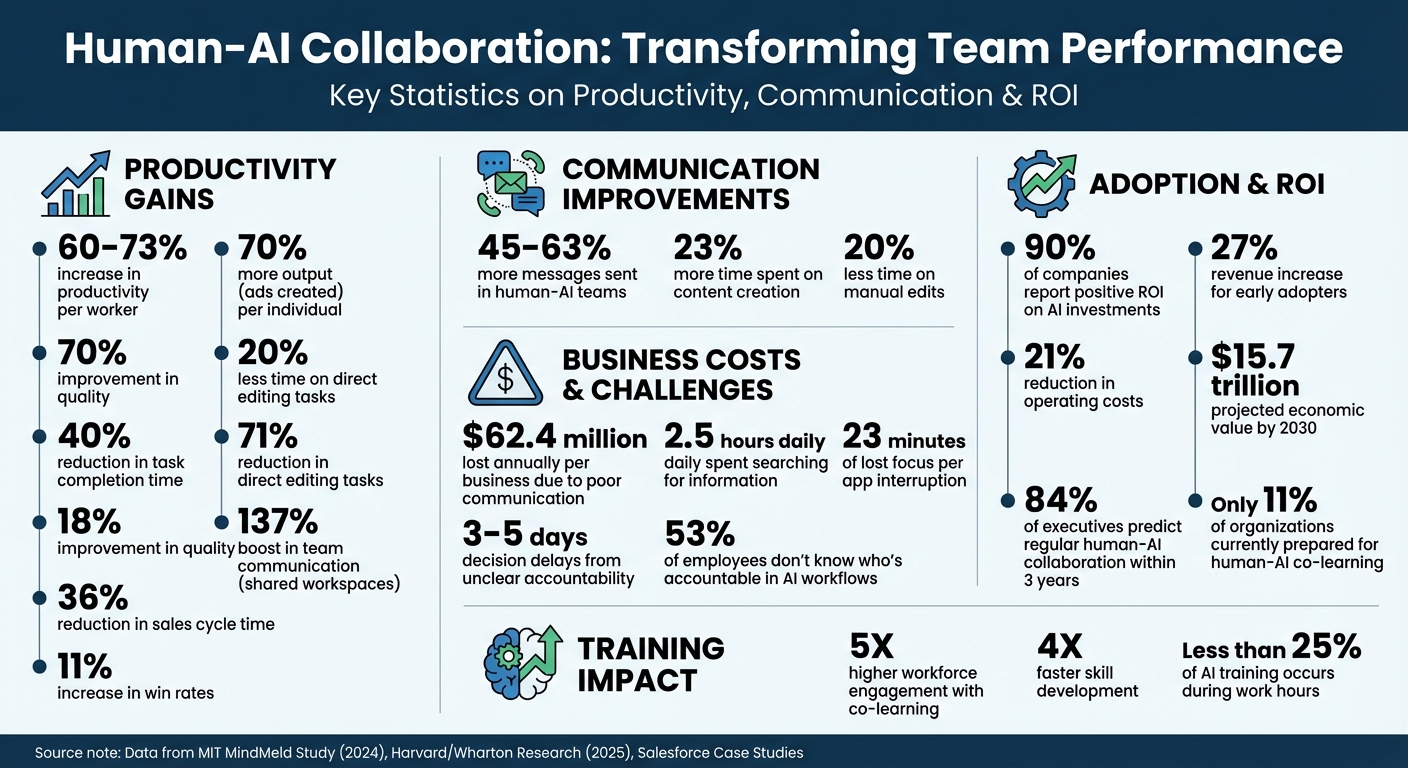
Human-AI Collaboration Impact: Key Statistics on Team Performance and Productivity
Common Team Challenges in the Workplace
Communication Breakdowns
Communication in the workplace often stumbles because of what’s known as the "illusion of communication" - the assumption that a message is clear when, in reality, it’s misunderstood [12]. A Stanford study highlights this issue with a fascinating example: participants tapping out a tune thought listeners would recognize it 50% of the time, but the actual success rate was a shockingly low 2.5% [12]. This disconnect between intent and understanding is a daily reality in many offices.
The cost of poor communication is staggering. Businesses lose around $62.4 million annually due to reduced productivity, and employees spend an average of 2.5 hours each day searching for scattered information across emails, chats, and documents [9][11]. The culprits? Information overload, siloed knowledge, and psychological barriers to open communication [10]. Adding to this, 42% of employees cite differing communication styles as the primary cause of workplace misunderstandings [10].
These communication gaps set the stage for deeper structural issues, like conflict resolution challenges.
Difficulty Resolving Conflicts
When teams rely on disjointed tools and fragmented workflows, duplicated efforts become inevitable [8][15]. This lack of cohesion often leads to unclear accountability, which can delay important decisions by 3 to 5 days [9].
For global teams, cultural differences add another layer of complexity. Direct and indirect communication styles frequently clash, creating additional friction [14]. Even high-performing teams aren’t immune - they face what researchers call "social coordination costs", which include the emotional toll of managing personality differences, building rapport, and navigating group dynamics [2]. Over time, unresolved conflicts can erode trust within teams and push talented employees to leave.
Beyond interpersonal struggles, these issues contribute to siloed workflows that stifle collaboration.
Siloed Workflows and Poor Collaboration
When departments operate in isolation, information gets trapped within specific teams or roles, making collaboration a challenge [5][16]. The MIT MindMeld study sheds light on this issue, revealing that while 49% of AI workflows are designed for individual use, only 6% see meaningful adoption by other team members [1]. This highlights a critical gap: tools that enhance personal productivity often fail to drive broader team success.
Symptoms of siloed workflows include misaligned communication, unclear role responsibilities, and bottlenecks caused by hierarchical structures [5][1][4]. Without well-defined accountability, teams struggle to identify who’s responsible when problems arise, further hindering collaboration and productivity.
AI for team collaboration: drive greater impact on innovation and productivity
How AI-Driven Personality Insights Help Teams
The challenges of communication breakdowns, unresolved conflicts, and siloed workflows often come down to mismatched expectations and misunderstood intentions. Traditional approaches frequently overlook the impact of personality dynamics, even though they play a key role in team performance. AI-powered personality insights step in by analyzing individual traits and offering real-time guidance to close these gaps.
Take this for example: an MIT study from October 2024 involving 2,310 participants found that human-AI teams created 70% more ads and achieved a 60% boost in productivity. Personality pairing - such as matching agreeable humans with neurotic AI - proved to improve teamwork quality significantly [6][2]. As Harang Ju observed:
"AI agents can be tuned to 'fit' the personality of human collaborators to improve productivity and performance" [2].
This research highlights how tailored personality insights can transform team dynamics. The idea isn’t to create uniformity but to harness complementary traits that AI can optimize for smoother collaboration. Tools like Personos utilize these insights to offer practical recommendations for better communication, conflict resolution, and teamwork.
Improving Communication with AI
We often think we’re clear communicators, but in reality, our messages can easily be misinterpreted. AI-powered personality insights help bridge this gap by analyzing communication styles and providing real-time suggestions on how to adapt based on a teammate’s personality. Using Theory of Mind (ToM), AI predicts behaviors, understands intentions, and promotes transparency. For instance, it can recognize when someone with high conscientiousness might misread a casual tone as unprofessional or when an extraverted teammate may need more frequent updates.
Personos takes this to the next level with its conversational AI interface, blending personality psychology with situational awareness. Instead of generic advice, it offers personalized prompts tailored to the specific dynamics between teammates. By picking up on subtle communication cues, it ensures exchanges are both clear and empathetic.
The results speak for themselves. Studies show human-AI teams send 45% more messages while reducing the number of social and emotional messages by 23% - allowing teams to focus more on actual tasks and problem-solving as the AI manages much of the coordination [2].
Resolving Conflicts Before They Escalate
Most workplace conflicts start small - minor misunderstandings that, if left unchecked, can grow into bigger issues. AI personality insights can detect early signs of friction and provide targeted coaching to address them before they escalate.
The MIT study also revealed that the effects of personality pairing can vary depending on the task and context [6]. For example, while pairing neurotic AI with agreeable humans enhanced teamwork in some scenarios, it could hinder collaboration when a highly conscientious team member was involved. This variability underscores why generic conflict resolution approaches often fail and highlights the need for personalized strategies.
Personos tackles this by offering detailed relationship analysis reports that map out interpersonal dynamics. When it detects friction, it uses Adaptive Theory of Mind (AToM) to suggest interventions that help resolve differences quickly [17]. Research shows that AI assistance can cut task completion time by 40% and improve quality by 18% [2], proving its value in managing and resolving conflicts efficiently.
Building Collaboration Through Group Analysis
While understanding individual personalities is crucial, effective teamwork requires insight into group dynamics as well. AI-powered group analysis goes beyond static assessments, providing real-time insights that evolve with team composition and project demands. It uncovers patterns that might be missed when focusing solely on individuals - like a group’s collective push for innovation that lacks follow-through or communication tendencies that unintentionally exclude certain members.
sbb-itb-f8fc6bf
Adding AI Tools to Team Workflows
Bringing AI into everyday team processes can unlock its full potential. The secret lies in enhancing, not replacing existing workflows. AI shines in tackling repetitive, time-consuming tasks, giving teams more freedom to focus on creative and strategic efforts [19][20]. This kind of integration helps streamline planning, task management, and the ability to generate scalable insights.
Take Morningstar, for example. In September 2025, their project management team, led by Senior Project Manager Alina Lamy and CIO Laura Kohl, introduced an Asana AI Teammate to analyze historical data for a complex project. What would typically take a human team one to two weeks to complete, the AI accomplished in just hours, delivering critical insights. As Lamy explained:
"A huge job that would have taken a human a monumental amount of time - about a week or two - the AI Teammate was able to just go through it in hours. Boom." [20]
This integration not only tapped into valuable institutional knowledge but also scaled data-driven insights by incorporating clear checkpoints and ensuring AI actions were transparent [20].
Using AI in Planning and Development
Planning can often hit roadblocks when teams struggle to align individual strengths with project goals. AI tools that factor in personality dynamics can help bridge this gap by aligning team members' unique strengths with project needs. For instance, Personos assists in project planning by analyzing individual traits and offering tailored suggestions for structuring roles and responsibilities. This approach ensures tasks are matched to team members based on their personality profiles.
In October 2024, a study involving 2,310 participants revealed that pairing open-minded humans with conscientious AI improved output quality. On the other hand, neurotic AI enhanced teamwork for agreeable humans but hindered it for highly conscientious individuals [6][2]. This highlights the importance of personality alignment - a nuance that generic AI systems often overlook.
Another critical shift is moving from measuring effort to rewarding outcomes. When AI boosts productivity, teams shouldn't feel burdened with extra work as a result of the time they save [19]. Instead, transparent AI use should be seen as a tool for achieving more meaningful, impactful work.
AI for Task Management and Optimization
AI’s role doesn’t stop at planning - it extends into task execution, improving project delivery. Data shows that teams combining human and AI efforts spend 23% more time on content creation and 20% less on direct editing tasks compared to human-only teams [2]. This efficiency comes from AI handling coordination tasks, like managing communication and building rapport, which often consume time without directly advancing projects.
Personos enhances task management by using personality psychology to provide tailored insights. Instead of generic reminders, it offers communication prompts suited to individual working styles. For example, a highly conscientious team member might value detailed progress updates, while someone with high openness may benefit from understanding how their work fits into the broader picture.
The numbers back this up: AI integration can reduce task completion time by 40% and improve quality by 18% [2]. However, these benefits are only achievable when AI tools are fully embedded in the business context. Tools that leverage organizational data to understand team dynamics perform far better than isolated systems acting as standalone chatbots [20].
Scaling Insights Across Larger Teams
Scaling personality-driven insights across larger teams requires a systematic approach. While small teams can rely on direct observation to manage dynamics, larger organizations need AI tools to maintain consistency across departments and locations. AI-assisted collaboration in shared workspaces can boost team communication by an impressive 137% [2], while scalable insights remain relevant through continuous updates.
Personos addresses this challenge with group analysis reports that evolve alongside team changes and project demands. These reports aren’t static - they adapt as new members join or project requirements shift. This adaptability is vital because autonomous agents often fail at 70% of work-related tasks when they lack team context or human oversight [20].
The rise of "multiplayer AI" - where teams interact with AI agents in shared environments rather than individually - is gaining momentum. This approach fosters higher adoption rates because it integrates AI seamlessly into the team’s workflow, eliminating the need for individuals to learn separate systems [1].
As Tomas Chamorro-Premuzic aptly put it:
"AI may excel at knowledge, but it's human traits like compassion and ingenuity that will set your team apart." [19]
The ultimate goal isn’t for AI to take over everything. Instead, it’s about creating a partnership where AI handles repetitive tasks, allowing humans to focus on their creativity, empathy, and problem-solving skills - the qualities that truly make teams stand out.
Measuring AI's Impact on Team Performance
To understand AI's true value, it's essential to measure its impact on team performance rather than just tracking usage stats. Metrics like login counts or time spent in a tool only tell part of the story. The real focus should be on adoption quality - how AI shifts from a simple task manager to a collaborative partner [25].
Key Metrics for Success
In October 2024, MIT researchers conducted a large-scale experiment involving 2,310 participants using the MindMeld platform. The results were striking: human-AI teams produced 70% more ads per individual, and productivity increased by 60% to 73% per worker. These ads collectively generated 4.9 million impressions on social media [2].
But productivity is just one piece of the puzzle. Communication dynamics also change significantly when AI is introduced. Research shows that human-AI teams send 45% to 63% more messages compared to human-only teams. Interestingly, 23% of these messages focus more on content creation, while 20% less time is spent on direct editing tasks [2][22]. This shift highlights how AI can take over coordination tasks, freeing up team members to focus on strategic, high-level thinking.
In March 2025, Procter & Gamble tested AI's impact with 776 professionals tackling real product innovation challenges. Researchers from Harvard and Wharton found that individuals using AI matched the performance of entire teams working without it. Even more compelling, AI tools helped break down traditional silos - R&D and Commercial teams collaborated on balanced, cross-functional solutions instead of staying confined to their respective areas [23]. Fabrizio Dell'Acqua, one of the researchers, noted:
"AI adoption at scale in knowledge work reshapes not only performance but also how expertise and social connectivity manifest within teams, compelling organizations to rethink the very structure of collaborative work." [23]
Quality is just as important as quantity. Both human evaluators and AI scoring systems can assess outputs for clarity, persuasiveness, and technical accuracy [2]. Field tests have shown that AI-assisted ads achieve higher click-through rates and lower cost-per-click [2].
One challenge to watch for: when workers switch back to solo tasks after using AI, their motivation and engagement can drop [21]. It's crucial to monitor whether team members maintain their sense of control and engagement, as autonomy is essential for sustained success.
| Metric Category | What to Track | Typical Impact |
|---|---|---|
| Productivity | Output per worker, volume of work | 60-73% increase [2][22] |
| Communication | Message volume, content vs. social focus | 45-63% more messages; 23% shift to content [2][22] |
| Efficiency | Time on manual edits, task completion | 71% reduction in direct editing [22] |
| Quality | Real-world performance (CTR, CPC), human ratings | Significant improvement in engagement [2] |
| Collaboration | Cross-functional balance, silo reduction | Better balanced solutions across departments [23] |
These metrics provide a foundation for refining AI integration, which can be further developed through continuous feedback and learning.
Continuous Improvement Through Feedback Loops
Once performance metrics are in place, teams can use them to refine how they collaborate with AI. AI tools work best when they evolve alongside their human counterparts. For example, in 2025, a Salesforce sales team led by Executive VP Kaylin Voss treated their AI systems like new team members, offering daily coaching to improve their effectiveness. The result? A 36% reduction in sales cycle time and an 11% increase in win rates [7]. As CEO Marc Benioff explained:
"The real magic is in the partnership: people and AI working together, achieving more than either could alone." [7]
This approach requires dedicated learning time, but currently, less than 25% of AI training occurs during work hours [25]. Companies that allocate protected time for AI training see significant benefits - 5X higher workforce engagement and 4X faster skill development [3].
Platforms like Personos support this ongoing improvement by adapting based on real-world usage. As teams interact with the platform, it refines its personality insights and communication prompts to align with what works best. This creates a feedback loop where AI continuously learns from team interactions, adjusting its guidance to better meet their needs.
Regular audits are also essential to spot performance gaps and address ethical concerns, ensuring AI remains transparent and accountable [18][13]. A 2025 global study of 1,104 organizations found that 90% of companies reported positive returns on their AI investments, with early adopters achieving a 27% increase in revenue and a 21% reduction in operating costs [24].
The goal isn’t to achieve perfection right away. Instead, it’s about building a system where humans and AI learn from each other over time, refining their collaboration to deliver stronger results. This ongoing process is what transforms challenges into opportunities for growth.
Conclusion
Team challenges like poor communication, unresolved conflicts, and siloed workflows continue to pose hurdles, even as solutions evolve rapidly. AI-powered tools are no longer just productivity boosters - they’re becoming collaborative teammates that help teams work smarter, communicate more effectively, and address issues before they escalate. According to data, organizations that embrace human-AI co-learning see 5x higher workforce engagement and 4x faster skill development. With 84% of executives predicting that regular human-AI collaboration will become the norm within the next three years [26], the urgency to integrate these tools effectively has never been greater. This shift is setting the stage for a new model of teamwork, where AI enhances how teams interact and solve problems.
By treating AI as a partner in continuous improvement, teams can tackle conflicts and strengthen collaboration. Tools like Personos integrate personality insights directly into daily workflows, turning everyday interactions into opportunities for growth and making conflict resolution a smoother process. Companies that commit to this partnership - through training, clear accountability, and embedding AI into natural work routines - are already seeing tangible results, from faster sales cycles to improved output quality. As Marc Benioff, CEO of Salesforce, aptly said:
"The real magic is in the partnership: people and AI working together, achieving more than either could alone" [7].
The benefits for early adopters are clear. Human-AI collaboration is projected to generate up to $15.7 trillion in economic value by 2030 [18]. Despite this enormous potential, only 11% of organizations are currently prepared to support effective human-AI co-learning [26]. Those who act now - integrating personality-driven AI tools and building the capabilities discussed in this article - will not only improve team efficiency but also position themselves as leaders in their industries for years to come.
FAQs
How does AI enhance team communication and help resolve conflicts?
AI is reshaping how teams communicate and handle conflicts by breaking down interactions and offering practical insights. With advanced tools, AI can pick up on changes in tone, spot areas where tensions might arise, and suggest timely actions to keep situations from escalating. It also simplifies communication by condensing lengthy conversations, providing real-time suggestions for phrasing, and promoting clarity and empathy in exchanges.
Platforms like Personos push this even further with personality-based coaching designed to enhance team dynamics. Tools such as detailed personality reports, tailored communication strategies, and conflict resolution cues empower teams to tackle challenges, improve listening skills, and stay aligned with their shared objectives.
How can AI improve task management and team productivity?
AI-powered tools make managing tasks easier by automating repetitive processes, streamlining workflows, and offering real-time insights. These tools enable teams to assign tasks more efficiently, monitor progress, and prioritize critical work by highlighting overdue deadlines and recommending task sequences based on historical data.
By cutting down on the time spent on manual planning and administrative duties, AI frees up teams to focus on creative and strategic projects. It also improves teamwork by providing predictive alerts and actionable insights, allowing teams to spot and address bottlenecks before they become major issues. In short, AI helps boost productivity, simplifies communication, and ensures teams consistently deliver top-notch results.
How does AI improve team collaboration and productivity?
AI-powered tools are reshaping how teams work together by taking over repetitive tasks and amplifying what humans can achieve. Studies reveal that teams leveraging AI can generate more content, communicate better, and hit higher productivity levels. A striking example? AI integration has resulted in a 60% increase in individual productivity, while also raising the bar for creative outputs like ad copy.
But it's not all smooth sailing - issues like coordination and team dynamics still pose challenges. To tackle these, platforms such as Personos offer AI-driven, personality-based coaching. These tools focus on improving communication, resolving conflicts, and aligning team dynamics by delivering tailored insights for individuals and groups. This approach allows teams to tap into AI's advantages while creating a more harmonious and effective collaborative environment.