How Power Dynamics Shape Conflict in Nonprofit Teams
Steps to map power, protect dissent, and resolve disputes over authority, funding, and caseloads.
Christian Thomas

How Power Dynamics Shape Conflict in Nonprofit Teams
I don’t treat silence as agreement when someone’s job, funding, or workload is at stake. I start by checking who controls the decision, who faces the risks, and whether staff can question it without losing hours or facing worse assignments.
My approach comes down to four steps:
- Map the power: Look beyond titles to donor ties, access to leaders, and control over caseloads.
- Make dissent safer: Ask for concerns before stating a preference, offer private channels, and explain confidentiality limits.
- Resolve the dispute: Review facts, client needs, and funding limits. Use neutral help when needed, and formal reporting routes for harassment, discrimination, or retaliation.
- Check what happens next: Document decisions, review workload and treatment, and share next steps within 30 days.
The test I use is simple: <u>Can staff disagree without paying a price?</u> Reflection tools can help people prepare, but leaders remain responsible for safe reporting, sound decisions, and protection from retaliation.
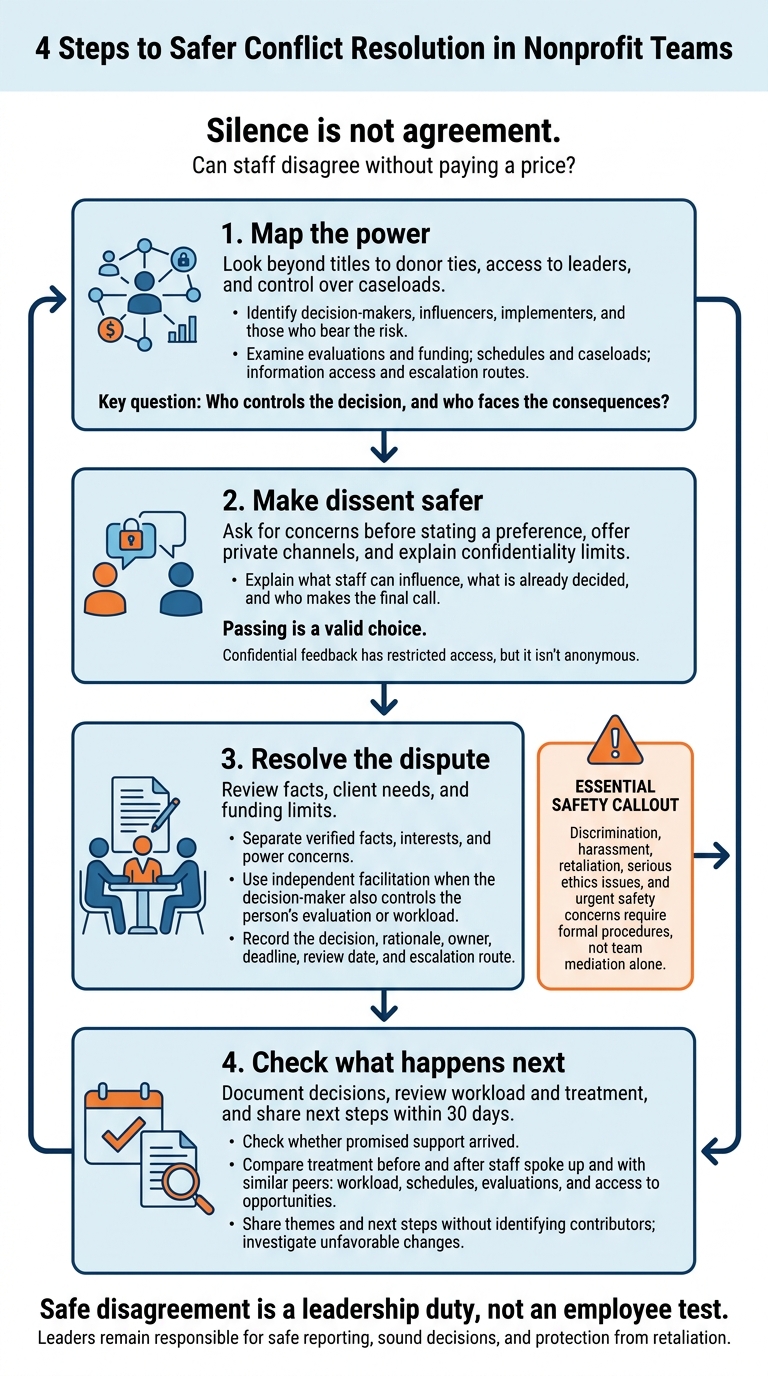
4 Steps to Safer Conflict Resolution in Nonprofit Teams
Power Conscious Conflict Engagement: Leading with Integrity and Courage
Identify Silence and Map Power Gaps
Once you can see patterns of silence, map where power makes speaking up costly.
Why Staff Withhold Concerns
Titles, funding, and control over caseloads can make disagreement cost staff hours, assignments, advancement, or relationships. Repeated dismissal, dependence on funding, and marginalized identity can add to that risk. Assess what each person could lose, not how confident they seem.
Use a three-to-six-month review checklist to track participation, interruptions, concerns shared only in private, clusters of departures or sick days, complaints about uneven caseloads, and decisions made without frontline input. Notice whether staff speak more freely when a manager leaves the room. These patterns call for review, not assumptions about motives, often requiring personality insights to resolve team conflicts effectively.
Patterns of silence point to power gaps. Next, identify who controls the decisions behind them.
Map Who Decides and Who Bears the Risk
Map decision-makers, influencers, implementers, and those who bear the risk across evaluations and funding, schedules and caseloads, and information access and escalation routes.
For each area, identify the formal approver, the people who influence decisions in practice, those who carry them out, and those who face the consequences. Check this map against job descriptions, approval policies, grant terms, and board charters.
Then watch who sets agendas, speaks first, gets interrupted, receives credit, and shapes the final decision. If the person requesting feedback also controls hours, evaluations, or assignments, record that power gap. Politeness doesn't remove it.
Gather Feedback Without Exposing Staff
Use pulse surveys, one-on-ones, meeting observations, and workload or turnover data. Ask whether staff could question assignments in the past 90 days without negative consequences. Keep participation and written comments optional. During one-on-ones, ask permission before taking notes and use consistent questions. Look for agreement across sources rather than treating one comment, or one absence, as proof.
Confidential feedback has restricted access, but it isn't anonymous. In small teams, a person's role, tenure, or an identifying incident can reveal who contributed. Don't promise anonymity without safeguards. Explain who can see responses, how long records are kept, and any safety or legal exceptions.[1][2][3]
Limit access to raw feedback, remove identifying details, and report themes instead of verbatim comments. Withhold subgroup results below a preset threshold, such as five responses. That threshold alone doesn't guarantee protection.[4][5] Direct concerns about harassment, discrimination, safety, and retaliation through designated reporting channels, not survey summaries.
Invite Dissent Without Public Pressure
Once staff can share concerns privately, make it safe to disagree in public, too. Titles, funding, and control over caseloads can make speaking up feel risky.
Ask for Concerns Before Giving Your View
Explain what staff can influence, what’s already decided, and who makes the final call. Set a deadline. Gather written concerns before sharing your position. Then invite discussion and summarize competing views before giving your assessment.
Ask:
“What risk are we missing?”
“What would make this decision unsafe or unworkable?”
Offer private and written ways to respond without requiring public disclosure. Staff shouldn’t have to share personal experiences, challenge a supervisor publicly, or use every channel. Passing is a valid choice.
Replace Pressured Requests With Safer Options
Structure meetings to reduce pressure tied to rank.
Ineffective invitation Why it increases pressure Safer practice “Speak up if you disagree with me.” Turns disagreement into a personal challenge. Ask for risks and alternatives before stating your view. “Everyone needs to weigh in.” Forces participation or disclosure. Let people pass or contribute privately. “The supervisor will handle concerns.” A supervisor-controlled channel can discourage dissent. Offer independent facilitation or another reporting route. “We need feedback, but the decision is final.” Asks for effort without giving people influence. Explain what can still change and document follow-up.
Rotate facilitation in routine meetings only when facilitators are trained and the role carries little risk. Use an independent facilitator for complaints or whenever a senior colleague could pressure a junior facilitator. Give frontline staff protected work time to contribute. Feedback shouldn’t become an after-hours task.
Explain Decisions and Watch for Retaliation
After the discussion, follow up in writing so silence isn’t mistaken for consent. Share a brief record of the concerns, decision, reasons, changes made, decision-maker, follow-up owner, and review date. If nothing changed, explain why without dismissing the concern. Set a deadline for corrections and offer optional private follow-up.
Power shows up in who gets heard next. Check whether staff who voiced concerns later face exclusion from meetings, unfavorable schedules, heavier caseloads, lost development opportunities, or changed evaluations. Compare their treatment before and after they spoke up, and with that of similar peers. Investigate any differences.
Provide a separate route for concerns after the decision. The EEOC recommends an alternative reporting route when the designated contact is the alleged harasser or closely connected to that person.[6] If the dispute remains about authority, funding, or caseloads, move it into a separate conflict process using emotional intelligence.
Resolve Conflicts Over Authority, Funding, and Caseloads
If feedback and follow-up haven’t resolved concerns, move the disputed decision into a structured review.
Separate Facts, Interests, and Power Concerns
Review both the decision and whether people can safely challenge it. Separate facts you can verify from assumptions about motives. Identify interests such as client safety, continuity of care, and grant compliance. Look beyond case counts to staffing, budgets, funding restrictions, case complexity, and supervision. Equal speaking time doesn’t mean equal risk, so offer private ways to share input alongside group discussion.
Document the disputed assignment, decision criteria, power gap, and support options considered. Keeping these points separate helps focus the discussion on the decision, rather than turning it into a test of loyalty.
Use Neutral Facilitation and Record Next Steps
Use an independent facilitator when the decision-maker also controls the person’s evaluation or workload. Make clear who retains decision-making authority, and explain confidentiality limits before the meeting begins. Discrimination, harassment, retaliation, serious ethics issues, and urgent safety concerns require formal procedures, not team mediation alone. EEOC guidance also calls for explaining anti-retaliation protections and reporting methods during EEO responses.[7]
Record the evidence, options considered, decision, rationale, owner, deadline, review date, and escalation route. If funding blocks reassignment, document the specific restriction and alternative safeguards. Don’t simply cite budget pressure.
At follow-up, check whether the promised support arrived. Compare post-dispute workload, scheduling, evaluation language, overtime, leave approvals, training access, and discipline with the pre-dispute period and with similar peers.
Keep the conflict record separate from performance management so it cannot be repurposed as discipline.
Use Personos for Reflection, Not Personnel Decisions
Use Personos only as a voluntary reflection tool to privately rehearse requests and communication. It’s for preparation, never for assignments, evaluations, promotions, or other personnel decisions.
Conclusion: Make Safe Disagreement a Leadership Standard
Titles, funding authority, and caseload control shape the risks staff take when they speak up. Silence is not agreement.
Put the power map and feedback safeguards described above to work on one real decision now. Map who controls titles, hiring, funding, performance reviews, caseloads, scheduling, information, and escalation. Identify who faces the consequences without equal authority. Choose one protected feedback channel and explain how submissions will be handled.
For example, use an anonymous form reviewed by a neutral person.
Within 30 days, share themes, decisions, and next steps without identifying contributors.
Make this checklist your operating standard:
- Invite without pressure: Ask for concerns before sharing your preference.
- Protect dissent: State that retaliation will not be tolerated and name an independent contact.
- Explain decisions: Share what changed, what did not, and when the decision will be reviewed.
- Monitor consequences: Track follow-up and watch for unfavorable changes after someone voices dissent.
- Correct harm: Protect affected staff, order an impartial review, and reverse harmful decisions.
Safe disagreement is a leadership duty, not an employee test. Leaders are responsible for making it safe and using their power responsibly.
FAQs
How can we rebuild trust after staff have faced retaliation?
Rebuilding trust after retaliation takes clear, open communication and a commitment to psychological safety. Leaders need to show they listen to staff and respect their input, without pushing anyone to agree.
Personos can help leaders prepare for sensitive conversations by tailoring personality-based language to each staff member’s motivators and communication style. That guidance can help leaders communicate more clearly and reduce friction as they work to rebuild trust.
Who can handle complaints when our nonprofit has no HR team?
Without a dedicated HR team, nonprofit leaders often handle complaints and internal conflicts themselves.
Personos, an AI-powered personality psychology platform, offers guidance tailored to performance conversations and conflict resolution. It considers how people process information and make decisions to help leaders deliver feedback, help staff feel heard, ease tension, and identify productive next steps.
How can we challenge donor influence without risking funding?
Move the conversation from personal disagreements to evidence-based results. Personos can help staff build stakeholder trust by shaping messages around board members’ and executives’ motivations and communication styles.
Its ActionBoard can track milestones transparently, making it easier to show funders measurable program impact. This approach can strengthen your position and ease the pressure to make compromises that put your mission at risk.