How Personality Traits Shape Conflict Resolution Strategies
Personality traits influence conflict styles; emotional intelligence and cognitive flexibility help professionals turn disagreements into constructive outcomes.
Rachel Johnson

How Personality Traits Shape Conflict Resolution Strategies
When people face conflicts, personality traits play a big role in shaping how they respond. The Five-Factor Model (Openness, Conscientiousness, Extraversion, Agreeableness, Neuroticism) helps explain these tendencies:
- Agreeableness: Encourages collaboration and compromise.
- Extraversion: Leads to assertiveness and open communication.
- Openness: Promotes creative solutions and flexibility.
- Conscientiousness: Focuses on goal-oriented, responsible strategies.
- Neuroticism: Often results in avoidance or emotional reactions.
Emotional intelligence (EI) and conflict solutions bridge the gap between personality-driven tendencies and effective conflict resolution. It equips individuals with tools like self-awareness, emotional regulation, and empathy to manage responses and improve outcomes. For professionals like social workers and counselors, understanding these traits and leveraging EI can lead to more effective and tailored strategies.
Tools like Personos combine personality insights with real-time guidance, offering actionable advice for handling conflicts based on individual traits. This approach helps professionals navigate challenging situations with better precision and results.
How to Deal With High Conflict People | Bill Eddy
The Five-Factor Model and Conflict Resolution Styles
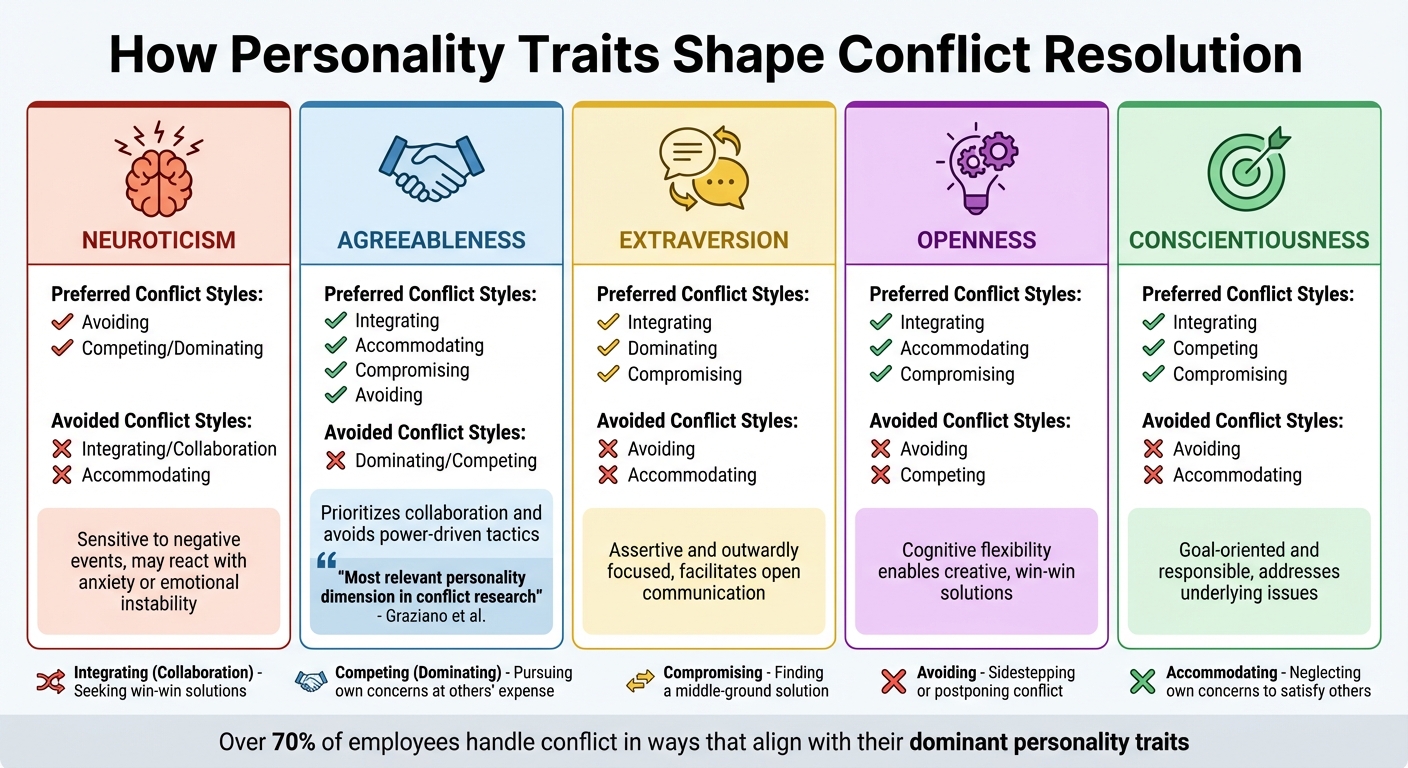
Five-Factor Model Personality Traits and Conflict Resolution Styles
What Is the Five-Factor Model?
The Five-Factor Model examines five key personality traits - Openness, Conscientiousness, Extraversion, Agreeableness, and Neuroticism - to help predict how individuals behave in various situations. These traits influence whether someone might collaborate during a disagreement, step back from the situation, or push aggressively for their own goals. For social workers and counselors managing tense client interactions, understanding these traits can provide valuable insights into anticipating reactions and tailoring intervention strategies.
How Each Personality Trait Affects Conflict Behavior
Agreeableness is a strong indicator of cooperative behavior during conflicts[5]. People with high scores in this trait tend to prioritize collaboration and avoid power-driven tactics. Research highlights its significance:
"Agreeableness is the most relevant personality dimension in conflict research" - Graziano et al.[5]
Extraversion often leads individuals to be assertive and outwardly focused, seeking influence and rewards[3][5]. Extraverts typically lean toward integrating and compromising strategies, though their assertiveness can also push them toward dominating approaches. Their sociable nature often facilitates open communication, making it easier to find mutually agreeable solutions.
Openness to Experience is tied to cognitive flexibility, which enables individuals to identify creative, win–win solutions that others might miss[5]. Those high in openness are usually receptive to diverse perspectives and favor collaboration or accommodation over competitive behavior.
Conscientiousness supports a collaborative mindset, as it aligns with achieving goals while maintaining a sense of responsibility[5]. Conscientious individuals tend to avoid passive strategies like avoidance or accommodation, as these approaches often fail to address underlying issues effectively[7][5].
Neuroticism, unlike the other traits, is negatively associated with integrating (win–win) styles[6]. People with high neuroticism are more sensitive to negative events and may react with anxiety or emotional instability[5]. This can lead to either avoiding conflict to reduce stress or engaging in aggressive competition when emotions take over[5][6].
| Personality Trait | Preferred Conflict Styles | Avoided Conflict Styles |
|---|---|---|
| Neuroticism | Avoiding, Competing/Dominating[5][6] | Integrating/Collaboration, Accommodating[5][6] |
| Agreeableness | Integrating, Accommodating, Compromising, Avoiding[5][6] | Dominating/Competing[3][5][6] |
| Extraversion | Integrating, Dominating, Compromising[5][6] | Avoiding, Accommodating[5] |
| Openness | Integrating, Accommodating, Compromising[5][6] | Avoiding, Competing[5] |
| Conscientiousness | Integrating, Competing, Compromising[5][6] | Avoiding, Accommodating[5] |
These patterns offer a useful framework for professionals to develop personalized strategies.
What This Means for Social Workers and Counselors
By understanding how these traits influence conflict behavior, professionals can better anticipate client responses. For instance, a client high in agreeableness might naturally lean toward accommodating or compromising but may need guidance to advocate for their own needs. On the other hand, a highly extraverted client might dominate discussions, requiring careful effort to ensure all perspectives are considered. For those in leadership roles, personality-driven guidance for executive coaching can help manage these dynamics in high-stakes environments.
"Understanding one's personality traits and their likelihood to address conflict in a certain way can be very beneficial in resolving conflict, especially if this is taken into account for all parties involved in the conflict." - GSC Admin, Pollack Peacebuilding[6]
Personality traits often play a bigger role in unstructured or ambiguous situations ("weak" situations)[5]. Counselors can either introduce more structure to help manage negative impulses or allow for personality-driven solutions in less rigid environments. For example, a client with high neuroticism might benefit from emotional support and stabilization before engaging in mediation.
Studies show that over 70% of employees handle conflict in ways that align with their dominant personality traits[7]. This highlights the potential value of personality-driven conflict resolution strategies. Instead of applying a uniform approach, professionals can work with individuals' natural tendencies to guide them toward more effective outcomes. While personality shapes responses, emotional intelligence and situational awareness can help mitigate unproductive tendencies, creating space for more constructive conflict resolution practices.
The HEXACO Model: An Alternative Approach
HEXACO Traits and How They Shape Conflict Responses
The HEXACO model builds on the Five-Factor Model by introducing a sixth personality dimension: Honesty-Humility (H). This trait measures sincerity, fairness, greed avoidance, and modesty. Unlike the traditional model, HEXACO replaces Neuroticism with Emotionality and redefines Agreeableness to focus on patience and forgiveness. This adjustment makes it easier to determine if someone avoids conflict due to anxiety or genuine forgiveness [8].
Honesty-Humility is particularly useful when working with individuals who might use manipulative or exploitative strategies. For example, a study involving nearly 90,000 participants from around the world confirmed the reliability of HEXACO’s personality dimensions. In workplace settings, Honesty-Humility stands out as a strong predictor of ethical behavior and performance ratings [8].
HEXACO vs. Big Five: Which Model Works Better?
While the Big Five model is widely accepted, HEXACO provides additional insights that the Big Five might overlook, particularly around exploitative tendencies and the subtleties of cooperation [8].
HEXACO shines in situations where fairness and integrity are crucial. Professionals like social workers, counselors, and case managers - especially those dealing with cases involving manipulation, ethical dilemmas, or disputes over resources - may find the distinction between Honesty-Humility and Agreeableness highly valuable. Additionally, HEXACO is more effective at identifying traits linked to the Dark Triad (narcissism, Machiavellianism, psychopathy) and socio-political attitudes. In high-stakes environments where it’s critical to distinguish between a relaxed attitude and genuine fairness, HEXACO offers clearer and more actionable insights [8].
How Emotional Intelligence Changes Conflict Outcomes
Our personality shapes how we instinctively handle conflict, but emotional intelligence (EI) gives us the tools to adjust those reactions. Research suggests that EI helps individuals work around personality-driven tendencies. For instance, someone prone to high levels of neuroticism might lean toward avoidance or aggression during conflict. However, with strong emotional regulation, they can stay composed and think more clearly instead [1][2]. As conflict researcher Laura Noelle Henderson puts it:
To be in conflict is to be emotionally activated. Human conflict does not occur in the absence of emotions or behavioral responses to emotions [12].
This becomes especially evident in high-pressure situations. A global study involving 1,527 participants from 10 different regions found that EI influences how cultural values shape preferences for various conflict styles, such as compromising, obliging, or integrating [5]. In the workplace, where managers reportedly spend about 42% of their time resolving conflicts, unresolved disagreements account for approximately 65% of performance issues [15]. Companies that invest in EI training have seen workplace conflicts drop by as much as 60% [9]. This ability to adapt is critical, particularly when tensions rise, laying the groundwork for strategies that leverage emotional intelligence effectively.
Using Emotional Intelligence to Overcome Personality Limitations
While personality often dictates our initial conflict responses, EI tools help refine these reactions in the moment. Two critical components, self-awareness and self-regulation, play a significant role in breaking free from automatic, personality-driven behaviors. Self-awareness means recognizing emotional triggers before they spiral, while self-regulation helps manage the body’s fight-or-flight response, which often leads to impulsive reactions [9][11]. For example:
"Slight-sensitive" negotiators - those who are easily offended - were twice as likely to declare an impasse in simulations when they felt their social image was threatened, showing a lack of emotional self-regulation [4].
Empathy and perspective-taking are equally important, as they shift the focus from self-centered strategies to more collaborative ones. High EI enables "perspective-taking", which promotes constructive approaches like collaboration, even for individuals with personality traits that lean toward self-interest [2]. In a study involving 975 university students, those classified as "dual-concern" types - marked by traits like extraversion, agreeableness, and conscientiousness - were far more likely to use adaptive conflict strategies compared to "control" types, who scored higher in neuroticism [2].
Practical tools can make these concepts actionable:
- "Heat mapping": Identify emotional triggers before engaging in difficult conversations [9].
- Timeouts: Step away when emotions run high to regain composure and return with a clearer mindset [9].
- Cyclic sighing: Use this breathing technique (a deep inhale, a quick second inhale, and a slow exhale) to activate the parasympathetic nervous system and reduce stress during conflict [10].
Cognitive Flexibility: Switching Strategies When Needed
Cognitive flexibility allows individuals to adapt their conflict strategy to the situation instead of defaulting to their personality-driven tendencies [1]. This involves weighing the importance of the relationship against the goal at hand - for instance, choosing to accommodate for harmony in a relationship versus competing when the stakes are high [1].
In structured environments, EI helps individuals follow what sociologist Alvin Gouldner coined as the "norm of reciprocity" - the idea that:
if one party receives something from the other party, that party returns something equivalent [5].
By initiating collaboration, you can often inspire reciprocal cooperation, regardless of personality traits [5]. Studies show that the "integrating" conflict style has the strongest positive relationship with EI, with 24% of EI variance explained by factors like integrating strategies, age, and education [12].
Another helpful approach is cognitive reappraisal, which involves reframing conflict as an opportunity rather than a threat. This technique helps rewire the brain’s natural stress response in high-stakes situations [10]. As Joel Salinas, M.D., Professor at NYU Langone, explains:
Emotional intelligence helps you understand emotions - conflict resilience helps you use them wisely [10].
Conflict resilience, or the ability to stay engaged during tense conversations, is crucial for navigating challenges effectively [10].
For professionals such as social workers and counselors, flexibility is essential. Training programs that combine conflict resolution with communication skills help bridge gaps between different personality types and generational perspectives [14]. To maintain cognitive flexibility under pressure, focus on "self-emotional appraisal" and "regulation of emotion" [13]. A simple yet effective strategy is the "Fact-Question-Listen" rule: state facts, ask clarifying questions (e.g., who, what, where, when, how), and listen without interrupting to ensure mutual understanding [11]. These EI-based methods naturally lead to practical tools for using personality insights to resolve conflicts.
Tools for Applying Personality Insights to Conflict Resolution
Understanding personality theory is one thing, but using it effectively in real-world situations is a whole different challenge. As mentioned earlier, combining personality theory with emotional intelligence can significantly improve conflict outcomes. For professionals navigating complex interpersonal dynamics, having tools that turn personality data into actionable insights is essential. While traditional assessments like the Thomas-Kilmann Mode Instrument (TKI) or the Rahim Organizational Conflict Inventory-II (ROCI-II) offer valuable baseline data, modern platforms now provide real-time, practical guidance.
How Personos Delivers Real-Time Conflict Guidance
Personality traits play a big role in conflict resolution, and tools like Personos take these insights to the next level. Using the Five-Factor Model, Personos measures 30 traits on an 80-point scale, covering dimensions like Extraversion, Neuroticism, Conscientiousness, Agreeableness, and Openness. This data is then used to categorize individuals into profiles such as "Dual-concern" (high concern for both self and others), "Stable", or "Control." These profiles help predict whether someone is more likely to collaborate or take a dominant approach in conflicts. Research indicates that 29% of people fall into the "dual-concern" category, 67% into "stable", and only 4% into "control" profiles [2].
The platform’s conversational AI chat feature offers immediate, tailored conflict resolution advice. For instance, a social worker managing a resistant client can input the situation and receive guidance that aligns with both their own and the client’s personality profiles, while also factoring in the broader context. Personos also provides Dynamic Reports that adapt to the evolving nature of conflicts, offering insights for individuals, relationships, or groups. These reports go beyond static assessments, delivering flexible recommendations that adjust as situations change. Additionally, the ActionBoard turns these insights into actionable, trackable tasks, helping users implement strategies and measure their effectiveness over time.
Personos Compared to Other Personality Tools
What sets Personos apart is its focus on real-time, situational guidance. Unlike tools like 16Personalities or Crystal, which offer static personality insights, Personos provides dynamic, role-specific advice. For example, a social worker would receive guidance tailored to their field, while an executive coach or teacher would get recommendations suited to their unique challenges.
Another standout feature is its commitment to privacy. Personality scores remain private unless users choose to share them, addressing concerns about labeling and misuse that often arise with other personality tools. At $9 per seat per month for the Pro version, Personos offers an affordable option for professionals managing heavy workloads. This makes it particularly valuable in high-pressure scenarios where quick, personalized guidance can make all the difference in resolving conflicts effectively. By providing adaptive, context-aware solutions, Personos helps bridge the gap between personality theory and practical conflict management.
Conclusion
High levels of Agreeableness and Extraversion often encourage cooperation, while individuals with high Neuroticism are more likely to lean toward avoidance or competitive behaviors [2][5]. A meta-analysis of 5,337 participants supports this, showing that personality traits play a significant role in predicting conflict resolution styles [3]. By understanding these patterns, professionals can anticipate how clients, colleagues, or team members may react in tense situations. These traits provide a foundation for how emotional intelligence (EI) can influence and modify natural responses.
However, personality traits alone don’t dictate outcomes. Emotional intelligence allows individuals to go beyond their innate tendencies. As M. Afzalur Rahim observed:
Whether conflicts yield negative or positive consequences depends how conflicts are resolved [5].
EI enables skills like perspective-taking and cognitive flexibility, helping people identify solutions that benefit everyone instead of falling into win-lose scenarios. This is especially critical when working with individuals who are highly sensitive to perceived social threats, as they are twice as likely to reach an impasse during conflicts [4].
For professionals like social workers, counselors, and coaches, the challenge lies in applying these insights in real time. While traditional tools provide useful baseline data, they often fall short in offering immediate, situation-specific guidance. Platforms like Personos bridge this gap by combining the Five-Factor Model with conversational AI to deliver actionable advice tailored to specific situations.
At just $9 per seat per month, Personos offers personalized guidance while maintaining a privacy-first design - ensuring personality scores stay confidential unless users choose to share them. This addresses concerns about labeling and builds trust. For professionals managing heavy caseloads and emotionally intense work, having real-time tools that consider both their own and their clients’ personality dynamics can make a meaningful difference in managing crises and improving outcomes.
Ultimately, personality traits set the stage, emotional intelligence refines the approach, and tools like Personos turn theory into practice. Whether it’s resolving a workplace conflict or navigating a crisis, combining personality insights with emotional regulation leads to better results and lasting positive change.
FAQs
Can I change my conflict style if it’s tied to my personality?
Yes, you can adjust your conflict resolution style. While your personality traits, like agreeableness or conscientiousness, may influence how you handle disagreements, they aren't set in stone. With practice and effort, these tendencies can evolve. Developing emotional intelligence and using resources like personality-based tools can make a big difference. For instance, platforms like Personos provide tailored advice to help refine your approach, enabling smoother and more effective interactions, no matter your natural inclinations.
When should I use the HEXACO model instead of the Big Five?
The HEXACO model is particularly useful when traits such as honesty, humility, and social responsibility are at the core of your focus. This model introduces a sixth dimension - Honesty-Humility - which provides a more nuanced understanding of sincerity and fairness. Studies suggest that HEXACO is more effective at predicting behaviors linked to ethics and interpersonal relationships, making it a strong choice in situations where trust or accountability plays a key role.
How do I handle conflict with someone whose traits clash with mine?
To navigate conflict with someone whose personality traits differ from yours, it’s essential to focus on understanding those differences and tailoring your approach. Tools like Personos can be useful in identifying personality traits and offering guidance on effective communication strategies.
What you can do: Start by recognizing that people handle conflict in different ways. Adjust your responses accordingly - stay composed when dealing with someone who tends to dominate, or create a safe space for open dialogue with someone who avoids confrontation. The goal is to work toward shared objectives, which can encourage teamwork and resolution.