How Personality Guides De-Escalation Choices
Use Big Five cues to match calming moves—structure, choice, reassurance or limits—for faster, safer de-escalation in tense moments.
Nick Blasi

How Personality Guides De-Escalation Choices
The same calming script does not work for every person. In tense moments, I get better results when I match my response to the person’s likely trait pattern, especially around emotional reactivity, need for structure, pushback, and trust.
Here’s the short version:
- High Neuroticism often calls for lower stimulation, fewer demands, and short choices first
- High Conscientiousness often responds best to clear steps, order, and timelines
- High Openness often needs plain reasons and room to ask why
- Low Agreeableness often tests whether I’m clear, calm, and direct
- Extraversion often changes how emotion shows up, from loud pushback to quiet withdrawal
A key data point stands out: a meta-analysis of 99 studies found that Neuroticism was tied to worse treatment outcomes, while Agreeableness, Conscientiousness, Extraversion, and Openness were tied to better outcomes. That matters because the traits I notice in the first minute can shape what I say next.
What I take from this article is simple:
- I should read the first 60 seconds
- I should pick an opening move based on likely trait cues
- I should use structure, choice, reassurance, or limits based on that read
- I should adjust fast if the person gets louder, shuts down, or keeps pushing back
- I can use AI tools built on the Five Factor Model to support these calls during high-pressure work , which is a common way to reduce burnout among social workers
There is also a tool angle here. The article says Personos uses the Five Factor Model with 30 traits on an 80-point scale, which gives more detail than broad type systems. The point is not to label people. The point is to help me make calmer, safer choices under pressure.
If I had to sum it up in one line, it would be this: de-escalation works better when I match the move to the person, not just the moment.
Conflict De-escalation Tactics
How Five Factor Traits Predict Conflict and Calm-Down Patterns
The Five Factor Model, or Big Five, describes personality through five traits: Openness, Conscientiousness, Extraversion, Agreeableness, and Neuroticism. A simple way to think about it: each trait is a dial, and stress can turn that dial up.
The Big Five Traits Most Relevant to De-Escalation
Each trait affects how someone reads threat and how they react when tension builds.
Agreeableness matters most in conflict work. People high in agreeableness tend to move toward cooperation. People low in agreeableness are more likely to push back and resist directions they see as unfair.
Conscientiousness is tied to order and predictability. These clients usually want a clear plan and a sense that things are being handled properly.
Openness is tied to curiosity. High-openness clients often ask why and may need an explanation before they can settle down.
Extraversion affects how emotion shows on the outside. High-extraversion clients may speak fast, loudly, and with force. Low-extraversion clients may do the opposite and go quiet.
Neuroticism is the trait most closely tied to emotional reactivity. It has strong links to anger, hostility, and sensitivity to threat. It also remained a predictor of aggression even after controlling for gender.
That gives you a practical starting point. You can use these patterns to decide whether the person in front of you needs more structure, more reassurance, more choice, or firmer limits. In live conflict, that often shapes the first move worth testing.
How Conflict Styles Show Up Under Stress
Under stress, trait patterns often line up with four conflict styles: integrating, dominating, avoiding, and accommodating. Neuroticism is most strongly linked to avoidance. Agreeableness, conscientiousness, extraversion, and openness are more often linked to integrating or compromising.
The broad trait label helps, but the smaller facets often tell you more. Two clients can score about the same on neuroticism and still look very different in the room. One may be driven by anger reactivity. Another may be driven by anxiety.
The same idea shows up with assertiveness. A client with high assertiveness will often push back in the open. A client with low assertiveness may hold frustration inside, then disengage without much warning.
Impulse control, which sits under conscientiousness, also matters. It affects how fast thoughts become actions. In a crisis, that gap can be the whole ballgame.
What to Watch for in the First 60 Seconds
Use the first minute to figure out which trait pattern may be driving the interaction. Think of these as working guesses, not fixed labels. Watch the response, then adjust.
| Observable Cue | Possible Trait Signal | What It Suggests |
|---|---|---|
| Interrupting, loud or rapid speech | High extraversion, high assertiveness | Dominating style; needs structured turn-taking |
| Fixating on rules, timelines, or procedures | High conscientiousness | Escalating over perceived procedural errors |
| Asking many "why" questions | High openness | Needs explanation before calming |
| Soft speech, minimal eye contact, quick agreement | High agreeableness + low extraversion | May be accommodating while internally distressed |
| Rapid breathing, tears, or pacing | High neuroticism | Needs emotional containment before problem-solving |
| Immediate reaction to disrespect or unfairness | Low agreeableness or high anger-proneness | Sensitive to fairness; avoid power struggles |
Start with the cue, treat it as your first hypothesis, and then choose your next move: structure, choice, reassurance, or limits.
How Personality Shapes Trust, Resistance, and Emotional Intensity
Once you’ve read the room, the next move is figuring out what drives trust, resistance, and emotional intensity. Those patterns help you decide where to start: with warmth, structure, choice, or firm limits.
Trust Signals Differ by Personality Pattern
People high in agreeableness usually respond to warmth first. People high in conscientiousness tend to trust structure, like clear steps, follow-through, and written agreements.
People low in agreeableness often test your credibility before they cooperate. That can sound like direct challenges, skeptical questions, or pushback on your authority. It’s not always defiance. More often, it’s a test: Can I trust what you’re saying? The best move is to stay calm, explain your reasoning plainly, and avoid promises you can’t keep. With this group, one broken commitment can damage trust fast.
That early trust cue shows whether you should lead with warmth, structure, or straight transparency.
Resistance Is Not Always Defiance
Resistance can show up in a lot of ways, and if you read it wrong, you’ll pick the wrong response.
Autonomy-based resistance, often seen in higher-openness, lower-agreeableness clients, sounds like: “You can’t make me do this.” These clients react against control, not always against you. Giving real choices and building the plan with them can lower that pushback.
Rule-based hesitation, which shows up more often in low-openness or high-conscientiousness clients, looks different. You may hear repeated questions about procedure, notice reluctance to try anything new, or see a strong need to know exactly what happens next before they agree.
Fear-based resistance often sounds like repeated questions about reporting, consequences, or control. Shame- and overload-based resistance can look like anger, minimization, missed appointments, or total shutdown.
Same label, different engine. And that means the response has to change too.
Who Is More Likely to Escalate, Argue, or Shut Down
These patterns matter because the same trait can lead to open conflict in one person and quiet withdrawal in another.
High neuroticism increases emotional reactivity. Anger/hostility facets tend to push outward, like raising their voice, arguing about rules, or threatening to leave a program. Anxiety/vulnerability facets tend to turn inward, with the person going silent or pulling away with no explanation.
Research links escalation and aggression most strongly with low agreeableness and high neuroticism [1][2]. Meanwhile, high agreeableness paired with low extraversion can show up as quiet shutdown. That’s the client who looks calm on the surface but feels flooded inside. Both patterns need attention. The quiet one just doesn’t announce itself.
The goal isn’t to label the person. It’s to choose the right calming move faster. Use these patterns to guide that first move: structure, choice, reassurance, or limits.
Now those cues need to become a live decision: what you say, how firm you are, and how much control you offer.
Matching De-Escalation Choices to Personality Patterns
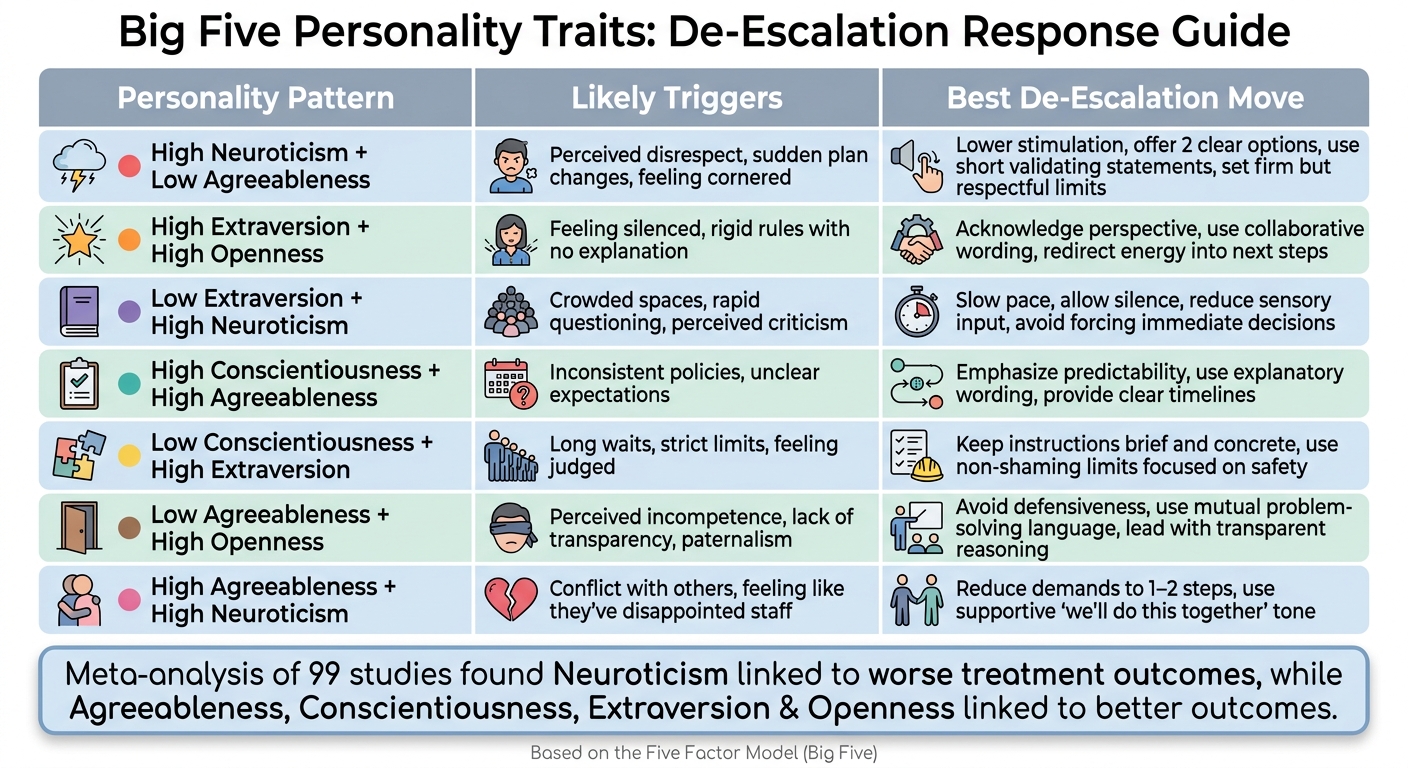
Big Five Personality Traits: De-Escalation Response Guide
Once you’ve spotted likely trust and resistance patterns, the next step is simple in theory and hard in the moment: turn that read into action. That means deciding what to say, how to say it, how close to stand, and how much control to offer.
Use these patterns as a response map for the Five Factor Model, not a label.
Best-Fit Calming Approaches by Trait Pattern
The table below connects common trait patterns to the fastest de-escalation move.
| Personality Pattern | Likely Triggers | Recommended De-Escalation Move |
|---|---|---|
| Start with low stimulation and firm limits (high neuroticism / low agreeableness) | Perceived disrespect, sudden plan changes, feeling cornered | Lower stimulation, offer two clear options, use short validating statements, set firm but respectful limits |
| Invite problem-solving immediately (high extraversion / high openness) | Feeling silenced, rigid rules with no explanation | Acknowledge perspective, use collaborative wording, redirect energy into next steps |
| Slow everything down (low extraversion / high neuroticism) | Crowded spaces, rapid questioning, perceived criticism | Slow pace, allow silence, reduce sensory input, avoid forcing immediate decisions |
| Provide structure and clear timelines (high conscientiousness / high agreeableness) | Inconsistent policies, unclear expectations | Emphasize predictability, use explanatory wording |
| Keep it brief and offer one immediate choice (low conscientiousness / high extraversion) | Long waits, strict limits, feeling judged | Keep instructions brief and concrete, use non-shaming limits focused on safety |
| Lead with transparent reasoning (low agreeableness / high openness) | Perceived incompetence, lack of transparency, paternalism | Avoid defensiveness, use mutual problem-solving language |
| Reduce demands and normalize the emotion (high agreeableness / high neuroticism) | Conflict with others, feeling like they've disappointed staff | Reduce demands to one or two steps, use supportive "we'll do this together" tone |
How to Adjust Language, Limits, and Nonverbal Behavior
For overwhelmed or high-Neuroticism clients, concise, concrete wording usually works best. Instead of "We're going to explore some options to see what aligns with your long-term goals," try: "Right now, you have two choices: we can start with housing paperwork, or we can just talk for a few minutes and slow things down." That kind of wording gives the person something solid to hold onto.
For high-Conscientiousness clients, explanation often lowers anxiety. You’re showing them there’s a process and a reason for it: "I'm going to ask you several questions. It might feel detailed, but it's how we make sure your application is correct and you get the right services."
With limits and choices, less often works better for anxious or agreeable clients. Too many options can pile on stress. Offer one or two realistic choices, and make the path clear. For clients who need control, frame boundaries as a shared agreement: "We do not yell here because other clients need to feel safe. You can either take a short walk and come back, or we can move to a quieter room." For impulsive personalities, keep rules short and connect them to what happens right now, not to a long explanation.
Nonverbal behavior often does more than the words themselves. Keep about 3 feet of space when safety allows, stand at a slight angle instead of square-on, and keep your hands visible. [6][7][9] For high-Neuroticism clients, a relaxed posture and soft facial expression can lower the sense that they’re being watched or judged. For low-Extraversion clients, steady eye contact may feel invasive. During a home visit, sitting a bit to the side and glancing at your notes now and then can show that you’re present without staring. If a person steps toward you, taking a small step back instead of planting yourself can drain some of the heat from the moment before it builds. [10]
When emotions spike, lower your own voice instead of matching theirs. Slower speech and shorter sentences signal calm without giving up authority. [3][5]
Silence matters too. It’s a tool, not empty space. Several de-escalation guidance sources directly recommend pausing and letting silence do some of the work before you repeat yourself. [4][7][8] For anxious or withdrawn clients, that quiet beat can help more than one more question.
A Step-by-Step Decision Process for Live Situations
Move from read to response in this order:
- Assess safety first. Scan right away for threats, self-harm risk, and hazards in the space. If there’s imminent danger, follow your agency’s crisis protocol before anything else.
- Read the pattern in the first 60 seconds. Notice emotional intensity, verbal style, and signs of cooperation. Are they argumentative or withdrawn? Do they respond to basic respect, or do they brace against it? That early read helps you spot whether the pattern is volatile, anxious, critical, or rule-focused.
- Choose your opening move. Match your first response to what you’re seeing: structure for the rule-focused, two clear options for the control-seeking, gentle reassurance for the anxious, collaborative language for the independent thinker. Don’t open with your default script just because it’s familiar.
- Watch the response and adjust quickly. If intensity rises, lower your voice and slow the pace. If they go quiet, leave room before prompting again. If they reject your framing, shift. Don’t keep using the same approach louder or faster.
- Document and debrief. Note the pattern you saw, the approach you used, and how the person responded. Flag anything outside your scope of practice for supervision.
The goal is a faster first move, followed by a quick adjustment.
Match the move, watch the response, then adjust.
Using Personality Tools and AI Support in De-Escalation Practice
Once you can spot the pattern, tools make it easier to use that insight the same way every time. After you identify what's driving the interaction, the right tool can cut down on guesswork and help you choose the next step with more care when the stakes are high.
Where Personos Fits In for Frontline Teams
Personos is built for helping professionals such as social workers, case managers, counselors, and nonprofit staff. It runs on the Five Factor Model and measures 30 personality traits on an 80-point scale. That level of detail matters in tense situations. It can tell apart traits like hostility, compliance, stress tolerance, and need for control, and those differences can shape how you respond in the moment.
In practice, a worker can enter a live scenario and get trait-specific guidance. They can then use Dynamic Reports, Prompts, and ActionBoard to carry that guidance into follow-up work and team practice. Personos also explains why a suggestion fits a given trait pattern, which helps practitioners build stronger judgment over time.
How Personos Compares with General AI Communication Tools
The gap isn't only about speed. It's about whether the guidance fits the person and the situation. General AI tools often give role-play scenarios or generic de-escalation scripts. Those can help with routine communication practice, but crisis-sensitive work asks for more. Sometimes one phrase that fits a person's traits can make the difference between a client shutting down and staying engaged.
| Dimension | Personos | General AI Communication Tools |
|---|---|---|
| Psychological model | Five Factor Model (scientifically validated) | Often generic, proprietary, or MBTI-based |
| Personality depth | 30 traits on an 80-point scale | Broad types, colors, or letter categories |
| Conflict-specific guidance | Real-time, trait-informed, situation-specific | Generic scripts or role-play scenarios |
| Support for helping professions | Built for social workers, case managers, counselors | Designed for general business or personal coaching |
| Crisis fit | High; designed with privacy safeguards and data masking | Low; typically lacks privacy protections for sensitive client work |
Conclusion: Use Personality to Make Calmer, Safer Choices
A meta-analysis across 99 studies found that Neuroticism had negative associations with nearly all treatment outcomes, while Agreeableness, Conscientiousness, Extraversion, and Openness showed consistently positive associations [11]. That matters in real time. The traits you notice in a tense moment are often the same ones that shape how someone responds to your next move.
Tools like Personos help teams use that insight in a steady way across day-to-day work. Instead of relying on instinct alone, staff can turn personality knowledge into real-time guidance that lowers cognitive load, supports faster decisions, and makes personality-informed de-escalation easier to use across a full caseload.
FAQs
How can I spot trait cues quickly?
Watch how a person communicates. Word choice, tone, and sentence structure can tell you a lot.
For example, words like always, must, or should can point to high conscientiousness. On the other hand, upbeat, social language often lines up with extraversion.
It also helps to pay attention to nonverbal cues, like body language and eye contact. Personos can analyze these signals in real time and flag personality patterns or possible triggers before they turn into bigger issues.
What if I misread someone’s personality?
Treat it as a working hypothesis, then adjust it to fit the situation. Personos uses the Five Factor Model, with 30 traits scored on an 80-point scale, plus situation and relationship details, to tailor guidance around how someone may be processing the moment.
If the approach feels off, update the context and run the situation again. That can give you de-escalation language that better matches their communication style and emotional intensity.
Can personality-based de-escalation work without formal assessments?
Yes. Personality-based de-escalation can work without formal assessments.
In practice, you can read the room in real time. Pay attention to how someone communicates and behaves, then adjust your approach. That might mean noticing they want direct answers, more structure, or cues that show trust and rapport. From there, you can shift your tone, pacing, and phrasing to fit the moment.
If you use tools, including AI-based personality assessments, treat them as hypothesis generators. They can give you a starting point, but they shouldn't be the whole story. Observation and human judgment still matter, and formal assessments are not a required starting point.