How Personality Data Improves Team Performance
Combine personality insights with skills metrics to improve collaboration, reduce hiring risk, and boost team performance.
Nick Blasi

How Personality Data Improves Team Performance
Personality data can transform how teams work together. Instead of focusing solely on skills and rigid processes, understanding individual traits - like communication styles and decision-making preferences - can help teams collaborate more effectively. Research from Google shows that emotional intelligence and communication matter more than technical expertise for team success. Tools like the Big Five or platforms such as Personos provide insights into how people work best, enabling leaders to build balanced teams and reduce conflict.
Key Takeaways:
- Traditional methods focus on tasks, hours, and annual reviews but often miss interpersonal dynamics.
- Personality-based approaches consider traits like emotional stability and curiosity, offering continuous insights for better collaboration.
- Combining both methods helps align technical skills with team synergy.
Quick Comparison:
| Feature | Traditional Methods | Personality-Based Approaches (e.g., Personos) |
|---|---|---|
| Focus | Skills, tasks, and outputs | Traits, behaviors, and team interactions |
| Feedback | Annual reviews | Continuous, real-time insights |
| Collaboration | Can lead to silos | Builds balanced, complementary teams |
| Cost | Lower upfront | Higher, but reduces hiring risks |
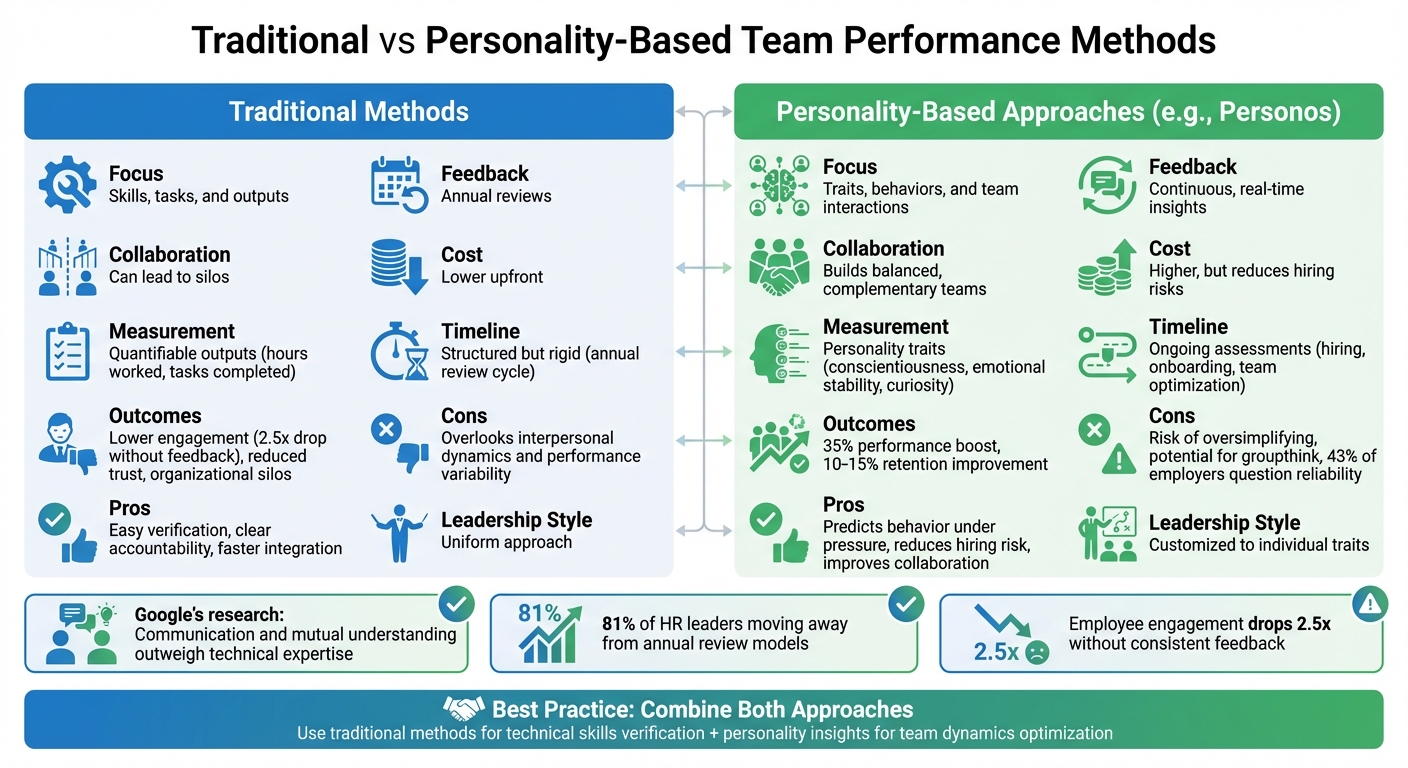
Traditional vs Personality-Based Team Performance Methods Comparison
1. Traditional Team Performance Methods
Measurement Focus
Traditional team performance methods focus heavily on quantifiable outputs, such as hours worked, tasks completed, or goods produced. These metrics provide a snapshot of past performance but fail to capture the human dynamics and team communication that fuel future success [1]. This approach often reduces team members to their individual skill sets, overlooking the importance of personality-driven workplace dynamics and collaboration [1].
However, research suggests this method misses the mark on key factors like emotional intelligence and communication. For instance, studies reveal that a team's average emotional intelligence and how frequently they communicate are better predictors of success than technical skills alone [2]. Google’s analysis of over 100 teams found that communication and mutual understanding outweighed technical expertise as indicators of high performance [2]. This reliance on retrospective data highlights a significant gap in traditional measurement strategies.
Implementation Timeline
Traditional performance methods follow a structured but rigid process. Typically, organizations select an assessment tool, hold team discussions, align roles based on strengths, and conduct periodic reviews [1]. Unfortunately, these reviews often occur just once a year, framed as formal appraisals that feel more like bureaucratic checkboxes than genuine opportunities for growth [3].
This infrequent feedback cycle can lead to unresolved interpersonal issues festering until annual reviews bring them to light [3]. Companies like Adobe discovered that their annual review processes consumed excessive time and energy, ultimately leaving employees feeling demotivated [3]. Even identifying what truly drives team success can be a lengthy endeavor - Google’s quest to uncover the traits of the "perfect team" involved years of interviews and data analysis across more than 100 teams [2].
Team Collaboration Outcomes
The traditional approach often leads to lower engagement, reduced trust, and the formation of organizational silos, where teams become overly focused on their own functions [3]. Without regular feedback, concerns are left unspoken until yearly reviews, fueling stress and dissatisfaction. In fact, employee engagement drops by 2.5 times in the absence of consistent feedback, which is why 81% of HR leaders are moving away from these outdated models [3].
An excessive meeting culture further complicates collaboration. Many teams mistakenly equate frequent meetings with effective teamwork, creating unnecessary noise without improving decision-making or execution. As Cat Symonds, Founder of The Content CAT, puts it:
"Traditional performance management typically involved self-evaluation, manager evaluation, scoring and annual appraisals. But appraisals were still very much tied in with bonuses and promotions... rather than individual performance and the impact it had on a company's goals" [3].
This rigid, output-focused approach often prioritizes process over people, undermining the very elements that could drive long-term team success.
2. Personality-Based Approaches (e.g., Personos)
Measurement Focus
Personality-driven platforms focus on more than just tracking accomplishments - they aim to understand how individuals might perform in changing circumstances. Instead of simply counting hours or completed tasks, these tools evaluate personality traits like conscientiousness, emotional stability, and curiosity. These traits are strong indicators of workplace performance, especially in roles requiring reliability and precision [4]. Duncan Stimpson from Thomas.co sums it up well:
"Skills and experience explain where someone has been, while personality explains how they'll operate when the conditions change" [4].
This approach gives organizations a clearer picture of how employees might handle new challenges or increased stress - insights that traditional resumes and interviews often miss [4]. It’s a proactive way to integrate personality data into team development strategies.
Implementation Timeline
Unlike the static nature of annual reviews, personality-based platforms offer ongoing assessments that span hiring, onboarding, and team optimization [4]. Companies are beginning to embed these insights into various workflows, such as hiring, promotions, and employee development, rather than treating them as a one-off activity. Platforms like Personos provide AI-powered, real-time personality insights, making it easier for teams to adapt and collaborate effectively. This continuous flow of data ensures teams stay aligned and productive.
Team Collaboration Outcomes
Using personality data, leaders can build more balanced teams by pairing individuals with complementary strengths - for instance, matching big-picture thinkers with detail-oriented planners. This approach also helps maintain team alignment by evaluating new hires for compatibility before potential conflicts emerge [1][4]. Additionally, personality insights can identify "hidden leaders" - individuals with leadership potential who might be overlooked by traditional performance metrics. These platforms create a more objective framework for hiring and promotions, reducing bias in decision-making. As Stimpson points out:
"Personality data now plays a decisive role in identifying leadership potential, preventing derailment, designing balanced teams, and reducing hiring risk" [4].
By relying on data-driven decisions, organizations can minimize the costly risks of mismatched hires.
Cost and ROI
Investing in personality data tools can lead to measurable financial benefits by reducing talent-related risks. For example, assessing whether a candidate's behavioral profile aligns with a role’s demands before hiring or promoting them can prevent expensive mistakes - especially in regulated industries like banking and insurance [4]. While traditional tools may come with a lower price tag, they often lack the predictive power of platforms like Personos. For $9 per seat monthly, Personos delivers dynamic reports, actionable recommendations, and real-time guidance. The platform also ensures privacy by keeping individual scores confidential unless explicitly shared, while offering clear explanations for its recommendations. This transparency and precision make it a valuable tool for organizations looking to make smarter, data-backed decisions.
Good Morning, HR #243 The Right Way to Use Personality Profiles
Advantages and Disadvantages
Let’s dig into the trade-offs between traditional and personality-based methods, highlighting what each brings to the table.
Traditional methods focus on technical expertise and structured clarity. They prioritize individual accountability without relying on personality labels. This makes them reliable for verifying skills and defining roles. However, these methods often miss the mark when it comes to understanding the interpersonal dynamics that fuel strong team performance.
On the other hand, personality-based platforms like Personos approach things differently. They aim to predict behavior, uncover "hidden leaders", and build teams with complementary strengths. Studies even suggest that such teams can boost performance by up to 35%, while aligning hiring with personality insights can improve retention rates by 10–15% [5]. But there’s a catch - 43% of employers question the reliability of personality tests, and only 30% believe these assessments offer strong predictive accuracy. Another concern is the risk of oversimplification, where personality insights are treated as rigid labels rather than conversation starters [1].
A key challenge with personality-driven tools lies in managing team dynamics. Management professor Jeff LePine highlights the dangers of excessive cohesion, which can lead to groupthink. For instance, a team full of extroverts might face dominance struggles, while overly agreeable members could have trouble making decisions. As LePine explains:
"Cohesion is good, but too much of it can be bad. Managing teams is all about managing dilemmas" [6].
Here’s a quick comparison of the two approaches:
| Feature | Traditional Methods | Personality-Based Approaches (e.g., Personos) |
|---|---|---|
| Focus | Technical skills, cultural fit, and clear role definition | Behavioral traits, communication styles, and team synergy |
| Pros | Easy verification, clear accountability, and faster integration | Predicts behavior under pressure, reduces hiring risk, and improves collaboration |
| Cons | Overlooks interpersonal dynamics and performance variability | Risk of oversimplifying, potential for groupthink, and some skepticism about test reliability |
| Leadership Style | Uniform approach | Customized to individual traits |
The smartest organizations combine both methods. They rely on traditional frameworks to ensure technical skills and role clarity, while using AI-driven personality insights to fine-tune team dynamics, reduce friction, and improve collaboration. Personality assessments, when used thoughtfully, can spark deeper conversations that lead to stronger teams [1].
This balanced approach opens the door to a more nuanced way of integrating personality insights with traditional performance metrics.
Conclusion
Traditional methods and personality-based platforms work best when used together. While traditional approaches are great for verifying technical skills and defining clear roles, they often overlook the interpersonal dynamics that can elevate a team from good to exceptional. Platforms like Personos bridge this gap by highlighting how individuals communicate, solve problems, and collaborate - turning potential friction into opportunities for effective teamwork.
Start with traditional methods to ensure your team has the right skills and clear responsibilities. Then, add personality insights to refine interactions, minimize misunderstandings, and harness each person’s strengths. This process is increasingly streamlined by using AI to analyze personality for better outcomes. As one contributor to Entrepreneur explains:
"When leaders take the time to know their people deeper, they build trust, reduce friction and unlock a synergy that transforms good teams into great ones" [1].
These insights can also guide decision-making. Whether you’re looking to improve communication or boost motivation, pairing complementary personalities can make a difference. For instance, understanding whether someone thrives on public recognition or prefers quiet acknowledgment can help tailor your approach. But remember, these insights are tools for starting conversations, not rigid rules:
"Personality assessments are starting points, not rigid definitions. They're not about shutting people into boxes but about opening doors" [1].
FAQs
How can we use personality data without labeling people?
Personality data can improve teamwork and productivity by emphasizing traits in a flexible way rather than attaching rigid labels. For instance, AI tools can align specific traits with the demands of a situation, steering clear of stereotypes or bias. Platforms such as Personos offer real-time, context-aware insights drawn from personality profiles. This approach supports respectful and adaptable communication, helping to build trust and enhance collaboration without resorting to fixed categorizations.
What’s the best way to combine personality insights with skills metrics?
Integrating personality data into team strategies can align individual traits with specific skills, leading to better collaboration and overall performance. For instance, combining complementary traits - like pairing someone with high conscientiousness with someone who scores high in openness - can create a more balanced and effective team dynamic. Tools such as Personos leverage scientifically backed personality profiles to provide real-time insights. These insights can be combined with skills assessments to offer personalized coaching, minimize burnout, and enhance team development outcomes.
How do you measure ROI from personality-based team tools?
ROI from personality-based team tools can be gauged by examining their effects on team performance, productivity, and collaboration. Metrics like smoother team dynamics, quicker project turnarounds, and improved output quality play a big role here. Tools such as Personos highlight ROI by offering features like real-time guidance and tracking measurable outcomes - things like lower burnout rates, better client results, and increased efficiency. These tools connect personality insights directly to tangible progress toward organizational objectives.