How Introverts and Extroverts Shape Team Trust
Explains how introvert and extrovert styles affect team trust and why norms, agreeableness, and clear processes matter.
Christian Thomas

How Introverts and Extroverts Shape Team Trust
The loudest person on a team is not the most trusted by default. If I strip this topic down to the part that matters most, it is this: team trust depends more on how people read behavior than on whether someone is introverted or extroverted.
Here’s the short version:
- Extraversion is not a strong sign of trust on its own
- Agreeableness matters more, especially empathy, cooperation, and care
- Trust usually comes down to three things: ability, care, and honesty
- Introverts often build trust through calm pacing, listening, and follow-through
- Extroverts often build trust through warmth, visibility, and live participation
- The main problem is not style itself
- The main problem is misreading style as intent
A few points stand out fast:
- A pause from an introvert may mean they are thinking
- Fast talk from an extrovert may mean they are thinking out loud
- In trust-game studies, people were 4x more likely to trust agreeable partners than disagreeable ones
- Team silence that looks like checking out was linked to an 18% drop in the chance of mutual trust
If I were putting this into one plain takeaway, it would be this: clear team norms matter more than personality labels. Agendas sent 24+ hours before meetings, written follow-ups, round-robin turns, and short processing pauses can stop small style gaps from turning into trust problems.
EP382 - How introverts and extroverts can work better together - PodPlus Thursdays
Quick Comparison
| Style | How trust is often built | Common misread | What helps |
|---|---|---|---|
| Introverts | Steady follow-through, careful speech, close listening | Silence gets read as disengagement | Agendas in advance, written input, named processing time |
| Extroverts | Warmth, visibility, open discussion, live momentum | Energy gets read as pressure or dominance | Turn-taking rules, clear decision notes, room for written feedback |
So if you want more trust on a mixed-style team, I would not start by asking who is quiet or who talks most. I would start by asking: Do we have clear rules for pace, participation, and follow-up to solve team conflicts with personality insights?
1. Introverts
Communication Pace
Introverts often think first and speak second. So when they pause, that usually means they’re processing, not wavering.
That pause can signal careful judgment, which supports competence and integrity. It also shapes how they sound: brief, careful, and direct.
Follow-Through and Reliability
For many introverts, especially conscientious ones, trust comes from steady follow-through and strong integrity. Organizations can analyze personality for team success to better understand these internal drivers. [3] A teammate who does what they said they’d do is building trust, even if they aren’t the most vocal person in the room.
The catch is simple: these quieter trust signals are easy to miss in live meetings.
Tone and Emotional Signal
Introverts often build trust through directness and candor. They’re also more likely to admit uncertainty and point out complexity instead of pretending everything is simple.
Still, a measured tone can come across as cold, even when it reflects careful, trustworthy judgment.
Meeting Presence and Visibility
Silence from an introvert can mean reflection. But on fast-moving teams, people often read that silence as withdrawal.
As Ryan C. Warner, Ph.D., Founder and CEO of RC Warner Consulting, puts it:
"For introverts, silence serves as a strategic pause for composing thoughtful responses rather than a gap in participation." [4]
That distinction matters. Checked-out silence correlates with an 18% decrease in the probability of mutual trust within a team. [5] The problem is that teammates often can’t tell which kind of silence they’re seeing.
When introverts do speak, their comments are often more focused because they’ve already worked through the issue in their heads.
Where introverts signal trust through restraint, extroverts often signal it through visible energy and reach.
2. Extroverts
Where introverts build trust through restraint, extroverts build it through visible participation.
Communication Pace
Extroverts often think out loud. That can move teamwork along, but it can also blur the line between brainstorming and making a call. That kind of visible energy may signal confidence and skill, but it only works when action follows.
If a half-formed idea sounds like a final decision, more reflective teammates may read it as impulsive. And that can chip away at trust before anyone even sees the problem.
Tone and Emotional Signal
Extroverts often show engagement through warmth, openness, and visible enthusiasm. Warmth can signal care and openness, which makes it easier for other people to speak up.
But there’s a catch. If the energy feels nonstop, skeptical teammates may start to wonder whether the enthusiasm is genuine.
Follow-Through and Reliability
The main trust risk is consistency: attention is easy to win; trust is not. The answer isn’t less energy. It’s pairing that energy with execution, and being clear about when you’re brainstorming versus when you’re committing to a deliverable.
Doing what you said you would do, when you said you would do it, closes the gap between presence and trust. That keeps integrity, one of the three pillars of trust, intact.
Meeting Presence and Visibility
Extroverts are often comfortable asking questions and getting feedback in the moment. That presence can help set a collaborative tone. But it can also leave less room for quieter voices if no one is paying attention to the room.
"Extraverts can unintentionally dominate space, which discourages input from quieter team members." - Bethany Peters, Leadership Coach who uses personality-driven guidance to help leaders manage these dynamics [2]
In mixed-style teams, that means turn-taking and follow-up rules matter just as much as energy. That’s why mixed-style teams need clear norms before misunderstanding hardens into distrust.
A Leader's Guide to Mixed-Style Teams
Once style differences are out in the open, leaders need clear ground rules. If they don't, small habits can start to look like trust issues.
Set Communication Norms Before Trust Breaks Down
Send agendas at least 24 hours before meetings. After each meeting, write down decisions and deadlines. For nonurgent messages, set a response-time norm.
That kind of clarity matters more than it may seem. Without it, silence can look like avoidance, speed can look like pressure, and a missed follow-up can look personal when it isn't.
Balance Live Discussion With Written Input
Use live meetings for in-the-moment problem-solving. Use written channels when people need time to think and respond.
When leaders do this on purpose, they don't have to choose between speed and careful thinking. They get both. The same idea should shape meeting format too, not just where messages happen.
Use Meeting Formats That Give Everyone a Voice
Round-robin check-ins give each person a set turn to speak. That simple format helps keep louder voices from taking over the room.
It also helps to build in a short pause, about 60 seconds, before opening the floor for responses. [2][6] Say what that pause is for. Call it processing time so silence reads as thinking, not pulling away.
Catch and Correct Common Trust Misreads Early
The table below shows common trust misreads, what may be driving them, and what a leader can do next.
| Common Trust Breakdown | Likely Cause | Leader Intervention |
|---|---|---|
| Introvert read as withdrawn or disengaged | Need for internal reflection before speaking | Send agendas 24h+ in advance; name silence as "processing time" |
| Extrovert read as overpowering or impatient | Thinking out loud and processing ideas in real-time | Use round-robin formats; balance live talk with written shared docs |
| Missed deadlines or unclear ownership | Vague expectations or fear of appearing incompetent | Document all deadlines in MM/DD/YYYY format; clarify response norms |
| Conflict-aversion leading to "yes" overload | High-Agreeableness types prioritizing harmony over capacity | Normalize saying "I do not have capacity"; check in privately on workloads |
Use Personality Data to Guide Behavior, Not Identity
Personality tools help most when they open up a conversation instead of boxing someone in. A framework like the Five Factor Model can help leaders make sense of why one teammate needs more lead time, while another talks through feedback in the moment. It measures traits such as Conscientiousness, Agreeableness, and Extraversion. The point is to use that information as a guide, not a stamp on someone's identity.
Used well, these tools turn traits into day-to-day guidance. Personos uses Five Factor Model insights to generate relationship-specific guidance for trust-sensitive conversations.
Pros and Cons
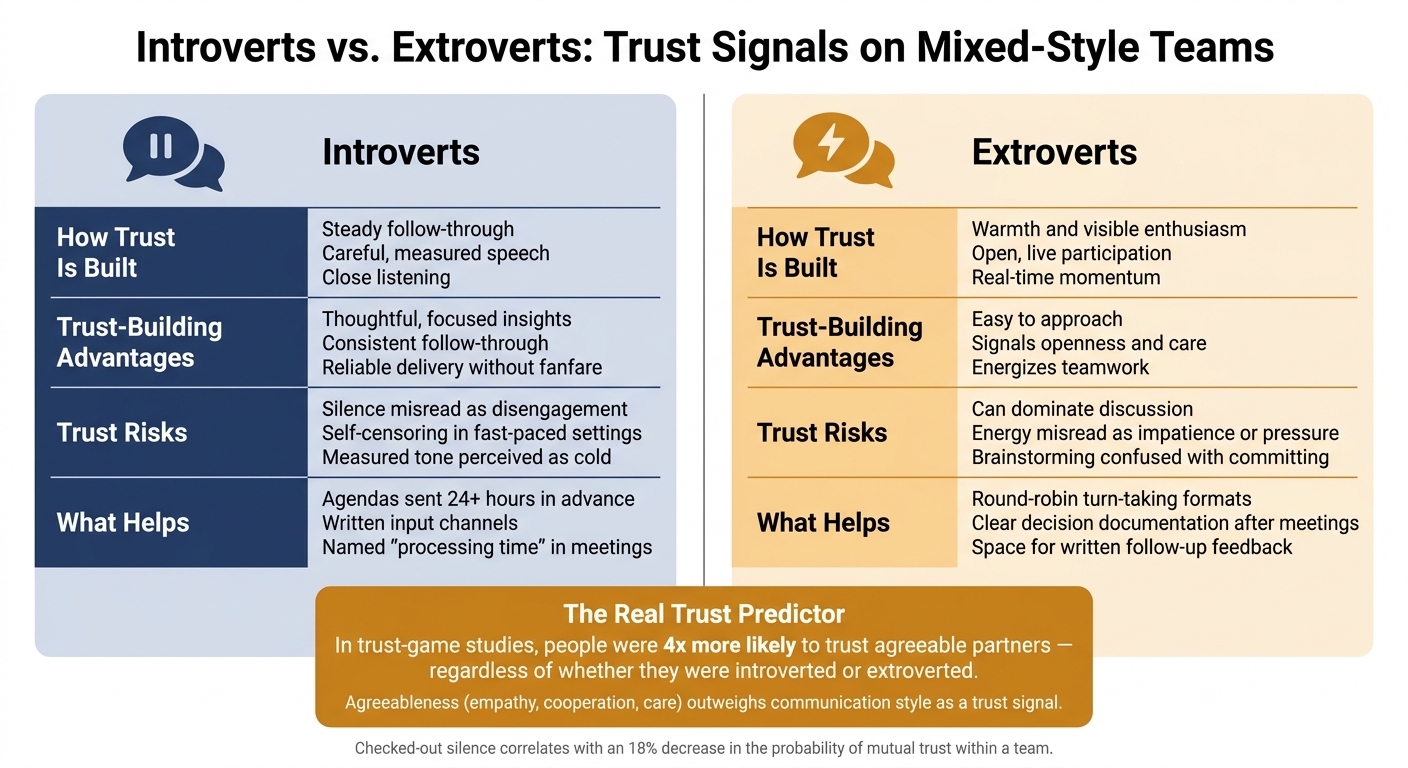
Introverts vs Extroverts: How Each Style Builds (and Risks) Team Trust
The same habits that help people earn trust can also get read the wrong way.
Where Introverts Often Build Trust Well
Introverts often build trust through a measured pace, close listening, and steady follow-through. Over time, teammates start to see a simple pattern: when an introvert says they’ll do something, it gets done. That kind of consistency builds credibility in a quiet, steady way.
Put simply, introverts often build trust through quiet attention and reliable follow-through.
Where Extroverts Often Build Trust Well
Extroverts often build trust through a warm tone, easy access, and visible presence. People may find them easier to approach because they seem open and ready to engage. Thinking out loud can also signal openness, while their visible involvement can make teamwork feel more immediate and alive.
When Each Style Creates Trust Risks
Problems show up when people confuse style with intent. Quiet can get mistaken for disengagement. Energy can get mistaken for dominance.
An introvert’s reliability may look like withdrawal to someone who links participation with speaking up. An extrovert’s energy may come across as impatience, especially for teammates who need more time to think things through. Neither read is correct, but both happen all the time. This is especially true in digital environments, where AI enhances remote team communication by clarifying intent.
When it comes to trust in particular, research points to agreeableness as the stronger predictor of trust. In trust-game experiments, participants were 4 times more likely to trust agreeable partners than disagreeable ones, whether the partner was introverted or extroverted [1].
Use this as a quick snapshot of trust signals, not a new framework.
| Style | Trust-Building Advantages | Trust Risks |
|---|---|---|
| Introverts | Thoughtful insights, careful listening, consistent follow-through | Silence misread as disengagement; self-censoring in fast-paced settings |
| Extroverts | Warmth, accessibility, visible engagement, real-time momentum | Dominating discussion; perceived as impatient or lacking depth |
Conclusion
Across pace, tone, follow-up, and presence, trust depends less on style and more on how a team reads that style. Team trust is not just about introversion or extroversion. It comes down to whether people judge each approach fairly within the team’s communication norms.
Visibility is not the same as trustworthiness. A teammate who speaks in every meeting is not, by default, more reliable than someone who listens closely and delivers without much fuss. That’s why mixed-style teams need clear rules before small habits start to feel like signs of mistrust.
The answer is not to relabel people. It’s to strengthen teams with clear systems: structured meetings, written input, and simple norms that give both styles the same chance to earn trust. When silence is no longer read as disengagement, and energy is no longer read as depth, trust stops turning into a personality contest. Clear norms help style differences build trust instead of tension.
FAQs
Can introverts be trusted more than extroverts?
No. Introverts are not automatically trusted less than extroverts, and extroverts are not automatically trusted more.
Trust tends to be linked more closely to agreeableness and to how people judge someone’s competence, integrity, and benevolence. Extroverts may come across as more social or more popular, but that does not consistently lead people to trust them more.
What builds trust on mixed-style teams?
Trust grows on mixed-style teams when people stop leaning on surface-level personality labels and pay attention to core traits like agreeableness, which strongly shapes interpersonal trust.
Introverts and extroverts may build connection in different ways, but trust tends to grow when leaders set up flexible structures that give space for both internal reflection and external processing. Tools like Personos can help teams use personality insights in day-to-day communication and cut down on friction.
How can leaders prevent trust misreads in meetings?
Leaders can cut down on trust misreads by setting up meetings in a way that works for both internal and external processors. A simple fix is to share the agenda and key questions ahead of time. That gives people a chance to think before they speak.
It also helps to use a write first, discuss second approach, or even a short silent pause before the conversation starts. That small change can lead to better input from people who think things through before jumping in.
A few other meeting habits can help too:
- Use structured turn-taking so the same voices don’t always lead
- Ask for asynchronous input before major decisions
- Separate idea generation from critique so people can share thoughts without feeling shut down
These steps make it easier for more people to contribute and help create psychological safety in the room.