How EQ And Conscientiousness Shape Team Collaboration
Emotional intelligence steadies team communication under stress, while conscientiousness ensures reliable follow-through—teams need both to avoid missed tasks and conflict.
Nick Blasi

How EQ And Conscientiousness Shape Team Collaboration
If your team talks well but still drops tasks, or finishes tasks but struggles with tension, you're likely missing either EQ, conscientiousness, or both.
I’d sum the article up like this: EQ keeps team communication steady under stress, and conscientiousness keeps work moving with clear follow-through. In human services, both matter because poor handoffs, late notes, and tense feedback can affect client care. The article also points to a few direct fixes: weekly coordination reviews, emotional check-ins, clear task owners, behavior-based feedback, and a 24-hour note rule.
Here’s the full picture in plain English:
- Low EQ often shows up as missed emotional cues, conflict avoidance, hard conversations put off too long, and blowups under pressure.
- Low conscientiousness often shows up as late documentation, weak task ownership, unclear handoffs, and missed follow-ups.
- High EQ helps people pause, listen, stay calm, and give feedback without blame.
- High conscientiousness helps people stay organized, close loops, and keep routines in place when work gets hectic.
- Stress hurts thinking fast, with the article citing up to 25% lower IQ performance and 30% lower analytical reasoning under pressure.
- Teams work best when both traits are high, because people feel heard and can rely on each other.
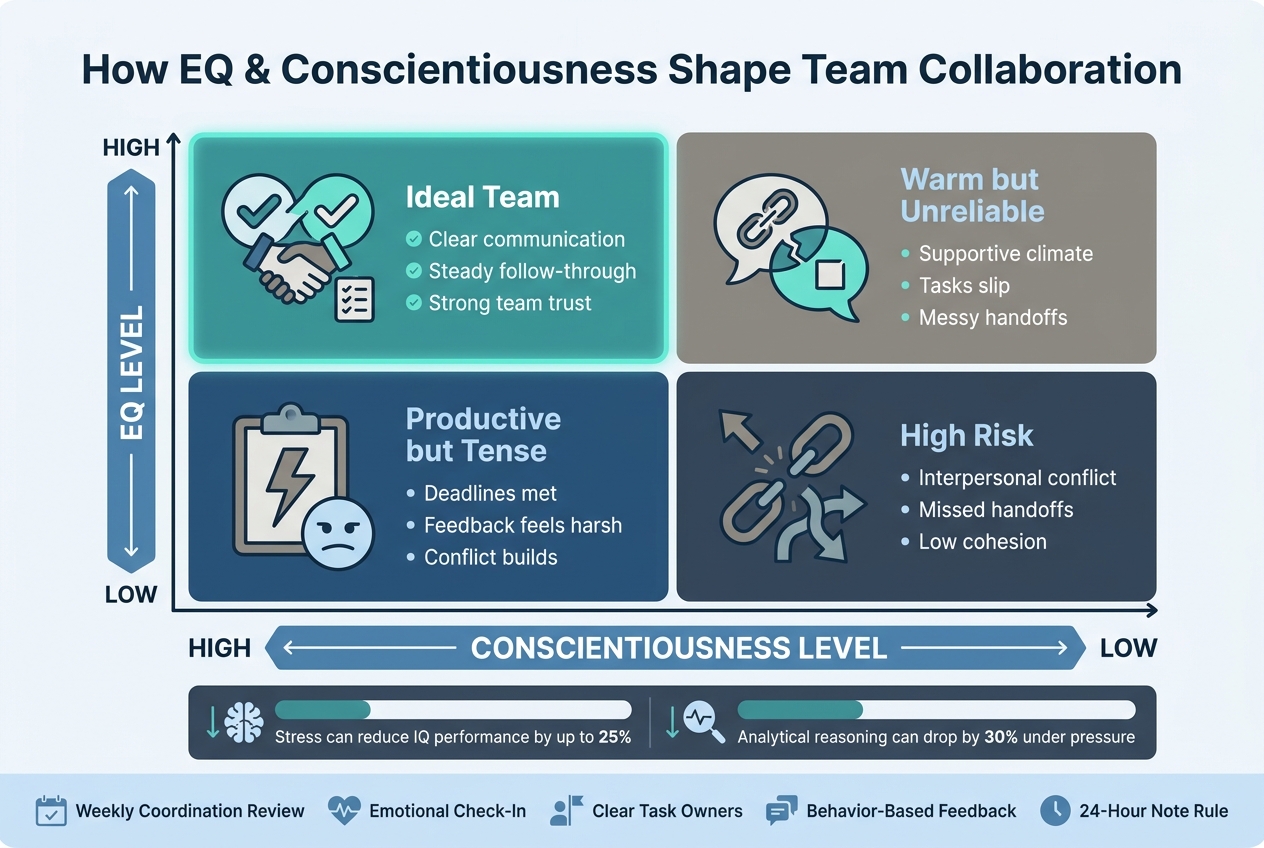
EQ vs. Conscientiousness: Team Collaboration Matrix
Team Emotional Intelligence 2.0: The Four Essential Skills of High Performing Teams
Quick Comparison
| Pattern | What it feels like |
|---|---|
| High EQ vs IQ + High conscientiousness | Clear communication, steady follow-through, stronger team trust |
| High EQ + Low conscientiousness | Warm team climate, but tasks slip and handoffs get messy |
| Low EQ + High conscientiousness | Work gets done, but feedback feels harsh and tension builds |
| Low EQ + Low conscientiousness | Conflict, missed work, weak coordination, and poor team flow |
My takeaway: if you want better collaboration, don’t just work on how people talk. Work on how they respond under stress and how reliably they close the loop.
How High EQ Improves Team Communication
High EQ helps people stay steady during tense case discussions, so frustration doesn’t take over the room.
Emotional Self-Management During Stressful Case Discussions
Human services work is high stress. And when stress spikes, performance can slip fast. IQ performance can drop by 25%, and analytical reasoning scores can fall by 30% [4]. That matters in day-to-day team discussions. One overwhelmed team member can miss a documentation gap or overlook a client risk.
People with high EQ are better at pausing before they react. They slow the moment down, separate emotion from facts, and keep the group focused on what needs to happen next.
Even strong performers miss details under pressure. High EQ helps them reset, stay calm, and keep the discussion grounded in facts.
That kind of steadiness makes feedback easier to hear and cuts the odds that tension spreads across the team.
Empathy, Perspective-Taking, And Better Feedback
High EQ also shapes how people read context and intent. A high-EQ response starts by looking at the full picture: workload, client concerns, and what coworkers already know [5].
In nonprofit, case management, and counseling teams, people often spot different signs of risk. One person may notice a documentation issue. Another may catch a shift in client behavior. Perspective-taking helps the team bring those views together instead of treating them like competing opinions. That makes it easier to ask for help and stay less defensive when workloads are heavy [4].
Teams that use shared language instead of blame build trust faster [3].
Once people understand each other better, communication gets clearer. Then it becomes more steady from one case discussion to the next.
Comparison Table: High EQ Communication Habits And Their Effects
| High EQ Communication Habit | Positive Effect on Team Coordination |
|---|---|
| Active listening | Calms tense situations and integrates diverse perspectives [3] |
| Emotional self-control | Prevents stress-induced drops in analytical reasoning and decision-making [4][5] |
| Naming concerns early | Reduces competitive behavior and builds trust within the team [1] |
| Using a calm tone | Triggers positive emotional contagion, keeping the team steady in crisis [1] |
| Checking understanding before closing | Ensures alignment before closing meetings, reducing errors in urgent decisions [3] |
| Empathy and perspective-taking | Leads to more help-seeking and less blame during heavy workloads [4][2] |
How Conscientiousness Strengthens Coordination And Follow-Through
If high EQ helps conversations stay calm, conscientiousness helps the work stay on track. It supports steady follow-through, clear ownership, and fewer service gaps. In human services, that can mean the difference between a smooth handoff and a missed task that affects someone’s care.
Research consistently finds that conscientiousness is the strongest predictor of team performance among the Big Five personality factors [1]. In this field, that matters a lot. Missed tasks and fuzzy handoffs don’t just slow down a workflow. They can affect real people. You often see that first in documentation, deadlines, and handoffs.
Reliable Documentation, Deadlines, And Handoffs
Conscientious team members bring order and follow-through. On the ground, that looks like case notes entered within 24 hours, referrals with clear ownership, and handoffs that spell out the next step. In case management and counseling teams, incomplete notes can turn into service gaps fast.
How Structure Keeps Teams Steady In Crisis-Heavy Work
This kind of structure matters even more when the day gets packed with interruptions. Without it, teams can slip into pure reaction mode. Conscientious team members help stop that. They lean on routines, checklists, and clear schedules that still hold when things go sideways.
Checklists and standard workflows reduce cognitive load, so staff can spend more attention on hard decisions instead of small process steps. That helps protect client care when teams are stretched thin. For lean nonprofit and counseling teams, structure isn’t rigidity. It’s a safeguard.
Comparison Table: Low vs. High Conscientiousness Team Habits
| Team Behavior | Low Conscientiousness | High Conscientiousness |
|---|---|---|
| Documentation timing | Notes entered sporadically or late | Notes entered within 24 hours |
| Scheduling | Inconsistent follow-up | Standardized follow-up windows |
| Task ownership | Vague; referrals left open | Named ownership; tasks closed out |
| Crisis response | Reactive, disorganized under pressure | Orderly routines and checklists maintain focus |
| Handoffs | Verbal summaries, unclear next steps | Structured handoffs with next steps |
Why Teams Need Both EQ And Conscientiousness
The real test isn't EQ or conscientiousness by itself. It's how the two work together. EQ helps keep conversations steady. Conscientiousness helps keep the work dependable. Teams need both.
4 Common Team Patterns When One Or Both Traits Are Missing
What a team feels like day to day changes a lot based on which trait is there and which one isn't.
When a team is high in EQ but low in conscientiousness, the atmosphere often feels warm and supportive. People listen, check in, and try to help. But referrals slip through, notes show up late, and follow-through gets shaky. The team feels caring, but not dependable.
Flip that around and you get a different problem. A team with high conscientiousness and low EQ usually hits deadlines and gets tasks done. But the tone can feel transactional. Feedback lands hard, conflict sits there untouched, and when pressure builds, weak coordination starts to show.
When both traits are low, that's where teams run into the most trouble. Handoffs get missed, conflict grows, and the work setting starts to wear down team cohesion.
How The Combination Builds Trust In Nonprofits, Case Management, And Counseling
Trust in human services has two layers. One is emotional. Staff need to feel heard, supported, and safe enough to bring up concerns. The other is operational. They need to know their coworkers will do what they said they'd do.
When EQ and conscientiousness are both high, those two layers stay in place. Case reviews become more honest because people feel safe giving and receiving feedback. Referral coordination gets better because ownership is clear and handoffs are complete. Treatment planning also improves because staff bring empathy for the client's situation and the discipline to track progress. That directly cuts the risk of service gaps that can affect client safety.
Together, EQ and conscientiousness improve trust, coordination, and task performance.
Comparison Table: EQ And Conscientiousness Team Matrix
| EQ Level | Conscientiousness Level | What The Team Experiences |
|---|---|---|
| High | High | Staff feel understood and can count on each other; strong case coordination, honest feedback, consistent follow-through |
| High | Low | Warm, empathetic environment; frequent missed deadlines, incomplete documentation, unreliable handoffs |
| Low | High | Tasks completed on time; communication feels rigid or cold, feedback lands poorly, potential for burnout and conflict |
| Low | Low | Interpersonal conflict, inconsistent work quality, missed handoffs, low team cohesion |
Leaders can turn this pairing into daily habits with clear norms, feedback rules, and dependable handoffs.
Leader Actions And Tools That Build Better Team Habits
Leader Practices And Team Norms That Improve Communication And Reliability
Those traits only matter when leaders turn them into everyday routines. A few repeatable habits can make a measurable difference in how staff communicate and how well they follow through.
Start with a 15-minute weekly coordination review. Keep it short. Focus on what's moving, what's stuck, and who owns what. Then add a brief emotional check-in at the start of team meetings. Stress can cloud judgment, so it helps to take the temperature of the room before jumping into problem-solving or real-time crisis communication.
At the end of every meeting, assign a clear owner and deadline for each action item. When giving peer feedback, keep it centered on behavior and impact, not personality. That keeps the conversation useful and protects the working relationship. It also helps to set a 24-hour note standard.
Leaders also shouldn't sit back and hope staff build stronger conscientiousness over time. When leaders model steady follow-through, say deadlines out loud, and point out when someone handles a handoff well, they reinforce the team norms people need day to day.
Where Personos Fits Alongside Other Personality Tools
When teams need help between meetings, the right tool can back up these habits. Many general tools aren't shaped for human services work. DISC-style assessments and Hogan can offer broad workplace profiles, but they don't line up as well with case management, crisis intervention, or nonprofit team dynamics.
Personos is built for human-services teams. It uses the Five Factor Model that this article has discussed and is designed for social workers, case managers, counselors, coaches, and nonprofit staff. In plain English, it's made for the day-to-day communication and coordination pressure that human services teams deal with.
| Feature | Personos | General tools (DISC, Hogan) |
|---|---|---|
| Primary Audience | Human services and nonprofits | General corporate |
| Core Model | Five Factor Model (FFM) | Varies (type-based or trait-based) |
| Practical use | Real-time chat guidance and ActionBoard | Static assessment reports |
| Privacy Focus | Privacy-first; scores are not shared without consent | Varies by provider |
| Goal | Habit-reinforcing collaboration | Individual self-awareness |
Personos turns personality insight into daily action through the ActionBoard, Dynamic Reports, and short Prompts. Because individual scores stay private by default, staff may be more willing to engage honestly instead of feeling watched or boxed in by a label.
Conclusion: The Team Habits That Matter Most
These routines mark the gap between good intentions and reliable execution. High EQ helps people communicate under pressure. High conscientiousness helps them follow through. Teams need both if they want to stay coordinated and trustworthy.
Leaders don't need complex programs to shift team behavior. Simple, repeatable habits like steady check-ins, clear ownership, 24-hour note norms, and behavior-focused feedback create the structure that helps both traits grow. Pair those habits with tools that fit your workflow.
FAQs
How can we tell whether our team needs more EQ or more conscientiousness?
Look at the main issue first: is it getting work done or working well together?
If your team struggles with productivity, planning, or messy workflows, it likely needs more conscientiousness.
If the team is dependable but deals with frequent conflict, low trust, or trouble under stress, it likely needs more EQ.
Personos can help teams assess peer dynamics and spot which area needs attention.
Can EQ and conscientiousness be improved through team habits?
Yes. Emotional intelligence (EQ) and conscientiousness can grow with deliberate team habits and steady practice. Personality traits tend to stay fairly stable, but they can still shift over time.
Leaders and coaches can help that growth by using exercises that build emotional awareness, self-regulation, and communication. Since EQ helps turn personality into stronger team performance, these habits can improve collaboration.
What should leaders do first to improve team coordination?
Leaders should start by building emotional intelligence across the team, with special attention on noticing and managing emotions in themselves and in others.
That work gets easier when teams use dialogical exercises that help people name their strengths, clarify their aspirations, and find shared goals. Tools like Personos can support that process by offering real-time, personality-informed guidance that improves communication, conflict resolution, and the habits teams build together.