How AI Tracks Leadership Style Under Stress
AI detects shifts in tone, voice, meetings, and work patterns to trigger private coaching and prevent leadership burnout.
Nick Blasi

How AI Tracks Leadership Style Under Stress
Stress can change how you lead before you notice it. AI can spot those shifts early by looking at your messages, meetings, work hours, and decision patterns, then turn that data into coaching prompts you can use right away.
Here’s the short version:
- Leadership style often shifts under pressure
- AI can spot tone, voice, meeting, and workload changes
- The goal is coaching, not surveillance
- Privacy, consent, and limited access matter
- Tools like Personos add personality-based guidance
A few numbers show why this matters:
- Only about 15% of people are sufficiently self-aware
- 78% of nonprofit employees reported burnout in 2025
- 53% of leaders become more closed-minded and more controlling under pressure
What can AI track?
- Written tone in email and chat, like shorter replies or more commands
- Voice stress cues in meetings, like faster speech or less pause time
- Meeting habits like interruptions and talk-to-listen ratio
- Workload signals like after-hours messaging and delayed decisions
- Decision bottlenecks when leaders pull choices into a smaller circle
What should happen next?
- Build a 4 to 8 week baseline
- Compare current behavior to that normal pattern
- Send real-time nudges before tense messages go out
- Use short reflection prompts after conflict or overload
- Track change over time with private coaching dashboards
A quick look at the tool types:
| Tool type | What it tracks | Best use |
|---|---|---|
| Language analysis | Email, chat, wording, tone | Harsh or abrupt communication |
| Voice and call analytics | Pitch, pace, pauses, tension | Stress during live calls |
| Work-pattern analytics | Calendar, collaboration, after-hours activity | Overload and burnout risk |
| AI coaching platforms | Assessments, prompts, reports | Behavior change and self-awareness |
My takeaway is simple: AI should help you notice pressure-driven behavior shifts early, so you can correct course before trust, team input, or staff well-being starts to slip. The tool should guide judgment, not replace it.
If I were reading this article for the answer fast, that would be it.
What AI can detect when leaders are under pressure
Tone and language shifts in messages and emails
AI can pick up these shifts in writing, meetings, and workload before they show up in business results. It uses NLP to track tone, urgency, blame, warmth, and collaboration in emails and chat.[2][6][7][8] Then it compares a leader’s current messages with that person’s usual pattern and flags changes like shorter replies, fewer thank-yous, and more commands than questions.[6][7]
That matters more than it might seem at first glance. A small change in wording can change how a team feels. Tone shifts can weaken trust and psychological safety. Email incivility has been linked to rumination, anxiety, absenteeism, and higher quitting intentions among staff.[14]
Written signals tell part of the story. Voice and meeting behavior show the rest.
Voice stress cues and meeting behavior
AI meeting tools look at pitch, speaking rate, pause frequency, vocal tension, and loudness to spot stress cues that leaders often miss in themselves.[3][4][9] Under pressure, pitch tends to rise, speech gets faster, and pauses get shorter, often before the leader even notices the strain.[3][4]
When you pair that with meeting behavior, the pattern gets clearer. AI can track interruption frequency, talk-to-listen ratio, and questions versus directives. That helps show when a leader has moved from facilitative to reactive and controlling.[3][10] In plain terms, someone who usually guides the discussion may start dominating it.
The shift can be stark. A leader who normally speaks 30% to 40% of the time may jump to 60% to 70% under stress, leaving less room for team input.[3][10] Meeting analytics turn that tension into something you can measure, not just sense. Calendar and workload data help fill in what meeting data alone can’t show.
Decision patterns, workload, and after-hours behavior
Behavioral and calendar data round out the picture.[2][5][10] One strong stress marker is after-hours messaging. It can set the tone that people should always be available, and that tends to add to exhaustion.[11][12][13] Even when leaders never say, “Answer me tonight,” the signal still lands. If late-night messages keep coming, many employees feel they need to match that pace.
AI can flag that pattern, but not in isolation. It works best when late-night communication shows up alongside more negative tone and lower meeting engagement.[2][10] That combination says more than any single signal on its own.
Collaboration network data adds another clue. Under stress, leaders often pull decisions into a smaller circle. They consult fewer people, keep more decisions at the top, and slow response times across the team.[2][10] That doesn’t just affect the leader’s workload. It changes how the whole team works.
AI can catch that bottleneck while it’s still forming, which gives coaches and HR teams an earlier chance to step in before the pattern turns into a full-blown crisis.
How AI turns stress signals into coaching steps
Once AI spots stress signals, coaching needs to turn that signal into action.
Build a baseline and map each leader's stress pattern
When AI flags stress, coaching should start with a 4 to 8 week baseline. Use normal communication and calendar data to map how a leader usually works, including tone, response time, work hours, and question-to-directive ratio, along with shifts in responsiveness and workload.[17]
Once that baseline is in place, changes start to mean something. A leader who moves from inclusive language to blunt directives is showing a clear shift. A leader who usually responds fast but then starts delaying decisions and leaving tasks hanging may be showing avoidant behavior under overload. AI can surface both patterns with time-bound context, like the last 2 weeks compared with the prior 6 weeks, so coaches can work from something concrete.[17]
That baseline also helps the system step in as soon as a leader starts to drift under pressure.
Use real-time nudges and structured reflection
Coaching tends to work best when it happens close to the trigger. AI tools built into email, Slack, or Microsoft Teams can catch a harsh draft before it goes out and nudge the leader to pause. In a tense thread, the system might suggest adding one clarifying question before pushing a decision ahead, such as What would success look like from your perspective?[17]
After conflict, overload, or a crisis, AI can also trigger a short reflection sequence. A simple template can ask:
- What was the situation?
- How did I communicate, in tone, speed, and clarity?
- How did others respond?
- What would I repeat or change next time?
Short prompts like these can build self-awareness over time.[17]
Track improvement over time
Dashboards can show weekly patterns in tone scores, after-hours messaging, talk-time balance in meetings, and decision turnaround time. A leader might notice that late-night approvals dropped over the past several weeks, or that their ratio of open-ended questions to directives improved across Monday status calls.
The framing matters just as much as the data. Access should stay between the leader and their coach. Metrics should tie back to goals the leader set for themselves, not compliance checks. The tone should stay developmental, not punitive: "Your tone is more consistent under pressure - what's working?" When progress data is used this way, it becomes something leaders are more likely to use rather than avoid.[15][16]
Those coaching loops work best when the tool fits the team's workflow and privacy rules.
Tools, safeguards, and where Personos fits
AI Leadership Stress Tracking: Tools, Signals & Coaching Steps
What to look for in AI leadership tools
Once AI spots stress, the next step is simple: pick the tool that fits the problem.
The best tools show when stress starts changing how a leader communicates, makes calls, and works with other people. In practice, AI leadership tools usually fall into four groups, and each one picks up a different kind of stress signal:
- Language analysis tools scan written messages for shifts in tone, urgency, and wording.
- Voice and call analytics platforms study vocal cues during live conversations.
- Work-pattern analytics tools use calendar and collaboration data to flag overload, less focus time, and after-hours work.
- AI coaching platforms combine assessments with digital prompts to help build resilience and stronger communication over time.
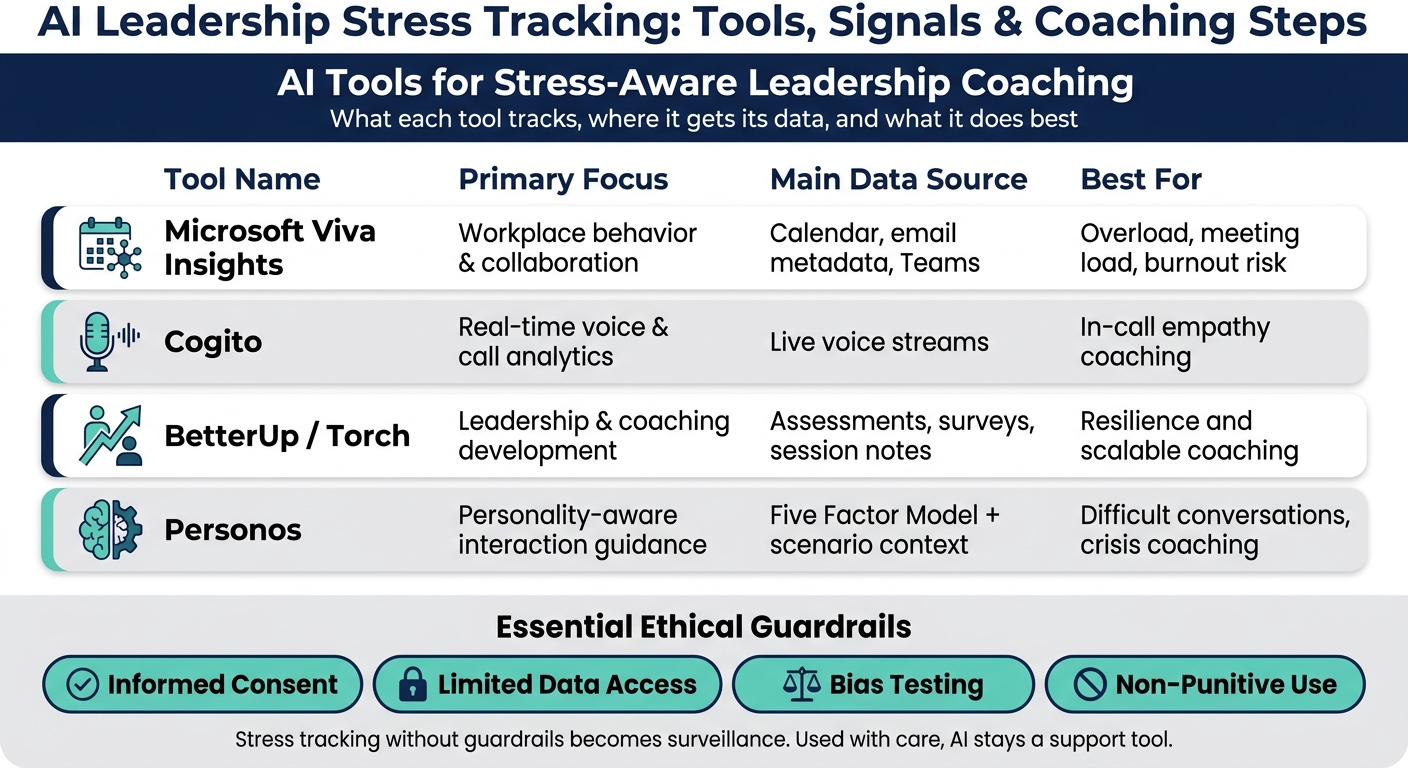
The right mix depends on your setting. A team dealing with meeting overload may need one type of signal. A leader handling tense client calls may need another. The table below helps match each tool to the stress pattern you want to catch.
How Personos supports stress-aware leadership coaching
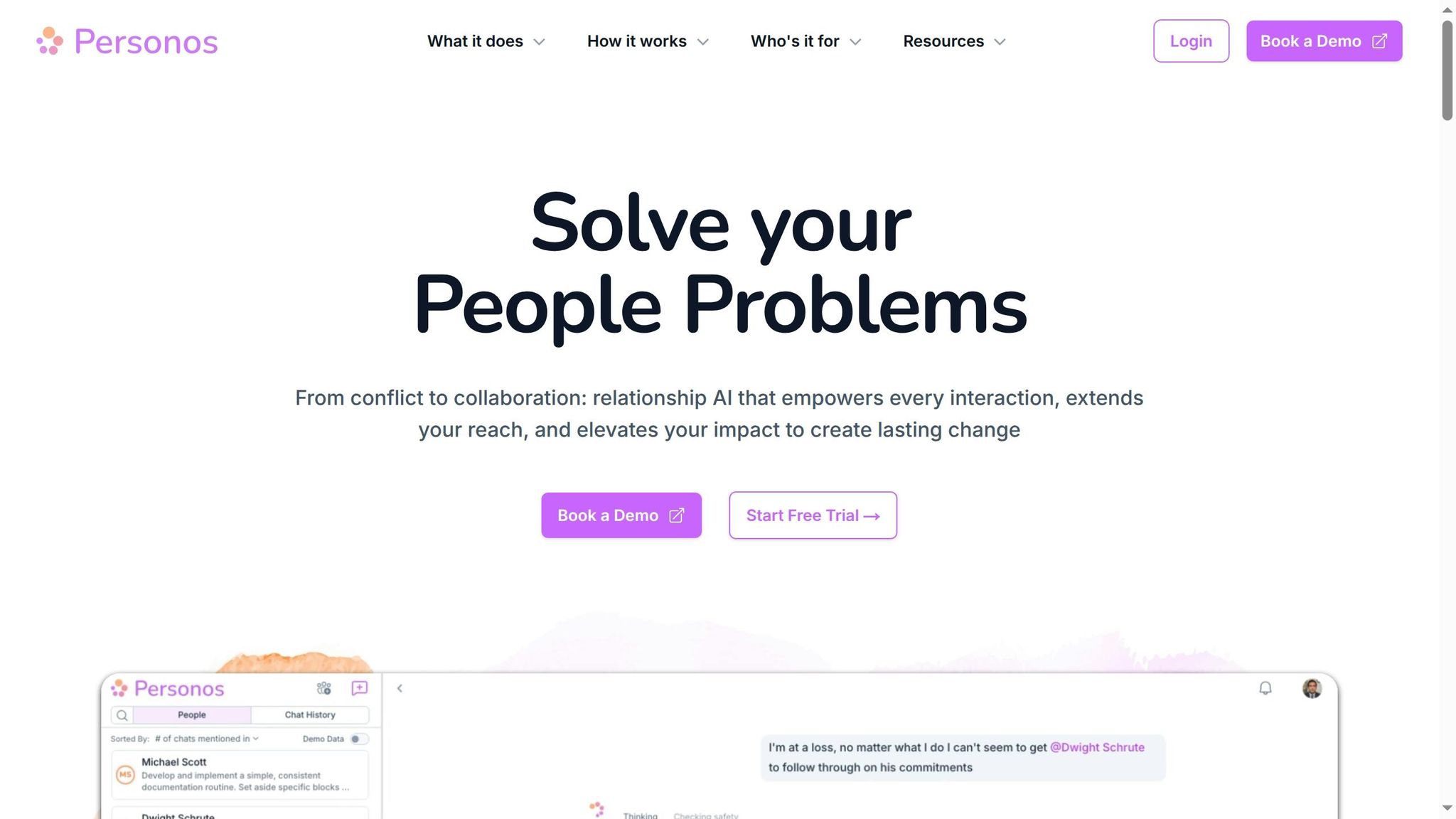
Personos goes a step further. It maps the personality pattern behind the stress, then points to the next move.
Built on the Five Factor Model, Personos measures 30 personality traits on an 80-point scale. That matters because stress does not hit every person the same way. One leader may get blunt under pressure. Another may avoid conflict. Someone else may over-explain or shut down.
Personos connects those patterns to action. It turns stress signals into next-step guidance for difficult conversations, crisis moments, and team conflict. Its core features, contextual AI chat, Dynamic Reports, Prompts, and ActionBoard, work together to give personality-aware guidance at the individual, relationship, and group level.
For helping professionals, this is where Personos stands out. It's especially useful when stress shows up in client conflict, team tension, or crisis response. It works best for helping professionals, nonprofit staff, and client-facing leaders who need support in messy human situations.
Comparison table and ethical guardrails
| Tool | Primary Focus | Main Data Source | Best For |
|---|---|---|---|
| Microsoft Viva Insights | Workplace behavior & collaboration | Calendar, email metadata, Teams | Overload, meeting load, burnout risk |
| Cogito | Real-time voice & call analytics | Live voice streams | In-call empathy coaching |
| BetterUp / Torch | Leadership & coaching development | Assessments, surveys, session notes | Resilience and scalable coaching |
| Personos | Personality-aware interaction guidance | Five Factor Model + scenario context | Difficult conversations, crisis coaching |
Of course, there’s a line here. Continuous tracking can wear down trust fast, so consent and access limits need to be crystal clear. Guardrails should cover consent, access, bias testing, and non-punitive use.
Viva Insights addresses this with aggregation, differential privacy, and minimum group-size thresholds, so managers can't drill down to individual behavior.[18][19] Personos supports the same goal through private-by-default personality scores and transparent reasoning that shows leaders which traits and situational factors shaped each recommendation.
Conclusion: Use AI to support leadership judgment, not replace it
Stress changes how leaders communicate, decide, and guide their teams in observable, measurable ways. A review of leadership under stress found that higher stress narrows judgment, increases reliance on shortcut thinking, and reduces exploration of alternatives.[1] Those shifts can show up in team trust, client relationships, and turnover risk long before an annual review spots them. That’s why early detection and response matter.
AI can flag these patterns early, before they appear in surveys or turnover data. But the point isn’t detection for its own sake. The point is turning signals into clear next steps, like an escalation script, a dissent prompt, or a small language nudge. Detection only matters if it leads to better action.
AI should support judgment, not take it over. AI can surface the pattern. Leaders and coaches still decide what to do next. Ethical judgment and context stay with people. And that only works if leaders trust the system.
Privacy and consent matter. Tools that rely on metadata, limit access to individual-level information, and explain why they flagged something help protect both leaders and the people they serve. Without guardrails, stress tracking slips into surveillance. Used with care, AI stays a support tool, not a stand-in for judgment.
Used well, AI-assisted stress awareness gives leaders support for steadier leadership. It helps them catch patterns before trust or performance starts to slip.
FAQs
How accurate is AI at spotting stress-related leadership changes?
AI can do a strong job of spotting stress-related shifts in leadership, especially when it uses personality traits to predict relationship patterns and job performance.
By looking at communication patterns and flagging likely triggers early, tools like Personos can help teams spot stress-driven changes, like curt messages before deadlines. When these insights are paired with emotional intelligence, decision-making accuracy may improve by 15% to 20%.
What data does AI need to track leadership style under stress?
AI needs a leader’s personality data and context-specific inputs that it can update over time. That gives it a clearer read on changes in tone, reactions, and decision-making under stress.
In Personos’ approach, that includes Five Factor Model traits, role, work history, company values, and masked, non-identifying message content. It uses those signals to produce real-time guidance and coaching reports when stress triggers show up, like conflict escalation, shutdown, or dips in motivation.
How can teams use AI coaching without crossing into surveillance?
Teams can steer clear of surveillance by being open about how data is used and by picking tools that respect clear privacy limits.
Take Personos. It does not share individual personality scores with management.
Instead, it gives only high-level insights that are useful to both sides, like collaboration suggestions, and shares them only within approved relationships. It also removes identifying details before data reaches the AI, which helps keep coaching private and supportive instead of turning it into supervision.