High vs. Low Power Distance: Workplace Conflict Styles
How power distance affects feedback, decision-making, and mediation — practical rules to surface concerns, name owners, and protect safety.
Christian Thomas

High vs. Low Power Distance: Workplace Conflict Styles
Higher power distance often favors private feedback and leader-led decisions. Lower power distance often favors open debate and shared input. In either setting, managers should offer more than one way to speak up, name the decision owner, and set clear reporting rules.
Power distance means how much people accept unequal authority. It can shape disagreement, feedback, decisions, and mediation, but nationality alone does not predict anyone’s behavior. Team norms and psychological safety matter.
Quick Comparison
| Area | Higher power distance | Lower power distance |
|---|---|---|
| Disagreement | Private concerns or formal channels | Open questions and debate |
| Feedback | Mostly downward; upward criticism may feel risky | Two-way and peer feedback |
| Decisions | Leaders expected to make the call | Consultation and delegated authority expected |
| Communication | Silence may not mean agreement | Directness may not mean disrespect |
| Conflict risks | Hidden concerns and delayed reports | Dominating voices and dismissive debate |
| Mediation | Clear authority and private discussions may help | Joint discussion and shared input may help |
Neither approach guarantees safe conflict resolution. In APA’s 2024 Work in America survey, 95% of workers with higher psychological safety rated their supervisor as effective at resolving conflict, compared with 66% of those with lower psychological safety.[9]
The practical approach: check team norms before judging motives, document mediation commitments, and review follow-through. Safety and reporting rights come first. Communication tools such as Personos can support wording and follow-up, but cannot replace management judgment or formal procedures.
Understanding Power Distance in Global Business Culture
High vs. Low Power Distance in Daily Conflict
Use these tendencies to check how your team works, not to label people. The same person may speak differently depending on their supervisor, team, and level of psychological safety.[7][8]
| Dimension | Higher power distance | Lower power distance | Manager move |
|---|---|---|---|
| Disagreement | Employees may share concerns privately or through a supervisor’s channel. | Employees may question proposals and challenge assumptions openly in meetings. | Provide private and public ways to share concerns. Make clear that respectful disagreement is welcome. |
| Feedback | Employees may expect feedback to flow downward and approach criticism of leaders cautiously. | Two-way feedback, including direct feedback to managers, may feel normal. | Schedule structured upward, downward, and peer feedback instead of relying on spontaneous comments. |
| Decision-making | Staff may expect leaders to decide after consultation or wait for explicit direction. | Staff may expect consultation, shared problem-solving, and delegated authority. | Clarify who recommends, decides, implements, and reviews each decision. |
| Communication signals | Silence, deference, or a “yes” may reflect respect, uncertainty, or disagreement, not agreement. | Questions and debate may show engagement rather than disrespect. | Check meaning before acting: ask for a recap, confirm next steps in writing, and separate politeness from agreement. |
| Conflict risks | Concerns may stay hidden, errors may be reported late, and public challenges may seem disrespectful. | Directness may feel aggressive, dismiss expertise, or let the loudest voices dominate meetings. | Set rules for response times, tone, turn-taking, escalation, and reporting without retaliation. |
These patterns affect how leaders gather input, make decisions, and handle mediation.
Higher Power Distance: Formal Channels and Leader Decisions
No objections does not always mean agreement. Ask directly about risks and alternatives, and give people time to respond. Offer one-on-one conversations, written input, and anonymous feedback where feasible. Do not promise anonymity if a small team could make contributors identifiable.
Show which suggestions changed the decision, which did not, and why. Without that response, repeated requests for feedback can feel empty. Employees need more than instructions.
Carry that structure into mediation with privacy, clarity, and a clear path to a decision.
Lower Power Distance: Open Debate and Shared Input
Open questioning can bring better options to light fast, but directness can sound dismissive without evidence to support it. Set a discussion deadline, name the decision owner, and document the final choice and reasoning. Written input and private follow-up let quieter employees contribute without joining a public debate.
Less hierarchy does not guarantee psychological safety. In APA’s 2024 Work in America survey, 95% of workers with higher psychological safety rated their supervisor as effective at resolving conflict with emotional intelligence, compared with 66% of those with lower psychological safety.[9] The survey links psychological safety to effective conflict resolution, not to any fixed advantage of lower power distance.
Even with open debate, mediation needs a clear owner, time limit, and next step.
Feedback and Mediation Across Authority Expectations
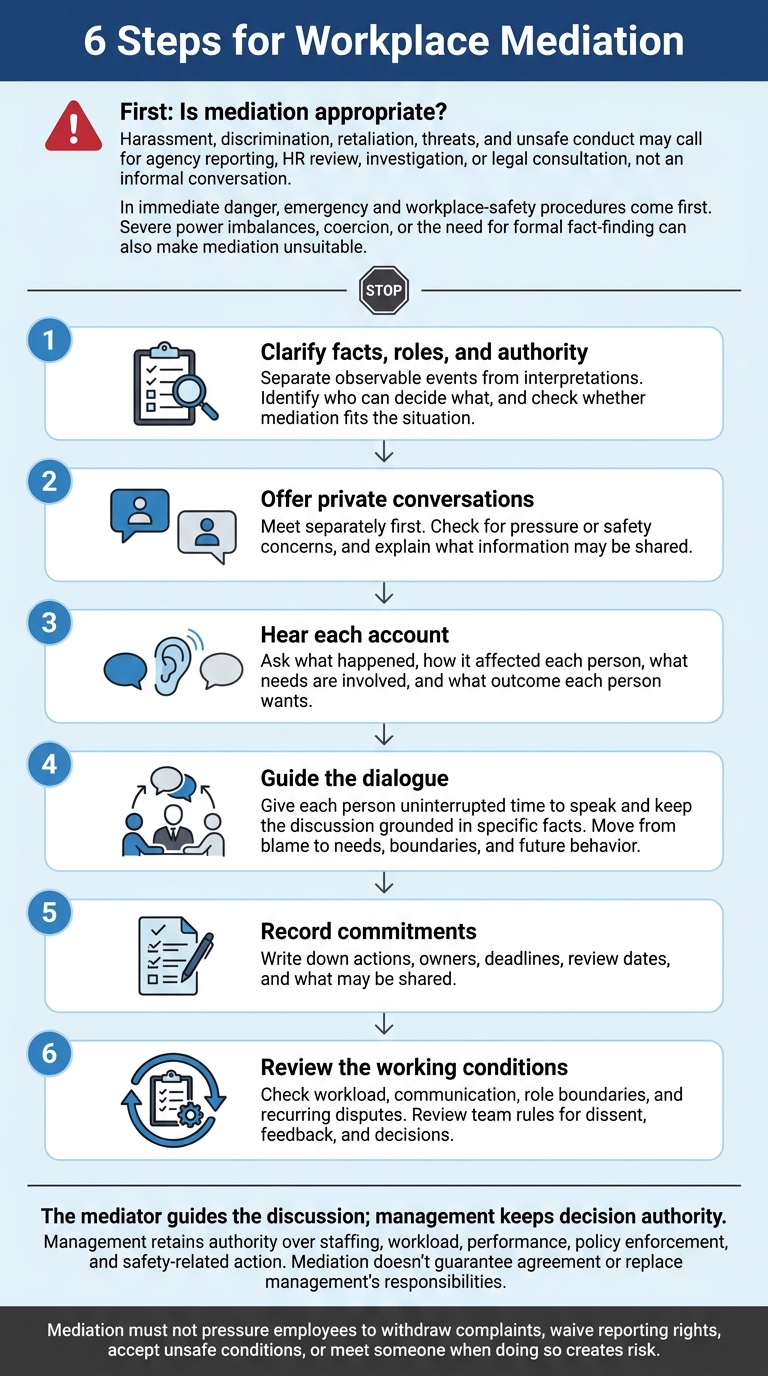
6 Steps for Workplace Mediation
Authority expectations affect how feedback and mediation happen, not the standards people must meet.
| Mediation choice | Manager or mediator adjustment | Shared team norm |
|---|---|---|
| Speaking up | Offer private or joint discussions. Explain when challenges are welcome and how dissent is recorded. | Challenge reasoning, not status. |
| Corrective feedback | Describe the behavior, its impact, and the required change. Stay factual and focus on solutions. | Apply the same performance standard; no personal attacks. |
| Escalation | Explain reporting routes and when an issue needs urgent attention. | Urgent risks bypass routine channels. |
| Decision ownership | Distinguish consultation from consensus. Name who makes the final call. | Make input rights and decision rights clear. |
| Mediation follow-up | Agree on updates, information sharing, and who handles next steps. | Record owners, dates, and review points. Using action tracking tools ensures these commitments are visible and followed. |
6 Steps for Workplace Mediation
Research links hierarchical distance and fear of negative consequences to less willingness to speak up. Psychological safety, by contrast, supports feedback-seeking and knowledge sharing.[11][6] Structured mediation gives people ways to speak without expecting everyone to communicate in the same way.
The mediator guides the discussion; management keeps decision authority over staffing, workload, performance, policy enforcement, and safety-related action. Mediation doesn't guarantee agreement or replace management's responsibilities.[12]
Use the approach above to guide these six steps:
- Clarify facts, roles, and authority: Separate observable events from interpretations. Identify who can decide what, and check whether mediation fits the situation.
- Offer private conversations: Meet separately first. Check for pressure or safety concerns, and explain what information may be shared.[13][14]
- Hear each account: Ask what happened, how it affected each person, what needs are involved, and what outcome each person wants.
- Guide the dialogue: Give each person uninterrupted time to speak and keep the discussion grounded in specific facts. Move from blame to needs, boundaries, and future behavior.[15][16]
- Record commitments: Write down actions, owners, deadlines, review dates, and what may be shared.[14][15]
- Review the working conditions: Check workload, communication, role boundaries, and recurring disputes. Review team rules for dissent, feedback, and decisions.[12][16]
When Safety and Formal Procedures Come First
Communication style never excuses harmful conduct. Harassment, discrimination, retaliation, threats, and unsafe conduct may call for agency reporting, HR review, investigation, or legal consultation, not an informal conversation. In immediate danger, emergency and workplace-safety procedures come first. Severe power imbalances, coercion, or the need for formal fact-finding can also make mediation unsuitable.[10][17]
Mediation must not pressure employees to withdraw complaints, waive reporting rights, accept unsafe conditions, or meet someone when doing so creates risk.[17]
Check Team Norms Before Assuming Motives
Before assuming someone’s motives, compare what the team says with what it rewards. Does policy welcome dissent while day-to-day behavior discourages it? Do people stay quiet only around senior leaders? Ask what input they thought was expected and what consequences they feared. Never treat someone’s conflict style as proof of their background or beliefs about authority.
Write Clear Rules for Dissent, Feedback, and Decisions
Create a short working agreement that spells out unspoken expectations about authority. Define a window for challenging routine decisions, keep urgent reporting channels open, and clarify how feedback works and who makes decisions.
Give people clear ways to speak up, including private, written, anonymous, or facilitated options where appropriate. Explain that identifying details and duties to investigate can limit anonymity. Invite objections before sharing a preferred answer. Silence does not mean consent.
Keep respectful disagreement separate from conduct and performance issues that need formal processes. Set a 30-day review to check response times, participation, and signs of retaliation. Few reports may reflect fear, not agreement.
Use Personos as Optional Communication Support
Tools can help, but team rules still set the standard. Personos can help draft wording and track follow-through. It does not measure power-distance expectations or determine conflict style.
Before entering sensitive information, confirm consent, applicable policies, access controls, privacy protections, and retention rules. Offer an option that does not require the tool. Never use profiles to discount complaints or judge performance. Use Personos alongside manager training, mediation, policy, and judgment, not as a replacement or a promise of resolution.
Conclusion: Adjust Communication, Keep Standards Consistent
In conflict, feedback, and mediation, tailor communication to clear team norms and observed behavior, not assumptions about culture or personality. Keep safety, anti-retaliation, and performance standards fixed. Close disagreements by making clear where to take dissent, who makes the decision, and how follow-up will be reviewed.
FAQs
How can I identify my team’s authority expectations without stereotyping?
Focus on observable team norms and individual personality traits, not broad assumptions about people’s backgrounds [1][2]. Personos uses the scientifically validated Five Factor Model to help you understand how each person works [1][3]. Add your team’s values, roles, and communication agreements to give its role-aware guidance more context. This helps you navigate authority dynamics based on how people actually interact, rather than assumptions about their backgrounds [1][4][5].
How can mixed-hierarchy teams agree on conflict rules?
Mixed-hierarchy teams can set clear rules for handling conflict through shared communication agreements and written team norms, rather than assumptions about people’s backgrounds.
Tools like Personos can help identify how each person collaborates and what triggers conflict. Leaders can use that information to create guidance that accounts for team roles, along with suggested wording to ease tension and clarify how everyone should handle disagreements, no matter who reports to whom.
How can I tell whether speaking up is getting safer?
Watch for changes in how your team interacts: colleagues speaking more openly and responding to feedback with a willingness to listen rather than pushing back.
Personos, an AI-powered personality psychology platform, offers real-time guidance for team collaboration. It uses team profiles and context to help you understand interpersonal patterns and spot signs of growing trust and psychological safety.