High vs. Low Agreeableness: How Coworkers Work Together
Practical steps for high- and low-agreeableness coworkers: make clear requests, invite concerns, and confirm responsibilities.
Rachel Johnson

High vs. Low Agreeableness: How Coworkers Work Together
Neither high nor low agreeableness makes someone a better coworker. I focus on 3 steps that help both styles work together: make clear requests, invite concerns, and confirm who will do what by when.
Agreeableness shapes workplace conflict outcomes by influencing how people handle requests and harmony versus questioning and holding firm. Both can help a team, but either can cause problems when taken too far.
Quick Comparison
| At work | Higher agreeableness tends to | Lower agreeableness tends to |
|---|---|---|
| Handling requests | Offer help readily | Check the need and workload |
| Saying no | Soften the refusal | State limits directly |
| Voicing concerns | Use diplomacy | Challenge the proposal directly |
| Giving feedback | Protect rapport | Focus on the problem |
| Receiving criticism | Seek agreement and repair | Question the evidence |
| Balancing priorities | Support others’ needs | Protect assigned goals |
| Reaching compromise | Seek consensus | Hold firm on priorities |
| Protecting relationships | Emphasize harmony | Emphasize standards and clarity |
My rule: <u>ask about preferences instead of assuming motives</u>. Keep personality scores private, use them only to guide communication, and check data policies before entering workplace details into tools such as Personos.
The Advantages of Being Disagreeable (Low on the Agreeableness Personality Trait)
High vs. Low Agreeableness: Key Workplace Differences
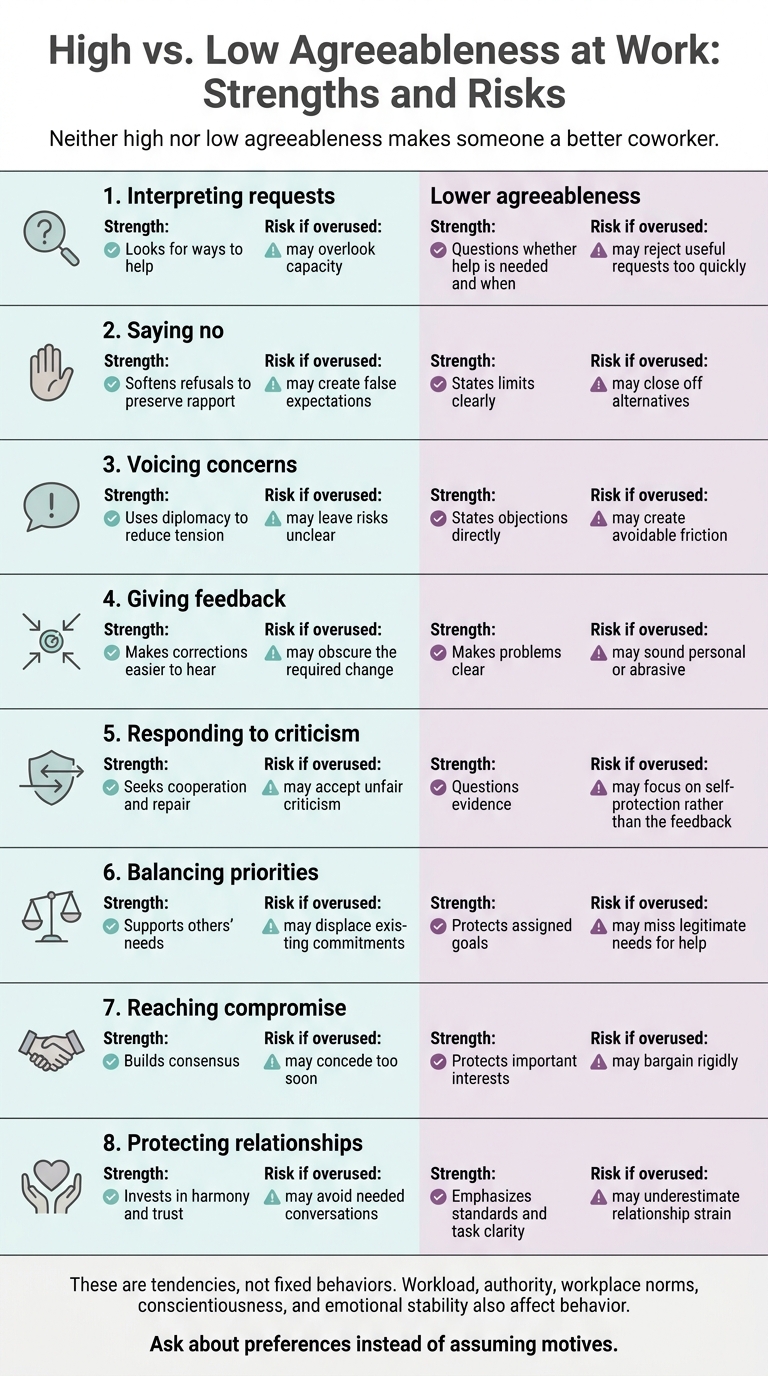
High vs. Low Agreeableness at Work: Strengths and Risks
Agreeableness shapes how coworkers help, push back, and bargain.[10] These differences often show up in requests, disagreements, and compromises. The table links each tendency to its strength and the risk of taking it too far. Workload, authority, workplace norms, conscientiousness, and emotional stability also affect behavior.
| Workplace behavior | Higher agreeableness tendency: strength → risk if overused | Lower agreeableness tendency: strength → risk if overused |
|---|---|---|
| Interpreting requests | Looks for ways to help → may overlook capacity | Questions whether help is needed and when → may reject useful requests too quickly |
| Saying no | Softens refusals to preserve rapport → may create false expectations | States limits clearly → may close off alternatives |
| Voicing concerns | Uses diplomacy to reduce tension → may leave risks unclear | States objections directly → may create avoidable friction |
| Giving feedback | Makes corrections easier to hear → may obscure the required change | Makes problems clear → may sound personal or abrasive |
| Responding to criticism | Seeks cooperation and repair → may accept unfair criticism | Questions evidence → may focus on self-protection rather than the feedback |
| Balancing priorities | Supports others’ needs → may displace existing commitments | Protects assigned goals → may miss legitimate needs for help |
| Reaching compromise | Builds consensus → may concede too soon | Protects important interests → may bargain rigidly |
| Protecting relationships | Invests in harmony and trust → may avoid needed conversations | Emphasizes standards and task clarity → may underestimate relationship strain |
The three patterns below show how these tendencies play out at work.
Requests: Offering Help vs. Questioning Workload
Seeking help and examining requests can both support better workload decisions. But neither guarantees good judgment. A responsible no can protect service quality. An uncertain yes can leave colleagues counting on help that never arrives.
Hypothetical request - covering another case manager’s intake appointments: Could you cover three of another case manager’s intake appointments next week? A higher-agreeableness coworker might volunteer before checking deadlines. A lower-agreeableness coworker might question the workload, timing, or fairness. Before committing, either person should confirm appointment lengths, urgency, existing commitments, and backup options.
Similar differences appear when coworkers push back or negotiate tradeoffs.
Disagreement: Softened Objections vs. Direct Challenges
The goal is to be clear without creating needless friction. Softened objections can hide concerns, while sharp challenges can distract from a valid point. Directness is not hostility; politeness is not agreement. Delivery also depends on emotional regulation, skill, culture, and power.[7][8]
Ask for the specific risk, evidence, and recommended change rather than assuming you know the speaker’s motives.
Teams face a similar balance when working toward a compromise.
Compromise: Seeking Consensus vs. Holding Firm
Higher agreeableness can help people find shared solutions, but it can also lead them to concede too soon. Lower agreeableness can protect priorities, but it may make bargaining rigid.
Harvard’s Program on Negotiation reports that higher agreeableness can slightly weaken outcomes in distributive bargaining but not in integrative bargaining.[6]
Before negotiating, establish shared goals, nonnegotiable constraints, and decision criteria. Judge proposed agreements by whether they protect core work, not just whether they keep the peace.
How to Make Requests and Work Through Disagreement
Clear communication is a shared responsibility. For both styles, use the same process: make requests specific, invite objections, and state decisions clearly. Higher-agreeableness coworkers may need permission to say no. Lower-agreeableness coworkers need a clear, respectful way to object. Psychological safety means people can speak up without fear of punishment. It does not mean everyone must agree.[11][12]
Make Clear Requests and Leave Room for No
A clear request names the task, expected outcome, deadline, estimated workload, and constraints. Ask coworkers to check their capacity before saying yes. If they say no, discuss a smaller commitment or a different assignment without treating refusal as poor teamwork.
If the work is mandatory, say so and identify who can change priorities. This gives high-agreeableness coworkers room to decline when allowed and low-agreeableness coworkers a clear standard for pushing back.
Invite Concerns and Give Specific Feedback
Before making a decision, pause and ask for specific concerns. Don't reward silence or bluntness. Ask what evidence is missing, what effects people expect, and what changes might help. Address the concern before explaining your intentions, and critique the proposal, not the coworker. This keeps direct feedback from becoming personal and cautious feedback from becoming vague.
In a referral-criteria discussion, one coworker might question whether complete intake documentation actually predicts better outcomes. The person proposing the change can separate safety-critical information from other paperwork, require safety information immediately, and test the revised process for 30 days.
Confirm Decisions and Record Responsibilities
Write down the decision, the reasoning behind it, task owners, deadlines, dependencies, and deferred work. This helps preserve working relationships while making responsibilities clear. Identify nonnegotiable safety, legal, and ethical requirements, along with who has authority to decide.
Ask affected coworkers whether the plan fits their workload. Silence is not agreement. Set a review date to check referral delays, missed deadlines, and workload. Escalate unresolved concerns about safety, confidentiality, discrimination, or decision-making authority to a supervisor or authorized reviewer.
Use Personality Information Without Labels
Once the team has a clear process for requests and decisions, use agreeableness data only to tailor communication and resolve conflicts. Scores describe tendencies, not fixed behavior. Use them to test assumptions, not to label coworkers as difficult or uncooperative.
Ask About Preferences and Keep Scores Private
Ask each coworker how they prefer to receive requests and feedback, and how much time they need to consider disagreements. Record the agreed preferences, not personality labels, in a one-page communication preferences sheet. Don’t reveal scores, and revisit the agreements after the next few interactions.
The goal is to adjust how you communicate, not label people. Before collecting assessments, explain their purpose, who can access them, confidentiality limits, how long data will be kept, and that participation is voluntary. Keep scores private by default and use them only to support workplace communication, not staffing decisions.[13][14][16][15]
Prepare Team Conversations With Personos
Personos can turn personality profiles and context into guidance for specific requests, feedback, and team conversations.
Before entering workplace or client information, check your organization’s data policies, access permissions, retention and deletion terms, and consent requirements. Use de-identified details where possible. Let Personos help draft questions and test wording, then check the plan against coworkers’ actual preferences.
Conclusion: Clear Requests and Workable Agreements
At work, neither style is better. What matters is how both help people make requests, disagree, and compromise. Higher agreeableness can build cooperation and trust, but it can also mean taking on too much or keeping concerns quiet. Lower agreeableness can help people set firm boundaries and push back when needed, but blunt delivery can cause needless tension.[5][9][10]
Both styles help balance trust with challenge when coworkers question the work, not the person.
Put that balance into practice:
- Clarify the request: State the deliverable, owner, and deadline so people know what they’re committing to.
- Invite disagreement: Leave room for concerns, a no, or another option without ranking personalities.
- Confirm the agreement: Record responsibilities and follow-up so everyone understands the commitments they’re expected to keep.
FAQs
How can I distinguish directness from disrespect?
Personality differences affect how people read directness. Bluntness doesn’t always mean disrespect [1]. Some people find it inconsiderate. Others see it as an efficient, honest way to solve problems [2].
Personos offers real-time, evidence-based guidance grounded in the Five Factor Model [1][3]. It focuses on specific traits instead of broad labels, helping you understand communication differences, maintain professional boundaries, and keep conversations constructive and respectful [1][4].
How can I say no without seeming uncooperative?
Match your wording to the person’s personality, but keep your boundaries clear. Highly agreeable coworkers may fear rejection, while less agreeable coworkers may focus on efficiency. Addressing these concerns can help maintain trust and teamwork.
Personos provides real-time, AI-powered guidance based on the scientifically validated Five Factor Model to help you plan how to communicate in these situations.
What if our communication styles still clash?
Personality differences can lead to misunderstandings and communication clashes. Personos, an AI-powered personality psychology platform based on the Five Factor Model, provides real-time guidance for specific situations to help people de-escalate conflict and agree on next steps.
Unlike static personality tests, its conversational AI suggests tailored language for difficult interactions, helping people put personality insights to work and turn friction into productive collaboration.