Habit Strategy Match by Personality Style
Match habit plans to your personality with stable cues, minimum versions, and simple restart rules to make habits easier to start and recover.
Rachel Johnson

Habit Strategy Match by Personality Style
Most habit plans fail for one simple reason: the plan does not fit the person. In one 12-week study, habit automaticity ranged from 18 to 254 days, and missing one day did not derail progress. That means I should stop asking, “What is the best habit system?” and start asking, “What system fits how I follow through?”
Here’s the short version:
- Structure-oriented: I do best with a clear cue, a small target, and a set restart rule.
- Novelty-seeking and flexible: I need a fixed trigger with some variety in the action.
- Socially motivated: I follow through more when another person is part of the plan, but I still need a solo backup.
- Stress-sensitive or emotionally reactive: I need smaller versions for hard days and low-pressure support.
- Lower-structure or externally supported: I need visible cues, reminders, and setup that removes the need to remember in the moment.
The article’s core point is simple: repetition matters, but fit matters more. The best habit setup makes it easier for me to start, repeat, and restart after I miss.
The Four Tendencies, with Gretchen Rubin
Quick Comparison
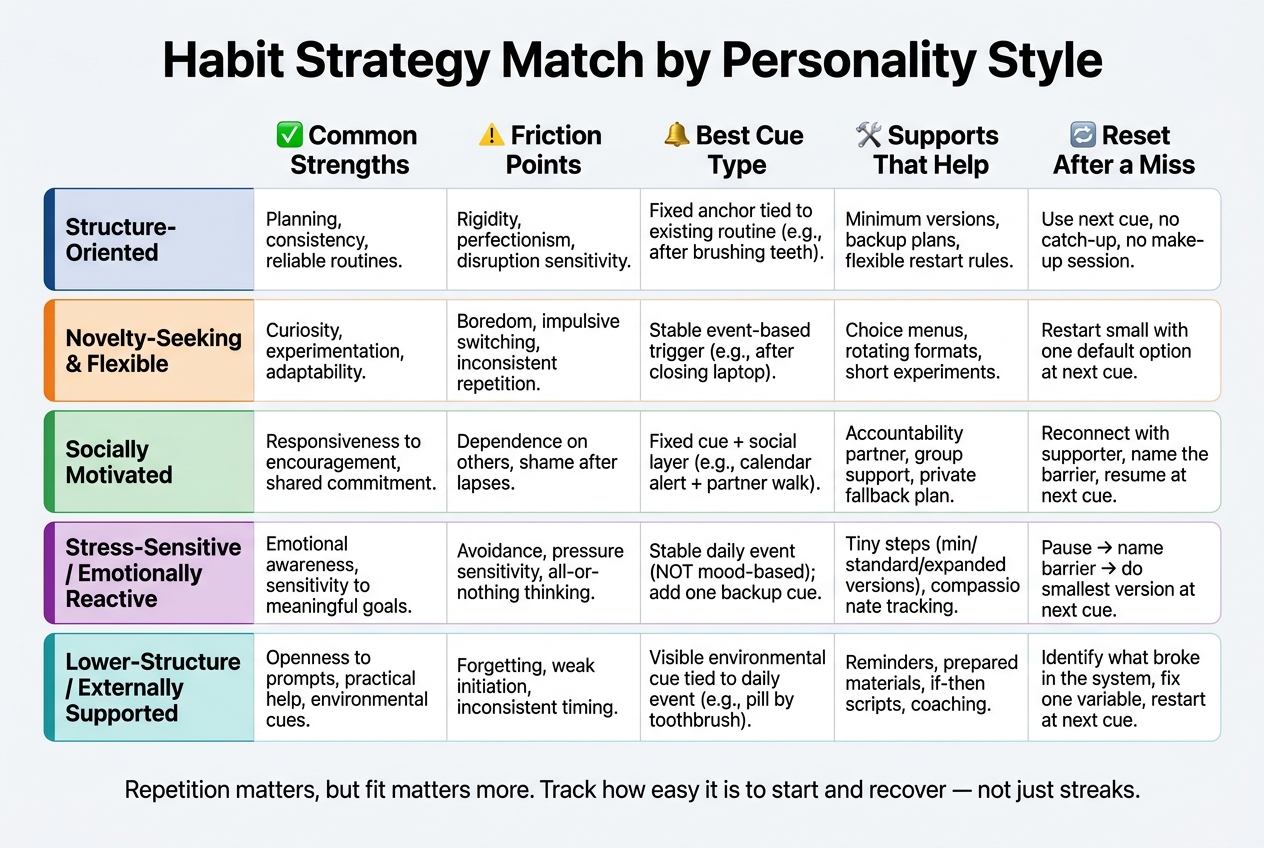
Habit Strategy by Personality Style: Strengths, Friction & Recovery
| Style | What usually helps me most | What often gets in the way | Best reset after a miss |
|---|---|---|---|
| Structure-oriented | Clear plan, fixed cue, minimum version | Overplanning, rigid rules | Use the next cue, no catch-up |
| Novelty-seeking and flexible | Stable trigger, rotating options | Boredom, too many switches | Restart small with one default option |
| Socially motivated | Check-ins, shared rhythm, visible support | Overreliance on one person, shame | Reconnect, name the barrier, resume at next cue |
| Stress-sensitive or emotionally reactive | Tiny versions, backup cues, private support | All-or-nothing thinking, pressure | Pause, name the problem, do the smallest version |
| Lower-structure or externally supported | Visible prompts, prepared materials, outside help | Forgetting, weak initiation | Fix the setup, then restart at the next cue |
If I want a habit to stick, I should track how easy it is to begin and how fast I recover, not just whether I kept a streak alive.
1. Structure-Oriented Style
People with a structure-oriented style like a clear plan. They tend to set goals, follow routines, and keep an eye on their progress. That usually works well when the path is clear and the finish line is easy to spot.
The main risk isn't lack of drive. It's building too much process around the habit. Someone in this group might spend an hour setting up the "perfect" system, then never begin. The plan works best when it cuts down decisions instead of piling on more.
Structure needs
The best place to start is with one small behavior that has a clear when, where, and how. Use an implementation intention: after I start the coffee maker, I will stretch for five minutes by the counter. Keep it simple: cue, action, finish rule. Don't build a tracker before the behavior has taken hold.
A two-level target can also help. Set a standard version, like a 30-minute workout, and a minimum version, like five minutes of movement. On hard days, the minimum keeps the routine going without asking for the full load.
Cue stability
Attach the habit to a steady routine you already do, such as brushing your teeth, starting work, or eating lunch. Use one reminder right where the action happens. Too many notifications can wear people out and make them easier to ignore.
Support type
Once the cue feels steady, feedback should help protect the routine, not make it harder to manage. Keep the feedback specific and tied to progress. For example:
"Your evening prep made the morning routine easier."
A weekly check-in usually works better than daily analysis. That check-in can be with a coach, an accountability partner, or just a short self-review. Focus on plain, useful questions:
- Did the cue happen on time?
- Was the minimum version done?
- What got in the way?
Lapse recovery
When structure breaks down, the recovery rule matters more than the streak. Missing one day doesn't mean the habit failed. The bigger problem is using that miss as a reason to stop.
A good fix is to decide the recovery rule ahead of time: if I miss my planned workout, I will complete the minimum version at the next available cue - no make-up session. Self-compassion after a lapse supports faster reentry than self-criticism. [2]
2. Novelty-Seeking and Flexible Style
This style doesn't do well with rigid routines. It does better with steady cues and built-in variety.
People with a novelty-seeking style often start with a lot of energy. A new habit feels fun at first, so they may jump into an ambitious plan, then drop it once that spark wears off. The issue is usually poor fit. The plan was made for consistency, not for someone who needs some change built in. Novelty seeking often runs into trouble with strict daily schedules. [7][8]
The answer isn't to get rid of structure. It's to use a kind of structure that fits: stable goal, variable activity. Keep the minimum behavior and the definition of success the same, but rotate the format, location, or the activity itself. For example, someone building a movement habit might choose between a 20-minute walk, a bike ride, dancing, or a workout video. The cue stays the same. The minimum time stays the same. [1] The variety should shape the action, not the trigger.
Structure needs
A light framework tends to work better than a detailed six-week plan. A good template might be: "On weekdays, I will complete one 10-minute learning activity before dinner; I can choose a podcast, article, video, or practice exercise." That gives enough direction without forcing one method.
It sets the target behavior, the minimum amount, the available options, and the timing. At the same time, it leaves room to choose. Weekly planning is often a better fit than a fixed long-range schedule because it can flex with changing interests and day-to-day life. To avoid early burnout, start small and wait to add difficulty until the behavior has stayed steady for two weeks. [6]
Cue stability
Keep the cue fixed and vary only the activity. That stable trigger helps hold the habit in place, while variety keeps it from feeling stale. Event-based cues work well here, such as "after I make coffee", "when I close my laptop", or "after finishing lunch." These cues don't depend on a set clock time, so they're easier to carry across messy or shifting schedules. [3]
A common breakdown happens when the cue, activity, and reward all change at once. If everything moves, nothing is left to act as an anchor. And without that anchor, the behavior is much less likely to happen on autopilot.
Support type
Accountability tends to work best when it's built around choice, not compliance. A coach or check-in partner can help by asking the person to pick the week's options, notice what felt easiest to repeat, and replace activities that have gone stale. Variation shouldn't be treated like failure.
For helping professionals using Personos, situation-specific prompts can help sort out what's going on. Does this person need more variety? Fewer decisions? A clearer cue? That distinction matters. When boredom leads to drift, the reset should be fast and easy.
Lapse recovery
If someone misses several repetitions, the goal is a quick restart with as little friction as possible, not a make-up session. Start again at the next available cue using the smallest acceptable version of the behavior. If the lapse happened during travel, a five-minute hotel-room routine after brushing teeth is enough to rebuild the cue association before adding variety again. [4]
In a weekly review, ask: "Did the variation support action, or replace it?" If switching starts blocking action, cut the choices down to one default and one backup until consistency returns. [4][5]
3. Socially Motivated Style
A socially motivated person tends to do better with connection. They follow through more often when another person is part of the plan, whether that's a partner, a group, or a simple check-in. This is a habit pattern, not a fixed trait. The same person might want support for exercise and total privacy for money matters. For this style, the main driver is visible accountability, not tougher self-control.
Structure needs
The setup should be steady enough to create a shared rhythm. Start with one habit, one supporter, and one weekly check-in. Add more time or more frequent sessions only after the routine feels repeatable.[13]
Cue stability
The habit can't rely on another person's schedule. The cue should stay fixed, while the social part can shift. For example, when my 6:00 p.m. calendar alert goes off, I put on my walking shoes and meet my neighbor. If the neighbor cancels, that same alert still leads to a 10-minute solo walk.[10][12]
Support type
Social motivation still needs a fixed cue. The difference is that the cue tends to work better when someone else is involved. Use emotional support to help effort stick, instrumental support to clear practical hurdles, and informational support to improve how the habit is done.[11]
A clear support agreement helps keep accountability cooperative, not bossy:
- one check-in text after each session
- one shared session each week
- no comment on missed days
A common weak spot is relying on one person too much. Build in a solo backup and a private reason to keep going, something that still matters even when no one is watching.[10][12]
Lapse recovery
When the social loop breaks, the first step is to restore contact, then return to the habit. After a miss, reconnect with the supporter and restart at the next cue. A short script can help:
I missed Tuesday because work ran late - I'll do five minutes tonight, and if I'm delayed again, I'll message you before 7:00 p.m.
The support person's role is problem-solving, not reassurance or criticism.[12] Message the supporter, name the barrier, and use the next cue. The goal is to resume, not catch up.
4. Stress-Sensitive or Emotionally Reactive Style
A stress-sensitive person often knows exactly what to do. The hard part is doing it when pressure hits. Stress can shift behavior from a planned choice into automatic coping, like scrolling, skipping exercise, or pulling away from people. That’s why this style doesn’t need a plan built only for good days. It needs a plan that still works when attention is low and energy drops. The issue is fit. The plan has to hold up on hard days.
Structure needs
This is not about more discipline. It’s about less friction.
Use three versions of the habit: minimum, standard, and expanded. For example, a movement habit could be:
- 5-minute walk for the minimum version
- 20-minute walk for the standard version
- Full workout for the expanded version
A 1–5 stress check can help decide which version fits the day. Specific if-then plans also help because they remove some of the mental load. When the plan spells out when, where, and what to do, it becomes easier to act even when emotions get in the way of thinking things through.[3]
Cue stability
Don’t use cues like when I feel motivated or when I’m calm. Those cues tend to vanish on the exact days the habit matters most.
Instead, link the habit to a stable event in your routine, like after brewing coffee, after putting a lunch container in the sink, or after opening your laptop. Then add one backup cue for days when the routine gets thrown off. For instance, if lunch runs long, do the breathing exercise when the afternoon calendar reminder goes off.
The key idea is simple: keep the trigger fixed and let the version shrink.
Support type
The best support here is calm, practical, and nonjudgmental. Pressure, public scorekeeping, or criticism can backfire and make things worse.[14]
A check-in that asks what made this easier or harder today? tends to work better than one that asks why the habit was missed. That small shift matters. It keeps the focus on problem-solving instead of blame.
Accountability should stay private and based on consent. A short text, a shared calendar, or a private check-in is often enough.[16] For helping professionals, Personos can help shape prompts and check-ins using the Five Factor Model, but it should support, not replace, clinical judgment, consent, and proper mental health care.
Lapse recovery
When stress breaks the routine, the restart rule matters more than the streak.
Use a pause, understand, restart sequence. Start by lowering self-criticism and naming the barrier. Maybe it was poor sleep, conflict, a missed cue, or a target that was too high. Then do the smallest version of the habit at the next available cue.
Restart at the next cue.
Research links higher self-compassion after a lapse with less negative affect and greater perceived self-control or intention to continue.[2][15] A useful restart script is to admit that the plan broke under those conditions, then ask what the smallest version is at the next cue.
Track recoveries, not streaks.
5. Lower-Structure or Externally Supported Style
Some habits don’t fail because a person lacks discipline. They fail because the setup asks too much of memory, planning, and self-starting. This style works better with more outside structure, not more pressure to “manage yourself better.” A longitudinal field study found that self-control capacity did not determine habit formation [17].
Structure needs
The goal is simple: make the next action obvious without requiring memory or planning in the moment.
That means defining:
- one behavior
- one starting point
- one clear finish line
Put on walking shoes after breakfast and walk for 5 minutes works much better than exercise more. It tells you what to do, when to start, and when you’re done.
Useful supports can include a visual checklist, a recurring calendar alert, a prepared materials station, a one-tap habit app, or a first-step card placed where the action happens. For the first move, one if-then script is often enough: If I finish brushing my teeth at night, I place my medication beside my phone.
Keep it that simple until the habit runs steadily. If you strip away support too soon, the whole thing can fall apart.
Cue stability
Tie the habit to something that already happens every day, not to a clock time or a fuzzy intention.
In practice, that might look like a pill organizer by the toothbrush, workout clothes by the bed, or a labeled charging station by the door. The point is to link the habit to a daily event and make the cue easy to see. Research points to context stability and cue salience, or how easy the cue is to notice, as key parts of habit development [9].
When memory is shaky, tools and other people need to help carry the cue. If the main cue may change, add a backup. For example, use a phone reminder plus visible supplies, or a calendar alert plus a short accountability text.
Support type
Support works best when it matches the exact problem.
A reminder helps with forgetting. A body double helps with getting started. An accountability partner helps with follow-through. A coach, counselor, case manager, or trusted peer can also help with planning and problem-solving.
Keep the setup collaborative, not controlling. A good check-in doesn’t need to cover everything. It can focus on one thing: whether the first step happened.
It also helps to have a step-down plan. Outside support should help build skill, then ease back instead of doing the whole job forever. For helping professionals, Personos can support personality-aware prompts and progress tracking, but it should supplement - not replace - clinical judgment, consent, privacy protections, and individualized care.
Lapse recovery
Treat a missed day as system feedback, not personal failure.
Instead of spiraling, check what broke. Was the cue missing? Was the task too big? Was the timing off? Were the materials not ready? Then change one variable.
A written recovery rule helps a lot because it removes the need to decide under stress: If I miss my morning walk, I'll walk for 5 minutes after lunch instead. Research links self-kindness after a lapse with greater perceived self-control and stronger intentions to continue [2][15].
A missed day is data. Find the weak spot, adjust one part of the system, and restart at the next realistic cue.
Tradeoffs and Pros and Cons by Style
This section sums up the main tradeoff for each style, along with the supports that make follow-through easier. The biggest differences tend to show up in those tradeoffs.
| Style | Common Strengths | Likely Friction Points | Supports That Improve Follow-Through | Key Tradeoff |
|---|---|---|---|---|
| Structure-oriented | Planning, consistency, reliable routines | Rigidity, perfectionism, disruption sensitivity | Fixed anchors, minimum versions, backup plans, flexible restart rules | Precision vs. adaptability |
| Novelty-seeking and flexible | Curiosity, experimentation, adaptability | Boredom, impulsive switching, inconsistent repetition | Choice menus, rotating formats, stable cues, short experiments | Engagement vs. consistency |
| Socially motivated | Responsiveness to encouragement, shared commitment | Dependence, comparison, shame after lapses | Chosen accountability partner, group support, private fallback plan | Connection vs. autonomy |
| Stress-sensitive or emotionally reactive | Emotional awareness, sensitivity to meaningful goals | Avoidance, pressure sensitivity, all-or-nothing responses | Tiny steps, compassionate tracking, flexible pacing, recovery plans | Emotional safety vs. urgency |
| Lower-structure or externally supported | Openness to prompts, practical help, environmental cues | Forgetting, weak initiation, inconsistent timing | Visible cues, reminders, prepared materials, coaching, if-then plans | External scaffolding vs. self-initiation |
The same habit tool can help one person and fall flat for another. It depends on what the tool is doing. Is it cutting friction? Adding stimulation? Giving support at the exact point where things tend to fall apart?
For example, rigid schedules usually work better when daily life is steady. But when life gets messy, flexible anchors often hold up better. Tracking can help too, but streak pressure can turn into a trap. Miss one day, and suddenly the whole thing feels blown. That's why weekly completion rates or simple restart markers are often easier to live with than daily streaks.
Accountability has a similar catch. It works best when the person chooses it, keeps it private if needed, and uses it to support the process instead of turning it into a performance. Across all five styles, the same basic rule applies: match the support to the main failure point. That failure point might be forgetting, boredom, isolation, stress, or trouble getting started.
Treat each style match like a test, not a life sentence. Change one support at a time, then keep the version that makes restarting feel easier.
Conclusion
Across all five styles, the best habit plan is the one that fits how a person starts, gets support, and bounces back. A good plan matches someone's self-regulation style, not just the habit itself. Habit formation looks different from person to person, so fixed timelines don't tell you much. And missing one occasion almost never wipes out progress.
Start small and keep it clean: one behavior, one cue, and one support method. Walk 10 minutes after lunch with a calendar reminder is already a full starting plan. Piling on more on day one adds noise, not clarity.
The best test of fit isn't a streak count. It's whether the plan is getting easier to start and easier to recover after a miss. Look at what happens when life gets messy, not just how neat the plan looks on paper. Track things like:
- initiation
- cue-linked repetitions
- effort
- autonomy
- recovery time
Those signals show whether the mismatch comes from cueing, pacing, or support.
Treat lapses as system feedback. Restart at the next cue.
Treat personality style as a starting hypothesis, then change one variable at a time. Better follow-through comes from matching the tool to the person's style, not from forcing one system on everyone.
FAQs
How do I know which habit style fits me?
Start by looking at your personality profile instead of leaning on one-size-fits-all advice.
Personos uses a five-minute assessment built on the Five Factor Model to measure 30 traits on an 80-point scale. Then it blends those results with your goals, work setting, and past experiences to suggest habit tools, support, and pacing that fit you better.
What if I match more than one style?
That’s common. Personality is messy, and most people don’t fit neatly into just one box.
Instead of forcing you into a single type, Personos uses the Five Factor Model to measure 30 traits on an 80-point scale. From there, it adjusts its guidance to fit your goals and situation, based on how your traits work together, so the habit strategies feel personal and easy to use.
What should I track besides streaks?
Track measurable outcomes and clear milestones, not just streaks of consecutive days. Those markers give you a better read on progress and make it easier to see growth or judge whether the program is working.
If you use Personos ActionBoard, you can sort commitments in a Kanban-style view. That makes it easier to track what’s done and keep momentum going between sessions.