Why Global Teams Misread Facial Cues
Cross-border teams misread neutral faces because culture, stress, and video limits skew cues—assume ambiguity and check intent.
Nick Blasi

Why Global Teams Misread Facial Cues
A neutral face is not neutral to everyone. In global teams, people often misread the same expression because they look at different facial cues, expect different levels of smiling or eye contact, and bring their own stress, burnout, trauma, or personality into the moment.
Here’s the short version:
- Neutral faces get filled in with assumptions. One person sees calm. Another sees disapproval.
- People do not read faces the same way across countries. Some focus more on the eyes. Others rely more on the mouth and brows.
- Remote work makes this worse. Lag, poor lighting, and small video tiles strip out context. This makes it harder to read personality types in meetings effectively.
- Burnout and anxiety can skew perception. A tired or tense person is more likely to read threat into an unclear expression.
- The fix is simple: treat facial cues as unclear until checked, and use tone, words, and context before making a call.
A few facts from the article stand out. Research cited here shows that East Asian and Western groups often scan faces differently, and burnout has been linked to lower accuracy when reading some emotions. That helps explain why common conflict triggers can shape trust, feedback, and who gets picked for work.
My takeaway: facial expressions are clues, not proof. If you want fewer mistakes in cross-border work, assume less, ask more, and judge the full situation, not just the face on the screen.
Neutral faces are not read as neutral
A neutral face isn't blank. People often read emotion, intent, or even personality into relaxed features.[1][2][4] The same face can seem calm to one person and cold to another.
And that's the key point: the face usually isn't the main variable. The observer is.
Why the same neutral face can look cold to one person and calm to another
These opposite readings often come from the observer's expectations and prior information. If someone expects teamwork, they're more likely to see a neutral expression as calm or thoughtfully engaged. If they expect rejection or conflict, they may see that same face as cold or judgmental.[3] In cross-border work, those assumptions can shape trust before anyone says a word.
Negativity bias makes this worse. In high-stakes or low-trust settings, people often treat ambiguity like a possible threat. So a neutral expression during a performance review or a tense project discussion can get read as disappointment or disapproval.[4][5]
Personality also plays a part. People high in neuroticism are more likely to read neutral faces as critical or threatening. People higher in agreeableness or emotional stability are more likely to assume harmless intent.[5]
Why this causes problems in remote and cross-border work
Video calls strip away body language and shared space. That makes neutral expressions harder to read, so people fill in the gaps with assumptions.
Technical problems push this even further. Latency, low-resolution video, poor lighting, and small tiles can flatten subtle cues. Concentration can start to look like stonewalling or disinterest.[6]
In global teams, the ambiguity grows when people expect different levels of smiling, eye contact, or visible engagement.
That shift gets sharper on video because the same expression loses context.
| What's happening | How it can read on a video meeting |
|---|---|
| Reviewing notes or slides | Disengaged or not paying attention |
| Processing a complex question | Annoyed or unimpressed |
| Connection lag | Stonewalling or avoidance |
| Time-zone fatigue | Checked out or disrespectful |
In teams that expect visible nodding and frequent smiling as signs of engagement, a neutral face during a long discussion can quietly damage trust. Not because anything actually went wrong, but because the medium removed the context that would have made the expression easier to read. AI-driven personality tools can help bridge this gap by providing real-time feedback on communication styles.
Culture then changes which cues people expect to see and trust.
Culture changes which facial signals people notice
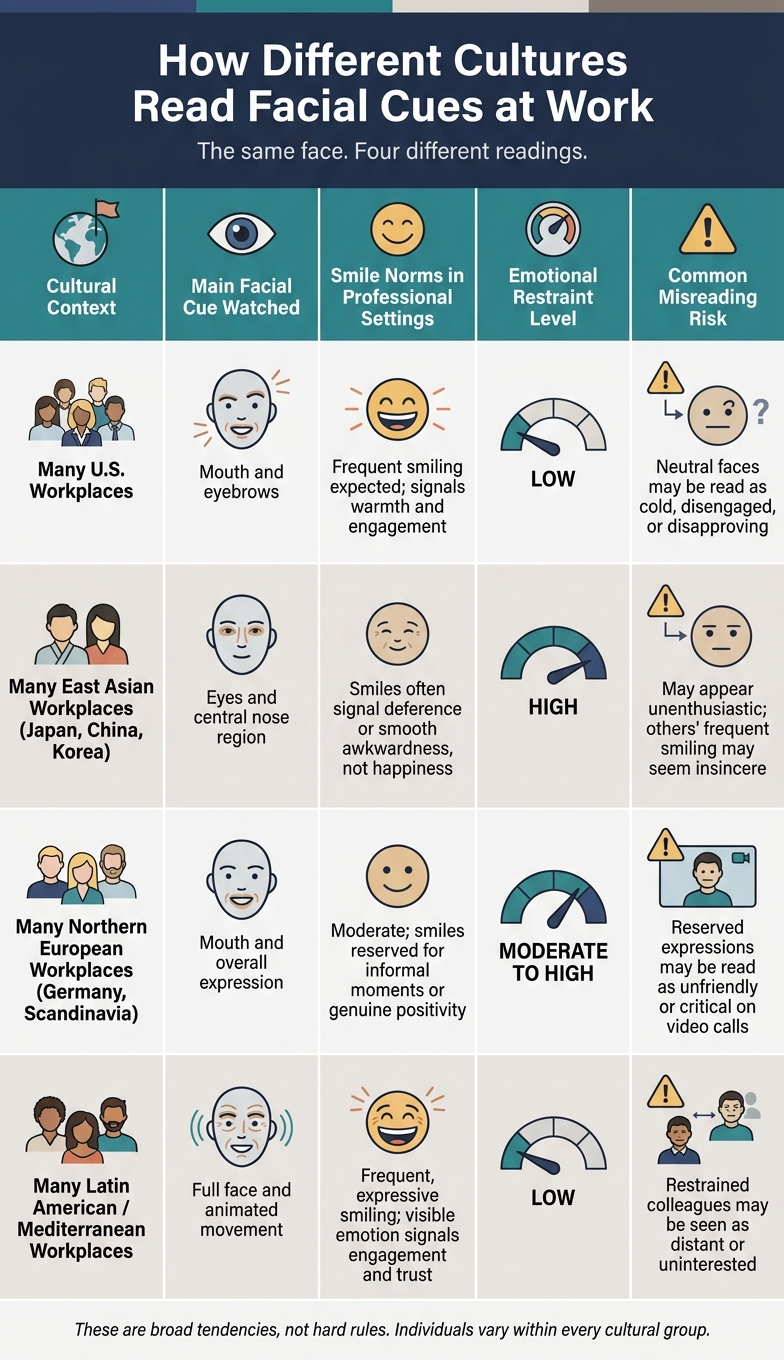
How Different Cultures Read Facial Cues at Work
Culture shapes which facial cues people see as meaningful. That helps explain why the same neutral face can seem calm in one team and cold in another.
Why smile frequency and eye cues do not mean the same thing everywhere
Research comparing East Asian and Western observers shows a steady split: people from East Asian cultures tend to pay more attention to the eyes and upper face, while Western observers often lean more on the mouth and eyebrows when reading emotion. So two teammates can watch the same video call and walk away with different takes on the exact same expression.
Smiling makes things even trickier. In many U.S. workplaces, frequent smiling signals warmth, openness, and engagement. But in some East Asian, Northern European, and more formal corporate settings, smiling during serious discussions can point to discomfort or deference, not happiness.
That matters because a composed, neutral face may be doing a job. A colleague from a culture that values emotional restraint may keep their expression controlled to show respect and professionalism, not coldness or lack of interest.
And the misread cuts both ways. Neither interpretation is automatically right, even if it feels obvious in the moment. A smile, a neutral face, or a steady gaze is a cue, not a conclusion.
Comparison table: display norms and attention patterns across cultures
The table below shows broad patterns. They are tendencies, not hard rules. People vary within every group.
| Cultural context | Main cue people watch | Smile norms in professional settings | Restraint norm | Common misreading risk in global teams |
|---|---|---|---|---|
| Many U.S. workplaces | Mouth and eyebrows | Frequent smiling expected; signals warmth and engagement | Lower. Visible reactions are often seen as honest and approachable | Colleagues with neutral faces may be read as cold, disengaged, or disapproving |
| Many East Asian workplaces (e.g., Japan, China, Korea) | Eyes and central nose region | Smiles often used to smooth awkwardness or show deference, not only to express happiness | Higher. A neutral or controlled face can signal respect and competence | May be read as unenthusiastic or withholding; frequent smiling from others may seem insincere |
| Many Northern European workplaces (e.g., Germany, Scandinavia) | Mouth and overall expression | Moderate. Smiles are often saved for informal moments or genuine positivity | Moderate to high. Emotional restraint in formal settings is standard | Colleagues may read reserved expressions as unfriendly or critical, especially on video calls |
| Many Latin American/Mediterranean workplaces | Full face, animated movement | Frequent, expressive smiling; visible emotion signals engagement and trust | Lower. Animated expressions are often expected and valued | Restrained colleagues may be seen as distant or uninterested |
Culture is only one lens, though. Stress, burnout, trauma, and personality also shape what people think they see. Specialized AI tools for helping professionals can help teams navigate these complexities by tracking actions and providing coaching insights.
Stress, trauma, burnout, and personality all shape what people think they see
Culture sets the lens. Stress and personality affect how clear that view feels. On top of that, stress, trauma, burnout, and personality all shape which facial cues people pick up and what meaning they attach to them.
How burnout and trauma can make neutral faces seem threatening
Burnout can push the brain into a hyperalert state. When that happens, neutral faces are easier to read as negative. In a study of healthcare providers, burnout was linked to lower accuracy for anger and fear, along with more misclassification of ambiguous expressions [7][12][13]. Picture a case manager who is running on fumes. On a video call, they may see a coworker’s neutral face as annoyance, when that coworker is simply focused on a case file.
Trauma exposure adds another layer. People in a hyperalert state often notice tiny signals, like tight lips, a brief look away, or a fast shift from smiling to neutral, then connect those cues to old threat patterns. A shelter worker, for example, may read a serious listening face as contempt or hostility even when there is no conflict at all [10][11][9]. Studies of social workers and child protection staff link repeated trauma exposure to over-detecting disapproval in faces where none was intended [11][14][15].
How personality affects whether someone sees tension, criticism, or warmth
Personality changes the threshold for threat too. People high in neuroticism tend to label ambiguous faces as angry sooner. People who are highly agreeable are more likely to read warmth into tense expressions [8]. On a global team, these filters stack on top of cross-cultural differences. A team member high in neuroticism may often experience colleagues from low-smile cultures as critical or distant. A highly agreeable teammate may miss real friction until it turns into a bigger problem.
Neither pattern is wrong by nature. These are filters, and they often work below conscious awareness. Tools like Personos can help surface those patterns in real time and nudge people toward a clarifying question instead of a snap judgment.
The answer is not better guessing. It is shared rules for checking intent.
How global teams can cut down on facial-cue errors
Use interpretation rules instead of snap judgments
People don't read faces in a vacuum. Culture, stress, and personality all shape what we think we see. That's why teams need shared rules for reading facial cues instead of making split-second calls.
Set a few default rules before problems show up. Start with this one: treat a neutral face as ambiguous, not negative. If someone looks serious or quiet, assume they're thinking unless they say otherwise. Add a second rule: assume task focus before conflict. If a teammate looks tense, think workload or concentration first, not personal friction.
Build these defaults into onboarding and team norms so everyone starts from the same place.
If something still feels off, don't jump into confrontation. Ask a calm, low-pressure question instead. You can ask how the proposal is landing, whether anything is worrying them, or how they're reacting so far.
It's also smart to read face, voice, and context together. A stern expression paired with a steady, supportive tone and solution-oriented comments usually points to engagement and problem-solving, not hostility. On the flip side, if someone is smiling but their voice is flat and their words point to burnout, take the words at face value.
When a facial cue still sticks with you, hold off on making a firm call during the meeting. Follow up in private afterward. A short message asking how the discussion landed can clear up far more than any in-meeting assumption.
The goal is to slow down judgment, not to get better at guessing.
Conclusion: what teams should take away
Facial cues do carry information, but they never tell the whole story. Neutral faces often get read as cold. Serious faces can look critical. Smiles may be mistaken for agreement when they're just a sign of politeness.
In remote meetings and cross-border work, context is thin and norms differ. That makes misreading easier, and each unchecked assumption adds a bit more friction. The goal isn't better face-reading. It's better checking before reacting.
FAQs
Why do neutral faces seem negative?
Neutral faces can come across as negative because people often read their own bias and expectations into what they see. That tends to happen even more when social or cultural norms don't line up. If a face doesn't show a clear emotion, some people may read it as disengagement, dissatisfaction, or even hostility.
Nonverbal cues play a big part in how people make sense of communication. So when a person isn't showing a warm or positive expression, others often fill that blank space with negative assumptions.
Which facial cues vary across cultures?
Eye contact and smile frequency don't mean the same thing everywhere. In one setting, steady eye contact can signal confidence and attention. In another, it may come across as rude or overly direct.
People use the same facial muscles, but that doesn't mean expressions are read the same way across every group. Small shifts in tension, posture, or timing can land differently depending on context.
Personos can help teams make sense of those differences. Instead of relying on broad assumptions, they offer context-aware guidance that helps people read cues with more care.
How can teams check intent better?
Teams can read intent more accurately when they set a baseline in low-pressure settings. That gives people a clearer sense of each person’s usual tone, expression, and style, which makes changes easier to spot when a tense discussion starts.
Facial expressions alone can still point people in the wrong direction. So it helps to check those signals through open conversation instead of guessing. A simple follow-up can go a long way, especially when emotions are running high.
AI platforms like Personos can support this by giving real-time, personality-aware guidance and tailored prompts. That might mean suggesting a different way to phrase a message or nudging someone to acknowledge the other person’s emotions, so the message lands the way it was meant to.