Global Team Emotion Norms: Comparison Guide
Quickly compare meeting, feedback, conflict, and client norms across US/Northern Europe, East Asia, Latin America, and the Middle East.
Rachel Johnson

Global Team Emotion Norms: Comparison Guide
The same emotional style can help you in one team and hurt you in another. If you work across the U.S. and Northern Europe, East Asia, Latin America, or the Middle East, you need to read four things fast: meetings, feedback, conflict, and client work.
Here’s the short version:
- U.S. and Northern Europe: clear, direct, controlled emotion
- East Asia: private feedback, harmony, indirect disagreement
- Latin America: visible warmth, relationship-first talk, high-energy meetings
- Middle East: warm but hierarchical, face-saving, strong personal rapport
- Personality matters too: Big Five traits affect who speaks up, who pulls back, and who feels strain from team emotion rules
This matters because style mismatches can cut team efficiency by 20% to 30%. And communication that is too soft or vague can lower productivity by 15% to 20%. On top of that, hiding emotion for long periods is tied to burnout and emotional exhaustion.
If I had to reduce the guide to one rule, it would be this: match your tone to the person, the room, and the job using personality reports for better empathy.
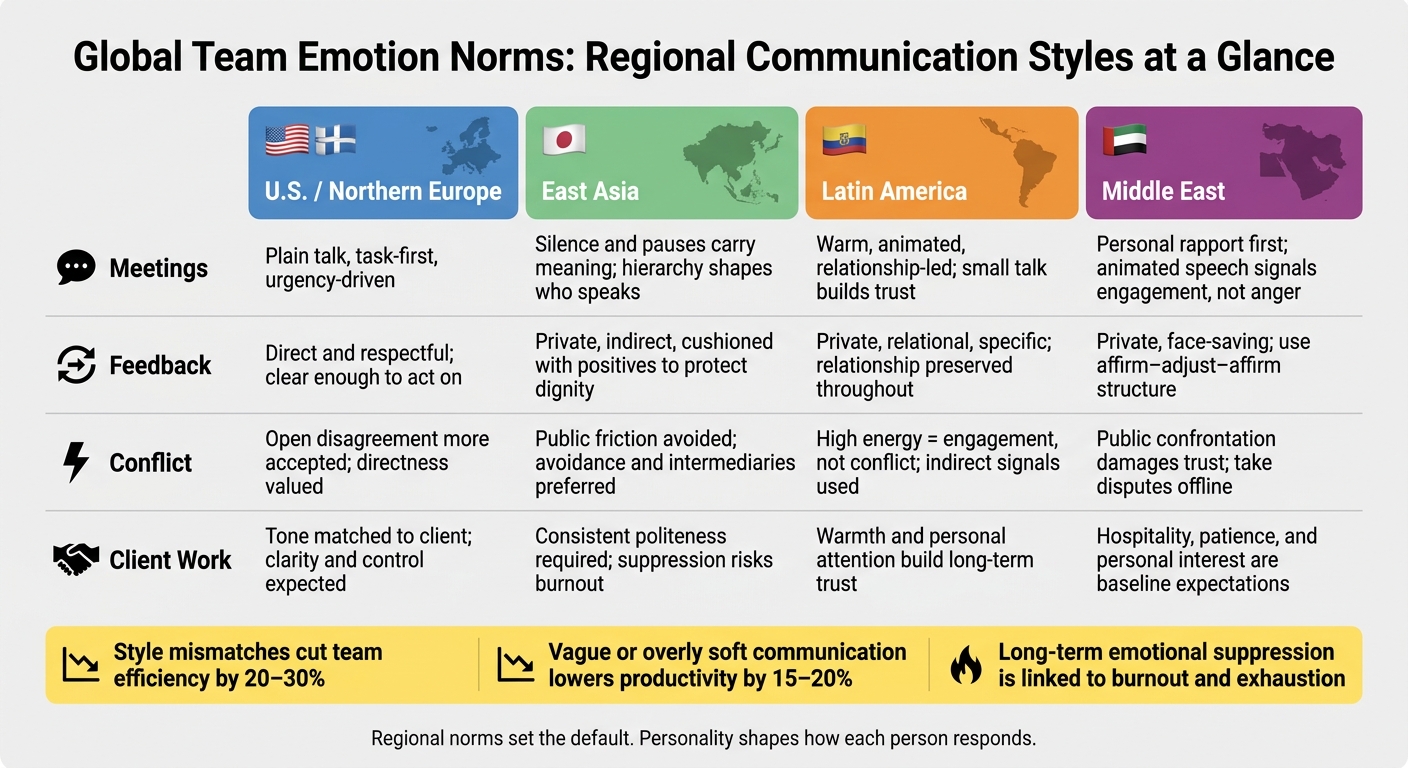
Global Team Emotion Norms: Regional Communication Styles Compared
Ep.078 - Creating connection in your global team
Quick Comparison
| Region | Meetings | Feedback | Conflict | Client Work |
|---|---|---|---|---|
| U.S. / Northern Europe | Plain talk, task focus | Direct and respectful | Open disagreement is more accepted | Tone should fit the client, with control and clarity |
| East Asia | Pauses and silence carry meaning | Private and indirect | Public friction is often avoided | Politeness is expected, but suppression can wear people down |
| Latin America | Warm, animated, relationship-led | Private, relational, clear | High energy does not always mean conflict | Personal warmth helps build trust |
| Middle East | Warm rapport plus hierarchy | Private, face-saving | Public pushback can damage trust | Hospitality, patience, and personal attention matter |
I’d use this guide as a fast filter, not a fixed rulebook. Regions set the default. Personality matters in how each person will react.
1. U.S. and Northern Europe
In U.S. and Northern European teams, people often speak plainly. Still, tone isn't one-size-fits-all. What works depends on the person, the moment, and the stakes. In day-to-day work, that broad norm shows up most clearly in four settings: meetings, feedback, conflict, and client work. As you move through those settings, the emotional pressure tends to climb.
Meeting Expression
In meetings, align your emotional tone with the person in front of you. Some coworkers want urgency and the bottom line first. Others respond better to structure and proof. Big-picture thinkers may lean into energy and momentum, while relationship-focused teammates often want to hear that the human side has been seen.
That shift matters. The same emotion can land in very different ways depending on the setting. Impatience might look like drive with one person, but with someone else it can come off as disrespect.
The same idea carries into feedback, where being clear matters, but so does keeping respect in place.
Feedback Style
Feedback tends to work best when it's plain and respectful. It should be direct enough that someone can act on it, but measured enough that trust stays intact. When communication styles don't line up, organizational efficiency can drop by 20% to 30% [1].
When feedback becomes disagreement, the job changes. It stops being only about clarity and starts being about repair.
Conflict Display
When conflict comes up, shape your response to both the urgency of the issue and the state of the relationship. In a time-sensitive moment, a more directive response may be the right call. If the goal is longer-term growth, a coaching-style approach usually lands better. This can be achieved by scaling personalized coaching across the team.
It also helps to check understanding instead of guessing. An open-ended question can do more than a quick "makes sense?" because it shows whether the message actually got through.
Client work adds another layer, since tone affects trust just as much as the work itself.
Client-Facing Emotional Labor
Client-facing work calls for deliberate shifts in visible warmth, restraint, and urgency based on what the client expects, not just on the message you're trying to deliver. In other words, how you say it can matter as much as what you say.
And going too soft or too vague has a cost too. Those styles can lower productivity by 15% to 20% [1].
2. East Asia
In Chinese, Japanese, and South Korean workplaces, communication is shaped by collectivism, hierarchy, and harmony. You can see it in meetings, feedback, conflict, and client work. Personality matters too. People high in Agreeableness and Conscientiousness often fit this style more easily. People high in Extraversion, or those who struggle with ambiguity, may find it harder. In practice, the first signs usually show up in meetings: silence, hesitation, and indirect disagreement.
Meeting Expression
Compared with the U.S. and Northern Europe, silence, pauses, and qualified agreement often mean more than blunt statements. A long pause or polite “yes” may actually signal deep doubt. Junior staff also tend to avoid challenging senior people in front of a group, because hierarchy affects who speaks first and how concerns are voiced.
For mixed teams, live debate can miss what people are actually thinking. Written input and follow-up one-on-ones often bring out concerns that never surface in the room.
Feedback Style
Critical feedback is usually delivered privately and indirectly. Negative points are often cushioned with positive comments and softened with qualifying language to protect the other person’s dignity. Even mild public criticism can damage trust and make later teamwork much harder.
A better approach is simple: use regular, low-key check-ins instead of rare, high-pressure reviews.
Conflict Display
Open conflict, like raised voices, direct blame, or visible frustration, is often seen as unprofessional and damaging to relationships across China, Japan, and South Korea. Disputes are more likely to move through intermediaries or private conversations than open group debate. Research on Japanese employees, in particular, points to avoidance as the preferred conflict strategy: staying quiet, stepping back from arguments, and steering away from contentious topics in public.
That means public blame usually backfires. Face-saving language and private channels work better.
The same logic carries into client interactions.
Client-Facing Emotional Labor
Workers are often expected to stay consistently friendly and hide negative emotions, even when customers behave badly. In many cases, that means holding a polite expression all day long. Studies on Chinese service workers link long-term emotional suppression to emotional exhaustion and burnout. The issue is not professionalism itself. The issue is the cost of keeping up that standard with no room to recover.
A few practical steps can help:
- Rotate high-intensity client work
- Protect recovery time
- Train emotion regulation
Latin America often moves in the other direction, where warmer visible emotion is more often seen as a strength than a risk.
3. Latin America
In many Latin American workplaces, including Brazilian, Mexican, Colombian, and Argentine teams, emotion is part of how trust gets built. It’s not something people try to hide. Many teams lean toward group-minded, family-centered, harmony-first norms. Communication runs on shared context and relationships, so tone, body language, and shared history can matter just as much as the words being said.
Compared with the direct style common in the U.S. and the more restrained style often seen in East Asia, Latin American teams usually see visible warmth as a plus. People high in Extraversion and Agreeableness often settle in more easily. By contrast, people who prefer blunt, low-emotion exchange may mistake warmth for inefficiency.
Meeting Expression
Meetings often start with personal conversation about family, local events, or how people are doing before shifting into business. That can feel slow to someone used to a task-first U.S. pace. But in this context, it helps set trust.
Unlike the task-first pace common in the U.S. or the deference-heavy silence of many East Asian meetings, visible emotion, animated gestures, a passionate tone, and even overlapping speech, is often read as engagement and sincerity, not a lack of professionalism.
Junior team members may still hesitate to challenge senior leaders in the room. Concerns may come up later, after the meeting, instead of during it. Decision-making can also take more time as teams look for buy-in and try to avoid harm to key relationships. That same relationship-first logic shapes feedback and conflict triggers too.
Feedback Style
Unlike the task-focused directness of U.S. teams or the hierarchy-driven indirectness of East Asian ones, the rule here is relational. Give negative feedback in private. Start with the relationship. State the issue clearly. End with a shared next step.
The aim is simple: stay specific and keep accountability in place without turning feedback into a relationship-breaking moment.
Conflict Display
Unlike the open debate that can be acceptable in U.S. teams, high energy here often signals engagement, not conflict. That’s an easy point to miss if you’re reading the room through a U.S. or Northern European lens.
When real disagreement does exist, it is more likely to be handled one-on-one or through indirect signals such as questions, alternatives, or silence. Teams from more direct cultures often miss those softer cues and read them as agreement.
Client-Facing Emotional Labor
Unlike the restraint expected in many U.S. or East Asian client interactions, client relationships here often depend on warmth, personal attention, and long-term commitment. Staff are expected to stay pleasant, manage frustration quietly, and protect the relationship.
Organizations can support this work with:
- Debriefs
- Scripts
- Role plays
- Training on high-context cues and positive framing
A blunt, efficiency-first approach can feel cold here, even if it works well in U.S. or Northern European teams. This warmth also stands apart from the more restraint-heavy styles often linked with the Middle East.
4. Middle East
Middle Eastern teams often mix warmth with a stronger chain of command and stricter face-saving than Latin America. In many workplaces across the Gulf, Egypt, Jordan, Lebanon, and Morocco, relationships come first, and public embarrassment is not acceptable. The exact style shifts by country, industry, and seniority. Hofstede data place Arab countries at a Power Distance score of 80 and an Individualism score of 38, which points to strong respect for hierarchy and group loyalty.[2][3] People with high social sensitivity tend to read these settings well. By contrast, blunt, low-context communication can misread silence and hedging.
Meeting Expression
Meetings often start with personal connection and small talk. That isn't just casual rapport. It helps build trust before business begins, especially in a more hierarchical setting. Once the work discussion starts, animated speech, emphatic gestures, and raised voices may signal engagement, not anger.[4][12][14]
Junior staff are much less likely to challenge a senior leader openly in the room. What sounds like agreement, or comes across as hedged language, may quietly signal hesitation or a soft no.[7][17] U.S.-style directness can come off as disrespectful here, while East Asian-style silence may still need follow-up through a senior intermediary.
Feedback Style
Criticism should be given in private. Public correction is often taken as a loss of face. A common approach is affirm-adjust-affirm: begin with sincere appreciation, address the specific behavior and its impact, then end by restating confidence in the person. Softened language helps frame the issue as an adjustment, not a failure.[11][13]
There are exceptions. Some UAE financial hubs use more direct, KPI-driven feedback, while Emirati-led firms tend to protect face more carefully.[15]
Conflict Display
Public confrontation can harm trust fast. When there is real disagreement, it often does not show up as direct pushback in the room. Instead, it may appear through shifts in tone, pauses, side conversations, or indirect questions. U.S.-based teams often read that as agreement or evasiveness, but it's usually neither.[7][12][14]
A better move is to take the issue offline, return to shared goals, and give people space to think. In higher-stakes cases, a trusted senior person or intermediary may be the best channel for easing tension, rather than pushing for an immediate public answer.[16] The same face-saving pattern carries into client work.
Client-Facing Emotional Labor
Client-facing roles in this region come with a high hospitality standard. Warmth, patience, and personal interest are basic expectations.[5][6] Staff are expected to stay composed and show close attention, even when they are managing frustration internally.
Practical support can include:
- Clear escalation paths
- Training on culturally appropriate empathy
- Performance reviews that reward relational effort, not just speed or volume[8][9][10]
5. Personality-Aware Tools for Team Guidance
Regional norms set the baseline. Personality-aware tools help teams adjust that baseline to the actual person in front of them.
It’s one thing to understand emotion norms across cultures. It’s another to use that insight with real people on a real team. That’s where personality-aware tools come in. Built on the Big Five traits, they turn trait profiles into practical guidance for managers. You see the payoff most in meetings, feedback, conflict, and client work.
Meeting Expression
A team’s shared personality profile can shape how meetings work best. If most members score high on Conscientiousness and low on Extraversion, a structured agenda and pre-reads sent ahead of time will usually work better than open-ended debate on the spot. Tools like Crystal can flag communication preferences and likely friction points before the meeting even begins.[19]
For global teams, some platforms can also warn when harmony-oriented members may hold back disagreement in group settings. In those cases, an anonymous pulse survey after a tense discussion can help surface what didn’t get said out loud.
Feedback Style
Personality-aware tools can also build feedback scripts based on individual trait profiles. For someone high in Neuroticism and Conscientiousness, the guidance usually points to private, scheduled conversations with concrete behavior-based steps and little emotionally charged language. For someone high in Extraversion and Openness, direct feedback in the moment may land better.
Personos (personos.ai) generates feedback talking points from a detailed Big Five profile, then adds contextual memory and real-time prompts.[18]
Conflict Display
Trait data can help leaders spot who may escalate, withdraw, or give in too much during conflict. Two teammates who are both high in extraversion and low in agreeableness are more likely to clash openly. A personality-aware tool can flag that mix and suggest ground rules before tension boils over, like turn-taking or a neutral facilitator.
For people high in Neuroticism and low in Extraversion, the risk often runs the other way. They may shut down during heated meetings. In that case, async follow-up and 1:1 conversations after group conflict are often the better move.
The same patterns show up in client work too, especially when the job calls for steady emotional control.
Client-Facing Emotional Labor
Faking positive emotion raises exhaustion and lowers loyalty. Genuine emotion regulation tends to work better and leads to less burnout.[21][22] Traits affect which path people lean toward. Neuroticism predicts surface acting, while higher Extraversion and Openness support more effective deep acting.[20][22] Staff high in Agreeableness may also need extra help with boundaries so they don’t overextend themselves.
For teams that need in-the-moment support during high-stakes interactions, Personos uses full personality profiles plus contextual information to give real-time guidance for difficult interactions. That can help practitioners adjust tone, pacing, and emotional presence for specific clients.[18]
Used well, these tools sharpen judgment instead of taking its place. Trait profiles should guide decisions, not dictate them.
Pros and Cons of Each Emotion-Norm Approach
No single emotion-norm approach works in every setting. Each one makes a different trade between speed, harmony, trust, and candor. And when communication styles clash, the cost is real: misalignment can cut organizational efficiency by 20% to 30% [1].
The table below turns those regional patterns into a quick guide for managers. It stays focused on the same four situations covered in this guide: meetings, feedback, conflict, and client-facing work.
| Subject | Key Strengths | Main Risks | Best Fit Situations | Watch-Outs for U.S.-Based Leaders |
|---|---|---|---|---|
| U.S. / Northern Europe | Speed, clarity, and objective decision-making | Can come across as cold, blunt, or aggressive | Short-term sprints; technical or engineering projects | Don't treat Northern European silence as agreement or U.S. enthusiasm as a guarantee |
| East Asia | Long-term harmony, high reliability, and meticulousness | Ambiguity; "Yes" may mean "I hear you", not "I agree" | Quality control; long-term R&D; long-cycle operations | Avoid public criticism; it usually damages trust |
| Latin America | High energy, creativity, and strong team loyalty | Slower decisions; time flexibility can look like low urgency to direct-culture teams | Sales, marketing, brainstorming, crisis management | Build the relationship first; small talk is part of the work |
| Middle East | Deep trust-based partnerships; high commitment | Visible intensity can be misread as volatility | High-stakes negotiations; long-term strategic alliances | Passionate debate signals engagement, not a personal attack or loss of control |
Personality also shapes how these norms play out. The same style can click with one teammate and fall flat with another. Extraversion tends to help in more expressive cultures. Conscientiousness often fits better in structured settings. Agreeableness can work well where harmony comes first. Neuroticism, on the other hand, can increase burnout risk in places where emotional restraint is expected.
These trade-offs create the starting point. The conclusion shows how to match the right norm to the audience and the task.
Conclusion
Across regions, the same emotion can either build trust or damage it. There isn’t one emotion rule that works for every team. Directness may come across as confidence in one place and disrespect in another. Warmth may help build trust in one setting and seem unprofessional in the next. That disconnect leads to miscommunication and slows work down.
Culture sets the default, but personality shapes how it shows up. Regional norms give you the starting point, and personality tells you what will actually land well. A high-Agreeableness teammate from a region still needs different guidance than a low-Agreeableness teammate from that same region. You see this most clearly in meetings, feedback, conflict, and client-facing work.
For leaders managing global or mixed teams, three moves matter most:
- Define what professional and respectful mean for this team
- Add async and written channels
- Adjust to the individual
Small changes can prevent costly misalignment. Match the emotion norm to the person, the setting, and the task.
FAQs
How can I tell if silence means agreement or hesitation?
Look for patterns in nonverbal behavior, not one-off signals. If someone says “yes” but avoids eye contact, slouches, or keeps a closed posture, that silence may point to inner conflict instead of real agreement.
It also helps to know how they usually act when they’re relaxed. Tools like Personos can add personality-aware insight, which makes it easier to tell the difference between a quiet, reflective teammate and someone showing unspoken hesitation or frustration.
What should I do if my direct style hurts trust on a global team?
Move away from blame and toward shared problem-solving. Listen closely, show that you understand the other person’s point of view, and use "I" statements to explain what you need without coming across as accusatory.
It also helps to adjust how you communicate based on your colleagues’ preferences. Some people want more context before they talk about next steps. Others need a bit more rapport first. Tools like Personos can help here too, offering real-time, personality-based guidance and prompts that make it easier to handle these differences and build trust.
How do personality traits affect the best feedback approach?
Personality traits shape how people take in information, handle emotions, and react to criticism. That’s why a one-size-fits-all feedback style usually falls flat.
For example, some people want feedback that’s logical, objective, and concise. Others are more open to it when you start by finding common ground and showing empathy. Tools like Personos can help tailor your language and tone, so feedback is more likely to be heard and acted on.