Why the Future of Work Needs 'People-First' AI
People-first AI puts human needs before efficiency—reducing burnout, improving communication, and keeping humans in control of high-stakes work.
Nick Blasi

Why the Future of Work Needs 'People-First' AI
AI can transform workplaces - but only if it prioritizes people over pure efficiency.
People-first AI focuses on improving collaboration between humans and technology. Instead of replacing workers, it helps reduce stress, improve communication, and support complex decision-making. Here's why it matters:
- Human Oversight: Unlike traditional AI, people-first AI ensures humans stay in control, making better decisions in nuanced situations.
- Workplace Benefits: Tools like Heineken Ireland's "People Pal" save time by automating repetitive tasks, allowing employees to focus on productivity, mentoring, and problem-solving.
- Reducing Burnout: AI platforms like Personos simplify overwhelming data into actionable insights, helping workers manage stress and improve relationships.
- Empathy in AI: Generic AI often misses the mark on human connection. People-first AI prioritizes empathy and tailored support, especially for helping professions like social work.
Workplace Challenges That Require People-First AI
The Mental and Emotional Burden on Helping Professionals
Helping professionals often find themselves drowning in paperwork, leaving little time for the core of their work - caring for people. For instance, care workers spend a staggering 65% of their week on administrative tasks, while social workers manage to dedicate just 20% of their time to direct client interactions [7]. To make matters worse, social workers juggle between 40 and 80 cases each month, with child protective cases requiring up to 400 forms - amounting to a mind-boggling 2,500 pages [7].
"Without proper documentation, people slip through the cracks." - Jason Codrington, Manager of Adult Social Care Intake, Ealing Council [7]
This overwhelming focus on documentation creates a vicious cycle. Instead of delivering the compassionate, hands-on care their clients desperately need, professionals are stuck behind desks. This not only risks burnout but also detracts from the meaningful interactions that could truly make a difference in people’s lives. Every hour spent on paperwork is an hour taken away from care.
Such challenges reveal a critical flaw in generic AI systems: they focus on efficiency at the expense of addressing real human needs.
Why Generic AI Falls Short for Human Needs
While standard AI tools often promise greater efficiency, they can unintentionally worsen existing problems. Research from UC Berkeley, based on interviews with 200 tech employees, showed that while AI expanded the variety of tasks, it also blurred work-life boundaries. Employees found their workloads spilling into lunch breaks and evenings [9][10]. One engineer shared that even with improved productivity, work hours didn’t decrease due to escalating expectations [9][10]. In some cases, teams faced tripled expectations, while productivity gains were a mere 10% [9].
This disconnect between leadership and employees further complicates matters. While 80% of workers believe human connection is more important in the AI era, only 65% of managers share this sentiment [8]. Even more concerning, nearly half of CEOs (49%) admit they don’t prioritize empathic connections with their staff. In fact, by 2025, the number of CEOs viewing empathy as essential dropped by 28% compared to the previous year [8].
Stanford psychologist Jamil Zaki warns about the dangers of "empathy-washing", where shallow gestures - like chatbots saying, "We care about your experience" - mask deeper organizational detachment.
"Shallow algorithmic attempts at empathy (a chatbot saying 'we care about your experience') can be worse than nothing." - Jamil Zaki, Psychologist, Stanford University [8]
Generic AI systems prioritize speed and efficiency, but helping professions demand something deeper: thoughtful, reciprocal, and authentic human judgment. This reveals the pressing need for people-first AI - an approach that emphasizes empathy and provides tailored support to meet these unique challenges.
The Future of HR: Human First, AI Second
How People-First AI Improves the Workplace
People-first AI doesn’t just make tasks faster; it helps reduce stress, improves communication, and enhances workplace outcomes by focusing on human interactions.
Lowering Burnout with Personalized Support
Burnout often stems from mental overload and stress-driven decisions. People-first AI addresses this by simplifying complex interpersonal data into actionable, real-time guidance tailored to specific needs. Instead of piling on more tasks, platforms like Personos provide clarity and support.
Mike Walker, Executive Leadership Coach and Founder of Dynamic Decisions Coaching, explains:
"Personos helps clients organize often overwhelming amounts of mental and physical information to make better, creative, more informed decisions that incorporate their values and preferences, as well as those with whom they are interacting." [11]
Using the Five-Factor Model (Big Five) of personality psychology, Personos evaluates 30 personality traits on an 80-point scale, delivering insights in just five minutes [12]. For professionals, this isn’t just about efficiency - it’s about confidence. Steve Huff, PhD, Founder of THRiVE Coaching, highlights:
"Personos isn't just technology, it's a teaching partner. A constant criticism of AI is that it makes us dumber. To the contrary, Personos helps make our members smarter about how they communicate." [12]
By offering tailored support, this approach not only eases burnout but also fosters better team dynamics and client relationships.
Improving Team Communication and Client Relationships
Unlike generic AI that provides one-size-fits-all solutions, people-first AI adapts to individual personalities, helping professionals fine-tune their communication styles. This personalization is key in both team settings and high-stakes client interactions.
For example, managers can adjust their approach - offering structure to team members who need guidance or autonomy to those who prefer independence [12]. In sensitive scenarios, like a social worker discussing child safety, the AI provides prompts based on personality insights, ensuring empathy remains at the forefront [12].
Christian Thomas, CEO and Co-Founder of Personos, underscores this philosophy:
"AI shouldn't just help people be more efficient but help people truly listen and understand each other better to foster connection and create impact." [12]
By making advanced psychological insights accessible to everyone - not just executives - people-first AI brings professional-grade coaching to frontline workers in nonprofits and other helping professions [12]. This leads to stronger relationships, improved well-being, and better results.
Tracking Results and Scaling Impact Responsibly
Evaluating the success of people-first AI means looking beyond efficiency metrics to focus on outcomes like trust, empowerment, and relationship quality. Organizations are shifting from tracking tool usage to measuring tangible business results and employee satisfaction.
In December 2025, Workday introduced its "EverydayAI Program", led by Chief Learning Officer Chris Ernst and Program Leader Garrett Gatlin. The initiative emphasized mindsets, skills, and sustainable habits - what they termed "operationalizing empathy." Within six months, the program achieved 85% workforce adoption. High adopters in the global sales team spent an extra hour weekly engaging with prospects, resulting in a 2.1x increase in annual contract value. The program also reclaimed an estimated one week of productivity per employee [13].
Heineken Ireland’s "People Pal" system scored 88% on employee empowerment and accountability in the Great Place to Work Trust Index. People Director Debra Popplewell highlighted:
"Our focus has always been on how to create a better employee experience not to replace human interaction." [5]
Scaling responsibly involves collaboration across HR, IT, and Learning & Development to ensure tools meet the diverse needs of different roles [2][4]. This balanced approach ensures people-first AI delivers meaningful, human-centered impact.
Personos: A Leading People-First AI Platform
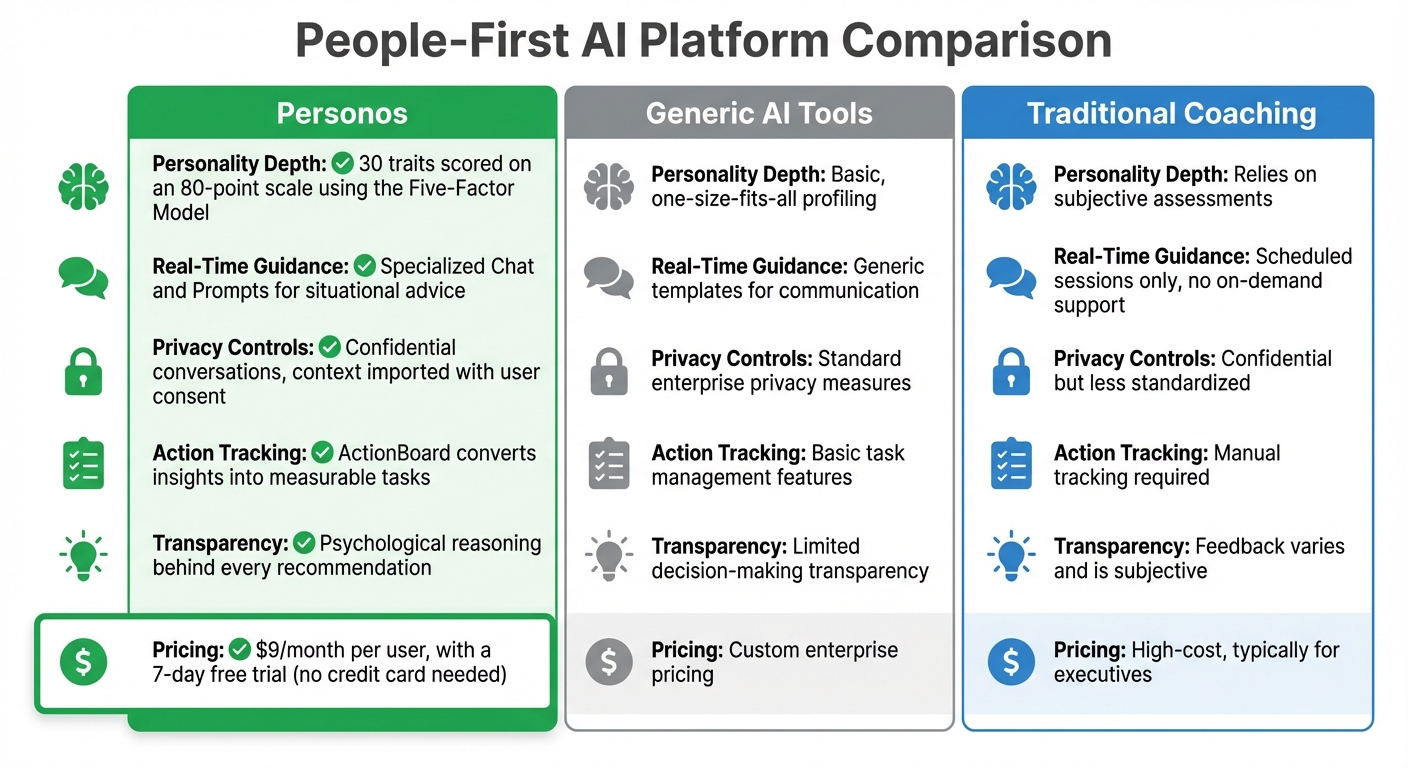
Personos vs Generic AI Tools and Traditional Coaching Comparison
Personos is a tailored solution designed for professionals like social workers, case managers, coaches, counselors, and nonprofit staff who deal with intricate human interactions daily. Unlike generic AI tools that prioritize speed over depth, Personos is built on the Five-Factor Model of personality psychology. It evaluates 30 personality traits on an 80-point scale, offering personalized guidance that aligns with each individual’s communication style and emotional needs.
This platform fills a major gap in the market. Traditional executive coaching is often too expensive for frontline workers, but Personos makes high-quality psychological insights accessible. At just $9 per month per user, it bridges the gap, providing tools and insights once reserved for executives to those on the frontlines. The results speak for themselves - Sarah Mitchell, MBA, VP of Operations, reported that her team reduced turnover by 45% in just six months by using Personos to identify and address team dynamics with tailored scripts for managers [15].
Core Features of Personos
Personos offers four integrated tools that transform insights into meaningful actions.
- Personos Chat: This AI assistant is tailored to specific roles and uses full personality profiles and situational context. Users can include details about relationships or groups with "@" mentions, ensuring the advice is directly relevant to the situation [14].
- Dynamic Reports: These reports provide insights at three levels - personal (self-awareness), relationship (interpersonal dynamics), and group (team interactions). They adapt as circumstances change and include specialized guidance, such as advice on trauma responses and readiness for resources [14].
- Personos Prompts: These short, actionable tips are delivered on a user-defined schedule - daily, weekly, or monthly. They’re designed to keep personality insights top of mind. Carla Mendoza, LCSW, an addiction recovery counselor, shared: "In recovery, timing is everything. Personos helps me anticipate when a client is on the edge of shutting down and adjust my approach so we stay connected" [15].
- ActionBoard: This Kanban-style task manager turns insights into trackable tasks. Users can convert chat messages, report sections, or prompts into actionable items. Practitioners can assign tasks to clients, monitor progress, and document outcomes for funders and supervisors. Steve Huff, PhD, a social work veteran, described it as a "teaching partner" that enhances communication in high-pressure situations [12].
What sets Personos apart is its commitment to transparency. Every recommendation includes the psychological reasoning behind it, detailing which traits and principles were considered. This approach not only builds trust but also helps practitioners develop their own expertise over time, rather than relying entirely on the AI [14].
Personos Compared to Other AI Tools
When considering people-first AI platforms, professionals should evaluate how well a tool understands personality, its ability to provide real-time guidance, privacy measures, and overall affordability. The table below highlights how Personos stacks up against generic AI tools and traditional coaching:
| Feature | Personos | Generic AI Tools | Traditional Coaching |
|---|---|---|---|
| Personality Depth | 30 traits scored on an 80-point scale using the Five-Factor Model [14] | Basic, one-size-fits-all profiling | Relies on subjective assessments |
| Real-Time Guidance | Specialized Chat and Prompts for situational advice [14] | Generic templates for communication | Scheduled sessions only, no on-demand support |
| Privacy Controls | Confidential conversations, context imported with user consent [14] | Standard enterprise privacy measures | Confidential but less standardized |
| Action Tracking | ActionBoard converts insights into measurable tasks [14] | Basic task management features | Manual tracking required |
| Transparency | Psychological reasoning behind every recommendation [14] | Limited decision-making transparency | Feedback varies and is subjective |
| Pricing | $9/month per user, with a 7-day free trial (no credit card needed) [15] | Custom enterprise pricing | High-cost, typically for executives |
This comparison highlights a key difference in approach. While generic AI tools and traditional coaching models often focus on efficiency or structured sessions, Personos is designed to help professionals handle the emotional challenges of their roles with empathy and confidence. As Christian Thomas, CEO and Co-Founder of Personos, explains: "AI shouldn't just help people be more efficient but help people truly listen and understand each other better to foster connection and create impact" [12].
How to Implement People-First AI Ethically
Keeping Humans in Control and AI Transparent
A key principle for ethical AI use is ensuring that humans retain control over critical decisions. AI should never act independently on high-stakes matters without explicit human approval. Think of it this way: humans are the "Agent Bosses", while AI serves as a digital assistant. This setup ensures that ultimate responsibility stays with people. To support this, systems should be designed with intentional checkpoints - moments where human review and approval are mandatory before moving forward [1][18].
Transparency is another cornerstone of ethical AI. Every AI recommendation should clearly explain its reasoning in simple terms. For example, Personos includes explanations of the psychological factors behind its suggestions, helping users understand the "why" rather than blindly following advice. Additionally, organizations should avoid human-like avatars and instead use clear, functional labels like "Case Management Assistant." This prevents users from over-relying on AI or misunderstanding its role [17]. These steps make integrating Personos into your organization a smoother process.
To ensure AI aligns with workplace values, organizations should create joint governance teams that include both IT and HR departments. Involving frontline managers in these committees ensures the technology addresses real-world needs and respects human priorities [16][18].
Steps to Integrate Personos into Your Organization
Start small by piloting Personos in areas with noticeable inefficiencies, such as case management documentation. This allows you to gather feedback, build confidence, and showcase measurable results before expanding its use [16].
Data quality is critical - AI is only as effective as the information it receives. Begin by mapping workflows to identify pain points, like repetitive client communications or challenges in team coordination. Train your staff not just on how to use Personos, but also on its ethical boundaries. Reinforce that Personos is there to enhance their expertise, not replace their judgment.
Create a clear AI policy that addresses data sensitivity and ethical concerns while encouraging innovation. This policy should outline when human review is required and detail escalation procedures for any issues [16]. Track outcomes such as reduced burnout, improved client satisfaction, and time saved on administrative tasks. At just $9 per user per month, Personos offers an affordable way to demonstrate a solid return on investment.
Lastly, focus on fostering psychological safety. Treat AI adoption as a collaborative effort. Leaders should openly acknowledge when AI outputs are confusing or when errors happen. Distinguish between "smart risks" - learning opportunities during experimentation - and "sloppy mistakes", creating an environment where employees feel safe to explore and adapt to the technology [19]. As Sol Rashidi puts it:
"Tech is the easiest part of the AI lifecycle. When AI fails, it's usually human: failure of judgment, foresight or responsibility" [1].
Conclusion
People-first AI isn't about replacing human effort - it’s about enhancing human connection. By automating repetitive tasks, it creates what some call a "busywork dividend", allowing 98% of employees to dedicate their time to mentoring, creative problem-solving, and strategic thinking [3]. This approach enables professionals to focus on areas where machines fall short: empathy and complex decision-making.
The numbers tell a compelling story. Companies that prioritize employee experience are 70% more likely to see engaged teams and 92% more likely to have well-informed employees [4]. As Zeynep Ton from MIT puts it:
"The status quo mindset in leaders is to see labor as a cost to be minimized. Exemplary companies think of employees as drivers of customer satisfaction, profitability and growth" [4].
This perspective is what separates successful AI integration from the 95% of pilots that fail [6]. Success hinges on a strategic, thoughtful approach to implementation.
Personos exemplifies this people-first philosophy, offering its services at just $9 per user per month. It ensures humans remain in control, delivering real-time, personality-aware guidance that reduces burnout and enhances client outcomes. With a commitment to transparency and privacy, Personos focuses on complementing human expertise rather than replacing it.
The ethical strategies discussed earlier provide a clear path forward. Start small with a pilot project targeting high-friction areas - be it case documentation, client communication, or team coordination. Foster a culture of psychological safety by encouraging "smart risks" and treating mistakes as learning opportunities [19]. As Sapthagiri Chapalapalli aptly notes:
"The future is AI, the future is human" [6].
FAQs
What makes AI 'people-first' at work?
AI designed with a 'people-first' approach aims to amplify human abilities while staying grounded in core principles like empathy and teamwork. By incorporating human oversight - often referred to as "human in the loop" - these systems ensure that AI outputs align with human judgment, reducing the risk of mistakes. This approach helps build trust, enhances communication, and supports overall well-being. In such workplaces, AI becomes a true partner, working alongside employees to empower them while upholding essential human values.
How do you prevent AI from increasing burnout and expectations?
To keep AI from contributing to burnout, organizations need to put people first. This means creating an environment where psychological safety comes first and focusing on strategies that prioritize employees' well-being. Use AI to handle repetitive tasks, freeing up time for employees to focus on more meaningful work. At the same time, ensure workloads are reasonable, communication is clear, and employee feedback is actively sought and acted upon.
Transparency is key - employees should understand how AI is being used and feel confident it’s there to support, not replace or overwhelm them. Building trust around AI use and setting clear boundaries for AI-driven communication can help reduce stress and fear of overwork. The goal is to make AI a tool that empowers employees, rather than adding to their challenges.
What should we measure to prove people-first AI is working?
Organizations aiming to show that people-first AI works should focus on evaluating key metrics. These include employee and customer engagement, trust, authenticity, psychological safety, and the AI's influence on collaboration and well-being. Tracking these indicators ensures that AI enhances human strengths, encourages meaningful connections, and stays aligned with essential values such as empathy.