Feedback-Driven Dialogue for Resistant Clients
Treat client pullback as feedback: notice small cues, slow the pace, and repair trust to double engagement.
Christian Thomas

Feedback-Driven Dialogue for Resistant Clients
When a client pulls back, I treat it as feedback, not refusal. That shift changes the whole conversation.
In this piece, I focus on three things: small cues, repeat pushback patterns, and repairing client relationships after trust slips. The core idea is simple. If I notice a flat “I’m fine,” repeated “I don’t know,” silence, joking, lateness, or polite agreement with no follow-through, I do less pushing and more checking.
Here’s the short version:
-
Resistance often starts small
- short answers
- dropped eye contact
- tense posture
- topic changes
- missed tasks
-
The wrong response adds pressure
- too many questions
- too much explaining
- treating silence like agreement
- pushing the same plan again
-
The better response is low-pressure
- name the shift
- slow the pace
- ask one process-check question
- give the client a choice
- repair the moment if trust slipped
A few lines sum up the article well:
- “How is this landing for you right now?”
- “Should we slow down or try a different angle?”
- “It’s okay if this plan doesn’t feel right yet.”
The article also points to one clear stat: using client feedback can double engagement rates and cut dropout. So if I want better sessions, I do not push harder. I pay closer attention to what the client is showing me, then I shift my response.
Dealing with Client Resistance: 4 Therapy Approaches
Problem 1: Missed cues that cause clients to shut down
Sessions often stall in quiet ways. Most clients don't storm out. They pull back. And in a busy session, those signs are easy to miss.
That's what makes these cues so important. They tell staff to slow down, simplify, or ask a different kind of question.
Cues staff commonly miss
These missed cues usually show up in three groups.
Verbal cues are often the easiest to brush past because they sound polite. A client says, "It's fine", "Whatever", "I'll try", or keeps answering with "I don't know." On the surface, that can sound cooperative. In practice, it often points to withdrawal.
Nonverbal cues are quieter. A client's shoulders tighten. Their eye contact drops. They lean back in the chair. They smile, but it doesn't quite reach their eyes. None of these signs should be read in isolation, but together they can signal that the person is pulling away.
Process cues tend to show up between sessions. The client arrives late, cancels often, or gives vague updates that technically count as participation without moving anything forward.
Each cue is a signal to adjust your pace, tone, or question type in real time, perhaps by using the Five Factor Model as a framework. One pattern shows up a lot: abstract debate. The client shifts into theory so they don't have to stay with the personal issue.
How staff responses can accidentally increase resistance
The most common mistake usually comes from good intentions. A client pulls back, and staff respond by adding more questions, more structure, or more explanation. But to the client, that can feel like pressure.
"Resistance is not the problem we think it is... it is often information about how the therapy process is interacting with the client's safety, capacity, or lived context." - Kaleidoscope Consulting [1]
Back-to-back questions are a clear example. One question may feel manageable. A string of them can start to feel like an interrogation.
Another common error is treating silence as agreement. If a client goes quiet and staff keep moving forward, the client may feel ignored rather than supported.
What looks like defiance is often a limit in capacity. If staff push harder in that moment, they may confirm the space doesn't feel safe.
Cue-response table for real-time adjustments
| Missed Cue | Typical Response (Increases Resistance) | Better Feedback-Driven Response |
|---|---|---|
| "It's fine" / "Whatever" / "I'll try" | Treating it as agreement and moving on | "You say 'it's fine,' but I sense hesitation. What feels not fine?" |
| Leaning back, dropping eye contact, tightening shoulders | Asking more direct questions or overexplaining a resource | "I noticed the energy shifted just now. What parts of this feel most - or least - useful to you?" |
| Repeated "I don't know" answers | Rephrasing the same question or pushing for more detail | "It's okay not to have the words yet. Let's sit with it for a moment." |
| Abstract debate: client shifts into theory to avoid the personal issue | Engaging in the debate or trying to redirect forcefully | "I wonder if thinking so deeply right now helps you avoid feeling something deeply? What's happening for you?" |
| Avoidance through logistics: arriving late or canceling repeatedly | Emphasizing rules, consistency, or consequences | "Part of you might not want to be here today - and that part deserves a voice, too. What is that part worried about?" |
| Long silence after a difficult question | Filling the gap with more talk or treating silence as agreement | "Take a moment. The words may not be there yet." |
When the same cue keeps showing up, you're no longer dealing with a one-off missed signal. You're looking at a pattern.
Problem 2: Pushback patterns that repeat when dialogue stays the same
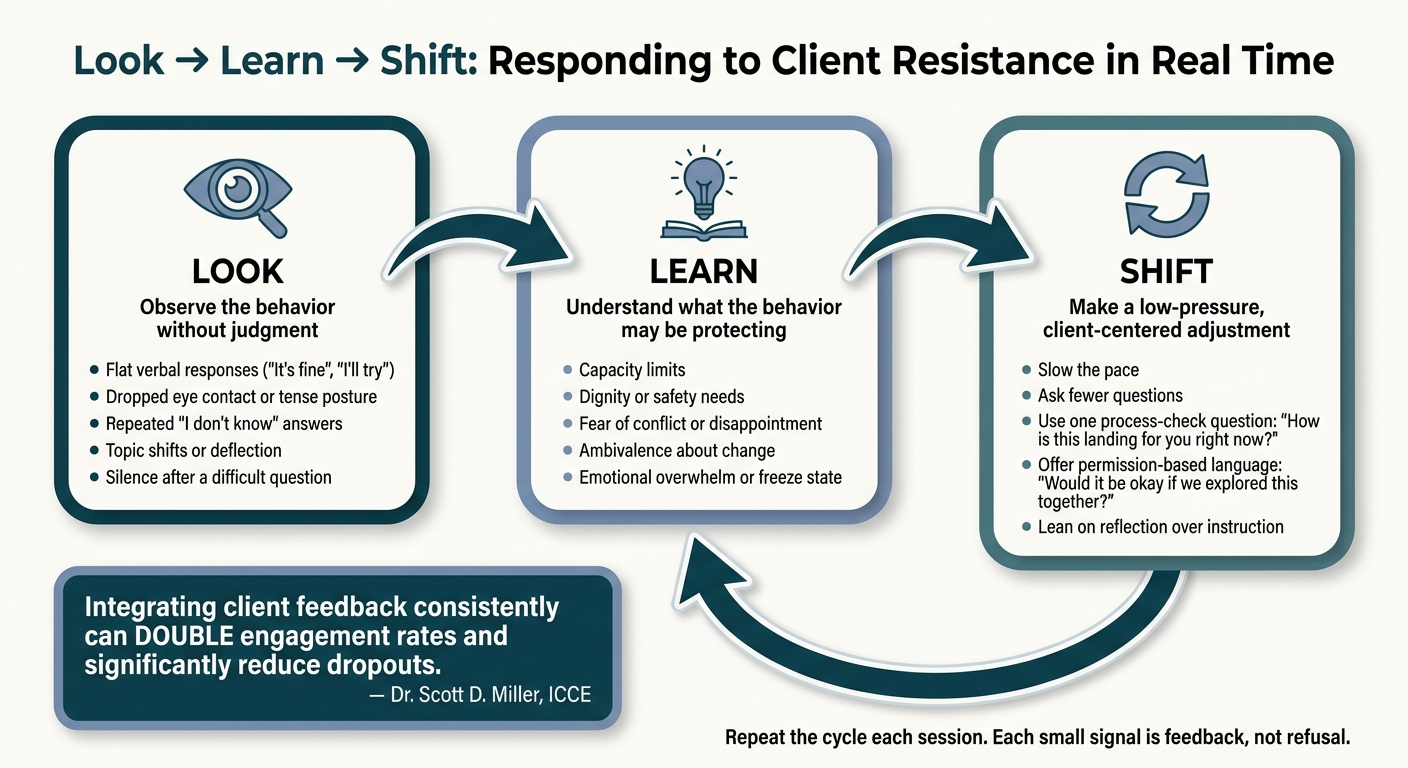
Look → Learn → Shift: Real-Time Framework for Resistant Clients
When missed cues don't get addressed, they often turn into repeatable pushback patterns. The same loop plays out again and again until staff respond in a different way. Once you can spot the pattern and name it, you have a much better shot at choosing a response that fits.
Common pushback patterns in helping conversations
Most pushback shows up in a few familiar forms.
- Arguing happens when a client questions your expertise or challenges the point of what you're doing. That often points to a need for autonomy.
- Passive compliance sounds agreeable on the surface, but nothing changes. In many cases, that signals fear of conflict or fear of letting you down.
- Change-resistant talk shows up when a client keeps circling back to reasons change won't work. That's often a sign of ambivalence.
- Deflection can sound like humor, sarcasm, or a sudden shift in topic that steers away from the personal issue. That often points to overwhelm.
The key issue is simple: does your response feed the pattern? In high-tension moments, directive answers, correction, or upbeat reassurance can increase resistance instead of easing it [3].
How to adjust pace, tone, and questions in the moment
The answer isn't more pressure. It's a response that fits the moment better.
The Look → Learn → Shift framework gives staff a practical way to interrupt these cycles in real time [1]. First, look at the behavior without judgment. Then learn what it may be protecting, such as capacity, dignity, or safety. After that, shift: slow the pace, ask fewer questions, and lean more on reflection than instruction.
One of the strongest in-the-moment moves is a process-check question:
"How is this landing for you right now?"
Permission-based language can help in the same way:
"Would it be okay if we explored what parts of today felt most useful for you?"
That kind of phrasing gives the client room to show whether the conversation still feels right. And when a client is in shutdown or freeze mode, problem-solving is hard to reach [1]. In that state, adding more structure or more tasks usually makes things worse, not better.
"Integrating client feedback consistently can double engagement rates and significantly reduce dropouts." - Dr. Scott D. Miller, Founder of the International Center for Clinical Excellence [2]
Method-matching table for different forms of resistance
Use the pattern, then choose the response that matches it.
| Client Signal | Recommended Communication Method | Intended Micro-Outcome |
|---|---|---|
| Arguing / Hostility | Validation & Empathy: Acknowledge the frustration without defending your position. | Defuse immediate tension and restore safety. |
| Passive Compliance | Normalization: "Many people find this part uncomfortable." | Lower the pressure to be polite and invite honesty. |
| Change-Resistant Talk | Simple Reflection: "You're not sure if the effort of changing is worth the stress it causes." | Client feels heard, reducing the need to defend their position. |
| Deflection / Subject Change | Process-Check: "I noticed we moved away from [topic]. Is that feeling too heavy to dive into today?" | Identify the pacing issue and adjust collaboratively. |
When pushback keeps showing up in the same form, the next step is to ask whether the relationship itself needs repair.
Problem 3: Broken trust and unclear next steps
When pushback keeps showing up, it helps to treat it as a relationship rupture, not a compliance issue. Silence, short answers, and dropped follow-through often mean trust or a sense of safety has changed. If the same pattern keeps coming back, the job is no longer about tweaking your response. It's about repair. Understanding the psychological drivers behind these moments can help in elevating client relationships beyond simple compliance.
How to name a rupture without making it worse
Don't push through. Don't launch into an explanation. Moves that feel pushy or corrective usually make resistance worse because they tell the client, in effect, that their reaction is being brushed aside.
A better move is to say what you're noticing in a gentle way, without blame. A simple line like "I noticed you got quieter when we talked about that" opens the door without dragging the client through it. Then add plain curiosity: "I wonder what that felt like?" That shows you're paying attention and that their reaction matters.
If you missed the mark, say so plainly: "I'm sorry. That felt unhelpful." A direct apology can keep the conversation open instead of shutting it down.
"Resistance is not something to eliminate. It is something to understand. When therapists learn to identify it early and respond skillfully, sessions feel less stuck, clients feel more understood, and therapy becomes more humane." - Jordan Harris, LMFT, LPC [3]
Next-step phrasing that lowers pressure and preserves choice
After a rupture, how you frame the next step matters just as much as the step itself. Use permission-based language each time: "Would it be okay if I share an option?" or "You get to decide what we focus on today." That lowers pressure and leaves choice where it belongs.
Rupture-repair table with sample phrases
Use the cue to guide the repair move, not the diagnosis.
| Rupture Type | What the Client May Be Signaling | Specific Repair Language |
|---|---|---|
| Withdrawal / Silence | Feeling unsafe or overwhelmed | "I noticed you got quieter when we talked about that. Should we slow down or try a different angle?" |
| Arguing / Challenging | Feeling pressured to change faster than they're ready to | "It sounds like I'm pushing a direction that doesn't fit for you. What feels off to you?" |
| Topic Shifting | The current subject feels too risky or emotionally intense | "I notice we moved away from that. I'm sensing it might be a hard area to go into right now - should we slow down?" |
| Missed Tasks / No Follow-Through | The plan is too big or doesn't fit their reality | "It's okay that didn't happen. It tells me the step might have been too big. What would a smaller, easier version look like?" |
| Minimal Agreement ("I'll try") | Fear of disappointing staff while remaining disengaged | "I hear you saying 'I'll try,' but I sense some hesitation. It's okay if this plan doesn't feel right yet." |
| Repeated "I Don't Know" | Feeling unsafe or overwhelmed | "It seems like this question might feel risky to answer. What would make this feel safer to discuss?" |
Once staff can spot a rupture and repair it, the next move is to make that feedback loop repeatable.
Tools and conclusion: Building a repeatable feedback loop
Once staff know how to repair a rupture, the next job is making that response repeatable.
The best way to do that is to use the same simple pattern in each interaction: notice a small signal, make one small adjustment, and then watch for any change in tone, pace, or engagement. This is sometimes called tracking conversation signals, like tone, posture, pace, and word choice, instead of waiting for a client to come right out and say something is wrong [3].
When staff do this on a regular basis with resistant clients, especially clients who go quiet, change the subject, give flat agreement, or stop following through, a few things tend to happen. Escalations drop. Course correction happens sooner. Trust gets repaired faster. The cycle itself is straightforward: observe the cue, identify what it likely means, make a low-pressure adjustment, then check whether the client seems more open, less tense, and more responsive [1][3].
That kind of in-the-moment adjustment gets easier when staff have personality-aware support.
Where Personos fits for personality-aware communication support
Personos is built for helping professionals dealing with exactly these moments. It uses the Five Factor Model, with 30 traits measured on an 80-point scale, to generate Dynamic Reports. Those reports show more than who a client is. They also show how that client's personality may interact with yours, where friction may show up, and what communication style may fit that profile.
If a session starts to go sideways, Personos Chat lets you describe the situation in plain language and get real-time, personality-aware guidance. The ActionBoard and Prompts help turn those insights into trackable next steps and between-session nudges, so the adjust-and-check cycle keeps going even when you're not in the room.
How Personos compares to general AI tools and consumer wellness apps
This is not just about convenience. It comes down to whether the tool reflects the client's context.
| Feature | Personos | General-Purpose AI Tool | Consumer Wellness App |
|---|---|---|---|
| Personality depth | Five Factor Model, 30 traits, 80-point scale | No clinical personality framework | Basic mood tracking or generic prompts |
| Contextual tailoring | Built for resistant-client communication and trust-building | General responses; may miss clinical cues | Standardized content; not tailored to resistance |
| Clinical utility | Dynamic Reports, ActionBoard, role-specific Prompts | Useful for drafting; lacks clinical workflow tools | Focused on self-help, not practitioner-client dynamics |
| Feedback loops | Tracks relational context and client progress over time | Static interactions; no alliance tracking | Tracks individual habits, not staff-client dynamics |
That gap matters when caseloads are high and each conversation carries weight.
Key takeaways for staff and program leaders
For staff, the rule is simple: treat each small shift as feedback. Resistant clients usually do not need more pressure. They need dialogue that responds well to what is happening in the moment.
For leaders, the priority is giving teams tools that help them respond the same way, even under pressure.
FAQs
How do I tell resistance from overwhelm?
Start by treating resistance as a signal, not a character flaw. In many cases, it points to overwhelm or unmet safety needs. A client may want to take part but not have the capacity to regulate, so pulling back can be a form of self-protection, not refusal.
Pay attention to the client’s physical and emotional energy without judgment. If the behavior points to a gap in regulation, shift the focus to building basic skills instead of pushing the first goal.
What should I say when a client shuts down?
Don’t label it as resistance or try to push them ahead. Shutdown is often a sign of self-protection or overload.
A better move is to respond with calm, nonjudgmental support that helps the person feel safe again. You might say:
- “I can see this is difficult for you. It’s okay to feel this way.”
- “Your feelings are valid, and I’m here to support you without judgment.”
That kind of response lowers pressure and shows you’re with them, not against them.
How do I repair trust after pushing too hard?
Name the rupture clearly. Take responsibility. Then apologize in a sincere, human way for how your approach landed. You might say you’re sorry they felt unheard or pressured.
After that, move into partnership. Ask what would feel more helpful or comfortable from here. If this keeps happening, Personos can give real-time, situation-specific guidance so you can adjust how you communicate and start repairing trust.