Enneagram vs. Other Personality Tools for Teams
Match personality tools to team needs: Enneagram for deep conflict, DiSC for quick communication fixes, Big Five for hiring and role fit.
Nick Blasi

Enneagram vs. Other Personality Tools for Teams
Choosing the right personality tool can transform team collaboration. Here's the essence:
- Enneagram focuses on core motivations and fears, ideal for leadership coaching and resolving deep conflicts.
- MBTI explores cognitive preferences, helping with self-awareness and decision-making styles.
- DiSC analyzes observable behaviors, making it practical for improving team communication.
- Big Five (e.g., Personos) measures continuous traits, excelling in hiring, role alignment, and performance insights.
- CliftonStrengths highlights dominant talents to activate team potential.
Each tool has strengths and limitations. For example, Enneagram is great for empathy-building but not for hiring decisions. DiSC is faster for communication fixes, while Big Five offers detailed, data-backed insights.
Quick Comparison Table:
| Tool | Focus | Best Use Case | Time to Complete |
|---|---|---|---|
| Enneagram | Core motivations and fears | Leadership coaching, conflicts | 30–45 minutes |
| MBTI | Cognitive preferences | Collaboration, decisions | 20–30 minutes |
| DiSC | Observable behaviors | Communication, feedback | 10–15 minutes |
| Big Five/Personos | Continuous traits | Hiring, role fit, performance | ~15 minutes |
| CliftonStrengths | Talent themes | Strengths development | 30–45 minutes |
Key Takeaway: Match the tool to your team’s challenges. For deeper conflicts, use Enneagram. For quick communication fixes, try DiSC. For hiring or detailed insights, go with Big Five tools like Personos.
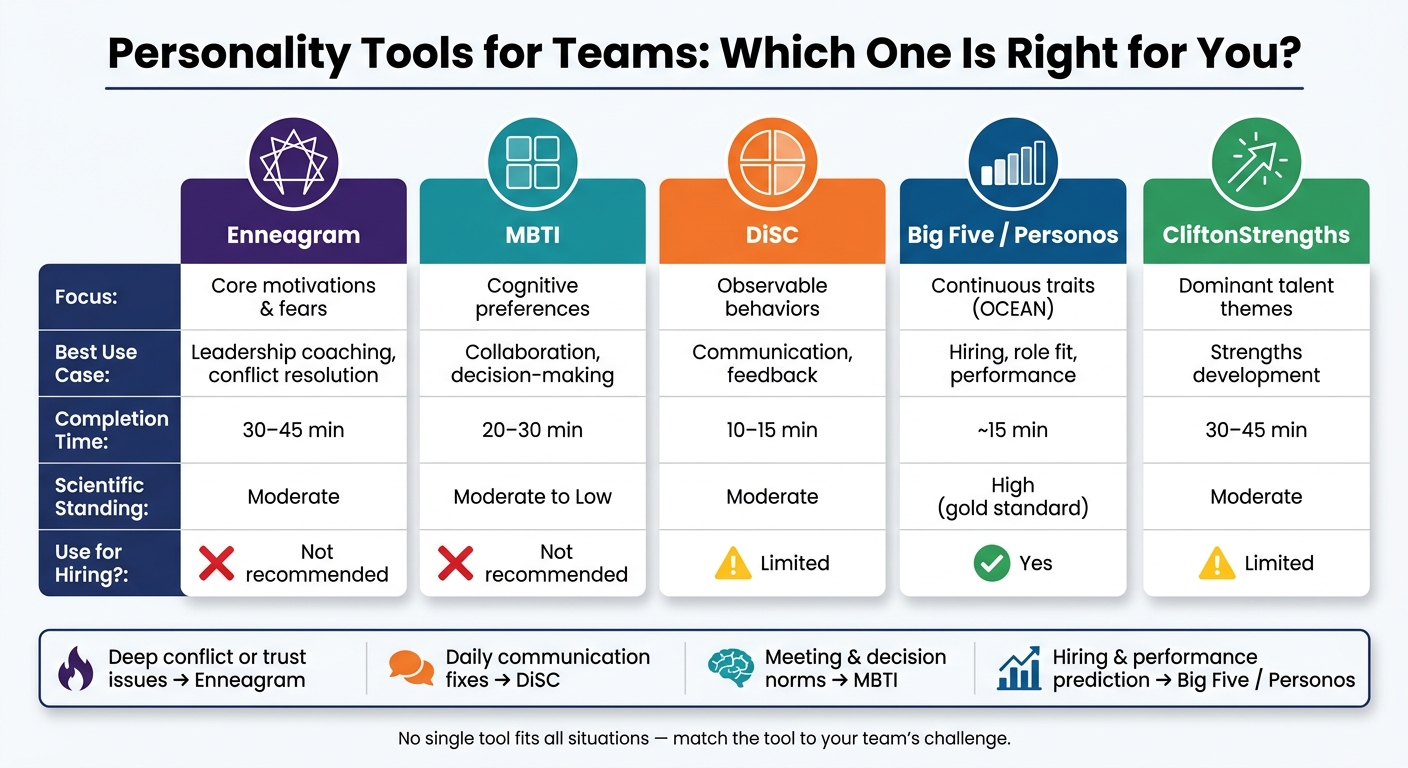
Enneagram vs. MBTI vs. DiSC vs. Big Five: Personality Tools Compared
How the Enneagram Supports Team Role Assignment
Core Features of the Enneagram
The Enneagram defines personality through nine distinct types, each shaped by a core motivation and fear. It’s less about surface behaviors and more about understanding what drives someone. For example, a Type 3 (The Achiever) is motivated by a desire to succeed and gain recognition, while a Type 9 (The Peacemaker) focuses on avoiding conflict to keep harmony intact. These motivations provide a window into the deeper psychological factors influencing workplace behavior.
A key feature of the Enneagram is its stress and growth arrows, which show how people react under pressure or when thriving. For instance, a Type 1 (The Reformer), known for being disciplined and principled, might become overly self-critical and moody under stress, mimicking traits of an unhealthy Type 4. Understanding these shifts helps managers step in with personality-driven leadership coaching before small issues snowball into bigger problems.
"The Enneagram identifies 9 types based on core motivations, not just behaviors - helping you understand why coworkers act the way they do." - Dan Cumberland, Founder, The Meaning Movement [5]
By revealing these patterns, the Enneagram can guide managers in aligning team members’ strengths with the right responsibilities.
Using the Enneagram to Assign Team Roles
The Enneagram’s real value in the workplace lies in matching individuals to roles that reflect their natural drives. Below is a breakdown of how each type’s motivation can translate into specific strengths on a team:
| Type | Name | Core Motivation | Best-Fit Role |
|---|---|---|---|
| 1 | The Reformer | To be good and improve things | Quality assurance, process improvement |
| 3 | The Achiever | To succeed and be admired | Project management, sales leadership |
| 5 | The Investigator | To understand and be competent | Research, data analysis, strategic planning |
| 8 | The Challenger | To be strong and in control | Decisive leadership, obstacle removal |
| 9 | The Peacemaker | To maintain peace and harmony | Mediation, team coordination, HR |
For example, a Type 5 might excel in research or strategy roles but may need extra time to process complex material in fast-paced settings. On the other hand, a Type 8 thrives in environments where they have autonomy and clear goals - micromanagement can quickly lead to conflict. These insights help managers shape team dynamics in a way that plays to individual strengths.
Where the Enneagram Falls Short in Workplace Settings
While the Enneagram offers valuable insights, it does come with limitations. Its focus on core fears and unconscious patterns requires honest self-reflection and proper guidance to interpret effectively. Tools like the Riso-Hudson Enneagram Type Indicator (RHETI) have an accuracy rate of about 72% [5], with internal reliability scores ranging from .56 to .82, depending on the type [5]. Although helpful for team-building and personal growth, these numbers highlight that it’s not precise enough for high-stakes decisions.
The Enneagram should never be used for hiring, promotions, or performance reviews. There’s no proven link between Enneagram type and job performance, and using it in these contexts could lead to legal and ethical issues [5][6]. For high-stakes decisions like hiring, many organizations instead turn to the Five Factor Model for workplace dynamics.
"Success in a role depends on far more than personality type - it depends on skills, experience, emotional intelligence, and countless other factors." - The Enneagram in Business [5]
The Enneagram works best when participation is voluntary, guided by someone trained in the method, and used to build empathy rather than limit someone’s potential with rigid labels. It’s a tool for understanding, not a definitive measure of capability.
Enneagram, MBTI, and DiSC: A Side-by-Side Comparison
Enneagram vs. MBTI: Motivations vs. Preferences
The MBTI and the Enneagram each bring something distinct to the table. MBTI focuses on how people think - how they process information, make decisions, and recharge their energy. On the other hand, the Enneagram dives into why people behave the way they do, uncovering the core fears and motivations that drive their actions. Together, they provide a fuller picture of both external behaviors and internal drivers.
"MBTI asks: 'How do you engage?' Enneagram asks: 'Why?' Together, they outline behaviors and reveal underlying drives." - JobCannon Editorial [10]
One challenge with the MBTI is its inconsistency over time. Research shows that 39% to 76% of people receive a different type when retaking the test after just five weeks [9][10]. The Enneagram, while also self-reported, tends to feel more stable because it’s grounded in deeply rooted motivations rather than situational preferences.
For teams, the MBTI is great for creating a shared language around work styles. The Enneagram, however, goes deeper by identifying the emotional triggers behind recurring conflicts. It’s worth noting that certain personality types often overlap between the two systems - like INTJs aligning with Enneagram Type 5 (The Investigator) or ENFPs correlating with Type 7 (The Enthusiast) [10].
| Feature | Enneagram | MBTI |
|---|---|---|
| Core Question | Why do you act this way? | How do you process and decide? |
| Number of Types | 9 types (+ wings/subtypes) | 16 types |
| Best For | Leadership coaching, emotional intelligence | Work-style awareness, career development |
| Test-Retest Reliability | Moderate (self-reported) | Moderate to low (frequently debated) |
| Ease of Use | Complex; requires facilitation | Moderate complexity |
While MBTI and the Enneagram explore internal processes, DiSC takes a more straightforward approach by focusing on external workplace behaviors.
Enneagram vs. DiSC: Internal Drivers vs. Observable Behavior
DiSC offers a completely different perspective by analyzing observable workplace behaviors rather than internal motivations. Its four dimensions - Dominance, Influence, Steadiness, and Conscientiousness - make it easy to identify how people act in professional environments. For example, high-D individuals push for quick decisions, while high-S individuals prefer steady, methodical approaches.
One of DiSC’s biggest advantages is its speed. The assessment takes just 10–15 minutes, compared to the 30–45 minutes typically required for the Enneagram [1]. A notable example comes from a Singapore-based financial services firm that used DiSC to tackle communication issues among sales, operations, and compliance teams. After a workshop in March 2026, 94% of participants reported better understanding of their colleagues' communication styles, and escalation incidents dropped significantly over the next two months [1].
The Enneagram, however, is better suited for addressing deeper issues - like persistent team conflicts that surface despite good intentions. Its depth can uncover the root causes of friction, but it requires skilled facilitation to ensure accurate application.
"The Enneagram's depth makes it particularly valuable for personal growth and coaching, while DISC's behavioral focus makes it the most consistently accurate and actionable choice for practical team building." - One Dynamics [1]
| Feature | Enneagram | DiSC |
|---|---|---|
| Core Question | Why do you act this way? | What do you do, and how? |
| Number of Types | 9 types (+ wings/subtypes) | 4 dimensions |
| Best For | Deep leadership development, conflict root causes | Immediate team dynamics, communication |
| Completion Time | 30–45 minutes | 10–15 minutes |
| Ease of Use | Complex | Very easy; highly intuitive |
Big Five-Based Tools and Where Personos Fits In
The Big Five Model and How Personos Uses It
The Big Five (OCEAN) model offers a completely different perspective compared to tools like the Enneagram, MBTI, and DiSC. Instead of assigning fixed personality types, it measures five continuous traits - Openness, Conscientiousness, Extraversion, Agreeableness, and Neuroticism. This approach creates a detailed profile that reflects the individuality of each person, rather than categorizing them into rigid labels.
"The Big Five measures personality on five continuous scales... you don't 'be' a Big Five type; you score at a specific point on each of five dimensions." - Conard Li, Author, AgentSoul [7]
Why does this matter? In team settings, two individuals might both identify as Enneagram Type 3 but respond very differently under stress. The Big Five’s granular scoring helps explain these differences. Additionally, its Neuroticism dimension addresses stress-related tendencies - a critical factor that type-based models often overlook when analyzing team dynamics.
Personos builds on the Big Five framework, analyzing 30 personality traits on an 80-point scale. Its adaptive conversational assessment creates a detailed portrait of each team member, offering insights that static, type-based tests simply can’t match. By capturing these continuous traits, Personos provides a nuanced understanding of individuals, which translates into sharper team insights.
Personos Features That Support Team Needs
Personos transforms its scientific foundation into practical tools for teams through Dynamic Reports. These reports adapt to the situation, offering tailored insights for individuals, relationships, and teams. For example, a report generated during a company restructuring will differ from one created for a stable, long-term team.
Another standout feature is how Personos addresses conflicts between different personality frameworks. For instance, imagine a team member who scores high in Big Five Agreeableness but identifies as an Enneagram Type 8. This person might feel pulled in two directions - balancing their natural inclination to accommodate others with their drive for control. Personos highlights these internal tensions, helping managers understand why certain behaviors emerge under pressure.
Privacy is another key advantage. Individual scores are never shared with managers or teammates without explicit consent. This ensures team members feel safe and respected, encouraging them to engage honestly with the assessment. Many workplace personality tools fall short in this area, reducing people to labels that can follow them throughout their careers. Personos avoids this pitfall entirely.
| Feature | Enneagram | Personos (Big Five-Based) |
|---|---|---|
| Primary Focus | Core motivations and fears | Measurable, empirical traits |
| Scientific Standing | Moderate | High (empirical gold standard) |
| Assessment Style | Static questionnaire or self-typing | Adaptive conversational assessment |
| Team Application | Empathy and motivation building | Role fit, performance prediction, conflict guidance |
| Neuroticism Measured | No | Yes |
| Privacy Controls | Varies by platform | Scores never shared without consent |
Personos also stands out for its affordability. At just $9 per seat per month, it’s far more budget-friendly than hiring a licensed psychologist, which typically costs $250–$600 per session [8]. For teams that need detailed personality insights and the ability to adapt in real time, Personos offers a practical and cost-effective solution, making it a smart addition to traditional tools.
How to Pick the Right Personality Tool for Your Team
Key Factors to Weigh When Choosing a Tool
Before diving into personality tools, it’s important to pinpoint your team’s core challenge.
"The question TD leaders most often ask me is: which assessment is best for leadership teams? The question I wish they'd ask instead is: what specific leadership problem are we trying to solve?" - Peggy Murriner, Applied Coaching Content Consultant, Cloverleaf [2]
When evaluating tools, consider factors like scientific credibility, the depth of insights provided, cost, and how well the tool integrates into your team’s daily routines.
The Big Five stands out for its strong scientific foundation. This model is also transforming executive coaching through data-driven insights. For example, Conscientiousness alone has been shown to correlate with job performance at rates of 0.22–0.31 across nearly all occupations [11][4]. Costs can vary significantly, with DiSC assessments typically priced between $50 and $200 per person, while Big Five-based platforms like Personos offer a subscription model at $9 per seat per month.
To make the most of these tools, it’s crucial to integrate them into your team’s workflow. Research reveals that participants retain only about 20% of what they learn in standalone personality workshops after just one week [2]. Embedding these tools into platforms like Slack, Teams, or daily dashboards ensures the insights remain accessible and actionable, unlike a forgotten binder from a single workshop.
"Assessment data isn't the problem. Assessment abandonment is." - Peggy Murriner, Applied Coaching Content Consultant, Cloverleaf [2]
By keeping these considerations in mind, you can identify the tool that meets your team’s specific needs.
When to Use the Enneagram and When to Use Something Else
Different challenges call for different tools. The Enneagram, with its focus on uncovering deep motivations, is particularly effective for teams facing significant trust issues or deep-seated conflicts. For instance, it’s a great fit for leadership teams navigating mergers or nonprofits dealing with burnout and interpersonal strain.
For everyday communication challenges - like differences in urgency, feedback styles, or work pace - DiSC is a faster, more practical option. Its straightforward four-type framework can be introduced in a quick 30-minute session, giving teams a shared language they can use right away. On the other hand, MBTI shines when the goal is to improve how a team collaborates and makes decisions, such as balancing big-picture thinkers with detail-oriented individuals or creating better meeting structures.
When it comes to hiring, predicting performance, and assessing role fit, Big Five-based tools like Personos are the top choice. Their higher predictive accuracy and continuous scoring system avoid the type-based limitations of tools like the Enneagram or MBTI, which experts caution against using for high-stakes decisions like hiring or firing [12][11].
| Goal | Best Tool |
|---|---|
| resolve conflict and strengthen teams | Enneagram |
| Improve daily communication and feedback | DiSC |
| Design better meeting and decision norms | MBTI |
| Hiring, performance prediction, role fit | Big Five / Personos |
Enneagram vs. Myers Briggs | Pros and Cons
Conclusion: Matching the Right Tool to Your Team
There's no one-size-fits-all framework for every situation. The Enneagram, for example, excels at uncovering the why behind people's actions - shedding light on their fears, motivations, and stress responses. It's a fantastic tool for rebuilding trust and coaching but falls short when it comes to hiring or predicting performance.
To overcome these gaps, combining multiple frameworks can provide a more complete picture of your team. Layering approaches leads to deeper insights and better outcomes.
"The Big Five gives you the reliable data. Let the Enneagram give you the story. Together, they're more powerful than either alone." - JobCannon [3]
This idea underscores the value of blending motivational tools with data-driven models. Platforms like Personos bring this integrated approach to life. By using the scientifically validated Big Five model - supported by over 10,000 studies [3] - Personos offers tools like Dynamic Reports, conversational AI, ActionBoard, and Prompts for just $9 per seat per month, embedding personality science into everyday workflows.
Use the Enneagram to foster empathy and address complex interpersonal dynamics. Turn to DiSC or MBTI for improving communication quickly. And when it comes to hiring, role alignment, and long-term collaboration, a Big Five–based platform provides the actionable insights you need.
FAQs
Can we use the Enneagram for hiring?
Experts caution against using the Enneagram in hiring decisions because it's primarily designed for self-awareness, not to predict how someone will perform on the job. Unlike scientifically validated tools such as the Big Five personality model, the Enneagram doesn't have a strong research foundation to support its use in talent evaluation.
Relying on it for hiring can lead to unintended consequences like stereotyping employees, potential discrimination, or making poor hiring choices. For more accurate and research-backed insights, platforms like Personos are a better option. They utilize the validated Five Factor Model, which provides actionable data to improve hiring decisions and workplace collaboration.
What’s the best tool for team conflict?
When it comes to addressing team conflict, tools that offer real-time, dynamic insights tend to work best. While frameworks like DISC and the Thomas-Kilmann Conflict Mode Instrument (TKI) provide solid foundations for understanding team dynamics, Personos takes things a step further. Its AI-powered platform integrates the Five Factor Model with conversational AI to deliver personalized, situation-specific guidance.
This combination doesn't just help teams understand the root of personality-based clashes - it offers practical, tailored advice to resolve them. By focusing on actionable strategies, Personos helps teams move past conflict and build stronger collaboration.
Can we combine multiple tools on one team?
Yes, combining personality tools can give you a richer understanding of individuals and teams. Each framework sheds light on different dimensions - take DISC, for instance, which highlights behavioral patterns, while the Enneagram dives into core motivations. A good approach is to start with straightforward tools like DISC to establish a common understanding, then introduce more nuanced models as needed. For teams navigating intricate dynamics, Personos stands out by offering real-time, personality-driven insights based on the Five Factor Model, helping tackle challenges that go beyond surface-level assessments.