Studies on Empathy and Employee Retention
Pair supervisor empathy with concrete workload, staffing, and supervision changes; track well-being and actual departures.
Christian Thomas

Studies on Empathy and Employee Retention
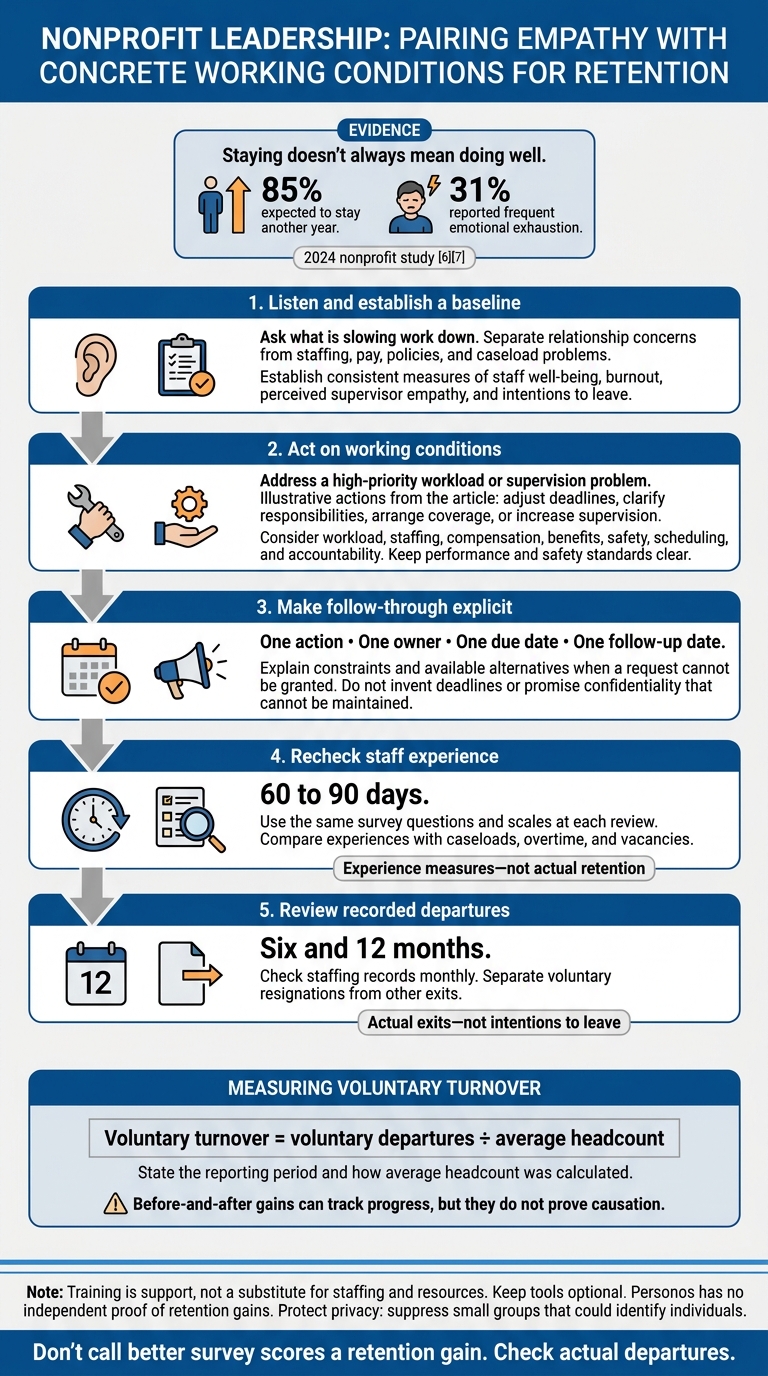
My takeaway: pair empathy with changes to workload, staffing, and supervision, then track whether employees stay. In a 2024 nonprofit study, 85% expected to stay another year, yet 31% reported frequent emotional exhaustion.[6][7] Staying doesn’t always mean doing well.
I read the research as support for better listening and follow-through, not proof that empathy prevents departures. Here’s what I’d put into practice:
- Act on staff concerns: address caseloads, schedules, pay, and coverage.
- Use training as support: it can improve measured skills, but it doesn’t replace resources.
- Measure both experiences and exits: check staff well-being after 60 to 90 days and departures at six and 12 months.
- Keep tools optional: Personos can help with conversation prep and action tracking, but it has no independent proof of retention gains.
My rule: <u>don’t call better survey scores a retention gain</u>. Check actual departures, protect staff privacy, and connect listening to changes employees can feel.
Empathy and Employee Retention: Listen, Act, Measure
What Research Says About Empathy and Employee Outcomes
Supervisor Empathy and Intentions to Stay
Catalyst’s 2021 survey of nearly 900 U.S. employees across industries examined empathic leadership during crisis and change.[14] Employees who described their senior leaders as highly empathic reported more frequent innovation, 61% versus 13%, and engagement, 76% versus 32%.[10][13] Among women of color, 18% reported considering departure when leaders were highly empathic, compared with 33% when leaders were less empathic.[11] These results show an association, not proof that empathy kept employees from leaving.
For supervisors, empathy means listening, giving respectful feedback, and addressing concerns without lowering performance standards. Do measures of employees’ emotional skills show a similar pattern?
Emotional Intelligence and Employee Attitudes
A 2017 meta-analysis by Miao, Humphrey, and Qian linked emotional intelligence to work attitudes. But the strength of that link depended on how researchers measured it. Job-satisfaction correlations were 0.08 for ability-based measures, 0.32 for self-report scales, and 0.39 for mixed measures. The analysis also found a 0.43 correlation with organizational commitment for self-report and mixed measures, and a −0.33 correlation with turnover intentions for self-report emotional intelligence.[8][9] Ability-based measures had a much weaker link to satisfaction than self-report or mixed measures.
These findings concern employee traits and attitudes, not supervisor behavior or actual retention. Shared self-report methods and overlap with personality may make the links appear stronger. Burnout offers another test because it sits closer to turnover.
Burnout and Employee Turnover
The available summaries do not identify a specific burnout study with a sample, effect size, or verified turnover result. For nonprofit teams, treat burnout as a workload signal. Specialized tools can help reduce burnout by identifying personality-driven needs. Check caseloads, vacancies, supervision, pay, and schedules.
Training is another practical option to examine.
What Empathy Training Can Change
A meta-analysis of workplace emotional-competency training found moderate gains in measured skills, with benefits lasting beyond three months. The pre-to-post standardized mean difference was 0.44 (95% confidence interval, 0.29–0.59), and the intervention-versus-control difference was 0.46.[12] No training type clearly outperformed the others. Empathy, emotional-intelligence, and emotion-regulation training showed benefits across professions.[12]
Training can improve measured skills, but the evidence does not show the same effect on burnout or departures. Use it as support, not a substitute, for staffing, reasonable caseloads, paid time off, and supervision.
Employee retention and job satisfaction are linked to empathetic leadership, report says
Comparing Studies and Their Limits
For nonprofit leaders, the question is whether empathy changes burnout, engagement, and actual turnover, not just whether it sounds helpful.
The table separates recorded departures from indirect signals: turnover intention, burnout, engagement, and compassion satisfaction. None of these studies reports fewer actual departures. Sample sizes or instruments that are missing are marked “not reported.”
| Source and year | Population and sample | Design | Measure | Retention-related outcome | Finding | Main limitation |
|---|---|---|---|---|---|---|
| 2022 meta-analysis of emotional intelligence and work outcomes[15][16] | 78,159 participants across 78 studies and 253 effect sizes | Meta-analysis | Varied emotional-intelligence measures | Work attitudes related to staying or leaving | Found links between emotional intelligence and work outcomes | Mixed measures and settings limit comparison; no actual departures reported |
| Perceived supervisor support meta-analysis, 2021[21] | 10,079 participants | Meta-analysis | Perceived supervisor support, not direct empathy | Turnover intention | No direct overall effect on turnover intention; indirect effects in some studies | Support and empathy are not interchangeable |
| Spanish primary-care training study, 2023[18] | 68 professionals: 43 intervention and 25 control | Controlled intervention with pre- and post-measures; mixed methods | Empathy, mindfulness, mood disturbance, and burnout scales | Burnout and work well-being | Eight sessions plus a full-day session; statistically significant improvements in mood disturbance and mindfulness, moderate improvements in burnout and empathy; no comparable control-group improvement | Small, profession-specific sample; short follow-up; turnover not tracked |
| Health-care empathy-training review of reviews, 2025[17][19] | Multiple reviews and primary studies; participant total not reported | Review of reviews | Multiple empathy instruments | Compassion satisfaction, or fulfillment from helping work; burnout, resilience, and lasting empathy | Short-term empathy gains in many interventions; some evidence of higher compassion satisfaction, lower burnout, and greater resilience | Inconsistent assessment tools; inadequate long-term follow-up |
| Physician empathy-and-burnout review, 2025[20] | 14 included studies | Review of observational and longitudinal studies | Empathy measures differed across studies | Burnout | Negative empathy–burnout association in 12 of 14 studies; some longitudinal support for a protective relationship | Mostly correlational, physician-focused evidence; no direct demonstration of lower turnover |
The harder question is which findings hold when researchers track actual exits rather than attitudes or well-being. Most of these studies are correlational: they show a pattern, but they do not establish cause.
Association Is Not Proof of Cause
Survey links alone cannot show that empathy causes people to stay. Reverse causation, differences in pay or staffing, and same-survey bias can make the connection look stronger than it is.
Reverse causation means employees who already feel satisfied may rate their supervisors as more empathetic. Confounding means pay, staffing, autonomy, or schedules could affect both empathy ratings and decisions to stay. Same-survey bias occurs when one person rates empathy and their intent to quit in the same survey.
For a nonprofit evaluation, measure starting conditions, repeat surveys, and compare the results with separate staffing records. Survey scores alone are not enough, especially when retention research relies on indirect measures.
Intentions to Leave Are Not Actual Departures
Turnover intention is someone’s stated likelihood of leaving. Recorded departures are actual exits. Commitment describes attachment or obligation, while burnout and engagement describe work experiences. Report actual departures before claiming a retention gain.
Apply these findings with care. Spanish primary care and physician settings differ from U.S. nonprofit work in staffing, pay, and exit options. Use the same measures across follow-ups, separate voluntary resignations from other exits, and track departures over six to 12 months. Treat these studies as guidance on what to examine, not proof that retention will improve on its own.
Putting Research Into Practice in Nonprofit Teams
Research points to a clear lesson: empathy helps most when it leads to concrete support.
Pair Listening With Workload Changes
Use a listen–act–follow-up cycle in one-on-ones. Ask what’s slowing work down. Then separate relationship concerns from problems with staffing, pay, policies, and caseloads.
Agree on a response you have the authority to make. That might mean adjusting deadlines, clarifying responsibilities, arranging coverage, or increasing supervision. Keep safety standards and deliverables clear throughout.
In a 2024 survey of 239 nonprofit leaders, 76% said staff burnout affected mission achievement.[24] Follow-up isn’t just a courtesy. It’s part of the intervention.
Give Respectful Feedback and Follow Up
Listen, summarize what you heard, and acknowledge the concern before explaining your decision. Empathy doesn’t mean granting every request. Be clear about what you can change and what needs leadership approval. Don’t promise confidentiality you can’t keep.
Close with one action, one owner, one due date, and one follow-up date. Record these briefly. Even when you deny a request, follow up to explain the constraint and any available alternative.
After making changes, track their effect on workload and turnover, not just how people feel about the conversation.
Track Staff Well-Being and Actual Departures
Set consistent measures for staff well-being, burnout, perceived supervisor empathy, and intentions to leave. Use the same questions and scales at each review, and check staffing records monthly.
Report voluntary turnover as voluntary departures divided by average headcount. State the time period and how you calculated average headcount.
Compare these trends with caseloads, overtime, and vacancies to see whether workload, burnout, and departures are changing. Break results down by role, tenure, or workload only when group sizes protect confidentiality. Suppress small groups that could identify individuals. Before-and-after gains can help you track progress, but they don’t prove causation.[22][23]
Use Personos for Optional Communication Support
Teams that want optional communication support can use a tool to help prepare for conversations and follow through afterward.
Personos is an optional personality-aware SaaS tool. Its chat, Dynamic Reports, Prompts, and ActionBoard can support conversation preparation, reminders, and action tracking.[1] Its Five Factor Model basis is not independent evidence that Personos reduces burnout or improves retention.[1]
Before using it, obtain informed consent and let staff decline without penalty. Review access controls, storage, retention, deletion, and other data-handling safeguards. Avoid entering unnecessary sensitive employee or client information. Treat suggestions as input, not decisions, and keep professional judgment and crisis protocols in place.
Conclusion: Pair Empathy With Practical Support
The studies point to the same lesson: empathy helps most when it changes work. Empathy and emotional intelligence are linked to better engagement and intent to stay,[25] but intent to stay is not the same as actual retention.
Turn listening into action. After staff share feedback, address one high-priority workload or supervision problem. Check staff experience again in 60 to 90 days, then review actual departures at six and 12 months. If staff still feel overloaded, address workload, staffing, compensation, benefits, safety, scheduling, and accountability rather than asking staff to become more resilient.
Keep tools optional. Personos can help with conversation prep and follow-up, but tools should sit alongside staffing, pay, and supervision, not take priority over them. Leaders need to back empathy with resources.
FAQs
How can we separate empathy’s impact from pay and staffing changes?
Track measurable outcomes tied to team dynamics, not just broad organizational metrics [1][2]. Pay and staffing are structural factors, but empathy’s role in performance often goes unmeasured [1][3].
Tools like Personos report on team collaboration and conflict triggers. These reports help leaders link personality-aware communication to gains in engagement, productivity, and retention. They also help separate improvements in interpersonal dynamics from compensation changes when assessing turnover and burnout [1][2][4][5].
What can we change when our staffing budget is limited?
Focus on tools that reduce staff burnout and help teams do more with the resources they already have. This can improve retention and productivity [1][2]. AI-powered platforms like Personos can ease mental workload and provide real-time, personality-aware guidance for teamwork and client interactions [1][3].
Use data-driven insights to set clear expectations, strengthen team dynamics, and reduce costly turnover. These insights can also help you show measurable results to stakeholders without a large increase in funding [1][4][3].
How should we interpret high retention alongside high burnout?
High retention paired with high burnout often means staff believe in the mission but feel exhausted day after day. They may face empathy fatigue and struggle to do their work as well, putting the team’s ability to keep going over the long term at risk [1][2].
Personos, an AI-powered personality psychology platform, provides tailored guidance on stress, boundaries, self-care, and making decisions under pressure. It helps professionals care for their well-being and work better together in demanding settings [1][3][4].