How Empathy Builds Trust in Resistant Clients
Accurate, paced, boundaried empathy—notice, reflect, validate, plan, and repair to build trust with resistant clients.
Rachel Johnson

How Empathy Builds Trust in Resistant Clients
If a client shuts down, pushes back, or keeps missing sessions, empathy is often the first step that helps trust start. I’d sum it up like this: slow down, read the behavior as self-protection, match your response to the person in front of you, keep clear limits, and fix tension early.
Here’s the core idea in plain English:
- Resistance usually protects something, like control, privacy, fear of judgment, or fear of failure
- Empathy works best when it fits the client’s style, not when I use the same response with everyone
- A simple six-step flow helps: notice, ask, reflect, validate, plan together, and repair tension fast
- Clear limits still matter, because clients who doubt systems often trust steady rules more than warm words
- Burnout is a risk when I rush, blur roles, or carry too much of the client’s pain
A few points stand out from the article:
- Clients high in anxiety may need a slower pace and more predictability
- Clients who question motives may need plain explanations and space to disagree
- Quiet clients may need silence, patience, and less pressure to open up
- Clients who miss follow-through may do better with small, low-pressure next steps
- Clients who stay in ideas may need help linking thoughts to feelings and action using personality data for better outcomes
The short version: empathy builds trust when it is accurate, calm, and boundaried. Not soft. Not vague. And not the same for every client.
The article also shows that how I show empathy matters as much as whether I show it at all. In many helping settings, trust can drop fast after one mismatch, so early repair matters.
| Focus area | What helps most |
|---|---|
| Guarded clients | Patience, low pressure, no push for disclosure |
| Clients who push back | Calm tone, plain reasoning, shared choices |
| Anxious clients | Reassurance, predictability, clear next steps |
| Burnout prevention | Limits, steady pace, professional distance |
If I remember one line from this piece, it’s this: ask what the behavior is protecting. That one shift can change the whole conversation.
Mastering the Therapeutic Relationship: Empathy & Trust – Mentalyc Podcast
Understanding Resistance Through a Personality Lens
Resistance is often a coping style, not defiance.
Seen through personality, it shows how clients try to protect themselves. When your empathy fits the client’s coping style, trust tends to build faster and resistance often eases. That matters because the same behavior can point to very different fears, depending on the person.
How Big Five Traits Shape Resistance Patterns
The Five Factor Model as a framework for understanding personality describes five traits: Neuroticism, Extraversion, Openness, Agreeableness, and Conscientiousness.
Use the pattern below to connect resistance with the kind of safety a client may be guarding.
| Big Five Trait | Common Resistance Behaviors | What It Protects | Empathic Stance That Helps |
|---|---|---|---|
| High Neuroticism | Frequent worrying, rapid withdrawal when misunderstood, clinging to what feels known | Emotional stability; fear of being overwhelmed or judged | Slow the pace, normalize anxiety, offer predictability |
| Low Agreeableness | Arguing, testing your motives, pushing back against suggestions | Autonomy; need to see you as credible and honest | Stay non-defensive, welcome skepticism, be transparent about your reasoning |
| Low Extraversion | Minimal self-disclosure, avoiding eye contact, slow warm-up | Energy and emotional privacy; fear of being put on the spot | Respect silence, offer gentle questions, normalize gradual engagement |
| Low Conscientiousness | Missed appointments, agreeing in session but not following through | Competence and self-worth; avoidance of situations where they might fail | Frame plans as low-pressure experiments, celebrate small steps, co-create simple next actions |
| High Openness | Questioning motives, jumping between ideas, talking around pain | Mental control and a clear story; fear of being emotionally flooded | Meet them at the idea level first, then gently link insight to emotion and action |
A simple rule helps here: ask what the behavior is protecting.
What Personality-Aware Empathy Changes
Generic empathy can miss the mark when it doesn’t fit how a client takes in the world. A client high in Neuroticism may need reassurance and predictability before opening up. A client low in Agreeableness may need to feel respected, not managed. That’s the difference between “I hear you” and “I get how you need this conversation to feel.”
Matching your empathic response to the client’s likely coping style and pace is what moves things forward.
Personos can turn Five Factor Model data into real-time, situation-specific guidance for difficult client conversations.
Once you can read the pattern, the next step is managing your own response before you enter the conversation.
How to Prepare Before the Conversation
What happens before you walk into a session matters. Resistance is often protective. So the first step is to show up regulated, not reactive, and not already telling yourself this client is going to be hard.
Regulate Your Own Reactions First
Start with a quick self-check: What am I expecting from this person today, and is that expectation fair? Then pause, take a breath, and reset your posture and tone. If a client’s lack of progress tends to stir up a fear that you’re failing them, plan for that before the session starts. That way, you’re less likely to push too hard or pull back when the work slows down [2].
You’re there to create the conditions for trust, not to fix the client or prove yourself. When you stay steady, the client is less likely to feel like the conversation is just one more threat.
Balance Empathy With Clear Limits
Empathy doesn’t mean letting go of structure. Before the session, review the non-negotiables, such as confidentiality, program rules, and session expectations. Then think through how you’ll explain them in plain language, as shared safeguards rather than rules being imposed on the client.
Consistency matters here. Sticking to the limits you set builds reliability, especially with guarded clients who’ve been let down before [1].
Personos can help with this prep by generating Dynamic Reports that flag likely friction points and suggest responses, with updates as the context changes.
Once your own response is settled and the frame is clear, empathy becomes much easier to use well in the conversation itself, starting with the six-step process in the next section.
A Six-Step Empathy Process for Building Trust
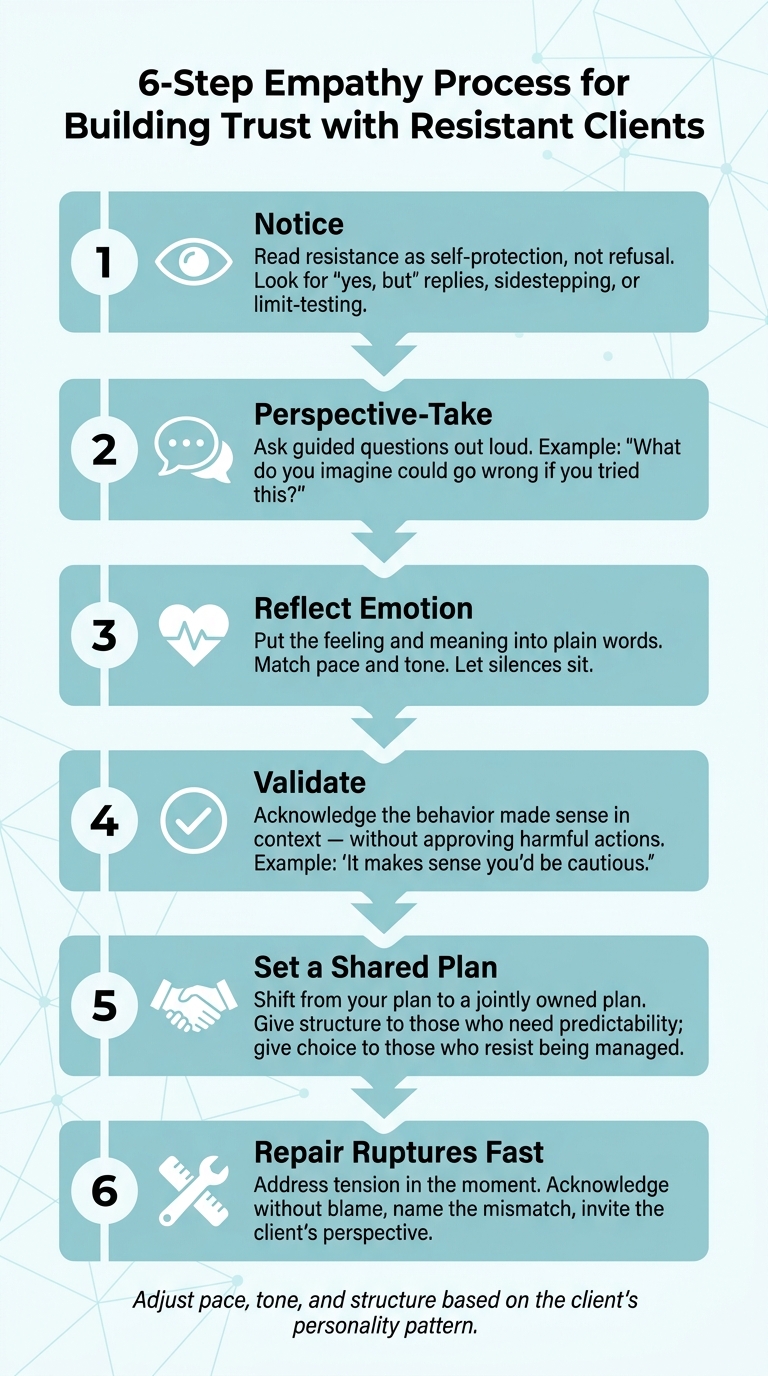
6-Step Empathy Process for Building Trust with Resistant Clients
Use this six-step flow in the session itself. The aim isn't to bulldoze resistance. It's to lower the sense of threat fast enough for honest conversation. Your pace, wording, and amount of structure should fit the client's likely personality pattern.
Steps 1 Through 3: Notice, Perspective-Take, and Reflect Emotion
Step 1 is noticing without judgment. Resistance tends to show up in clear ways: "yes, but" replies, sidestepping the agenda, intellectualizing, or testing limits. Read that resistance as self-protection, not refusal.
Step 2 is perspective-taking out loud. Instead of guessing why a client is pushing back, ask them. A question like "What do you imagine could go wrong if you tried this?" gives them room to explain their own logic. That's guided questioning, not interrogation.
Step 3 is reflecting emotion and meaning. Put the feeling and meaning into plain words. Match their pace and tone. A calm, unhurried delivery helps signal safety. If you overstate the emotion or label it wrong, the connection can break fast. Here, accuracy matters more than speed. And if the client goes quiet, let the pause sit.
Steps 4 Through 6: Validate, Set Collaborative Limits, and Repair Ruptures
Step 4 is validation, with one key distinction. You're not approving harmful behavior. You're acknowledging that the behavior made sense in context. Saying something like "It makes sense you'd be cautious - you've been let down before" can reduce shame and help the client feel safer.
Step 5 shifts from your plan to a shared plan. Using AI tools for helping professionals can streamline this transition by providing structured prompts and action tracking. Once the client feels heard, move from understanding to shared action. Collaborative goal-setting changes the dynamic from practitioner-led to jointly owned. Give more structure to clients who want predictability. Give more choice to clients who push back against being managed.
Step 6 is repair, and it needs to happen fast. If tension rises, address it in the moment instead of waiting until the next session. When a rupture happens, acknowledge it without blame, name the mismatch openly, and invite the client's perspective.
Applying the Approach Across Scenarios and Avoiding Burnout
How Empathy Shifts Across Common Resistance Scenarios
Use the same six steps, but adjust the pace, tone, and structure based on how safe and in-control the client feels.
Once you can spot the resistance pattern, the next move is simple: change how you deliver empathy.
| Scenario | Pacing & Language | Structure Needed | Key Boundary |
|---|---|---|---|
| Guarded/trauma-impacted clients | Slow, patient, non-judgmental | Low - let the client set the pace | Don't push for disclosure |
| Strongly resistant clients | Calm, steady, transparent | Moderate - focus on safety and clarity | Avoid forcing immediate openness |
| Uncertain/anxious clients | Direct, reassuring, explanatory | Moderate - explain the process | Clarify what happens next |
That lens helps you choose the right pace, the right amount of structure, and how much disclosure makes sense.
It also protects you. Steady empathy depends on staying regulated and keeping clear boundaries.
The biggest risk is over-identifying with a client's distress. When you start carrying their pain as if it's your own, empathy can slide into emotional overreach, and boundaries start to blur.
| Burnout Risk Factor | Impact | Mitigation |
|---|---|---|
| Rushing the process | Raises resistance and frustration | Allow silences and respect the client's pace |
| Lack of clear boundaries | Blurs roles and raises dependency risk | Frame limits as mutual protection from the start |
| Inconsistent communication | Raises uncertainty and adds caseload stress | Set a predictable check-in rhythm |
| Over-identification with client pain | Weakens professional distance and increases exhaustion [3] | Step back and re-establish professional perspective |
Comparing Support Tools and Key Takeaways
When caseloads get heavy, the right support tool can help you stay steady without flattening the human side of the work.
| Option | Best Use | Limits | When It Helps Most |
|---|---|---|---|
| Traditional personality assessments | Initial client orientation and team onboarding | Static; not built for real-time guidance | Pre-session planning when you have time to review |
| Generic AI chatbots | Drafting language and general brainstorming | Don't know the client's profile or relationship context | Low-stakes writing tasks and scenario thinking |
| Personos | Real-time, personality-aware guidance during and between sessions | Works best when you have an assessment and context to draw from | Challenging client interactions, trust-building, crisis moments, and high-caseload environments |
Personos gives you real-time, context-aware guidance that generic AI tools and static assessments can't provide. That makes it more useful in hard conversations, trust-building work, crisis moments, and high-caseload settings.
Resistance is often protective, not personal. Empathy works when it's specific, accurate, and boundaried. Match your delivery to the client's personality profile, protect your professional distance, and use regular check-ins and course correction to keep the work moving.
FAQs
How do I show empathy without seeming weak?
Show empathy with patience, validation, and transparency. Listen with care, name what the client may be feeling, and make it clear that hesitation is normal. Progress often takes time, and that’s okay.
Keep the space safe and free of judgment. Ask open-ended questions, and check in often so the client feels heard, not pushed. That kind of steady presence respects boundaries while also showing strength, stability, and commitment.
What if a client rejects my empathy?
If a client shuts down your empathy, that often says more about what they’ve been through, or how they feel in that moment, than it does about you. It isn’t always personal.
In fact, pushing too hard to connect can backfire. When that happens, the client may become more guarded or pull away even more.
A better approach is to meet them where they are. That can look like:
- matching their emotional bandwidth
- listening closely
- validating what they feel
- asking open-ended questions
- respecting their boundaries
Consistency and patience can help trust grow over time.
How can I tell what resistance is protecting?
Pay close attention to the client’s behavior, emotional responses, body language, and level of anxiety. In many cases, resistance is protecting something deeper, like trust, vulnerability, fear of rejection, or a strong need for independence and control.
It helps to stay curious instead of reading that reaction as simple defiance. Emotional distance can come from long-standing personal struggles or family-of-origin patterns, and careful questions may reveal what the resistance is trying to guard.