Emotional Intelligence in Transformational Leadership
Emotional intelligence is the key to transformational leadership—building trust, resolving conflict, and boosting team engagement and adaptability.
Rachel Johnson

Emotional Intelligence in Transformational Leadership
Transformational leadership thrives on emotional intelligence (EI). Research shows that 93% of leadership success ties to EI traits like trust, honesty, and empathy, while only 7% depends on cognitive abilities. Leaders with high EI inspire teams, resolve conflicts effectively, and maintain composure during challenges. Without EI, leaders struggle to engage employees, manage stress, or create a psychologically safe workplace.
Key takeaways:
- Transformational leadership focuses on inspiring teams toward a shared vision using four pillars: role modeling, motivation, encouraging innovation, and personalized support.
- Emotional intelligence is critical for leadership success, impacting trust, team morale, and decision-making.
- Leaders without EI face issues like low team engagement, unresolved conflicts, and poor adaptability in high-pressure situations.
- Developing EI involves self-awareness, self-regulation, motivation, empathy, and social skills, with tools like AI-driven platforms offering practical support.
Leaders who prioritize emotional intelligence create environments where teams excel, making EI a cornerstone for effective leadership.
Daniel Goleman: The 4 domains of emotional intelligence | Daniel Goleman for Big Think+
Problems Transformational Leaders Face Without Emotional Intelligence
When transformational leaders lack emotional intelligence (EI), the effects can ripple through an organization, undermining trust and connection - key pillars of effective leadership. Without EI, leaders struggle to inspire and engage their teams, leaving employees disconnected, conflicts unresolved, and the organization ill-equipped to adapt to change. These challenges can be seen in how team morale, communication, and adaptability suffer.
Effects on Team Engagement and Morale
A leader without emotional intelligence can quickly erode team morale and engagement. Leaders with low EI often exhibit behaviors that hurt job satisfaction and reduce employees' commitment to the organization [4]. Empathy, a cornerstone of EI, enables leaders to provide the personalized support that teams need to grow. Without it, employees feel overlooked and unsupported [2][5].
Research indicates that emotional intelligence accounts for at least 60% of an employee's effectiveness [2]. When leaders fail to create a psychologically safe environment, team members hesitate to share ideas or voice concerns [5]. This lack of safety fosters resistance to change and drives up turnover rates [4]. The workplace becomes a tense and stressful environment, leaving employees feeling undervalued and powerless [4].
Conflict Escalation and Poor Communication
Leaders lacking EI often struggle to keep their composure under pressure, which can cause minor disagreements to spiral into larger conflicts [5]. Without self-regulation, they fail to de-escalate tense situations, leading to communication breakdowns. These breakdowns not only slow a team's ability to respond to challenges but also damage trust within the group, ultimately lowering the quality of decision-making [5].
Daniel Goleman, a renowned psychologist, highlights this issue:
"Without [EI], a person can have the best training in the world, an incisive, analytical mind, and an endless supply of smart ideas, but still will not make a good leader." [6]
When leaders are unable to manage their own emotions - or those of their team - disagreements remain unresolved, and the workplace harmony deteriorates [6]. Leaders who cannot mediate conflicts or encourage inclusive dialogue risk fostering toxic behaviors. This often leads to cycles of insensitivity or even abusive conduct, further undermining employees' sense of agency and well-being [4].
Difficulty Adapting in VUCA Environments
The absence of emotional intelligence creates even greater challenges in volatile, uncertain, complex, and ambiguous (VUCA) environments. Leaders without EI often fail to manage stress effectively, allowing it to trickle down to their teams. This reduces productivity and team well-being, especially during high-pressure situations [7]. They often miss early warning signs of problems, allowing small issues to escalate into major crises [7][8].
The difference in outcomes is striking. Teams led by emotionally intelligent leaders perform 31% better and make decisions 23% faster in crisis situations [7]. EI enables leaders to foster psychological safety, encouraging team members to voice concerns and innovate even during turbulent times [7]. Without it, leaders struggle to build the resilience needed to turn challenges into opportunities, leaving their organizations fragile and anxious when stability is most critical [9].
As organizations transition from VUCA to BANI (Brittle, Anxious, Non-linear, and Incomprehensible) environments, the need for emotional intelligence becomes even more pressing. These new conditions demand leaders who can navigate human dynamics with precision and foster emotional resilience. Leaders who lack EI are unprepared to manage the fear and stress brought on by global crises, such as the COVID-19 pandemic, leaving their teams vulnerable and overwhelmed [4].
How Emotional Intelligence Improves Transformational Leadership
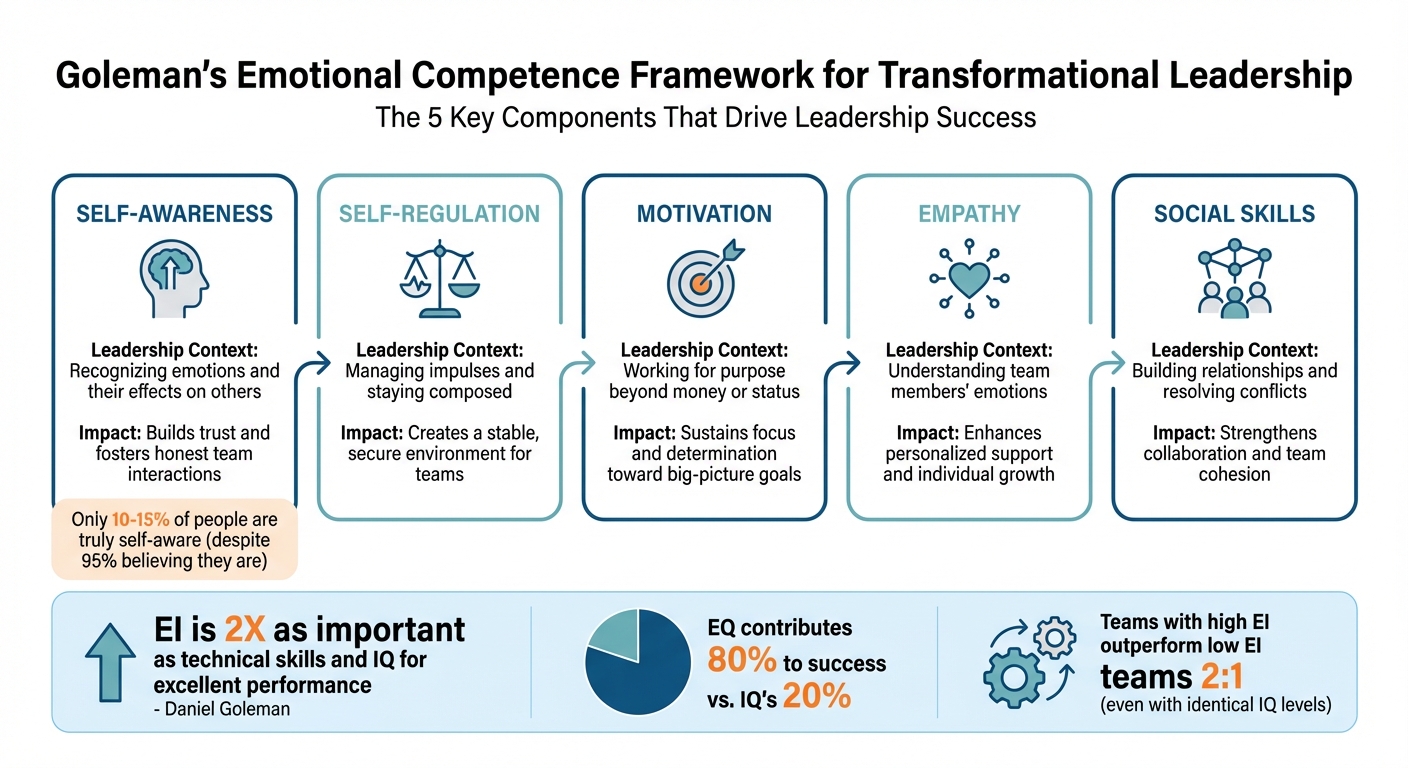
Goleman's 5 Components of Emotional Intelligence in Leadership
Emotional intelligence (EI) is more than just a helpful skill - it’s a game-changer in transformational leadership. Research shows that EI significantly impacts leadership effectiveness, with studies revealing that emotional intelligence is twice as important as technical skills and IQ for excellent performance at all job levels [10]. Even a modest 10% increase in EI scores can lead to a 7% improvement in business performance [10].
Daniel Goleman, the psychologist who brought emotional intelligence into the spotlight, emphasizes its importance:
"When I calculated the ratio of technical skills, IQ, and emotional intelligence as ingredients of excellent performance, emotional intelligence proved to be twice as important as the others for jobs at all levels." [10]
The difference between a leader who merely manages and one who inspires transformation often comes down to emotional competence. While IQ accounts for only 20% of success, emotional quotient (EQ) contributes around 80% [3]. This explains why companies may hire based on intelligence but often let employees go due to poor attitudes or a lack of emotional understanding [3].
Goleman’s Emotional Competence Framework
Goleman outlined five key competencies that empower transformational leadership: self-awareness, self-regulation, motivation, empathy, and social skills. Each plays a unique role in how leaders inspire and connect with their teams.
- Self-awareness helps leaders understand their own emotions and how these emotions influence others. This builds trust and offers an honest perspective on team dynamics. Interestingly, while 95% of people believe they are self-aware, only 10-15% actually are [10].
- Self-regulation allows leaders to control impulsive reactions and act thoughtfully, fostering stability and calm, especially during challenging situations.
- Motivation drives leaders to pursue goals beyond financial gain, maintaining focus and resilience even when facing setbacks.
- Empathy enables leaders to understand the emotions and needs of their team members, offering personalized support that boosts individual motivation [2][3].
- Social skills help leaders build relationships, encourage collaboration, and manage conflicts effectively.
Here’s how these competencies translate into leadership:
| Goleman’s EI Component | Leadership Context | Impact on Transformational Leadership |
|---|---|---|
| Self-awareness | Recognizing emotions and their effects on others | Builds trust and fosters honest team interactions |
| Self-regulation | Managing impulses and staying composed | Creates a stable, secure environment for teams |
| Motivation | Working for purpose beyond money or status | Sustains focus and determination toward big-picture goals |
| Empathy | Understanding team members’ emotions | Enhances personalized support and individual growth |
| Social Skills | Building relationships and resolving conflicts | Strengthens collaboration and team cohesion |
These competencies are the foundation for building trust, inspiring teams, and maintaining motivation.
Building Trust and Employee Motivation
Trust is at the heart of transformational leadership, and emotional intelligence is the key to building it. Leaders with high EI use "inspirational motivation" to energize their teams, communicating a vision that resonates on an emotional level [3]. Self-aware leaders who are open to feedback create an environment where employees feel safe to take risks and think creatively without fear of judgment.
The impact of EI on team performance is striking. Teams with high EI outperform those with low EI by a ratio of two to one, even when their IQ levels are identical [3].
Dr. Bilal Zaghmout, a business strategist, highlights the practical benefits of emotionally intelligent leadership:
"Managers with high emotional intelligence were better at resolving conflicts, fostering teamwork, and maintaining high morale among employees. This in turn led to increased employee engagement, lower turnover rates, and improved overall productivity." [10]
Empathy plays a critical role in this dynamic. By understanding each team member’s emotional needs, leaders can provide tailored support that helps individuals grow and thrive. Without empathy, employees often feel undervalued, leading to declining motivation and commitment [2]. Active listening - focusing on body language and rephrasing what’s been said - helps leaders uncover underlying concerns and foster stronger connections [2].
A survey of 300 companies found that 62.5% had already integrated emotional intelligence into their leadership strategies [1]. These organizations understand that EI equips leaders to handle the "messy human realities" that arise in any workplace, sustaining motivation and minimizing tension during times of change.
Better Conflict Resolution and Team Dynamics
Conflict is inevitable, but emotionally intelligent leaders transform how it’s managed. Leaders with high EI can read emotions through tone and expressions, adapting their responses to resolve issues effectively [2]. Social skills are particularly valuable in navigating conflicts stemming from personal or cultural differences. Leaders who excel in this area keep communication open and maintain productivity despite differing perspectives [2]. Meanwhile, self-regulation ensures leaders remain composed, sometimes even using humor to defuse tense situations rather than reacting emotionally [2].
Emotionally intelligent leaders also foster psychological safety - creating an environment where team members feel comfortable voicing concerns and sharing ideas, even during challenging times.
James MacGregor Burns, the scholar who coined the term "transformational leadership", captured this idea perfectly:
"The genius of transformational leadership lies in the manner in which leaders see and act on their own and their followers' values and motivations." [3]
This encapsulates why EI is so effective in conflict resolution. Leaders who understand their own emotions and those of their team members can bridge differences and find solutions that respect everyone’s values. They create what researchers call "resonant" leadership, where leaders and teams harmonize like strings on a well-tuned instrument [10]. In contrast, leaders without EI often foster "dissonant" environments, leading to burnout and poor collaboration.
For leaders aiming to develop these skills, tools like Personos offer AI-driven insights for understanding personality dynamics and improving communication. These platforms provide real-time support for conflict resolution and coaching tailored to individual needs, making it easier to apply EI principles in everyday leadership scenarios. By strengthening relationships and refining team dynamics, emotionally intelligent leadership creates a workplace where everyone can thrive.
sbb-itb-f8fc6bf
Practical Ways to Develop Emotional Intelligence for Leadership
Building emotional intelligence (EI) involves intentional practice and the right tools. Empathy, for instance, can be strengthened through exercises like active listening and perspective-taking [13]. Research shows that leaders with high EI often deliver impressive results: 90% of top performers demonstrate strong emotional intelligence [12][13]. Moreover, change initiatives led by emotionally skilled leaders are 2.5 times more likely to succeed, leading to productivity gains of 15–25% [13]. Below, we’ll explore how structured training, AI-powered tools, and personality-based coaching can accelerate EI development.
Training Programs and Self-Development Methods
Structured training programs provide a solid starting point for developing emotional intelligence. Institutions like Harvard's Division of Continuing Education (offering two-day on-campus programs for $3,300), the University of Wisconsin–Madison (charging $480), and the Center for Leadership Studies use tools like the EQ-i 2.0 Workplace Report and 360-degree assessments to identify emotional blind spots and create actionable growth plans [11][12][14]. These programs follow a step-by-step approach: identifying emotions, recognizing patterns, improving perception, fostering empathy, and enhancing influence [2].
Daily self-development practices also yield impressive results. For instance, spending 5–10 minutes each day reflecting on emotions can improve decision-making clarity by 15–20% [13]. Journaling is another effective tool - write down specific emotions, their triggers, physical sensations, and possible alternative responses [13]. To manage emotions in the moment, try the STOP Technique: Stop, Take a breath, Observe your thoughts and sensations, and Proceed with intention [13]. Physical activity also plays a role - regular aerobic exercise boosts blood flow to the prefrontal cortex by 10–15%, improving cognitive function. Practices like yoga or tai chi, done 2–3 times a week, can increase emotional awareness by 25–30% [13].
Simple techniques like affect labeling - naming your emotions - can help regulate feelings by engaging the prefrontal cortex and calming the amygdala [13]. Empathy mapping is another practical tool: create a four-quadrant chart to explore what stakeholders might be thinking, feeling, saying, and doing [13]. Starting team meetings with "emotion check-ins" encourages an emotional vocabulary and builds psychological safety [13][14]. When faced with tough feedback, applying the "24-Hour Rule" to delay your response can help you process emotions and respond thoughtfully [13].
Using AI Tools like Personos for Growth
Technology offers new ways to develop emotional intelligence. Tools like Personos provide real-time, personalized EI coaching for $9 per seat per month. By analyzing communication patterns in emails, chats, and meetings, Personos identifies when a leader’s tone might come across as dismissive or impatient. Organizations using AI tools like this have reported a 25% reduction in team conflicts, 12% faster resolution of interpersonal issues, 14% higher peer trust scores, and a 22% improvement in feedback quality during one-on-one meetings within three months [15].
AI tools also create a private space for leaders to practice and refine their skills. For example, leaders can use scenario-based role-play to rehearse challenging conversations - such as delivering performance reviews or handling terminations - and receive feedback on their empathy and phrasing. Personos also generates personality reports tailored to individuals, relationships, and teams, offering proactive communication prompts based on personality insights. Its sentiment and conflict detection algorithms analyze meeting transcripts to identify hidden tensions or shifts in team morale [15].
Joshua Freedman, CEO of Six Seconds, sums up the value of combining human and AI insights:
"Work with AI as a tool for particular types of thinking, partner with humans for meaning." [16]
Personos tracks behavioral changes over time, such as a leader transitioning from a directive to a collaborative communication style, and provides data to measure EI progress. It also offers perspective-taking insights, helping leaders tailor their communication to different personality types or demographics, ensuring messages resonate while maintaining a human connection.
Applying Personality-Based Coaching
Incorporating personality insights into coaching enhances emotional intelligence development. Research shows that EI is the strongest predictor of job performance, accounting for 58% of success [18]. Personality-based coaching begins with assessments like the Emotional Intelligence Appraisal or the MSCEIT to establish a baseline. Models like the Big 5 - focusing on traits such as Extraversion, Openness, Agreeableness, Conscientiousness, and Neuroticism - help leaders understand how their personality influences emotional responses [17][19][20].
Personalized growth plans are key. For example, a leader high in Conscientiousness but low in Agreeableness might focus on developing empathy and collaboration skills. Meanwhile, someone high in Neuroticism could prioritize self-regulation techniques [20]. Daniel Goleman emphasizes the importance of self-awareness as a foundation for emotional intelligence:
"Self-awareness is the foundation of EI." [17]
Coaching often includes continuous feedback loops, with regular check-ins and peer evaluations to measure progress and refine strategies [18][21]. Leaders also learn to interpret non-verbal cues - like body language, tone, and facial expressions - which account for 55% of communication impact, compared to just 7% for verbal content [19]. Techniques like cognitive reframing can help shift negative thoughts into productive actions, while mindfulness practices such as deep breathing can improve emotional regulation in stressful situations [18][19].
Platforms like Personos complement this approach by offering 24/7 guidance. The platform analyzes team dynamics and delivers weekly insights with actionable prompts to improve interactions [21]. By combining personality psychology with AI-driven coaching, leaders can develop the emotional intelligence needed to inspire and guide their teams effectively.
Measuring the Impact of Emotional Intelligence on Leadership Effectiveness
Tracking emotional intelligence (EI) is key to understanding the effectiveness of leadership. Research shows that teams with higher EI are 20% more productive and 40% more profitable. Companies that prioritize employees with strong EI also see a 90% retention rate, compared to just 67% in companies with lower EI scores [23]. Without measuring EI, it’s difficult to gauge how well leadership strategies are working. Regular evaluations turn the abstract benefits of EI into concrete, measurable outcomes.
Validated Methods for Measuring EI
There are several reliable ways to assess emotional intelligence and monitor progress over time:
- Self-report measures: These questionnaires help individuals evaluate their self-awareness and self-regulation, providing a baseline for improvement [23].
- Ability-based tests: Tools like the MSCEIT test problem-solving abilities related to emotions, offering objective insights into real-world emotional skills [22][23].
- 360-degree feedback: This method combines self-assessments with anonymous feedback from colleagues, supervisors, and team members, helping identify blind spots [23][24].
- Behavioral observation: Trained evaluators analyze emotional agility and leadership behaviors in real or simulated scenarios [23].
- Mixed models: Instruments like the EQ-i 2.0 integrate personality traits, social skills, and behavioral competencies for a comprehensive assessment [22].
To make the most of these tools, organizations often reassess leaders every 3–6 months, ensuring that coaching and development efforts produce measurable results [22].
| Assessment Tool | Model Type | Purpose |
|---|---|---|
| MSCEIT | Ability-based | Evaluates problem-solving skills involving emotions [22] |
| EQ-i 2.0 / EQ 360 | Mixed-model | Combines multi-rater feedback with emotional and social functioning assessments [22] |
| TEIQue | Trait-based | Measures self-perception of emotional abilities and personality [22] |
| ESCI | Goleman’s Mixed | 360-degree evaluation of leadership-related emotional competencies [22] |
| WLEIS-16 | Workplace-specific | A concise tool for assessing emotional appraisal in workplace settings [22] |
By using these methods, organizations can create a structured approach to improving EI among leaders.
Continuous Evaluation Using Tools like Personos
Periodic assessments are helpful, but digital tools take EI tracking to the next level by enabling continuous monitoring. Platforms like Personos offer real-time insights and track behavioral changes, making it easier to sustain and improve emotional intelligence. These tools provide weekly updates with actionable suggestions to enhance team dynamics and leadership effectiveness.
Connecting EI scores to tangible outcomes - such as team productivity, goal achievement, and employee retention - helps demonstrate the business value of emotional intelligence. Leaders with high EI often achieve double the customer retention rates of their lower-EI counterparts. Additionally, emotionally intelligent leadership can improve overall team performance by up to 50%, thanks to better communication and empathy [23][25].
Conclusion
Emotional intelligence plays a central role in shaping effective transformational leadership. As Daniel Goleman pointed out, leadership success heavily depends on emotional intelligence, with a staggering 93% of success tied to soft skills [2][6].
Leaders with strong emotional intelligence create workplaces where teams can excel. They nurture psychological safety, minimize conflicts, and encourage innovation. Emotional intelligence enhances every aspect of transformational leadership - whether it's inspiring team motivation or offering tailored coaching [5]. By managing their own emotions and understanding those of others, leaders set an example that earns trust and respect [6]. This connection highlights the importance of developing emotional intelligence as a cornerstone for leadership growth.
Building emotional intelligence isn’t a one-time effort - it’s an ongoing process that demands self-awareness and consistent practice. Tools like Personos can help leaders on this journey. For just $9 per seat per month, Personos offers real-time insights into personality dynamics, communication styles, and team interactions. With features like personalized AI-driven feedback and dynamic personality reports, leaders can uncover blind spots, track their growth, and gain actionable advice tailored to real-world challenges.
FAQs
How can leaders develop emotional intelligence to improve team performance?
Leaders can strengthen their emotional intelligence (EI) by honing four core areas: self-awareness, self-regulation, empathy, and social skills. Improving self-awareness starts with reflection - whether through journaling or seeking feedback - to identify emotional triggers and understand how they influence decisions. Self-regulation, on the other hand, means learning to pause before reacting in challenging situations, enabling better emotional management. Building empathy involves actively listening, asking thoughtful questions, and genuinely considering others' perspectives. And finally, developing social skills - such as offering constructive feedback, acknowledging accomplishments, and encouraging teamwork - helps foster trust and unity within a team.
To accelerate this growth, leaders can turn to structured programs, consistent coaching, and tools like Personos, which offers real-time insights tailored to individual personalities and communication styles. By weaving these practices together and embracing supportive technology, leaders can cultivate a positive team atmosphere where individuals feel appreciated, motivated, and aligned with shared objectives - crucial elements for stronger performance and smoother communication.
What happens when transformational leaders lack emotional intelligence?
When leaders who aim to inspire and drive change lack emotional intelligence (EI), their effectiveness takes a serious hit. Without self-awareness and empathy, they often find it challenging to earn trust, communicate a clear and motivating vision, or build meaningful connections with their team. This gap can make it harder to energize employees and support their growth - both of which are essential for creating high-performing teams.
Low EI can manifest in several ways: frequent interpersonal conflicts, reduced teamwork, and poor conflict resolution skills. Over time, these issues can lead to disengaged employees, higher turnover rates, and a noticeable drop in overall performance. To help leaders overcome these hurdles, tools like Personos provide AI-powered coaching and real-time feedback. These tools focus on developing critical EI skills - such as self-regulation, empathy, and effective communication - that are essential for achieving transformative leadership success.
How does emotional intelligence help leaders resolve conflicts and improve team dynamics?
Emotional intelligence (EI) equips transformational leaders with the tools to handle conflicts effectively and boost team dynamics. By honing skills like self-awareness, empathy, and emotional regulation, these leaders can better understand the emotions of others, stay composed under pressure, and approach tensions with a constructive mindset. This approach turns potential conflicts into opportunities for collaboration and progress.
Leaders who excel in EI build trust and foster a sense of psychological safety within their teams. This kind of environment encourages open communication and strengthens teamwork. Studies consistently highlight that leaders with high emotional intelligence are more adept at resolving disputes, nurturing positive relationships, and inspiring their teams to work toward common objectives. Tools such as Personos offer real-time insights and tailored strategies, helping leaders apply EI principles effectively to enhance team unity and achieve sustainable success.