Emotional Intelligence, Psychological Safety, and Staff Burnout
Burnout on frontline helping teams often stems more from low emotional-intelligence supervision than workload — change leadership to protect staff.
Nick Blasi

Emotional Intelligence, Psychological Safety, and Staff Burnout
If I want to cut burnout on frontline helping teams, I need to look at supervision first. In U.S. care settings, leadership style shapes whether staff speak up, ask for help, report mistakes, or stay quiet until stress turns into burnout and turnover.
Here’s the core idea in plain English:
- Low-EI leadership often means poor listening, reactive behavior, and dismissive feedback
- That can weaken psychological safety, so staff hide stress and hold back concerns
- When people stop speaking up, errors surface later and strain builds
- High-EI leadership supports calm supervision, reflection, and clear feedback
- That helps staff recover better, stay engaged, and remain in their jobs
This matters because burnout is common in social work, counseling, case management, and nonprofit teams. In many U.S. workplaces, burnout has been linked with absenteeism, turnover, and lower job satisfaction. Some studies have found that more than 40% of workers report burnout symptoms at times, and helping professions often face even heavier emotional strain.
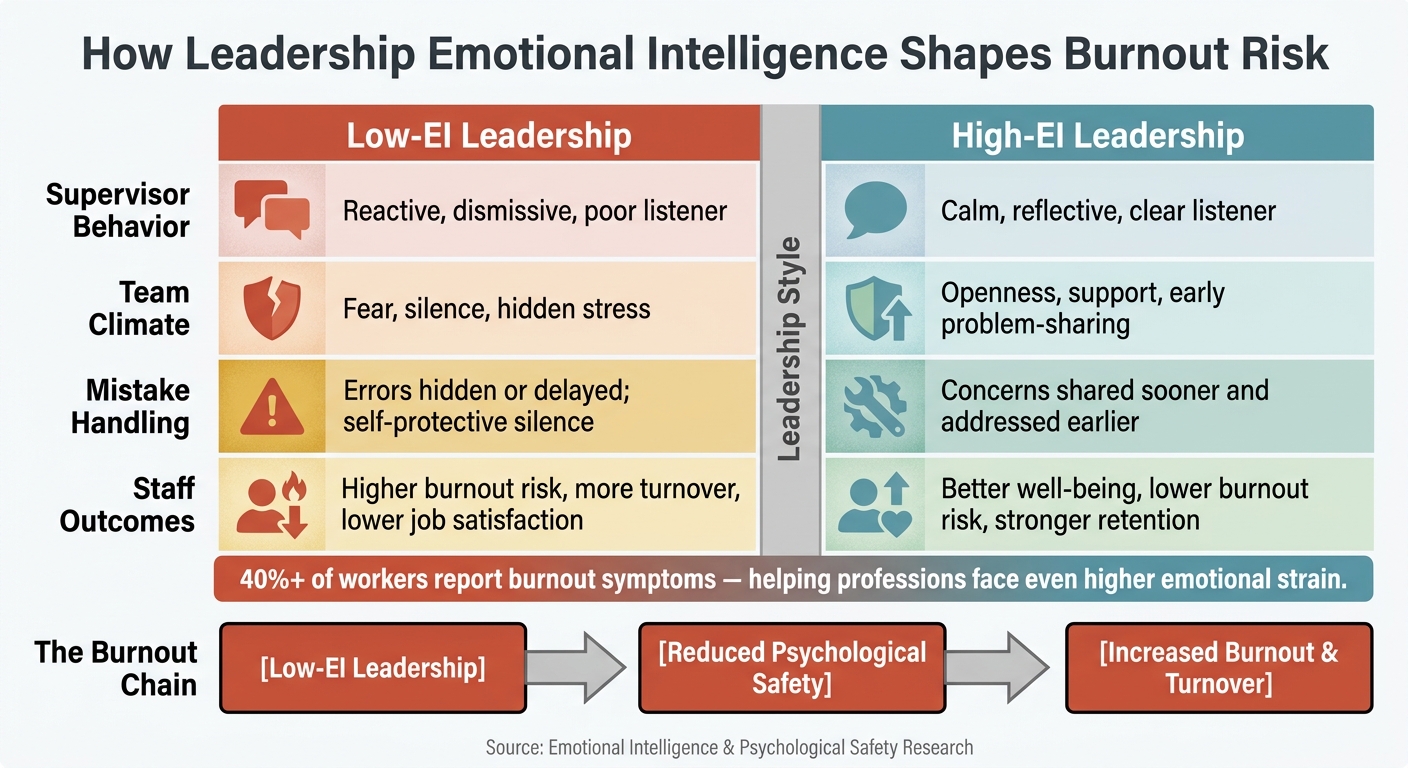
Low-EI vs High-EI Leadership: Impact on Burnout & Psychological Safety
Unlocking the Resilience Code: Emotional Intelligence and Burnout Immunity
Quick comparison
| Area | Low-EI leadership | High-EI leadership |
|---|---|---|
| Supervisor behavior | Reactive, dismissive, poor listener | Calm, reflective, clear listener |
| Team climate | Fear, silence, stress | Openness, support, early problem-sharing |
| Mistakes and concerns | Hidden or delayed | Shared sooner and addressed earlier |
| Staff effect | More strain, more burnout risk, more turnover | Better well-being, lower burnout risk, stronger retention |
What I take from this article is simple: burnout is not just a workload issue. It is also a leadership issue. If I improve how supervisors listen, respond, and guide staff between meetings, I can help create a safer workplace for people doing hard emotional work every day.
What low emotional intelligence leadership looks like and how it affects psychological safety
In supervision, low EI tends to show up in a few familiar ways: weak self-regulation, poor listening, and dismissive feedback. On high-stress helping teams, that mix can chip away at trust fast.
The next weak spot is communication. Once staff stop speaking up, small problems stay hidden.
Team climate under low-EI supervision
In frontline helping professions, emotional reactivity and uneven reactions from supervisors can create a fear-based climate. Staff may hide stress and keep concerns to themselves. Over time, that can turn into self-protective silence, where employees avoid taking risks or reporting mistakes to protect themselves. That kind of self-protection drains energy and increases burnout risk.
And that silence doesn't just sit there. It adds strain and pushes burnout higher.
Missed errors and delayed escalation under low-EI leadership
When people don't feel safe speaking up, trust starts to erode and problems come to light later. Teams flag fewer concerns, and honest case discussion begins to break down.
As stress builds and support falls, burnout goes up and turnover risk climbs.
Comparison table: Low-EI leadership and team response
| Leadership dimension | Low-EI leadership | Typical team response |
|---|---|---|
| Self-regulation | Weak self-regulation | Emotional reactivity can spill into the team climate |
| Listening style | Poor listening | Staff hide stress and withhold concerns |
| Feedback approach | Dismissive feedback | Trust erodes |
| Psychological safety | Low psychological safety | Self-protective silence; employees avoid taking risks or reporting mistakes; staff well-being declines and turnover risk increases |
The same pattern looks very different under high-EI leadership. High-EI supervision can reverse it by making it easier for people to speak up early and recover faster.
How high emotional intelligence leadership protects psychological safety and staff well-being
High-EI leadership creates a very different kind of workplace. People speak up sooner, bounce back faster, and carry less stress home. It helps build psychological safety by making it easier to surface problems early, fix mistakes, and reduce burnout.
Leader behaviors that build psychological safety
High-EI supervisors listen more than they talk. That simple shift helps problems come out early instead of sitting in the dark until they get worse. These leaders stay calm when pressure spikes, and they deal with mistakes without turning them into blame sessions. They set the context first, then move to the fix. That makes staff more willing to bring bad news forward instead of hiding it.
As Pebb Insights puts it:
"Say the hard thing plainly. Then help fix it." - Pebb Insights [1]
When staff can speak early and get calm, clear correction, teams avoid the slow stress buildup that often leads to burnout and turnover.
High-EI supervisors also change how they communicate based on the person in front of them. Some people need more structure and detail. Others need less explanation and a little more room to think. Good supervisors check for understanding in a way that feels collaborative, not patronizing. So instead of asking, "Do you understand?" they might say, "What's your read on the next step?" That small change can lower friction and make feedback easier to act on.
These habits matter even more in supervision, where emotional strain and case pressure tend to run highest.
Reflective supervision and stronger team functioning
High-EI supervisors do more than handle one-on-one moments well. They also make room for teams to process the emotional weight of the work. Reflective supervision adds that layer of emotional processing to case review, so staff aren't left carrying hard cases by themselves.
The good news is that these habits can be learned. In day-to-day work, supervisors who model reflection, calm, and clear feedback can help teams stay steadier under pressure and function better from one day to the next.
A personality-aware tool can help make that steadiness more consistent across supervisors and teams. Personos can extend reflective supervision with personality-aware guidance for client meetings, crisis calls, team conflict, and high-stakes decisions, while ActionBoard turns supervision insights into follow-through.
Practical steps for leaders and organizations
Leadership and supervision changes that reduce burnout
If leaders want healthy habits to last, they need to build them into supervision. One simple place to start is situation-specific supervision.
Personos does this by adding personality-aware guidance for tough client interactions, crisis calls, and team collaboration. That gives supervisors help choosing responses based on personality, context, and relationship dynamics.
That point matters. Psychological safety is shaped between meetings, not just during them.
Organization-level supports beyond individual resilience
Personos also helps teams build a healthier climate by keeping personality profiles private unless someone decides to share them in coaching. That privacy-first setup can lower stigma tied to labeling and support psychological safety.
Its Dynamic Reports, Prompts, and ActionBoard help teams turn insight into follow-through. For social workers, counselors, case managers, and nonprofit staff, support doesn't stop at the supervision hour. It carries into the moments when burnout risk is at its highest.
Comparison table: generic wellness tools and personality-aware support
The difference shows up most clearly in day-to-day work.
| Intervention | Primary Benefit | Fit for frontline helping teams |
|---|---|---|
| Generic wellness tools | Basic check-ins and resource access | Helpful for general support |
| Personality-aware tools (e.g., Personos) | Situation-specific guidance, team pattern insights, and action tracking | Designed for social workers, case managers, counselors, and nonprofit staff |
Generic wellness tools can help with basic support. Personality-aware tools go after the harder stuff: conversations, conflict, and follow-through that shape burnout risk. The best results come when leadership skill is paired with tools that back it up.
Conclusion: The leadership pattern helping teams can change
Low-EI leadership creates confusion, friction, and exhaustion. High-EI leadership does the opposite. It builds the psychological safety that helps staff stay engaged and supports retention. In U.S. helping organizations, that has a direct effect on burnout risk and turnover.
That’s why systems matter just as much as skill. Leadership is more likely to stick when leaders have clear ways to communicate and teams have shared follow-through systems. In plain terms, changing leadership behavior is part of burnout prevention.
Emotional intelligence can be measured and improved. And training tends to work best when leaders use those skills in supervision, not only in workshops.
For social workers, case managers, counselors, and nonprofit staff, the stakes are too high to treat leadership development as optional. It can start small: one clearer sentence, one follow-up question, and one less assumption.
FAQs
How does low-EI supervision raise burnout risk?
Low-EI supervision can push burnout risk up fast. It creates a workplace where people feel ignored, brushed aside, or treated unfairly. When supervisors miss employees’ contributions, play favorites, or communicate in a vague way, trust starts to slip. Once that happens, resentment tends to build.
Weak conflict resolution makes things worse. Small issues don’t stay small for long when no one handles them well.
Tools like Personos can help supervisors communicate better, respond with empathy, and create more collaborative team environments that cut burnout risk and support retention.
What does psychological safety look like on helping teams?
On teams, psychological safety means people can talk through differences in a useful way instead of dodging them or turning every disagreement into a win-or-lose fight. When leaders show strong EQ, admit mistakes, and speak openly, trust grows. That trust helps staff feel valued and gives them more drive to do their best work.
Personos can help professionals handle these moments with personality-aware communication. In practice, that can help teams move from conflict to collaboration, while cutting burnout and making the team environment better.
Can supervisors build emotional intelligence over time?
Yes. Supervisors can build emotional intelligence over time.
The catch is that old-school feedback on people skills often falls short. It can come too late, reflect bias, or stay so general that it's hard to use in the moment.
Tools like Personos can help close that gap. They give real-time, situation-specific guidance based on personality psychology and communication patterns. So instead of broad advice that sounds good but goes nowhere, supervisors get practical direction they can use in day-to-day management.