How Personality Shapes Emotional Intelligence Growth
How Big Five traits shape self-awareness, self-regulation, empathy and social skills, plus AI tools for tailored EI growth.
Nick Blasi

How Personality Shapes Emotional Intelligence Growth
Some people naturally excel at understanding emotions and managing relationships, while others find it challenging. This difference often comes down to emotional intelligence (EI), which is influenced by personality traits. Research shows that personality accounts for 20–30% of EI development, making a tailored approach essential for growth. The Big Five traits - Openness, Conscientiousness, Extraversion, Agreeableness, and Neuroticism - play a key role in shaping EI strengths and challenges.
Key Takeaways:
- EI Components: Self-awareness, self-regulation, motivation, empathy, and social skills.
- Personality Links: Traits like Agreeableness boost empathy, while Neuroticism can hinder self-regulation.
- Tailored Growth: Personalized strategies based on personality improve EI training by up to 60%.
- AI Tools: Platforms like Personos provide real-time, personality-based guidance to improve EI.
Understanding your personality baseline helps identify areas for improvement, and tools like Personos offer personalized support for managing emotions and relationships effectively.
Understanding Personality Styles and Emotional Intelligence PD Pt. 1
How Personality Traits Affect Emotional Intelligence
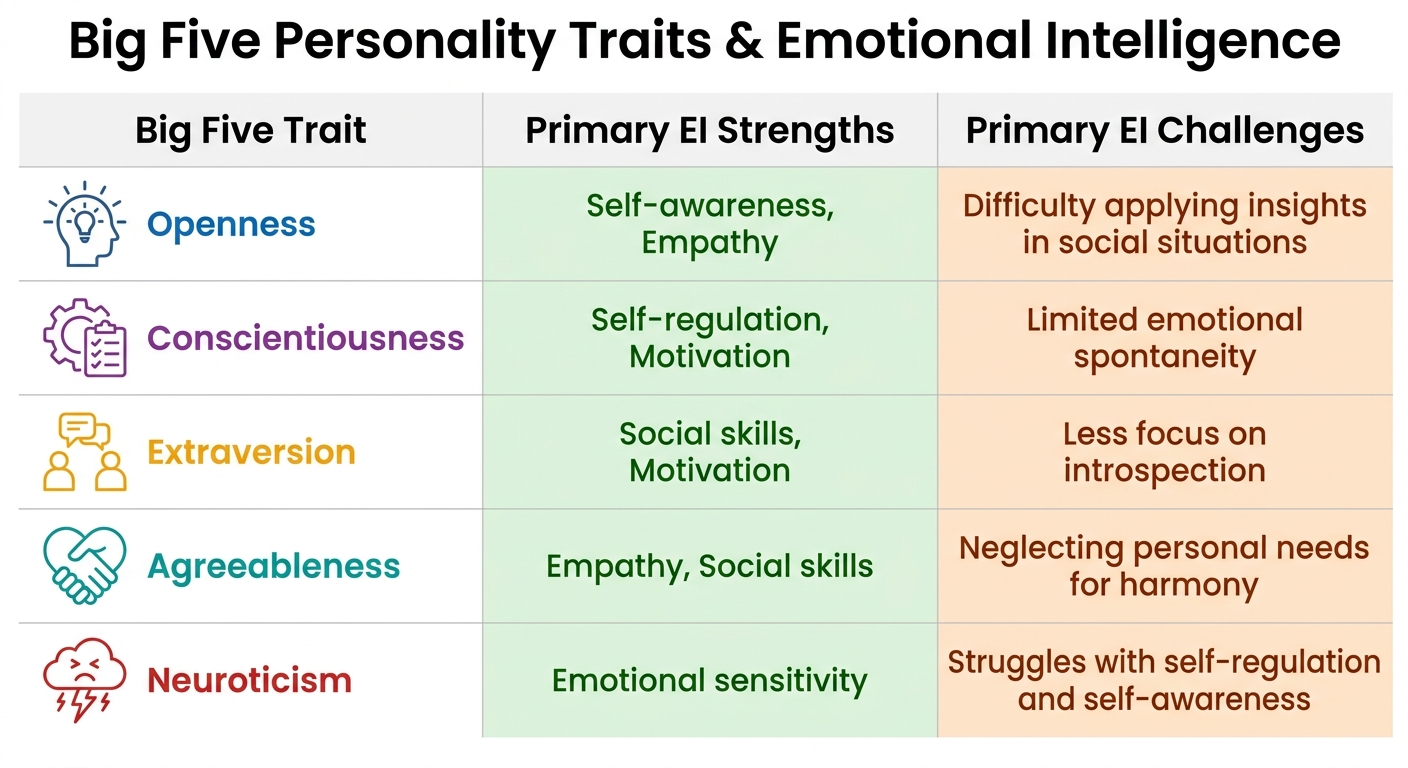
How Big Five Personality Traits Impact Emotional Intelligence Development
The Big Five Personality Traits and EI
The Big Five personality traits shape emotional intelligence (EI) in unique ways, offering both strengths and challenges. Let’s break it down:
- Openness encourages self-awareness and empathy. People high in Openness often reflect deeply, making it easier for them to understand their own emotions and others' perspectives. However, they might struggle to apply this insight in practical social settings.
- Conscientiousness bolsters self-regulation and motivation. The discipline associated with this trait helps manage emotional reactions and stay focused on goals, but it can sometimes come at the expense of spontaneity.
- Extraversion naturally supports social skills and motivation. Extraverts thrive in social environments and maintain the energy to pursue objectives. However, their focus on external interactions might limit their ability to introspect.
- Agreeableness stands out as a strong predictor of empathy. Agreeable individuals are highly attuned to others' emotions and prioritize harmony in relationships. This focus on harmony is crucial for managing workplace conflicts effectively. On the flip side, they may suppress their own needs to maintain peace.
- Neuroticism, while associated with emotional intensity, can make self-regulation challenging. Research by Brackett and Mayer highlights that individuals high in Neuroticism often experience strong emotions, which can hinder their ability to manage those feelings effectively[1].
Here’s a quick summary of how these traits connect to EI:
| Big Five Trait | Primary EI Strengths | Primary EI Challenges |
|---|---|---|
| Openness | Self-awareness, Empathy | Difficulty applying insights in social situations |
| Conscientiousness | Self-regulation, Motivation | Limited emotional spontaneity |
| Extraversion | Social skills, Motivation | Less focus on introspection |
| Agreeableness | Empathy, Social skills | Neglecting personal needs for harmony |
| Neuroticism | Emotional sensitivity | Struggles with self-regulation and self-awareness |
Finding Growth Opportunities Through Personality Awareness
Understanding your personality traits can help you pinpoint areas for EI growth. As JobCannon puts it, "Knowing your personality profile gives you a precise map of which EQ components you're starting from strength and which require deliberate development"[1]. This tailored approach allows you to focus on strategies that match your natural tendencies by combining personality psychology with AI.
For instance, if you score high in Neuroticism, practicing mindfulness or regulating your physiological responses can help manage intense emotions. Those with lower Agreeableness might focus on building affective empathy by practicing perspective-taking or engaging in exercises that promote social warmth. Meanwhile, individuals high in both Extraversion and Agreeableness could benefit from enhancing self-awareness to better distinguish their emotions from others'.
AI-Powered Tools for Improving Emotional Intelligence
How AI Uses Personality Psychology for EI Development
AI-powered tools designed to boost emotional intelligence (EI) rely on machine learning to analyze behavioral signals like tone, word choices, and facial expressions in real time[2][4]. Unlike traditional training programs, these tools provide personalized, scalable, and data-driven solutions tailored to individual needs[2]. One standout feature is real-time feedback. For instance, messaging assistants can analyze the tone of your message before you hit send, suggesting tweaks to avoid sounding overly harsh[4]. These tools also identify behavioral blind spots, offering actionable suggestions to address them[4]. By combining real-time analysis and personalized insights, these platforms create a more effective way to enhance EI, adapting their guidance to fit individual personality profiles.
Why Personos Works Better
Many AI platforms lean heavily on emotional warmth, often leading to over-affirmation. This approach, while pleasant, can hinder critical thinking. Research has shown that leading AI models frequently over-affirm user actions compared to human responders[3]. Tamilla Triantoro, Associate Professor of Business Analytics and Information Systems at Quinnipiac University, highlights the issue:
"A model tuned to be agreeable does not just feel pleasant. It can degrade human judgment by reinforcing existing beliefs and suppressing the friction that critical thinking requires"[3].
Personos takes a different approach. Built on the Five Factor Model, which evaluates 30 traits on an 80-point scale, it’s designed for professionals navigating complex interpersonal challenges. Its conversational AI uses detailed personality profiles to provide tailored guidance for situations like managing client relationships, resolving crises, and fostering team collaboration. Features like Dynamic Reports offer personalized insights for individuals, relationships, and teams, while the ActionBoard tracks progress, turning insights into measurable improvements.
What makes Personos stand out is its commitment to transparency. Each recommendation explains the personality traits and psychological principles behind it, helping users develop their own expertise rather than becoming overly dependent on the tool. For professionals managing demanding workloads and emotionally taxing situations, Personos offers the critical balance of thoughtful guidance and real-time support. This not only helps reduce burnout but also enhances decision-making and extends a professional’s capacity to handle complex challenges effectively.
How to Use Personality Knowledge to Improve EI
Measure Your Personality Baseline
Start by taking an honest look at your personality. While most people think they know themselves well, studies reveal that only 10–15% of individuals are genuinely self-aware, even though 95% believe they are[5]. This gap highlights the need for an objective approach to understanding yourself.
Begin with a Five Factor Model assessment, which evaluates traits like Openness, Conscientiousness, Extraversion, Agreeableness, and Neuroticism. Then, collect 360-degree feedback from colleagues, managers, and friends. Ask them to evaluate your emotional intelligence (EI) skills - things like handling conflict, showing empathy, or managing change[5]. Comparing your self-assessment with their feedback will help you uncover blind spots and establish a realistic baseline for improvement.
"If you're aware of your own emotions and the behaviors they trigger, you can begin to manage these emotions and behaviors."[5]
Once you have this baseline, you can start applying targeted strategies to enhance your EI in specific situations.
Get Tailored Guidance for Real-Time Situations
Understanding your personality is just the beginning. To truly improve, you need advice that fits your unique traits and the challenges you face. Generic tips don’t cut it when dealing with complex, real-world scenarios.
This is where tools like Personos Chat come in. It offers real-time guidance based on your personality baseline. For example, you can describe a specific challenge - like resolving a conflict, building trust with a skeptical colleague, or navigating a tense conversation - and the AI provides advice tailored to how you handle stress, process information, and communicate. Additionally, Dynamic Reports can help you identify friction points in relationships and suggest practical strategies to improve communication.
Once you’ve applied this tailored advice, the next step is to track your progress and refine your efforts.
Track Your Progress Over Time
Improving emotional intelligence isn’t a one-and-done effort. It’s an ongoing process that requires consistent practice and evaluation. A great example of this comes from journalist Laurie Clarke, who participated in a six-week personality intervention in January 2026. Using methods like daily meditation, gratitude journaling, and spontaneous social interactions, she reduced her neuroticism from the 83rd to the 50th percentile and increased her extraversion from the 30th to the 50th percentile[6]. Her experience shows how focused, intentional efforts can lead to noticeable changes in personality traits.
Tools like the Personos ActionBoard make it easier to track your growth. You can turn any recommendation into a specific, measurable action - like identifying your emotions during difficult calls or asking clarifying questions to practice empathy. Set clear goals, monitor your progress, and reassess your personality traits every 6 to 15 weeks of active practice[6]. This consistent tracking turns insights into meaningful, long-term EI development.
Conclusion: Using Personality to Grow Your Emotional Intelligence
Your personality isn’t a limitation when it comes to emotional intelligence - it’s actually your guide. By recognizing how your individual traits shape your emotional reactions, communication habits, and approach to stress, you can build a solid foundation for self-awareness. As Margaret Andrews, Instructor of Emotional Intelligence in Leadership at Harvard University, explains:
"It all starts with self-awareness, which is foundation of EI, and it builds from there. If you're aware of your own emotions and the behaviors they trigger, you can begin to manage these emotions and behaviors." [5]
This deeper understanding of your emotional patterns allows you to implement practical, real-time solutions. This is especially critical for leaders and managers, who often receive less honest feedback as they climb the organizational ladder. Without clear insights, it’s easy to lose sight of the behaviors that either strengthen or harm professional relationships.
AI tools like Personos help close this self-awareness gap. By using the scientifically validated Five Factor Model, these tools provide objective personality assessments, create tailored strategies for addressing challenges, and track progress over time. This turns emotional intelligence into something measurable and actionable.
Research shows that individuals with strong emotional intelligence experience higher job satisfaction and are more innovative than those with lower EQs [5]. Building emotional intelligence isn’t about natural ability - it’s about consistent, intentional effort. By identifying your core traits, applying targeted strategies, and monitoring your growth, you can achieve meaningful emotional development.
FAQs
Can emotional intelligence improve even if personality is fixed?
Yes, emotional intelligence can grow, even if personality is viewed as unchanging. Studies indicate that while personality traits might feel fixed, they can shift gradually with effort and self-reflection. Emotional intelligence, in particular, can be strengthened through deliberate strategies and consistent practice, no matter where you begin.
Which Big Five trait should I focus on first to grow my EI?
Start by prioritizing low Neuroticism, as it plays a critical role in developing self-awareness and self-regulation - two essential aspects of emotional intelligence. Studies suggest that minimizing traits like anxiety and emotional instability can greatly enhance your capacity to recognize and control emotions more effectively.
How can I tell if an AI tool is giving real EI coaching or just being agreeable?
To determine if an AI tool truly delivers emotional intelligence (EI) coaching, look for personalized and context-specific guidance instead of vague, overly agreeable responses. Genuine EI coaching reflects a deep understanding of emotions, provides tailored feedback, and acknowledges the complexities of human feelings. Tools like Personos, which are based on proven personality models, aim to encourage real emotional development and build trust. They go beyond superficial interactions, offering actionable insights and meaningful support.