Emotional Intelligence in Teams: Why It Matters
Team emotional intelligence boosts trust, reduces conflict, and improves performance via training, leadership, and personality tools.
Nick Blasi

Emotional Intelligence in Teams: Why It Matters
Emotional intelligence (EQ) is more than just understanding emotions - it’s about using them effectively to improve team dynamics, communication, and performance. Research shows a moderate-to-high correlation (r ≈ 0.41) between EQ and team effectiveness, proving its value in creating trust, reducing conflict, and boosting morale. High-EQ teams communicate better, handle disagreements constructively, and maintain engagement even under stress.
Key takeaways:
- Teams with strong EQ are better at building trust and resolving conflicts.
- Leadership plays a critical role in shaping team EQ through emotional tone and constructive guidance.
- EQ can be developed through structured training, tools like Personos ($9/month per user), and hiring practices focused on emotional skills.
Investing in EQ improves team performance and reduces turnover. Whether through training or tools, small steps can lead to measurable improvements in collaboration and morale.
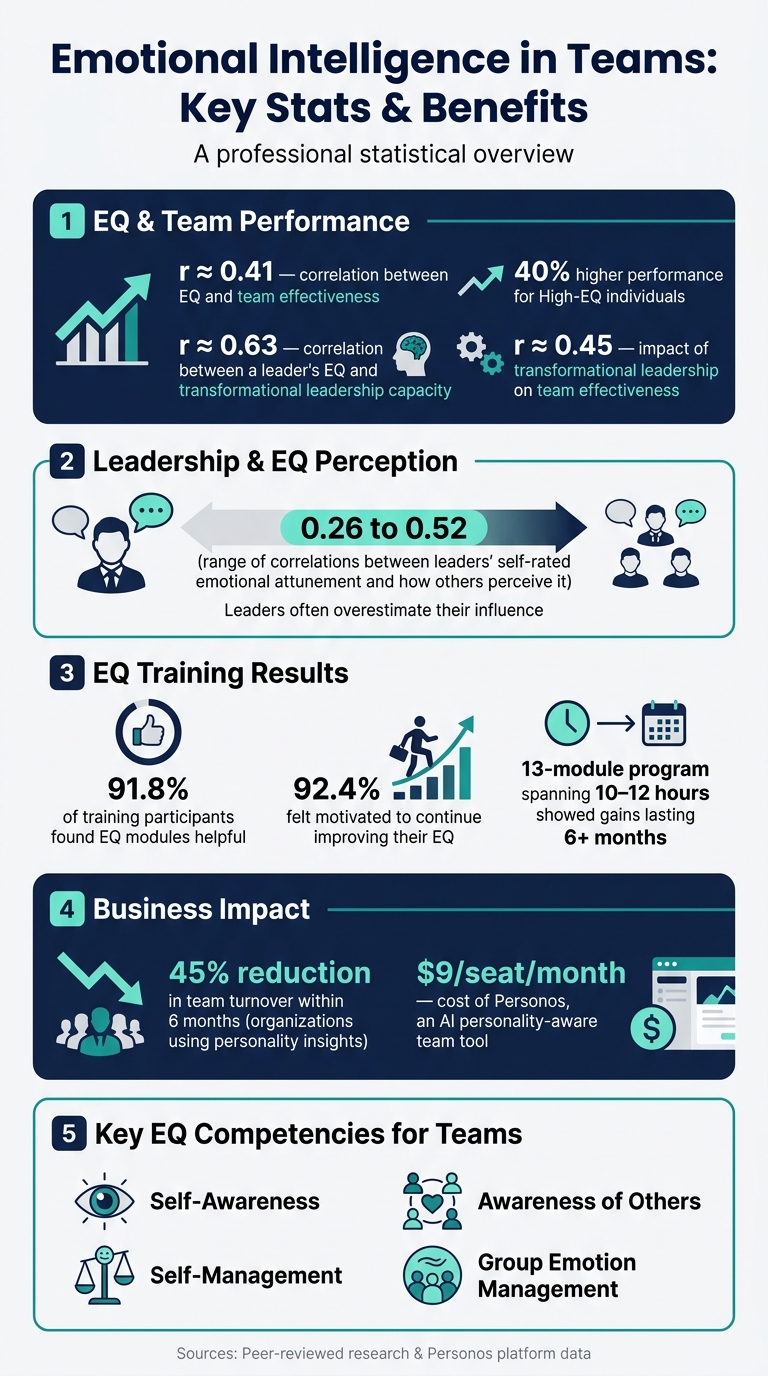
Emotional Intelligence in Teams: Key Stats & Benefits
What Emotional Intelligence Means: A Research-Based View
Defining Emotional Intelligence
Emotional intelligence (EQ) refers to a set of skills that help individuals understand and manage emotions, especially in social contexts. Researchers generally categorize EQ into two main frameworks.
The Ability Model, introduced by psychologists John D. Mayer and Peter Salovey, views EQ as a mental ability, much like analytical intelligence. According to Mayer, Roberts, and Barsade:
"Emotional intelligence involves the ability to carry out accurate reasoning about emotions and the ability to use emotions and emotional knowledge to enhance thought." [5]
On the other hand, the Mixed Model, championed by figures like Daniel Goleman and Reuven Bar-On, takes a broader approach. It combines emotional skills with personality traits, such as empathy, self-regulation, and social awareness.
For team dynamics, researchers often rely on the Workgroup Emotional Intelligence Profile (WEIP-S). This tool focuses on four key abilities: self-awareness, self-management, other-awareness, and emotion management [4]. These models are the foundation for practical assessments in workplace settings.
How Researchers Measure EQ in Teams
Using these frameworks, researchers have developed various tools to evaluate EQ, especially within teams.
| Measurement Stream | Approach | Common Tools |
|---|---|---|
| Ability-Based | Tests designed to measure mental abilities related to emotions | MSCEIT |
| Self/Peer Report | Ratings given by individuals or teammates on emotional skills | WEIP-S, Schutte et al. measure |
| Mixed Models | Combines emotional competencies with personality traits | Bar-On EQ-i, Emotional Competence Inventory |
At the team level, one common method is calculating the average member EQ, which aggregates individual scores. Researchers then analyze how this average correlates with outcomes like trust, cohesion, and performance [2]. Important metrics include intrateam trust, communication quality, solving team conflicts with personality insights, and psychological safety [1][2].
How to Build Emotionally Intelligent Teams: Vanessa Druskat's 9-Norm Framework
This framework often integrates with AI-driven personality analysis to identify and strengthen these team norms.
How Emotional Intelligence Affects Team Performance
Studies show that emotional intelligence (EQ) plays a key role in shaping team performance. From improving communication to reducing conflicts and boosting morale, EQ has a measurable influence on how teams function and succeed.
Better Communication and Trust
Effective communication is at the heart of strong team performance. When team members can interpret emotional cues and manage their responses, conversations flow more smoothly. This clarity fosters collaboration and reduces misunderstandings.
"EI improves communication clarity, empathy, and emotional regulation which results in effective communication, reduces misunderstandings, and engages people in open dialogue more." - Shailaja Karve and Kiran Gupta, Researchers [7]
A study involving 91 teams found that both a leader's EQ and the team's average EQ independently enhance trust within the group, which directly impacts performance [2]. Interestingly, even if a leader has a lower EQ, a team with high EQ can maintain trust, and vice versa. This highlights EQ as a collective strength rather than just an individual trait.
Beyond trust and communication, EQ also plays a critical role in managing team dynamics, particularly when conflicts arise.
Less Conflict and Stress
Teams with high EQ don't avoid disagreements - they manage them constructively by solving team conflicts with personality insights. Research on 79 teams in South Korea revealed that team EQ is inversely related to both task-related and personal conflicts [8]. This means that while strategic debates may occur, they are less likely to spiral into personal disputes. By keeping conflicts productive and respectful, teams maintain the psychological safety needed for open, honest collaboration.
This reduction in conflict creates a more positive atmosphere, which directly impacts team morale and engagement.
Stronger Engagement and Morale
EQ also influences how team members feel about their work. Teams with higher EQ are often more cohesive, motivated, and satisfied with their jobs. Studies link EQ to "functional psychobiosocial states", which refer to sustained positive emotions and motivation [9]. Leaders with high EQ amplify these benefits:
"Emotionally intelligent leaders have a higher propensity to engage and make their employees happier at work and more resilient to the rigors of fulfilling their roles." - Shailaja Karve and Kiran Gupta, Researchers [7]
This is especially crucial in hybrid or remote work settings, where maintaining team energy and connection can be more challenging. High EQ helps bridge these gaps, ensuring that teams remain engaged and motivated even when working apart.
How Leadership Shapes Team Emotional Intelligence
Leadership plays a crucial role in nurturing and enhancing emotional intelligence (EQ) within teams, which is essential for driving performance and fostering a positive work environment.
Leading by Example with Emotional Intelligence
Leaders do more than just oversee tasks - they set the emotional tone for their teams. Research refers to this as creating an "affective tone," where a leader's emotional state significantly influences the group. This phenomenon, called emotional contagion, shows that when leaders consistently display emotions like enthusiasm, pride, or joy, these feelings ripple through the team, boosting cohesion and morale [10][11].
One key way leaders achieve this is through emotional repair. Rather than ignoring or suppressing negative emotions, they openly acknowledge challenges and guide the team toward a constructive mindset. For example, a 2024 study involving teachers and school principals in Yogyakarta, Indonesia, revealed that principals with high EQ directly improved teacher performance and well-being. Notably, this effect was strongest in environments where a positive emotional climate already existed, highlighting the importance of a supportive team culture [12].
"Leaders are not just what they think they are, but also what their followers perceive them as." - Rosa Mindeguia, Researcher, University of the Basque Country [13]
Interestingly, meta-analyses show only moderate correlations (0.26 to 0.52) between how leaders rate their own emotional attunement and how others perceive it, suggesting leaders may overestimate their influence [13].
Developing Leaders to Build Team-Wide EQ
Leadership isn’t just about setting the tone - it’s also about actively developing team-wide emotional intelligence.
A study conducted in Spain (2014–2016) examined 1,566 managers across 188 teams and found that transformational leadership played a central role in linking leadership style to employee cohesion. The study highlighted the importance of Team Emotional Intelligence (TEI), particularly the collective ability to recover from negative moods and maintain positive emotions like passion and pride [11].
Further evidence from a 2026 meta-analysis underscores the value of investing in leadership development. The findings revealed a strong correlation (r ≈ 0.63) between a leader's emotional intelligence and their capacity for transformational leadership, which in turn significantly impacts team effectiveness (r ≈ 0.45) [1]. Enhancing a leader’s emotional skills creates a ripple effect, improving the dynamics and performance of the entire team.
"Emotional intelligence emerges as a central resource that strengthens transformational leadership and, through psychological and relational mechanisms, consistently enhances team effectiveness in complex organizational contexts." - Maribel Paredes-Saavedra, PhD, Universidad Peruana Unión [1]
To maximize these benefits, leadership development programs should prioritize practical emotional skills. This includes teaching leaders how to strategically use both positive and negative emotions, reduce the gap between how they perceive themselves and how others see them, and establish shared norms that promote emotional well-being within the team [10][11].
Practical Ways to Build Emotional Intelligence in Teams
Team Training and Development Programs
Understanding the importance of emotional intelligence (EQ) is one thing, but developing it is where the challenge lies. The encouraging news? EQ can be developed, and structured training programs have proven to deliver lasting improvements.
Research shows that multimodal training, which focuses on multiple emotional skills at once, achieves better results than programs targeting just one skill.
"Evidence from social–emotional skill interventions suggests that multimodal trainings tend to produce better short-term and long-term outcomes compared to interventions that focus on training a single skill." - Frontiers in Psychology [14]
A study published in Frontiers in Psychology in August 2023 highlights this approach. Researchers at the University of Arizona tested a 13-module online Emotional Intelligence Training (EIT) program with 326 participants. Spanning 1 to 3 weeks, the program required 10–12 hours of engagement and included three levels: foundational emotional concepts, skill-building (like mindfulness and cognitive reframing), and practice simulations. The results were impressive - participants showed significant improvement in managing emotions strategically, with these gains persisting even six months later. Additionally, 91.8% of participants found the modules helpful, and 92.4% felt motivated to continue improving their EQ [14].
One key takeaway? Spacing out training sessions improves retention. Adding interactive elements - like writing exercises, simulations, and personalized feedback - also enhances how well participants apply what they learn [14].
To further reinforce these skills, AI-enabled tools like Personos can provide ongoing support in real-world team interactions.
Using Personality-Aware Tools Like Personos
Personality-aware tools can play a big role in embedding emotional intelligence into daily team dynamics.
Personos is an AI-driven platform based on the Five Factor Model, which measures 30 personality traits on an 80-point scale. For teams, it generates Dynamic Reports at individual, relationship, and group levels. These reports cover areas like communication preferences, collaboration tendencies, conflict triggers, and personal strengths. Unlike static personality tests, Personos adapts as team contexts change and offers role-specific guidance tailored to contributors, managers, or leaders [3].
In moments of tension, Personos provides personalized language suggestions to match individual communication styles. As the platform explains: "In moments of conflict, change, or performance pressure, get clear guidance tailored to how each person processes information and makes decisions." [3] By fostering clearer communication and reducing conflict, Personos strengthens the trust and cohesion that high-EQ teams thrive on. This aligns with research showing that effective team communication bridges the gap between emotional intelligence and team functionality [9].
For organizations looking to supplement general EQ training, Personos offers a practical solution. At just $9 per seat per month, it’s an affordable way to integrate personality insights into daily team interactions without expecting everyone to master EQ concepts upfront.
While tools like Personos enhance ongoing development, hiring practices can establish a strong EQ foundation from the start.
Hiring for Emotional Intelligence
The journey to building a high-EQ team begins long before a new hire’s first day. Incorporating emotional intelligence into hiring decisions is a cost-effective way to promote better team dynamics and long-term cohesion.
Researchers have identified four essential EQ competencies for workgroups: self-awareness, self-management, awareness of others, and group emotion management [4]. Tools like the Workgroup Emotional Intelligence Profile (WEIP-S) - a 16-item assessment - can be used during hiring to measure these abilities [4].
In interviews, focus on traits like "Positive Conflict" (constructively handling disagreements) and "Acceptance" (showing appreciation for colleagues). Both are strong indicators of team cohesion [9]. Situational questions that explore how candidates handle role ambiguity are also valuable, as role clarity supports the psychological safety teams need to perform well [9].
"Effective communication typically requires an understanding of others' viewpoints and effective management of emotions." - Rachele Nateri et al., Sustainability Journal [9]
Platforms like Personos can even preview how a candidate’s personality might align with existing team dynamics, highlighting potential challenges or strengths [3].
Conclusion: The Case for Investing in Team Emotional Intelligence
Research makes it clear: team emotional intelligence has measurable benefits. Studies show that emotionally intelligent teams perform better, with high-EQ individuals achieving 40% higher performance. Organizations that use personality insights have also seen team turnover drop by 45% within just six months [15].
Whether it's a single emotionally aware leader or a team-wide effort, boosting EQ consistently leads to better results [2]. Building team EQ doesn’t require massive overhauls. Small, manageable steps - like online training programs, personality-focused tools, and more thoughtful hiring - can strengthen teams and build trust, which directly improves outcomes [2].
"We reduced team turnover by 45% in six months. Personos helped us understand why certain team dynamics weren't working and gave managers the exact words to fix it." - Sarah Mitchell, MBA, VP of Operations [15]
These findings aren't just theoretical - they can guide actionable strategies for companies. For organizations ready to take the next step, Personos offers a practical solution. Unlike static tools like DISC or Hogan, Personos provides ongoing, context-specific guidance for just $9 per seat per month, helping teams improve collaboration, retention, and morale over time.
FAQs
How can we measure team emotional intelligence?
Team emotional intelligence is gauged by looking at how well a group can recognize, understand, and handle emotions within the team. One widely used approach is the Workgroup Emotional Intelligence Profile (WEIP-S), which measures emotional awareness and management skills.
Additionally, team-level models focus on how the group collectively perceives and processes emotions, offering a broader perspective on emotional dynamics. For more nuanced insights, tools like Personos leverage AI to provide tailored guidance, helping teams improve collaboration and address conflicts more effectively.
What are the fastest ways to improve EQ in a team?
The fastest way to boost a team's emotional intelligence (EI) is by using focused strategies that help members learn how to identify and manage emotions in the workplace. Studies indicate that these approaches can strengthen teamwork, improve overall well-being, and even make up for lower EI levels in individuals.
One tool that professionals can use is Personos, an AI-driven platform that delivers personalized, real-time advice for improving team collaboration, resolving conflicts, and managing emotions effectively. This can lead to stronger results and help prevent burnout.
How do we hire for emotional intelligence?
Hiring with emotional intelligence in mind means digging into how candidates manage challenges and build relationships. To do this, ask situational and behavioral questions that encourage them to share specific examples of past mistakes and their part in those situations. Pay close attention to how they describe their actions and what they learned.
Another key indicator? Watch how they treat everyone they interact with during the process, from support staff to junior interviewers. This can reveal a lot about their respect for others, regardless of rank or role.
For additional insights, tools like Personos can help by offering personality-based data. These insights can guide leaders in making informed decisions during both hiring and onboarding.