10 Emotional Engagement Tips for Resistant Clients
Practical emotional strategies—empathy, reflective listening, motivational interviewing, choices, and real-time AI support—to connect with and guide resistant clients.
Nick Blasi

10 Emotional Engagement Tips for Resistant Clients
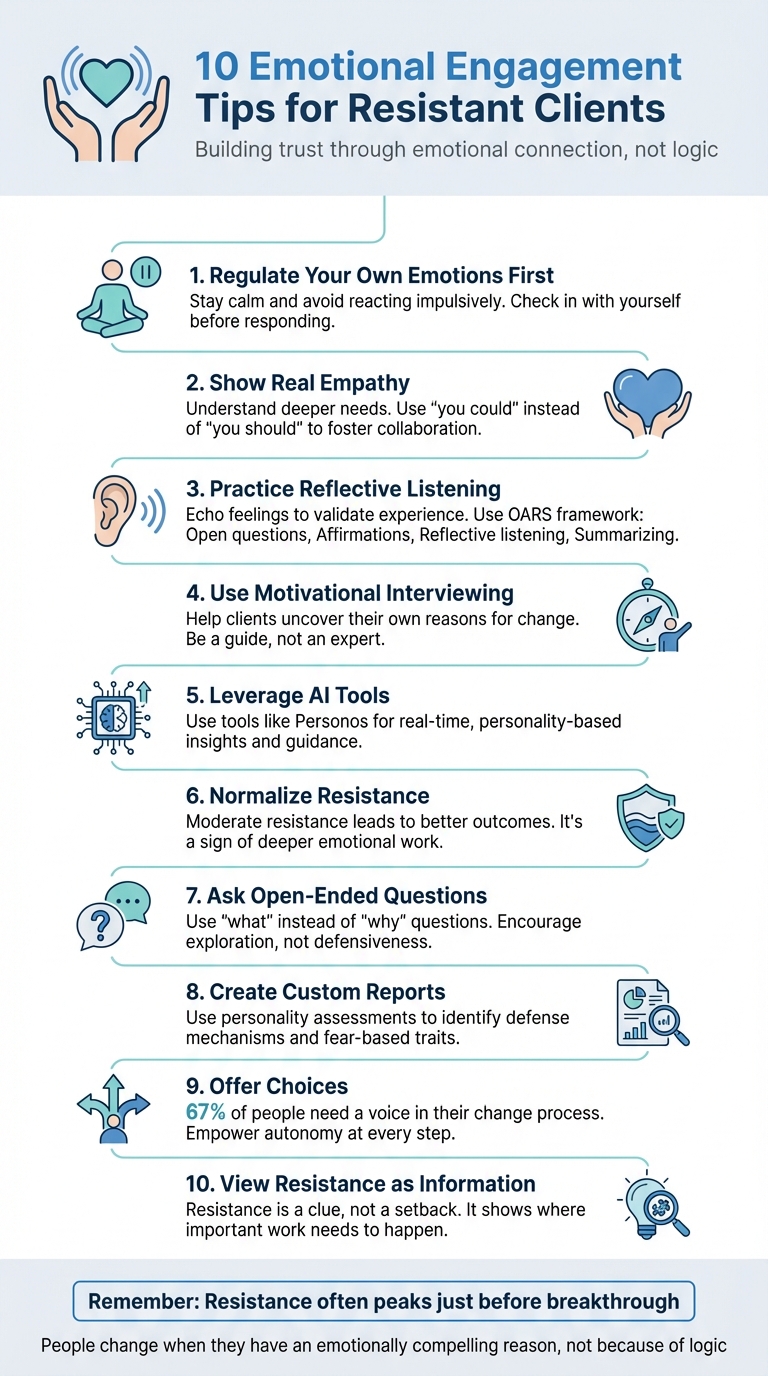
When clients resist - crossing their arms, avoiding eye contact, or saying "yeah, but" - it’s not about you. Resistance is often a protective response rooted in fear, past pain, or vulnerability. The key to breaking through isn’t logic - it’s emotional connection. Research shows moderate resistance can lead to better outcomes when handled well. Here’s how to navigate these challenging moments effectively:
- Manage your emotions first: Stay calm and avoid reacting impulsively.
- Show empathy: Understand their deeper needs without judgment.
- Use reflective listening: Echo their feelings to validate their experience.
- Apply motivational interviewing: Help clients uncover their reasons for change.
- Leverage AI tools like Personos: Gain real-time insights into client behavior using the Five Factor Model for AI-assisted therapy.
- Normalize resistance: Recognize it as a natural part of progress.
- Ask open-ended questions: Encourage exploration rather than defensiveness.
- Offer choices: Empower clients to maintain control over their journey.
- View resistance as information: Treat it as a clue to deeper issues.
These strategies help you build trust, lower defenses, and guide clients toward meaningful progress. Remember, resistance isn’t the enemy - it’s an opportunity to connect and grow.
10 Strategies for Engaging Resistant Clients in Therapy
Dealing with Client Resistance: 4 Therapy Approaches
These techniques can be further enhanced by using AI tools for helping professionals to track client progress and manage session notes.
1. Regulate Your Own Emotions First
When a client resists or shuts down, your body often reacts before your mind even registers what's happening. Maybe your heart starts racing, your palms sweat, or you feel a wave of confusion or dread washing over you. These physical signals are your body’s early warning system, telling you that you're becoming emotionally hooked - and that's the moment to hit pause [7].
The real challenge isn’t the client’s resistance - it’s how you respond to it. Fred J. Hanna, PhD, explains it perfectly: "When the client is resisting the therapist and the therapist starts getting irritated, then you have two people resisting each other. That's not therapy; that's war" [8]. If you find yourself arguing, trying to convince your client, or working harder than they are, it’s a clear sign that you’ve lost your emotional intelligence [3][7].
Therapist Kirk Honda shared a striking example of this in July 2017. During a session with a father and daughter, both clients began verbally attacking him. Honda felt overwhelmed by intense physical reactions - sweating, near-panic, and even the urge to flee the room. It wasn’t until he recognized these feelings as his own reaction to their resistance that he was able to regain control and repair the therapeutic relationship [7].
Before responding to resistance, pause and check in with yourself. Ask: "Am I feeling impatient or pushing too hard?" [6]. Slow down your pace, soften your tone, and allow space for the moment to settle. This internal reset helps you avoid impulsive reactions and instead creates a sense of calm and safety for your client [6]. After all, clients often reflect your emotional state - if you’re anxious, they’ll pick up on it too.
The takeaway? You can’t help regulate your client’s emotions until you’ve managed your own. As Clifton Mitchell, PhD, wisely notes: "You can't change your clients. You can only change how you interact with your clients and hope that changes results" [2].
2. Show Real Empathy
Empathy is about understanding and addressing a client’s deeper needs rather than rushing to fix them. Often, resistance signals unmet needs like a desire for control, respect, acceptance, or safety [9]. Instead of saying "you should", try offering "you could" as an alternative. This subtle shift moves the conversation from criticism to collaboration. For instance, if a client seems guarded, you might say, "It sounds like keeping things in has helped you feel safe in the past - does that resonate with you?" [1]. Recognizing their behavior as a survival strategy rather than a flaw helps reduce shame and opens the door to meaningful dialogue.
Empathy operates on three levels: cognitive (understanding someone’s perspective), affective (sharing their emotions), and behavioral (showing care through actions). A systematic review found that targeted behavioral training improved empathy by 75% [9]. Even small gestures, like sitting down during a conversation instead of standing, can make a big difference in how empathetic you seem [9].
In practice, if a client becomes quiet or withdrawn, you could ask, "This seems like a tough topic; what’s coming up for you as we talk about it?" [1]. And if you make a mistake that disrupts the connection, a simple apology can go a long way. Try saying, "I’m sorry for making you feel hurt or misunderstood" [7]. Rebuilding trust starts with acknowledgment. As Cheryl Richardson wisely said:
"Listen. People start to heal the moment they feel heard" [9].
3. Practice Reflective Listening
Reflective listening builds on empathy to help clients feel understood while lowering their defenses. It’s not about parroting their words but about grasping the heart of their message and echoing it back. When clients hear their thoughts reflected without judgment, it often eases their resistance and encourages open communication.
One effective technique is to focus on the client’s final statements before they withdraw or become guarded. Paraphrasing those moments can validate their feelings in real time. For instance, if a client grows quiet after mentioning their family, you might respond with, "It seems like talking about your family brings up something difficult for you." This approach acknowledges their emotions without pressuring them to elaborate.
It’s also important to recognize that resistance often stems from self-protection. Instead of viewing silence or avoidance as obstacles, see them as strategies clients use to cope. You could say, "It sounds like staying quiet has been a way to protect yourself - does that feel accurate?" [1][5]. By validating their experience, you shift the dynamic from conflict to collaboration.
Avoid falling into the "expert trap" of offering too many solutions. As Clifton Mitchell, PhD, Associate Professor at East Tennessee State University, puts it:
"People rarely change because of the logic of the situation; people change when they have an emotionally compelling reason." [3]
Slowing down and staying slightly "behind" the client gives them space to discover their own insights. When you resist the urge to rush or fix, clients often begin guiding themselves toward solutions [3].
To support this approach, use the OARS framework: Open questions, Affirmations, Reflective listening, and Summarizing [1]. After reflecting, check your understanding with simple questions like, "Did I get that right?" or "Does that match how you’re feeling?" [10][11]. Research shows that 67% of people feel that having a voice - being able to express concerns and ask questions - is key to making meaningful changes [10]. Reflective listening provides that voice and shows clients you’re working alongside them, not trying to fix them [1].
This thoughtful process sets the stage for the next steps in effectively engaging resistant clients.
4. Use Motivational Interviewing Techniques
Motivational interviewing (MI) shifts your role from being the expert to becoming a guide. Instead of telling clients what to do, you help them uncover their own reasons for change. This is particularly effective with resistant clients, as it allows them to feel in control of their progress.
At its core, MI relies on four key principles: expressing empathy through reflective listening, developing discrepancy between current behaviors and personal values, rolling with resistance rather than confronting it, and supporting self-efficacy by focusing on the client’s strengths [12]. For example, you might ask, "How does staying isolated fit with your goal of being there for your kids?" This kind of question encourages clients to see the gap between their actions and what truly matters to them.
Research highlights the power of "change talk", where clients express their own desire, ability, or reasons for making a change. This is a strong indicator of successful outcomes [12]. Instead of pushing your perspective, aim to elicit this kind of talk. Scaling questions can help, like asking, "On a scale of 0 to 10, how important is this change to you?" Follow up with, "Why are you at a 4 and not a 2?" These questions encourage clients to verbalize their motivations.
When framing questions, avoid starting with "Why", as this can make clients defensive. Instead, use "What" or "How" to keep the tone open and exploratory. If resistance builds, try the Columbo Technique - adopt a curious, non-judgmental stance that invites clients to clarify their thoughts. As Clifton Mitchell, PhD, explains:
"When a therapist appears 'two steps behind,' the client often steps forward to lead" [3].
Ambivalence is a natural part of change. When clients express mixed feelings, validate both sides with open-ended questions like, "What do you appreciate about staying isolated, and what concerns you about it?" This approach removes judgment and creates space for honest discussion. As Joshua Schultz, Psy.D., puts it:
"A 'guide' helps the person to get where they need to go, whereas an 'expert' tells the person what they need to do" [13].
5. Get Real-Time Guidance with Personos Chat
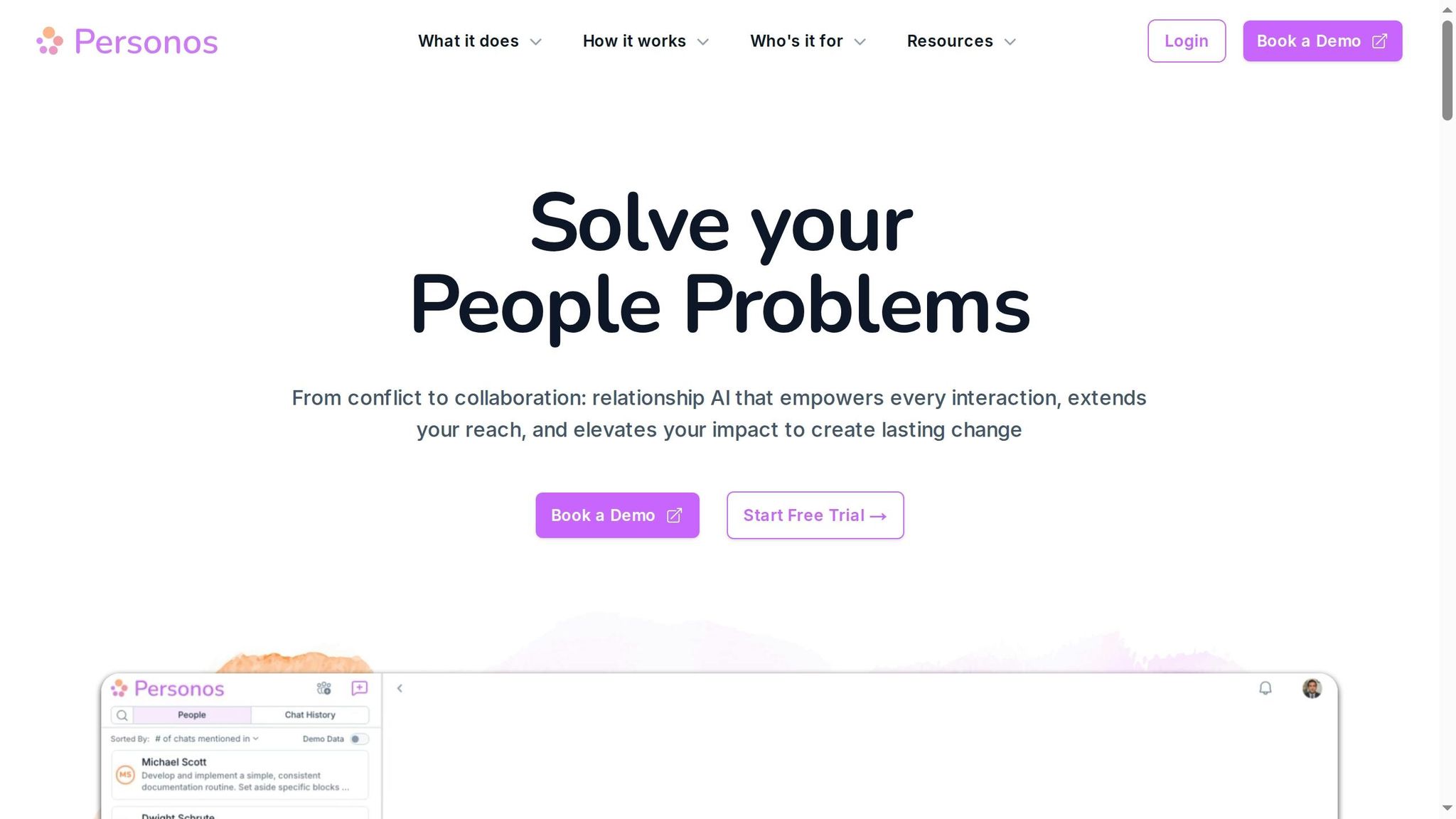
Handling a client who becomes hostile or unresponsive can be one of the most challenging moments in any session. You need help right away. That’s where Personos Chat steps in, offering tailored guidance based on your client’s personality profile - while you’re still in the middle of the conversation.
Unlike traditional supervision methods, Personos combines your client’s detailed personality insights with the real-time context of your interaction. If a client pushes back against your approach or starts leaning into intellectualization, the AI provides specific de-escalation phrases that align with both their personality and the nuances of your relationship. This kind of real-time, personalized support helps you stay constructive, even when your natural fight-or-flight instincts kick in.
The tool also helps with co-regulation, offering grounding strategies to keep you from unintentionally mirroring your client’s anxiety. As Dr. Janina Fisher, Founder of Trauma-Informed Stabilization Treatment, puts it:
"The absence of feeling doesn't mean that we're not feeling. The absence of feeling means that we're feeling too much, just as overwhelmed means we're feeling too much." [15]
Personos helps you manage those overwhelming moments as they happen, so you can stay fully present and engaged.
What makes Personos stand out from platforms like Mentalyc or Alliance Genie? While those tools focus on documentation, Personos delivers real-time, actionable advice. It’s all about giving you practical, in-the-moment recommendations.
For just $9 per seat per month, Personos lightens your mental load during high-pressure interactions. It personalizes motivational interviewing prompts and identifies resistant behaviors in a way that avoids triggering defensiveness. With this tool, you can maintain a calm, emotionally connected presence - even in the most difficult sessions.
6. Treat Resistance as Normal
When working with clients, it's important to recognize that resistance isn't a mistake or a failure - it’s often a sign that deeper emotional work is happening. If a client shuts down or pushes back, it might feel like a setback, but research suggests otherwise. Studies show that moderate levels of resistance in therapy are actually linked to better outcomes, while very low resistance may indicate that significant issues are being missed [3]. In other words, some resistance can be a clue that meaningful progress is on the horizon.
Think of resistance as a protective mechanism. Fear often acts as a safeguard, making change feel risky or even threatening [10]. When clients avoid certain topics or hesitate to engage, it’s usually because they’re trying to protect something important to them. Sandra Kushnir, Therapist and Founder of Degree to Practice, explains it well:
"Resistance isn't inherently oppositional or problematic. More often than not, it's a natural part of the change process. When a client resists engaging deeply, it's typically because they're protecting themselves from vulnerability, past trauma, or the fear of judgment." [1]
Acknowledging from the start that uncertainty and hesitation are normal can help reduce feelings of shame or defensiveness for your client [1].
Once you understand resistance as a natural response, you can adjust the session’s pace to meet the client where they are. If resistance arises, slow things down and acknowledge that the topic feels challenging. This validates their need for a more gradual approach while keeping the conversation open for deeper exploration [3][6]. By respecting their protective instincts, you create a space where they can feel safe enough to engage more fully over time.
7. Ask Open-Ended Questions
When working with a guarded client, the way you frame your questions can make all the difference. Closed-ended questions, like "Don't you think you should try this?" often feel like traps, triggering defensiveness and what’s known as the "Yes, But" cycle [3]. Instead, open-ended questions can create a more inviting and nonjudgmental space for conversation.
One way to shift the tone is by moving from "why" questions to "what" questions. For example, instead of asking, "Why don’t you want to stop [behavior]?" try, "What do you enjoy about [behavior], and what concerns do you have about it?" [1]. This approach removes any sense of confrontation, allowing clients to explore their thoughts and motivations at their own pace, without feeling attacked.
The Columbo Technique, mentioned earlier, highlights the value of adopting a curious stance. By presenting yourself as someone trying to better understand the situation, you encourage clients to clarify their own thinking [3]. This subtle strategy can guide them toward recognizing their own solutions.
Another effective tool is using process comments to address shifts in the conversation. For instance, if you notice a change in tone or energy, you might say, "I noticed a shift just now - can we explore what happened?" [1][16]. This invites clients to reflect on their own reactions and protective behaviors without feeling judged or cornered.
These techniques align with conversational strategies that prioritize curiosity over interrogation. Open-ended questions signal genuine interest and give clients the freedom to uncover their own answers. Often, resistance stems from fear - clients may already know the solution but feel overwhelmed by what it entails [3]. Your role is to create a safe environment where they can confront those fears on their own terms.
8. Create Custom Reports with Personos
Resistance often stems from a client's natural reaction to pressure, vulnerability, or change. Personos Dynamic Reports offer a way to uncover the specific traits and behaviors driving that resistance, helping you adapt your approach in real time.
Unlike generic personality tests, these reports are built on the scientifically validated Five Factor Model. They evaluate 30 traits on an 80-point scale, delivering highly personalized insights for individuals, relationships, and groups. These insights include details on defense mechanisms - like intellectualization, denial, or projection - and identify fear-based traits such as fear of failure, loss of control, or the unknown, which often fuel resistance.
For practitioners managing heavy caseloads, this depth of detail is a game-changer. The reports highlight patterns like over-compliance, externalizing blame, or superficial engagement, giving you the tools to fine-tune your communication before resistance becomes a bigger issue.
Clifton Mitchell, a professor and expert on resistance, emphasizes this point:
"If what you're doing with the client is not working, then do something else because your interaction is creating resistance" [14].
Personos reports also help you recognize when your approach might not align with a client's personality or readiness for change. They assess a client’s stage of change - from contemplation to action - helping you avoid interventions that could be counterproductive.
The platform goes even further with Relationship Reports, which analyze how your personality interacts with your client’s. These reports identify potential friction points and suggest specific strategies to improve communication. For clients with trauma histories, the reports reframe resistance as a survival mechanism rather than defiance, encouraging a shift from frustration to empathy. This level of understanding lays the groundwork for creating personalized strategies that truly empower your clients.
9. Give Clients Choices
Resistance often arises when clients fear that change might take away their sense of control. By offering choices instead of issuing directives, you transform the interaction into a partnership. It shifts the focus from something being imposed on them to a collaborative process where they remain in control.
Mark Tyrrell, a psychotherapist trainer, explains this concept:
"People's unconscious need for a sense of autonomy may feel greater than their need to overcome their problem." [4]
This highlights an essential truth: a client's desire to maintain independence can sometimes overshadow their willingness to change. Even those eager for help may resist if they feel their autonomy is at risk. The key isn't to push harder but to provide options at every step.
Start by letting clients take the lead in setting their goals and deciding on session details, such as appointment times, topics to discuss, or the therapeutic approach. Jennifer Jim, a provider at Spring Health, emphasizes the importance of this approach:
"If you can work through their goal first, they build confidence and trust. Often, they'll become open to hearing suggestions from you." [10]
This collaborative process builds trust and confidence, making clients more receptive to additional input. Using permissive language - like "perhaps", "maybe", or "I wonder if" - creates space for them to choose their own path forward.
Research supports this approach: 67% of people believe that having a voice - being able to ask questions and express concerns - is critical for successfully changing behavior. [10] When clients feel heard and empowered to make decisions, resistance naturally diminishes. Without a need to defend their autonomy, they become more open to change. This empowerment also helps reframe resistance into valuable insights, as explored in the next section.
10. View Resistance as Information
When clients become guarded or deflect, consider it a signal rather than a setback. Resistance isn't a dead end - it's a clue. It highlights where important work needs to happen. Cory Newman from the University of Pennsylvania explains:
"Resistance... is not simply an impediment to treatment, but also a potentially rich source of information about each client." [2]
When resistance surfaces, take a moment to assess what the client might be protecting. What feels too vulnerable or risky to explore? Resistance often arises right before deeper, meaningful work begins. It can point to fears of the unknown, feelings of shame or guilt, or even a desire to maintain a sense of identity.
Address what you observe without judgment. For example, you could say, "I noticed the topic shifted; what was that like for you?" This approach encourages the client to reflect on their internal barriers without feeling blamed. You can also validate the protective role of resistance by saying something like, "Avoiding this might have been a way you've coped for a long time." Acknowledging this helps reduce shame and builds trust, elevating client relationships through reflective listening techniques while focusing on resistance.
Think of resistance as a pacing tool: if a client becomes guarded, slow down, use grounding techniques, or focus on rebuilding rapport. Clifton Mitchell, a professor at East Tennessee State University, offers this perspective:
"Resistance goes two ways. The challenge is finding more creative and effective ways to interact." [7]
This feedback aligns with earlier strategies that emphasize staying calm and measured in your responses.
Conclusion
Dealing with resistant clients requires recognizing the protective function behind their defenses. The strategies discussed here touch on various aspects of emotional connection, helping you approach resistance with greater confidence and skill. By prioritizing your own emotional regulation, showing genuine empathy, and viewing resistance as a form of communication rather than opposition, you set the stage for meaningful progress.
The techniques outlined - such as reflective listening, motivational interviewing, and offering meaningful choices - respect the essential need for autonomy. As Clifton Mitchell wisely notes:
"You can't change your clients. You can only change how you interact with your clients and hope that changes results" [2].
For those managing heavy caseloads, tools like Personos can provide real-time, personality-tailored guidance and detailed reports for just $9 per seat per month. These resources can help extend your capabilities while reducing the risk of burnout.
Consider focusing on one or two of these techniques over the next two weeks. Observe the changes that occur when you slow your pace instead of rushing, validate resistance rather than confronting it, and align your approach with your client’s readiness. Remember, resistance often peaks just before significant therapeutic breakthroughs - its presence can signal that important work is underway [3].
The aim isn’t to eliminate resistance but to navigate it with care and skill. By adopting these strategies, you can improve client outcomes while also protecting your own well-being in this challenging yet rewarding field.
FAQs
How can I tell fear-based resistance from simple disengagement?
Fear-based resistance often arises from a deep sense of unease about change or feeling exposed. It can manifest in behaviors like avoidance, defensiveness, or outright hesitation. At its core, this reaction is an emotional shield against what feels like a potential threat. On the other hand, simple disengagement is more passive - it might look like someone putting in minimal effort or quietly withdrawing. Signs of fear-based resistance include avoiding certain topics or agreeing too readily. Addressing this requires empathy and patience to gently explore the fears driving these reactions.
What should I say when a client keeps responding with 'yeah, but'?
When a client responds with "yeah, but", it usually hints at some hesitation or mixed feelings. Instead of pushing back, try acknowledging their stance by saying something like, "I hear you saying 'yeah, but,' which makes me think there might be some concerns. Would you mind sharing what's on your mind?" This kind of response encourages trust and keeps the conversation open. By staying curious and patient, you can turn resistance into a meaningful and constructive discussion.
When should I use Personos during a live session?
Use Personos during live sessions to receive real-time, tailored guidance for managing tricky client interactions. By combining in-depth personality profiles with contextual insights, it helps you connect with even the most resistant clients, fostering trust while improving both communication and results.