Emotional Communication Across Groups: Guide
Stop treating single cues as facts—observe, ask, document, and verify to read emotions across cultures, power differences, and trauma.
Rachel Johnson

Emotional Communication Across Groups: Guide
Most mistakes happen when I treat one cue as proof. A pause, flat tone, brief answer, or lack of eye contact can point to stress, safety concerns, power pressure, language differences, trauma, or group norms. It does not tell me the full story on its own.
Here’s the short version:
- I look at words, tone, silence, posture, and setting together
- I separate what I observed from what I think it means
- I check my read with short process questions
- I remember that power and stress can make emotion less visible
- I use trauma-aware communication by giving choice, clarity, and pacing
- I treat AI as a support tool, not the final call
A few numbers show why this matters. One study cited in the article found display rules explained 69% of the variance in how emotional expressions were rated. Another found African American patients in HIV care were 50% less likely to show emotion openly without prompting. And a 2024 study found 62.7% of sampled clinical notes included potentially stigmatizing language.
If I want fewer misreads, I keep the routine simple: observe, ask, document, verify.
How Emotion Is Expressed: Verbal and Nonverbal Signals Across Groups
Verbal Signals: Emotion Words, Indirect Language, and Silence
Display rules and context matter, but they don't tell the whole story. You also have to read what's said, what's not said, and how it's delivered before deciding what emotion is in the room. A short message can mean efficiency, stress, politeness, or uncertainty. It depends on the setting.
In frontline environments, communication is often shorter and more transactional. Noise, shift changes, and stress leave less room for extra explanation. In that kind of setting, brief wording can cover up stress or uncertainty. A smart move is to match the other person's level of detail instead of assuming that more explanation will fix the gap.[3]
When language is brief or indirect, check what it means before you label the emotion. Silence can mean many things too. It might point to hesitation, respect, overload, or a simple pause to think.
Nonverbal Signals: Face, Voice, Eye Contact, Posture, and Distance
Tone, timing, and body language can shift the meaning of the exact same words. Look at facial tension, voice volume, eye contact, posture, and physical distance. Each one can hint at comfort, strain, deference, or withdrawal.
The best next step is simple: check your read. Use short summaries and process questions. Ask what the person thinks the next step is, how confident they feel, and what they see as the strongest counterargument.[3][4] That keeps your read tied to meaning instead of assumption. This approach is central to an AI social work framework designed for communication excellence.
These cues are useful, but they aren't proof of what someone feels. Think of them as signals to follow up, not a final answer.
What Is Broadly Shared and What Varies by Group
Read cues in context, then verify before drawing a conclusion. Treat style as context, not character.[4] If verbal and nonverbal cues don't line up, slow down. Pause, ask, and test your interpretation instead of guessing.
Common Blind Spots When Reading Emotion Across Groups
Directness Bias and Overreliance on U.S. Mainstream Norms
These blind spots matter because the same cues from the last section can mean very different things across groups. A lot of U.S.-trained helping professionals carry an unspoken default: emotional openness is supposed to look like direct eye contact, clear feeling words, and visible affect. That default is learned. And in cross-group work, it can throw your reading off.
Eye contact, silence, and smiling do not mean one thing in every context. Depending on the group and the setting, they can signal respect, careful thought, or even distress that's being held in. So when a client answers briefly, stays composed, or looks away, it's easy to reach for pathologizing labels like guarded or minimizing. The cue may be there. The mistake happens in the interpretation, which is why clinicians are exploring the Five Factor Model in therapy to better understand individual personality nuances.
That risk grows when the setting feels high-stakes or watched.
How Power, Identity, and Setting Shape Emotional Expression
Before you interpret any emotional cue, pause and ask: What is at stake for this person if they show strong emotion here?
In HIV care encounters, African American patients were 50% less likely to openly show emotion unprompted than other patients (OR 0.50; 95% CI 0.29–0.85). They were also more than three times as likely to convey emotion by repeating an otherwise neutral expression (OR 3.40; 95% CI 1.57–7.36), which is a more indirect signal and easy to miss [6]. That is not disengagement. It's a different communication pattern being read through a biased lens.
You see the same pattern in clinical settings. In ICU family meetings, Black families expressed fewer negative emotions than white families, with a median of 1 versus 4 expressions per meeting, and they received empathic replies from clinicians at about half the rate [7]. A parent who goes quiet in a school IEP meeting, a shelter intake client who sticks to the facts, a probation client who stays formal and tightly controlled, each may be adjusting to a setting where visible emotion can carry a cost.
Power, setting, and group norms can make emotion less visible. That's the thread running through all of this.
How to Check Meaning Instead of Guessing
The answer is not to memorize rules for every group. It's simpler than that. Slow down and ask.
Paraphrase with a check: "I want to make sure I'm getting this right. It sounds like you prefer to keep some feelings private until you know how this will be used. Is that accurate?"
Name your uncertainty: "I notice you're sharing mostly facts and not a lot about feelings. I don't want to assume what that means for you. Can you help me understand how you prefer to talk about your emotions?" [5][1]
Ask about the cue itself: "I see you're very quiet and looking down. Some people do that when they're feeling overwhelmed; others do it to focus or feel safe. What's it like for you right now?"
The same care belongs in case notes. Write what you observed, not what you think it means. For example, write "Client gave brief, factual answers in this setting" instead of "Client is guarded." That leaves room for a better read over time, and that habit carries straight into trauma-aware practice.
How Culture Influences Our Emotions (and Why it Matters) with Jeanne Tsai
Trauma-Aware and Culturally Responsive Communication in Practice
When emotion is hard to read, start with safety before you try to make sense of what it means.
Applying Safety, Choice, Respect, and Collaboration
SAMHSA's six core trauma-informed principles, safety, trustworthiness and transparency, peer support, collaboration and mutuality, empowerment and choice, and attention to cultural, historical, and gender issues, can guide everyday communication in session. [8][9][10][14]
Safety starts with simple clarity. Explain your role. Explain what will happen next. Transparency means being plain about limits from the start, including reporting rules and time limits. Respect means using the person's chosen name and pronouns, and asking permission before moving into sensitive topics. Collaboration means building the agenda together. A simple line can do a lot of work here:
Empowerment often gets missed in high-stakes settings. Even when someone did not choose to be there, small choices still matter. They can choose where to sit, whether to begin with paperwork or conversation, or whether you'd like to take notes while they speak. Those choices restore a sense of agency, which trauma often strips away. [9][11][16]
Once safety is in place, you can turn to the emotion itself.
Practical Responses for High-Stress Conversations
If a person is escalated, shut down, or panicked, your first task is to lower stimulation, not collect more facts. Slow your speech. Lower your voice. If it's safe, cut down noise in the room and remove extra observers.
Name what you see without guessing why it's happening. You might say: Your body's really on high alert right now. That makes sense. Then offer grounding as an option, not a command. For example: Some people find it helps to feel their feet on the floor. Avoid ultimatums.
Collaborative limit-setting can sound like this: I want you to be able to express how angry you are. I also need to keep everyone safe. Can we try using words instead? [2][9][12]
The point is not to stop emotion. The point is to help the person get back to a state where thinking and choice are possible again. [2]
If restraint keeps showing up, read it as information instead of writing it off as resistance.
When Emotional Restraint Is Protective, Not Always Avoidance
Guardedness, short answers, flat affect, or humor in hard moments may reflect trauma coping, cultural norms, or both. Pushing past that too fast can do damage. [9][10]
Take a refugee parent who smiles and says all good while describing severe hardship. If you keep pressing for how you really feel, you may deepen mistrust. That person may have learned, through hard experience, that visible distress brings danger. In that case, restraint is adaptive, not evasive. It reflects both trauma and context. [2]
Pressing for strong emotional disclosure before someone is ready can lead to shame, overwhelm, dissociation, and dropout. A steadier response is: We don't have to go into detail today. You're in charge of how much you share. Outside formal therapy, stabilization and present-day functioning come before trauma processing. [2][9]
The same approach matters when language, power, or distress shapes how emotion comes through.
Working With Interpreters and in Multilingual Settings
These habits matter just as much when an interpreter is part of the conversation. Multilingual settings are not a side issue. They are another place where emotion can be misread.
Before the session, brief the interpreter on the goals, any sensitive topics, and agreed terms. Be clear that their job is to interpret everything that is said, not to filter it or soften it. [15]
During the session, speak in short segments, one or two sentences at a time, and speak to the client directly in first person. Use consecutive interpreting with steady pauses, about every three short sentences, and tell the client how that rhythm will work before you begin. [18]
One common mistake is treating the English version as if it carries the full meaning. It often doesn't. If a strong phrase appears in English, such as I can't do this anymore, pause and check what it means through the interpreter. Ask what that phrase carries in the client's own language and whether it signals exhaustion, hopelessness, or something else. That distinction matters a lot in high-stakes decisions, including safety assessments and child welfare action. Document the translated phrase and the client's meaning, not only the English wording. [15][11][2]
Interpreters also hear painful material. Leave 10 to 15 minutes for debriefing, and make sure they understand that confidentiality rules apply to them too. [17]
Repeatable Practices That Improve Emotional Interpretation
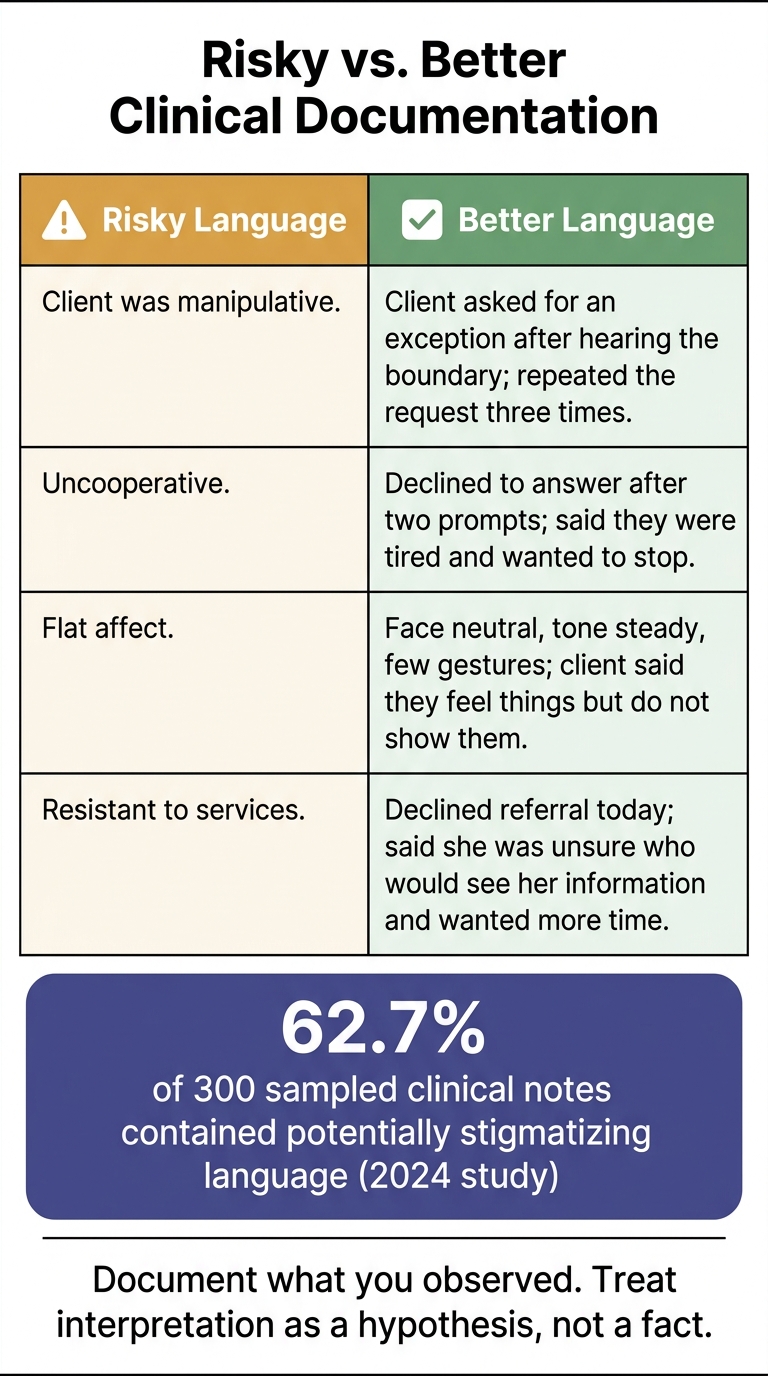
Risky vs. Better Clinical Documentation: Emotional Cues Across Groups
Once context and power are clear, a few repeatable habits can keep your read of emotion disciplined. This is the practical payoff of everything covered so far about display rules, power, and trauma. It’s how you cut down on misreading emotion across groups. The sequence is simple: observe, ask, document.
Observe First, Then Interpret
Use small, repeatable habits to cut error when time is tight.
One more reliable habit is to write what you saw or heard before you write what you think it means. Instead of avoidant, try: client paused for approximately 15 seconds and lowered their voice before answering. That description leaves space for more than one explanation, like fatigue, shame, cultural deference, or a trauma response, instead of slipping an assumption into the note before you’ve looked at the facts.
Pause and ask: What did I actually observe, and what am I assuming?
If the read is still unclear, move to process questions.
Ask Process Questions, Not Just Content Questions
Most session questions focus on content. Process questions focus on how a person communicates, and that’s often where your interpretation shifts.
Three high-yield prompts:
- When you're under stress, what changes in how you talk or act?
- What usually tells me someone is upset in your family or community?
- When you go quiet, what does that mean for you?
A client may say silence means anger, not withdrawal. That one answer can reframe months of sessions.
In intake, case checks, or ER work, one process question per encounter is enough to start building a communication profile.
Capture the answer in the note using neutral language.
Document Cues Carefully and Avoid Loaded Labels
A 2024 study found that 62.7% of 300 sampled clinical notes contained potentially stigmatizing language, and negative language was more likely to persist across the record than positive language.[20][19]
Record behavior, speech, and the client’s meaning. Treat interpretation as a hypothesis, not a fact.
| Risky version | Better version |
|---|---|
| Client was manipulative. | Client asked for an exception after hearing the boundary; repeated the request three times. |
| Uncooperative. | Declined to answer after two prompts; said they were tired and wanted to stop. |
| Flat affect. | Face neutral, tone steady, few gestures; client said they feel things but do not show them. |
| Resistant to services. | Declined referral today; said she was unsure who would see her information and wanted more time. |
If the client or supervisor read this, would it still sound fair? When in doubt, underline labels like manipulative or uncooperative and rewrite them as observable facts.
Using AI Tools Carefully: Personality Insight, Communication Review, and Next Steps
AI can help you notice patterns that are easy to miss. It can scan case notes, emails, or session summaries and point out recurring themes, like repeated withdrawal after certain topics, minimizing language that keeps showing up, or tone shifts when certain people are around. It can also spot patterns across notes and interactions faster than a manual review, which makes it easier to see where misunderstandings may be starting.[21][25][31]
Treat AI as a reflective tool, not a supervisor. Final judgment stays with you.
In helping work, the best use of these tools is turning pattern-spotting into clearer next steps.
Where Personos Fits for Helping Professionals
Personos can help you check your read of cross-group communication against structured personality data. It is a personality-guided support tool built for social workers, case managers, counselors, coaches, and nonprofit staff. It is especially useful when your work includes trauma, power imbalances, high caseloads, and crisis situations.
Its foundation is the Five Factor Model. Personos measures 30 personality traits on an 80-point scale, giving you a detailed picture of how a client may communicate, respond to stress, and build trust. For example, a client who prefers low-stimulation settings may do better in writing than in a busy group.
Four core features support cross-group interpretation:
- Dynamic Reports map the relationship between you and a specific client. They flag likely friction points and suggest concrete adjustments, such as using more reflective questions and adding explicit pauses when working with a highly indirect client.
- Conversational chat uses a full personality profile plus situational context to suggest trauma-informed scripts that fit the client's trust-building needs.
- Prompts extend care beyond sessions with brief, carefully framed nudges, such as a check-in after a stressful court date.
- ActionBoard tracks client progress and your own development goals, like practicing assumption-checking in cross-group conversations.
Personos treats its outputs as probabilistic and context-dependent, not final. Use them as a starting point for shared exploration, then let the client confirm or correct the picture.
That difference matters most when the work involves trauma, trust, and limited time.
How Personos Compares With Other Communication and Coaching AI Tools
General coaching chatbots and workplace communication analyzers have grown fast, but most were built for corporate or productivity settings. For helping professionals, those differences can matter a lot.
| Criteria | Personos | General Coaching/Communication AI Tools |
|---|---|---|
| Audience fit | Purpose-built for social workers, case managers, counselors, coaches, and nonprofit staff | Often built for corporate teams, sales, or individual productivity |
| Personality depth | 30 traits via a validated Five Factor Model, measured on an 80-point scale | Simplified style labels or basic sentiment scoring |
| Relationship-specific guidance | Dynamic Reports for client–practitioner, peer-to-peer, and group dynamics; shows which traits and principles informed each suggestion | Generic tips or single-person style profiles |
| Privacy approach | Privacy-first design with individual scores not shared unless explicitly consented | May have less transparent data policies |
| Nonprofit/social service usefulness | Supports trust-building, crisis guidance, trauma-aware pacing, and measurable progress | Usually not designed for trauma context or resource-limited agencies |
Useful tools still need firm boundaries.
Limits, Ethics, and Privacy Checks for AI-Assisted Interpretation
A few limits are non-negotiable, no matter which tool you use.
AI output is never a diagnosis. Even if a pattern looks like depression, PTSD, or a personality trait, only qualified professionals using proper assessments should make diagnostic determinations.[23][24]
Don't automate high-stakes decisions. AI can help organize information for a case discussion. But decisions about child removal, hospitalization, housing placement, legal reporting, or program termination must depend on direct client engagement, multidisciplinary input, and established agency policy.[30][32]
Privacy needs the same level of care. Pasting session notes into a general chatbot sends them to a third-party server.[22][31] Before entering any client-related information into any AI tool, confirm your organization's policy. Then check whether the tool meets the standards that apply to your work, including HIPAA when health information is involved. Use the minimum necessary detail, such as initials and de-identified summaries instead of full names and case histories. Guidance for victim services is blunt on this point: personally identifying survivor information should never be entered into AI tools unless security and compliance can be fully verified.[27]
Clients should also know when AI is part of your process. Plain-language consent matters here: what the tool does, what data is used, where it is stored, and that outputs are advisory. That is both an ethical requirement and a step that helps build trust.[26][28][29]
Conclusion: Core Habits That Improve Emotional Communication Across Groups
Everything in this guide comes back to a short list of habits that add up over time. Read both verbal and nonverbal signals, and don't lean too hard on one while ignoring the other. Account for group norms, power dynamics, and setting before you decide what a behavior means. Keep observation and inference in separate sentences, both in your notes and in your own thinking. Check assumptions directly with clients before any label goes into a record. Use trauma-informed pacing: slower, more choice-rich, and less directive.
For helping professionals, the practical takeaway is simple: use AI to think more carefully, not less, and always verify meaning with the client.
FAQs
How can I tell stress from cultural communication style?
Look past surface behavior. The same trait can show up in very different ways depending on social norms, especially around direct or indirect communication. Stress often stands out less by what someone does in general and more by a shift in their usual pattern, like sudden curtness or pulling back.
Observation can also be biased. That’s where Personos can help. By using the Five Factor Model, it helps separate social context from a person’s own stress triggers, so you respond to the person instead of a reaction you’ve labeled the wrong way.
What should I document when emotional cues are unclear?
Write down what you notice yourself, and add input from AI-powered tools like Personos to get a more balanced view.
People often act a bit differently when they know they’re being evaluated. That’s why it helps to mix direct observation with 360-degree feedback and one-on-one conversations instead of leaning on just one source. Personos can also track communication patterns over time, which makes your notes more consistent.
How can AI help without replacing my judgment?
AI tools like Personos are there to support your professional judgment, not take its place. They can surface hypotheses and data-informed insights that sit alongside what you see firsthand and what you know from clinical work.
Personos also makes its guidance transparent. It shows the traits, situational details, and psychological principles behind each suggestion, so you can review the logic, question it when needed, and decide whether it fits your case.