Emotional Awareness for Conflict Prevention: Guide
Spot early emotional cues, slow your response, use trauma‑aware language, offer clear choices, and document events to prevent workplace conflicts.
Nick Blasi

Emotional Awareness for Conflict Prevention: Guide
Most conflict in human services starts before anyone argues. I can lower the chance of blowups by spotting early cues, slowing my response, testing my assumptions, and giving clear choices before tension gets out of hand.
Here’s the article in plain terms:
- I watch for early signs like silence, sharper tone, pacing, repeated questions, or my own body tensing up.
- I treat cues as guesses, not facts. Crossed arms, eye contact changes, or quick agreement can mean many things.
- I use a simple 5-step loop: notice, test, pause, use plain language, and check understanding.
- I separate observation from assumption. For example, “They repeated the question twice” is more useful than “They were being difficult.”
- I adjust how I speak based on the person’s stress level, likely preferences, and trauma history.
- I offer one clear choice and one clear boundary instead of arguing.
- I plan for de-escalation ahead of time with triggers, warning signs, staff roles, and safety steps.
- I document facts after tense events and debrief with the team to improve the plan.
- I use AI tools for greater impact with care for prep, wording, and follow-up, but not to make safety calls or act on its own.
A few facts stand out. The article notes that workplace assaults are common in health care and social services, which is why written escalation steps matter. It also points to 60- or 90-day pilots as a better way to check whether AI support helps than looking at usage alone.
If I had to boil the full piece down to one line, it would be this: <u>notice early, slow down, speak plainly, and document what happened.</u>
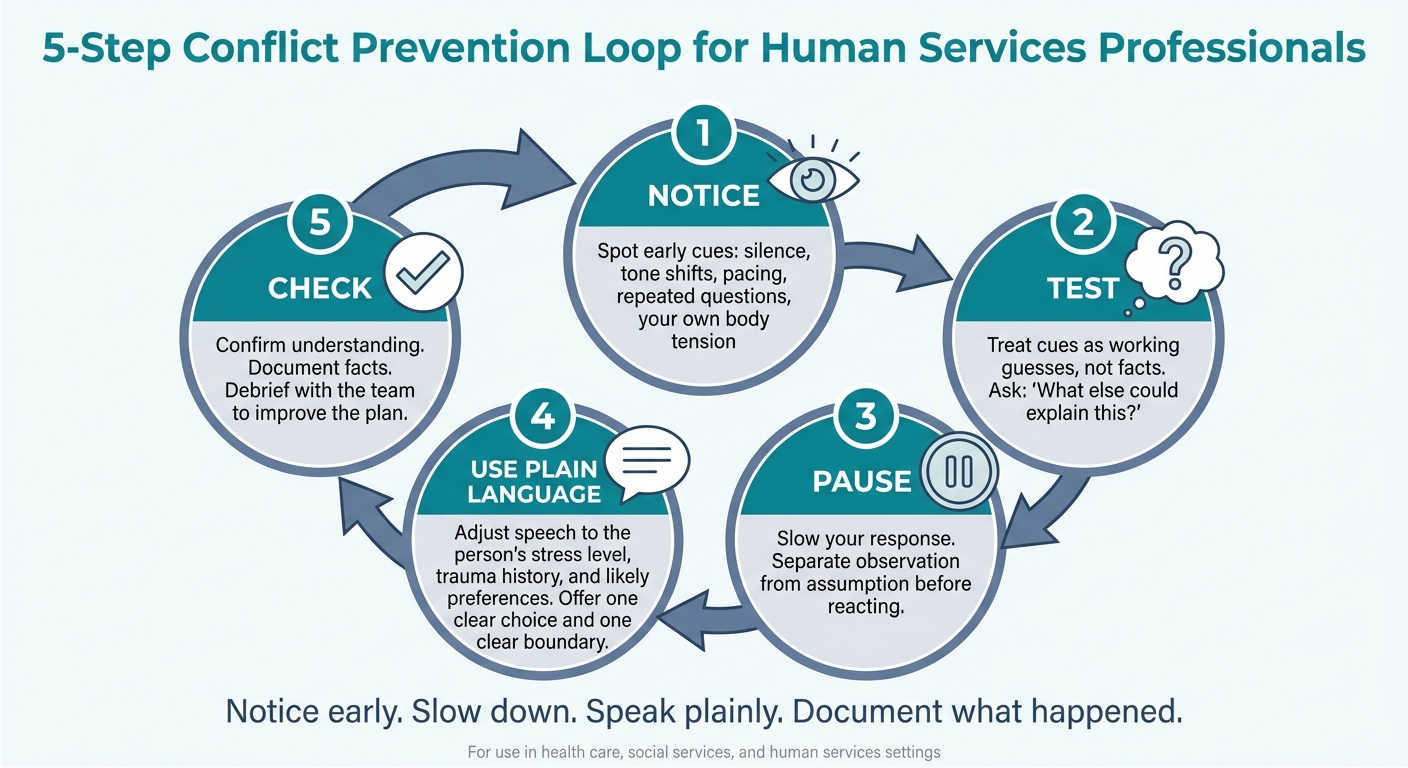
5-Step Conflict Prevention Loop for Human Services Professionals
Master Emotional Awareness in Workplace Conflicts
How to Read Emotional Cues Without Overinterpreting Them
This section tightens the Notice and Test parts of the conflict-prevention loop. The key idea is simple: treat every emotional cue as a working guess until you check it.
Observable Cues in Clients, Colleagues, and Yourself
Watch for shifts in voice, silence, body language, facial expression, eye contact, and behavior over time. If a client starts repeating the same eligibility question, talking faster, or giving shorter or sharper answers than usual, that tells you something is going on. But it does not tell you exactly what it means yet.
That pause matters. It keeps you from jumping from I noticed a change to I know why it happened.
Your own cues matter just as much. Irritation, urgency, the urge to "win" the exchange, or mentally labeling someone as difficult are signs that your own stress response may be narrowing your view. When that happens, slow the pace and check your read of the situation.
A short self-check can help:
"What am I assuming, and what else could explain this?"
That small pause can stop a brief tension spike from turning into a bigger conflict.
Context That Raises Tension Before Anyone Argues
A lot of conflict starts with process, not personality. A long wait with no explanation, unclear eligibility rules, a sudden change in housing placement, or a room with no privacy can increase a person's sense of threat before anyone says much at all.
Some conversations come with built-in pressure. That includes talks about eligibility decisions, housing placement, recovery expectations, child welfare, or discharge planning. The stakes are high, and the power gap is often obvious.
One simple habit helps here: before a high-stakes conversation, briefly explain what will happen, how long it may take, what choices are on the table, and what is outside your control. That kind of plain talk can lower uncertainty, which often lowers tension too.
The table below shows common cues, more than one way to read them, and a low-risk response you can use in the moment.
| Observable cue | Possible meaning | Alternative explanations | Low-risk practitioner response |
|---|---|---|---|
| Repeated eligibility question | Fear of losing services or not understanding the rule | Complex language, hearing difficulty, memory problem, interpreter need | "Let me explain the rule a different way and write down the next step." |
| Louder speech after a housing delay | Frustration, fear, or feeling powerless | Hearing loss, noisy setting, cultural communication style, accumulated stress | Move to a quieter space, acknowledge the delay, explain timing, and offer available options. |
| Silence and averted gaze during intake | Distress, shame, or feeling unsafe | Fatigue, cultural norms, pain, sensory overload, need for privacy | Pause and ask, "Would you prefer a break, a different setting, or to continue another way?" |
| Quick agreement with every suggestion | Desire to end an uncomfortable conversation | Genuine agreement, deference to authority, limited comprehension | Ask the person to describe the plan in their own words and invite disagreement. |
| Colleague's abrupt answers during a case conference | Pressure, disagreement, or emotional activation | Time constraints, workload, communication style, competing priorities | "I'm noticing we're moving quickly. Is there a concern we need to address before deciding?" |
| Missed two follow-up appointments | Disengagement or ambivalence | Transportation, unstable housing, phone loss, work schedule, caregiving | Contact through their preferred channel and ask what barrier affected attendance. |
Once you can spot the cue, the next move is to match your communication to personality and trauma.
Using Personality and Trauma-Aware Communication to Lower Risk
Use the Five Factor Model (FFM) and trauma-aware communication to choose how to respond. The goal isn't to replace direct conversation. It's to make that conversation sharper and safer. These cues can help you decide if the next step should be a slower pace, more structure, or an explanation that feels less threatening.
Apply the Five Factor Model as a Communication Hypothesis, Not a Label
The FFM describes five broad personality dimensions: openness, conscientiousness, extraversion, agreeableness, and negative emotionality. These are stable tendencies, not fixed labels.[2][3] So don't treat traits like a verdict. Treat them like a starting point, then ask, adjust, and check.
Use the trait as an early hypothesis to guide wording, pacing, and the amount of detail you give. A simple sequence works well: hypothesize, ask, adapt, verify, document.
The table below shows how a personality-aware adjustment can change the communication move in practice.
| Personality- and context-aware guidance |
|---|
| Explain the sequence, timing, and documentation in writing; ask whether any step needs clarification. |
| Offer two realistic options, describe the consequences of each, and allow extra processing time. |
| Reduce interruptions and begin with the immediate concern; match the person's requested pace. |
| Be transparent about role limits, confidentiality, and next steps to reduce mistrust. |
Traits are stable tendencies. States are temporary stress responses. A person who is usually detail-oriented may not be able to work through a checklist in a crisis. That's why verification matters. Ask whether more detail would help, or whether a shorter version would be easier to take in.
Once you have a sense of the person's likely preference, trauma-aware language helps you keep the message clear without setting off more threat.
Use Trauma-Aware Language Before Escalation Starts
Personality helps shape the message. Trauma-aware language helps the message land in a safer way. This approach centers safety, transparency, choice, and context. In service conversations like intake, eligibility, scheduling, housing, and documentation, that means being plain about your role, why you're asking certain questions, what will be written down, and any limits to confidentiality.
Ask permission before moving into sensitive topics. Offer choices that mean something. Name power differences instead of pretending they aren't there. When you reflect emotion, do it carefully: describe what you see, then check whether you read it right. Validation means saying a reaction makes sense in context. It does not mean agreeing with every interpretation or every proposed action. You can acknowledge concern while still explaining the safety rule and the options that remain.
The table below shows how common phrases can add tension, and how trauma-aware language can lower it.
| Escalating phrasing | Trauma-aware alternative |
|---|---|
| Calm down. | I can see this is intense. We can slow down, move to a quieter space, or continue here - what would help? |
| You're overreacting. | This is having a strong impact on you. What part feels most urgent right now? |
| Because I said so. | This is required by our safety procedure. I'll explain what I can, what I cannot change, and the choices you still have. |
| You're being difficult. | We have not reached an agreement yet. Which part of the plan does not work for you? |
| If you don't cooperate, there will be consequences. | This requirement has consequences, and I want to explain them clearly. Let's review what choices are still available. |
Trauma-aware language removes extra threat without weakening boundaries. If these phrases don't do enough, move to a preplanned de-escalation response.
Build a De-Escalation Plan for Individuals and Teams
Use emotional awareness to build a team de-escalation plan before things heat up. When cues keep building, a written plan helps the team move from noticing a problem to acting in sync. De-escalation works best as a team process, not a split-second reaction.
Prepare, Detect, Respond, and Escalate Safely
Create an easy-to-find plan during intake, care planning, or supervision, not after a crisis. Keep it centered on four basics: known triggers, early warning signs, preferred supports, and actions staff should avoid. Write down only what affects care, safety, or workflow. Then update the plan after major changes or incidents.
Set team roles ahead of time based on who is most likely to notice the first cue and who can safely lead the response. That may include:
- a primary communicator
- a safety observer
- a supervisor or crisis contact
- a staff member who can support other clients or create privacy
Match those roles to your agency's policy, staffing levels, and mandated reporting duties.
Watch for three kinds of signals: behavior, context, and your own stress response. When those signals start climbing, use one short check-in question and lower stimulation. For example:
"I notice the conversation is getting harder. Would a quieter space or a short pause help?"
When you respond, keep it simple. Use one calm speaker. Keep a respectful distance. Don't crowd the person or argue with them. Slow the whole interaction down. If you need to set a boundary, say what it is, explain the safety reason, state the next step, and describe the consequence in plain language.
The table below shows how to match the situation to the right response and when extra support should step in.
| Interaction condition | Primary objective | Recommended response | When to seek additional support |
|---|---|---|---|
| Early warning signs are rising but the person can still converse | Shift from conversation to a formal de-escalation plan | Move to a quieter area, reduce the audience, use short statements, and offer a brief pause | Request a second trained staff member before intensity becomes unmanageable |
| Person is yelling, threatening, pacing, or unable to process information | Protect safety while reducing demands | Maintain distance and an exit path, set one clear boundary, remove unnecessary people, and keep one person communicating | Activate the agency's crisis or safety response when threats continue or staff cannot maintain safety |
| Physical aggression, weapon access, serious self-harm risk, or immediate danger | Protect life and obtain emergency assistance | Disengage, create distance, direct others to safety, use only approved procedures by trained personnel | Contact emergency services immediately according to policy |
| Interaction has stabilized | Restore choice and confirm next steps | Confirm immediate needs, explain next steps, and offer water or a quiet space when appropriate | Arrange clinical, medical, supervisory, or advocacy follow-up if risk or distress remains |
Workplace assaults are common in health care and social services, so escalation thresholds need to be written down and practiced.[6]
Recover, Document, and Learn as a Team
Once the interaction settles, shift from response mode to recovery, documentation, and team learning.
Start with physical safety. Then give the person a calm explanation of what happened, what choices still exist, and what happens next. Staff need time to settle too before going back into high-pressure work.
Document promptly and stick to facts. Include the date, time, location, people present, observable behavior, exact words when material, the sequence of events, de-escalation actions taken, choices offered, responses, notifications, and follow-up duties. Write "Jordan raised their voice, paced near the doorway, and said, 'I'm leaving now,'" instead of "Jordan became manipulative." Skip diagnostic guesswork, personality labels, and claims about intent that you can't support.
After everyone is safe and calm enough to take part, hold a short, structured debrief. In many cases, that means the same day or within one to two days, depending on the event and policy.[5] Start with the first warning signs seen during the incident. Then walk through what helped, what didn't, and what support anyone needs now. The point of the debrief is to improve the plan, not point fingers. Keep this separate from any formal disciplinary or regulatory review tied to injuries, allegations, or serious incidents.
The table below shows how recovery steps apply in different settings.
| Interaction setting | Emotional signals to monitor | Preventive action |
|---|---|---|
| Individual practitioner–client interaction | Rising volume, pacing, shutdown, repeated demands, practitioner urgency | Use one speaker. Reduce stimulation. Offer realistic choices. |
| Team interaction or case conference | Interruptions, rigid positions, visible withdrawal, sarcasm, rapid decision-making | Name the process. Slow the pace. Assign a facilitator. |
| Supervisory response | Staff avoidance, emotional flooding, inconsistent accounts, delayed reporting | Provide nonjudgmental consultation. Confirm documentation steps. Assign follow-up. |
For handoffs, keep the format short: early signs, helpful responses, what to avoid, and when to escalate. For case conferences, flag likely stress points ahead of time, assign a facilitator, set a pause signal, and make sure the client knows how decisions will be made. These steps reflect trauma-informed principles of collaboration, mutuality, empowerment, voice, choice, safety, and transparency.[4][1]
These written routines also make it easier for AI support to extend steady guidance across cases and teams.
Use AI Support Carefully and Measure What Changes
Once you have a de-escalation plan, AI can help you use it the same way across cases and teams.
It can support preparation, documentation, and follow-up with more consistency. But it works best as a supervised support layer, not as a substitute for your judgment, your agency's safety rules, or emergency procedures.
Where AI Fits in Personality-Aware Conflict Prevention
Before a hard conversation, AI can help you spot likely stressors, draft trauma-aware questions, and think through other reasons a client may be acting a certain way. After the interaction, it can turn notes into a more structured follow-up. What it should never do is judge danger, decide eligibility, contact clients on its own, or slow down an emergency response.
A simple four-step preparation workflow can help:
- Clarify your goal for the conversation.
- Separate observable facts from your interpretations.
- Ask for two or three trauma-aware openings and other possible explanations.
- Identify who to consult and what to document.
For example, instead of entering "the client was being difficult", write "the client left after being asked to complete a form." Then ask the system what else might explain that behavior.
Privacy and governance come first. Before entering any client information, confirm that your agency has approved the tool, understand whether your inputs may be used for model training, and share only the minimum needed. When possible, use de-identified or pseudonymized summaries, remove names and unnecessary dates or diagnoses, and never paste unrestricted case files into an unapproved system. Under HIPAA, the minimum necessary standard generally requires reasonable efforts to limit protected health information to what is needed for the intended permitted purpose.[7] HHS also stresses privacy, security, and legal compliance in responsible AI use across health and human services.[8] Every AI output should be checked for factual accuracy, fit for the person and setting, and safety risks before you act on it. NIST also warns about automation bias, which is the tendency to accept AI suggestions too easily when they sound confident or personal.[9]
You also need to measure whether AI support is helping outcomes, not just adding more activity. Useful indicators include the share of difficult conversations with a documented preparation plan, the rate of preventable escalations, client reports of respect, voice, choice, and clarity, and how often staff correct or reject AI suggestions. A 60- or 90-day pilot with a defined comparison period, using both numeric measures and supervision feedback, gives a much more honest view than adoption rates alone.
Manual Workflows, Generic AI, and Personos: A Side-by-Side Comparison
Use the same conflict-prevention standards when comparing manual workflows, generic AI, and Personos.
| Dimension | Manual preparation | Generic AI tools | Personos (purpose-built) |
|---|---|---|---|
| Personalization | Depends on practitioner memory and available time | Useful language, but often lacks validated personality context | Uses Five Factor Model traits and context to tailor guidance |
| Contextual continuity | Stored in case notes, supervision, or team memory | Usually limited to what's pasted into a single session | Supports ongoing workflows across chats, reports, prompts, and tasks |
| Explainability | Practitioner explains reasoning directly | Output assumptions can be hard to inspect | Shows which traits and principles shaped the guidance; practitioner verification is still required |
| Privacy controls | Governed by agency systems and staff practice | Varies substantially by provider and configuration | Requires agency review and contract checks before use |
| Practitioner oversight | Direct and central | Can weaken if staff copy recommendations without review | Designed as a support layer; does not replace professional judgment or emergency procedures |
| Team collaboration | Requires meetings, supervision, and manual documentation | Can produce disconnected drafts | Reports and task tracking can organize shared goals and follow-up when approved workflows are in place |
Personos (personos.ai) is a purpose-built option for helping professionals. Check fit, privacy terms, and procurement requirements before using it.
Generic AI tools can help with brainstorming and drafting, but they do not come with validated personality context or role-specific workflows. Manual workflows still matter for relationship-based judgment and nuanced case formulation. AI adds support to that work. It does not replace it.
Conclusion: Put Emotional Awareness Into Daily Practice
Emotional awareness for conflict prevention is not a one-time training. It's a daily practice made up of small habits done over and over: noticing cues early, separating what you observe from what you assume, using personality-aware and trauma-aware communication before tension grows, and planning de-escalation before you need it. AI can support each of these steps, but only when it is supervised, governed, and measured.
Use this short checklist before or after any hard interaction:
- What am I feeling? Notice urgency, fear, frustration, shame, or defensiveness before you respond.
- What am I observing, and what else could explain it? Record concrete behavior such as tone, pacing, silence, or posture. Then consider stress, trauma activation, pain, disability, culture, language, or an unmet practical need before landing on one explanation.
- What does the person say they need? Ask directly and listen for preferences, concerns, and desired choices.
- What choice or boundary can I offer? Give realistic options while keeping nonnegotiable safety or policy limits clear.
- Who should be consulted? Identify a supervisor, clinical lead, interpreter, safety partner, or emergency resource when needed.
- What follow-up should be documented? Record observable facts, the person's stated preference, agreed actions, safety decisions, consultation, and the next review point.
AI may help organize this checklist or suggest wording, but the practitioner must make the final judgment and follow agency emergency procedures when immediate danger is present.
FAQs
How do I tell stress cues from resistance?
Watch how the person takes in information and responds when the pressure is on. Stress often shows up as an emotional spike or a sudden shutdown. Resistance, on the other hand, is often a reaction to feeling ignored, misunderstood, or guarded.
Personos can help tell the difference. It gives real-time, personality-aware guidance based on personality traits and context, with prompts tailored for validation, reframing, or de-escalation.
When should I switch from prevention to de-escalation?
Shift from prevention to de-escalation when the signs of crisis are clear, like when a client shuts down, starts losing motivation, or a conflict begins to heat up.
Prevention is about trust and clear expectations. De-escalation comes into play when tension rises and you need to act right away to bring back safety and respect. In those moments, Personos can help with real-time prompts shaped to the person’s style, so the language fits the situation instead of making it worse.
How can AI help without replacing my judgment?
AI tools like Personos are built to support your professional judgment, not take its place. They give you clear, evidence-based input so you can make decisions with more confidence.
With Personos, you stay the final decision-maker. It shows the reasoning behind its guidance, including the personality traits, situational details, and psychological principles involved. That means you can compare its input with your own experience, use what helps, and stay in control.