Emotion-Driven Conflict: Common Challenges
Explore how emotional triggers derail discussions and practical EI-based tactics—self-awareness, self-regulation, empathy, and relationship repair—for resolving conflicts.
Rachel Johnson

Emotion-Driven Conflict: Common Challenges
Emotion-driven conflicts happen when feelings like anger, frustration, or stress take over discussions, often derailing problem-solving and damaging relationships. These conflicts can escalate quickly, impact trust, and harm workplaces, leading to issues like absenteeism, high turnover, and decreased productivity. But with the right skills, such as emotional awareness, self-regulation, and empathy, these situations can be managed more effectively.
Key challenges include:
- Lack of self-awareness: Many people fail to recognize emotional triggers, leading to reactive behavior.
- Struggles with self-regulation: Intense emotions can override logical thinking, escalating tensions.
- Limited empathy: Without understanding others' perspectives, conflicts often become personal and harder to resolve.
- Weak relationship management: Avoiding honest communication leaves issues unresolved, eroding trust.
Solutions focus on building emotional intelligence:
- Self-awareness: Identify triggers and understand emotional patterns.
- Self-regulation: Practice techniques like pausing, breathing, and reframing situations.
- Empathy: Actively listen and consider others' viewpoints.
- Relationship rebuilding: Use clear communication to restore trust after conflicts.
Tools like Personos can assist by providing real-time emotional insights and guidance, helping individuals manage conflicts more effectively for $9 per seat per month.
Master Emotional Intelligence for Conflict Resolution
Common Challenges in Emotion-Driven Conflict
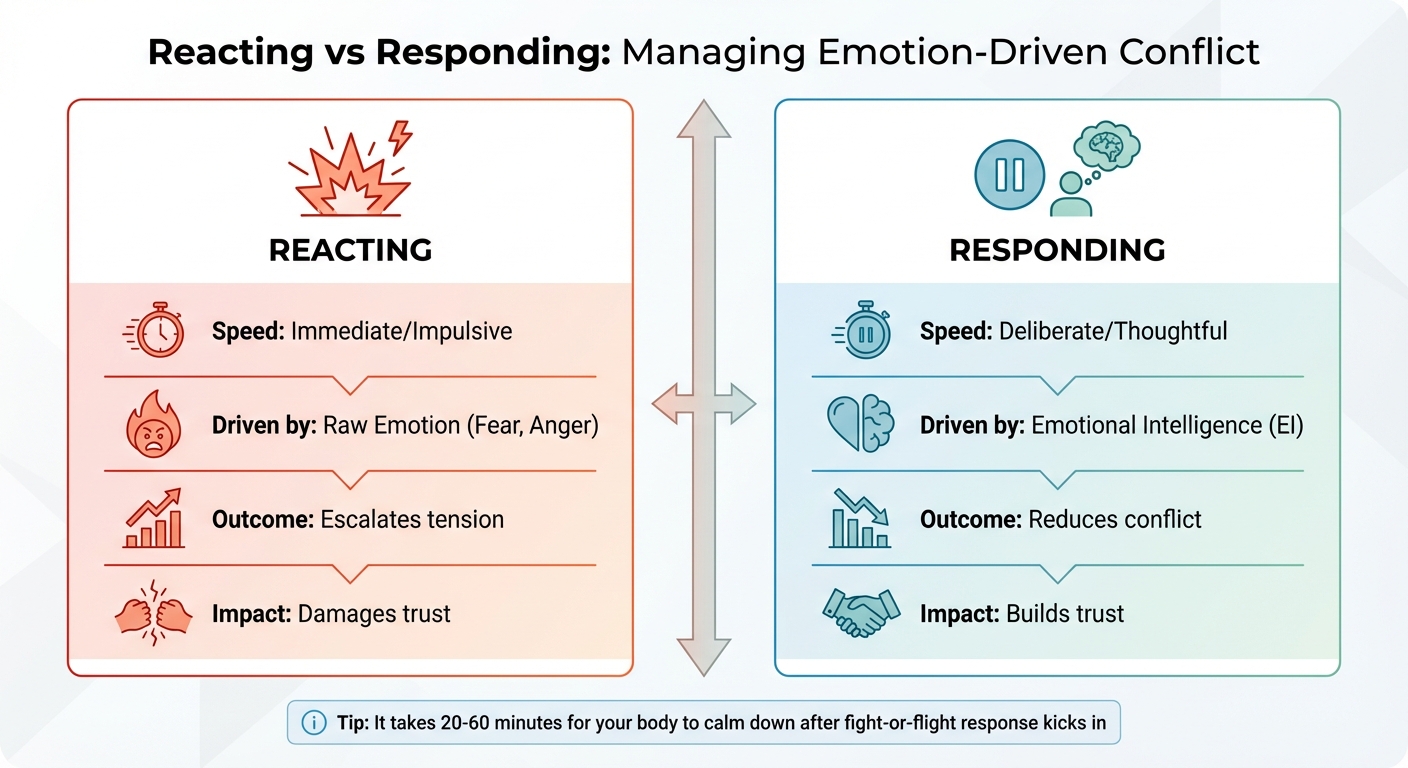
Reacting vs Responding in Emotion-Driven Conflict
When emotions take control during conflicts, four key obstacles often emerge: lack of self-awareness, difficulty with self-regulation, limited empathy, and struggles with managing relationships.
Missing Self-Awareness and Emotional Triggers
Many people don’t realize what sets them off until they’re already caught in the heat of the moment. Conflicts often arise from unmet expectations, interruptions, miscommunication, or perceived rudeness [4]. In the workplace, triggers can include feeling undervalued, receiving only negative feedback, or dealing with burnout. A 2022 Deloitte survey revealed that 77% of people have experienced burnout in their current jobs [4], which can lead to shorter tempers and emotional outbursts.
Failing to identify what triggers your emotions can trap you in reactive behaviors. Psychotherapist Rachel Wright, L.M.F.T., explains:
"You need to get to the 'why,' or why this is happening. Otherwise, you're just putting a Band-Aid on the symptoms" [4].
If you don’t recognize triggers - like interruptions, feeling unappreciated, or underlying anxieties - you may find yourself stuck in a cycle of reactive responses. But recognizing triggers is just the start; learning to manage those emotions is equally important.
Weak Self-Regulation and Escalation
Even when you’re aware of your emotions, controlling them can be a major challenge. High emotional arousal disrupts the brain’s executive functions, which are responsible for self-regulation [6]. This can create a feedback loop where your emotions fuel thoughts that intensify those same feelings [6].
Explosive reactions rarely resolve anger [7]. Research shows that suppressing emotions or reacting aggressively during conflict increases blood pressure and negative feelings for everyone involved [6].
| Aspect | Reacting | Responding |
|---|---|---|
| Speed | Immediate/Impulsive | Deliberate/Thoughtful |
| Driven by | Raw Emotion (Fear, Anger) | Emotional Intelligence (EI) |
| Outcome | Escalates tension | Reduces conflict |
| Impact | Damages trust | Builds trust |
To de-escalate conflict, it’s essential to not only manage your own emotions but also consider the perspectives of others.
Limited Empathy and Social Awareness
Without the ability to see things from another person’s point of view, conflicts can quickly turn into personal showdowns. A lack of empathy often leads people to distance themselves emotionally, resorting to negative labels like "idiot" or "rude", which only deepen the divide [8].
When empathy is absent, conflicts often escalate into shouting, blaming, or complete withdrawal [9]. This dismissive or judgmental behavior can trigger defensiveness, shutting down any chance of open communication. As The Conflict Expert puts it:
"Empathy allows us to bridge the gaps in our differences, especially those which we create in our minds that allow conflict to continue" [8].
Focusing on differences rather than shared goals erodes trust, turning manageable disagreements into standoffs where no one comes out ahead.
Poor Relationship Management
After a heated conflict, rebuilding trust and collaboration is often neglected. Ignoring another person’s perspective or pain makes it harder to repair relationships, which are often at the core of the conflict [9]. Avoiding honest feedback or cooperative problem-solving only allows tensions to linger beneath the surface.
Ellen Kandell, a Certified Professional Mediator, notes:
"Conflicts often escalate because emotions run high, leading to a breakdown in communication and an increase in negative behaviors such as yelling, blaming, or withdrawing" [9].
This avoidance creates a toxic cycle where people either tiptoe around each other or withdraw entirely, leaving the real issues unresolved and trust further eroded.
Solutions for Emotion-Driven Conflict
Breaking free from emotional conflict patterns starts with developing emotional intelligence. The good news? These skills aren’t something you’re born with - they’re practices anyone can learn and refine with intention and effort.
Developing Self-Awareness
Start by tuning in to your body. Pay attention to physical signs like a racing heart, dry mouth, or sweating, and keep a journal to track recurring emotional triggers [11][12].
Psychologist Daniel Goleman highlights that emotional intelligence (EI) accounts for 58% of job performance across various roles [10][12]. Interestingly, while 95% of people believe they’re self-aware, only about 10–15% actually are [10][12].
Try the "Cup of Tea" Method: Instead of suppressing uncomfortable emotions, pause and calmly ask yourself what your feelings are trying to tell you. Maybe they’re signaling a need for rest or stronger boundaries [13]. Psychotherapist Donald Altman explains:
"The moment you pause, the emotion becomes the object of your attention. Since you are now observing the emotion... you are safely distanced from it and are no longer being held in its vice-like grip." [13]
Before tough conversations, perform a Mood Check by asking, "How would I react if someone pressed one of my triggers right now?" [11].
Improving Self-Regulation
Once you’ve identified your triggers, the next step is managing your reactions. The Stop-Breathe-Reflect-Choose method offers a simple framework: when emotions run high, pause, take slow breaths, and count to 10 before responding [5].
Another tool is cognitive reappraisal, or reframing. This involves stepping back and viewing a triggering situation from a different, less emotionally charged perspective [15][16]. Keep in mind that once your fight-or-flight response kicks in, it can take 20 to 60 minutes for your body to calm down [11]. When caught off guard, give yourself time before reacting [17]. You can also mentally rehearse calm, thoughtful responses ahead of time if you know a challenging situation is coming [17].
Health writer Lisa Catanese puts it like this:
"Self-regulation is the act of controlling your behaviors, thoughts, emotions, choices, and impulses." [5]
Daily habits like getting enough sleep, regular exercise, journaling, and meditation can strengthen your ability to self-regulate over time [16].
With solid self-regulation in place, you can build on these skills by focusing on empathy.
Increasing Empathy and Social Awareness
Empathy transforms conflict into an opportunity to connect. Marshall B. Rosenberg, author of Nonviolent Communication, defines empathy as:
"a respectful understanding of what another is experiencing" [8].
To enhance empathy, practice summarizing and clarifying the other person’s perspective during discussions [8][18].
Use Heat Mapping to pinpoint the specific emotional or social issue at play. This approach keeps the conversation focused on the real problem rather than letting it spiral into unrelated grievances [14]. Avoid behaviors known as the "Four Horsemen" - criticism, contempt, defensiveness, and stonewalling - which can sabotage attempts at understanding [14]. As conflict resolution expert Dan Shapiro from Harvard University notes:
"There is nothing more in the world that we like than to feel appreciated. Recognize your power to appreciate them." [14]
Better Relationship Management
Managing relationships effectively, like self-awareness and self-regulation, takes practice. Rebuild trust through one-on-one conversations that use calm, non-reactive language and establish clear boundaries [17]. Practicing perspective-taking can help you overcome personal biases and understand the motivations behind someone else’s actions [9]. Acknowledging that everyone shares universal needs - like the desire to feel included or respected - makes finding common ground much easier [8][9].
When faced with hostile feedback, ask clarifying questions calmly to diffuse tension [17].
Priya Parker, a conflict resolution expert, describes managing conflict as:
"A good conversation is the gentle harnessing of the right amount of heat for a group to face what it needs to face." [14]
sbb-itb-f8fc6bf
Using Personos for Conflict Resolution
Personos helps you sharpen emotional awareness and improve how you handle conflicts by offering AI-powered insights and real-time guidance. It tackles one of the main drivers of emotion-based conflicts: unrecognized feelings. For example, anger from a personal issue can spill into professional relationships, affecting trust and decision-making [2].
At its heart, Personos focuses on emotional awareness by tracking physical signals in the moment [3]. The platform also provides detailed personality reports, drawing from well-known conflict style models, to help you understand your emotional tendencies and engage with others more empathetically [14].
Its conversational AI acts as a real-time coach during tense situations. By identifying emotions like fear, frustration, or hurt [9], it helps you avoid "amygdala hijacking" - a state where emotions overpower logical thinking [14].
Personos also encourages proactive communication by offering prompts to address concerns early, reducing the risk of unresolved issues turning into resentment [1]. These prompts include tools like heat mapping, which helps you identify emotional flashpoints before discussions even start. This allows you to rehearse calm, thoughtful responses and approach conversations with a better understanding of both your own triggers and the other person’s perspective. Together, these tools provide a well-rounded system for managing conflict effectively.
All of this support is available for just $9 per seat per month with Personos Pro. This plan includes features like relationship and group analysis reports, task tracking, and privacy-protected interactions - making it a valuable tool for conflict resolution in both your personal and professional life.
Conclusion
When emotions run high, our biological responses often take over, pushing us into fight, flight, or freeze mode. This makes it tough to think clearly or resolve conflicts effectively [14][19]. Combine that with unrelated emotions - like frustration from personal issues spilling into the workplace - and it’s no wonder misunderstandings can erode trust and cooperation [2].
This is where emotional intelligence steps in. By developing skills like self-awareness, self-regulation, empathy, and relationship management, you can recognize emotional triggers, pause before reacting, and better understand others’ perspectives. These tools help break harmful cycles of criticism, defensiveness, and stonewalling, which can otherwise derail relationships [14].
"Everyone can control their emotions more than they imagine." - Lisa Feldman, Professor of Psychology, Northeastern University [14]
Conflict is a natural part of any healthy relationship. But when approached with empathy and open communication, it can lead to deeper understanding rather than surface-level squabbles [14][19]. With consistent practice, these constructive responses become second nature, forming what experts call "emotional memory" [14].
Tools like Personos make developing these skills more accessible. For just $9 per seat per month, it provides real-time guidance and personality insights to help you navigate conflicts both at work and at home. By applying these strategies, you can turn heated moments into opportunities for stronger connections - something Personos is designed to assist with every step of the way.
FAQs
How can I recognize and understand my emotional triggers during conflicts?
Recognizing what sets off your emotional reactions begins with self-awareness - a cornerstone of understanding your emotions. Pay close attention to how you feel during moments of conflict. Are you experiencing anger, frustration, or anxiety? Notice the physical signs too: a racing heartbeat, a clenched jaw, or a tightness in your chest. These are often clues pointing to deeper emotional triggers.
Take some time to think about why a particular situation stirs such strong feelings. Often, these triggers are tied to past experiences - perhaps unresolved emotions from childhood or earlier relationships. Spotting these patterns can shine a light on the root cause of your reactions.
One way to dig deeper is by keeping a journal to note recurring triggers. Alternatively, you can explore tools like AI-powered platforms that analyze your interactions to uncover patterns. Over time, these practices can help you better anticipate and manage your emotions, paving the way for calmer and more productive resolutions during conflicts.
What are some practical ways to improve self-regulation in emotional situations?
Recognizing and managing your emotions is the first step toward better self-regulation. By identifying how you feel and intentionally choosing how to respond, you can prevent emotions from dictating your actions. Techniques like mindfulness - focusing on your breath or practicing brief meditations - can help you become more aware of emotional triggers and respond with greater calm. Another effective approach is reframing stressful situations. For instance, asking yourself, “What can I learn from this?” can help shift your focus away from negativity and reduce emotional intensity.
Establishing healthy routines also plays a big role in emotional management. Regular exercise, 7–9 hours of quality sleep, and a balanced diet can boost your resilience and ability to handle stress. Structured goal-setting and tracking your progress can further help you stay organized and minimize feelings of overwhelm. For added support, tools like Personos offer real-time personality insights and reminders to help you stay grounded during tough moments.
By blending these strategies, you can build a solid framework for handling emotions and navigating conflicts with greater ease and confidence.
How does Personos support resolving emotion-driven conflicts?
Personos takes the guesswork out of handling emotion-driven conflicts by leveraging AI to analyze how people communicate. It examines factors like tone, communication styles, and personality traits to pinpoint emotional triggers and preferred ways of interacting. Based on this analysis, it delivers real-time, tailored prompts - such as suggestions to rephrase a statement or gentle reminders to pause and consider another perspective. These tools help keep conversations productive and minimize the risk of misunderstandings.
Beyond individual interactions, Personos provides insights at the group level to uncover potential friction points. For example, it can identify personality clashes or differences in decision-making approaches that might lead to tension. Armed with this information, teams can adopt proactive communication strategies and follow dynamic recommendations to navigate conflicts more effectively. The result? A more positive and collaborative work environment where relationships thrive, workplace stress decreases, and overall team satisfaction gets a boost.