How AI Supports Leaders in Cross-Cultural Conflict Resolution
How AI tools help leaders prevent and resolve cross-cultural team conflicts, plus strengths, limits, and best-use cases.
Nick Blasi

How AI Supports Leaders in Cross-Cultural Conflict Resolution
Managing global teams can be tricky. Misunderstandings about communication styles, feedback, or deadlines often arise due to differences in how people interpret behavior. Left unresolved, these issues can harm trust and reduce productivity.
AI tools like Personos, Crystal, and Hogan Assessments with AI are helping leaders handle these challenges. They offer personalized advice, real-time communication tips, and insights based on behavioral data, making conflict resolution more effective. Here's how they compare:
- Personos: Uses a 30-trait personality model for tailored, real-time guidance and tracks outcomes like engagement and retention.
- Crystal: Focuses on DISC profiles to predict communication preferences, with tools for improving emails and meetings.
- Hogan Assessments with AI: Combines traditional leadership tests with AI for long-term development but lacks live conflict support.
Each tool has strengths and weaknesses. Personos excels in live scenarios, Crystal simplifies communication prep, and Hogan provides deep personality insights. However, AI shouldn't replace human judgment - tools work best when paired with mediators or HR experts.
Quick Comparison:
| Tool | Strengths | Weaknesses |
|---|---|---|
| Personos | Real-time guidance, tracks results | May depend on input quality |
| Crystal | Easy-to-use for emails/meetings | Limited in-depth conflict insights |
| Hogan Assessments | Deep personality data for reflection | No real-time conflict support |
AI helps leaders prepare and respond better, but human expertise remains essential for handling sensitive or complex situations.
AI Roleplay: Conflict Resolution (Live Example)
1. Personos
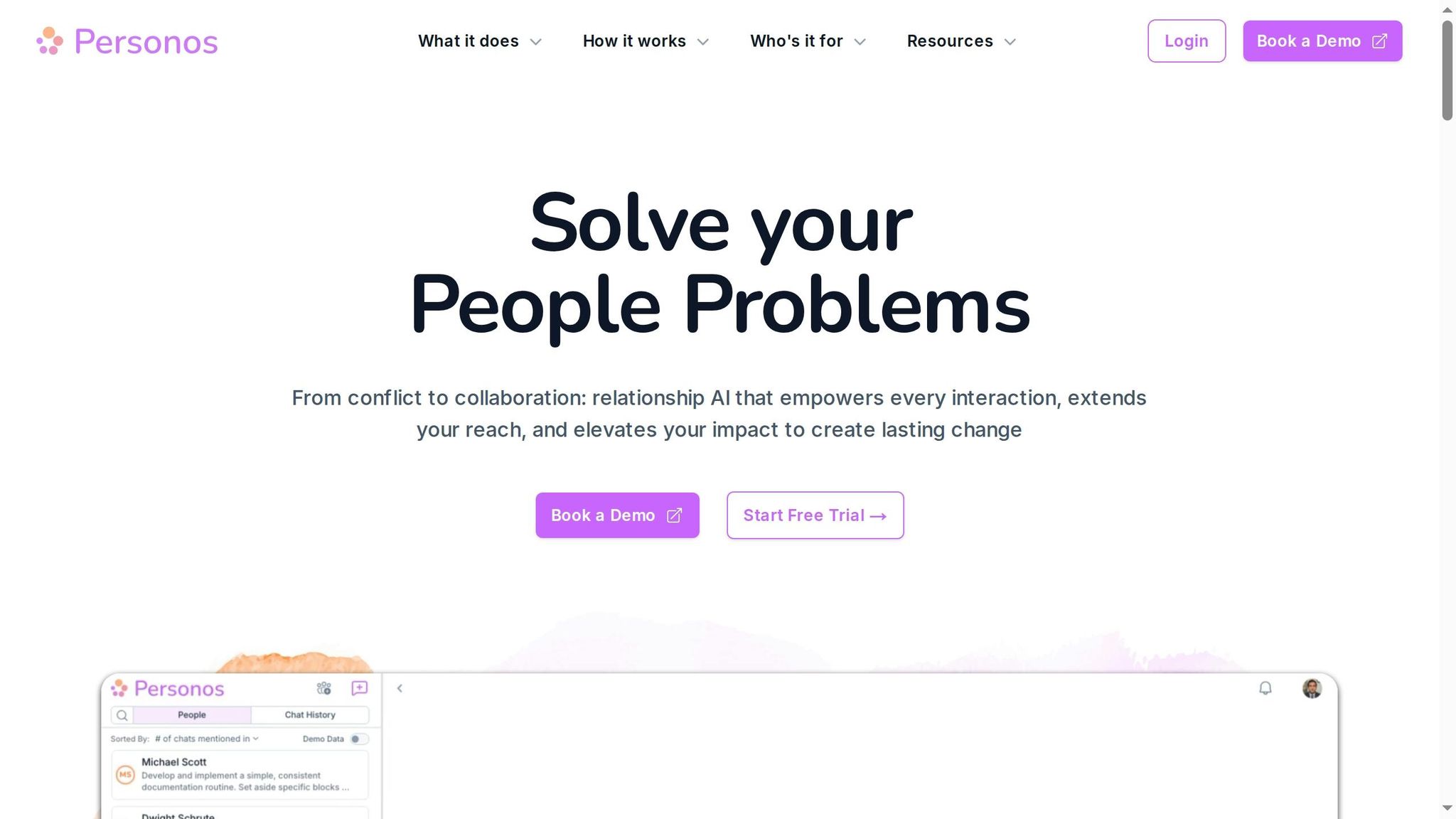
Personos uses the Five Factor Model, a scientifically validated framework, to measure 30 personality traits on an 80-point scale. This approach provides detailed insights into how individuals process information, approach conflict, and respond to feedback, especially in diverse team environments. Let’s dive into how Personos delivers in areas like personalization, real-time guidance, cultural awareness, and tracking outcomes.
Personalization
Personos adapts its guidance to fit the unique needs of individuals and organizations. The AI adjusts its suggestions based on roles, ensuring leadership advice aligns with each level. Leaders can even upload their company’s values, communication styles, and frameworks into the platform. This way, the guidance reflects the company’s specific culture rather than a one-size-fits-all model.
Real-Time Guidance
When conversations get tense or cultural misunderstandings arise, Personos steps in with immediate, tailored language suggestions. These cues are based on real-time personality data and any contextual notes you’ve added. Unlike traditional conflict resolution strategies that often come into play after issues escalate, Personos offers support in the moment, helping to defuse situations before they worsen.
Cultural Sensitivity
Instead of relying on generic cultural stereotypes, Personos bases its recommendations on individual personality insights. It also factors in organizational context, such as local norms, team agreements, and company values, ensuring its advice stays relevant to your specific environment. Additionally, its Relationship and Team Reports identify potential conflict triggers and collaboration trends within teams, giving leaders a proactive edge in managing dynamics.
Outcome Measurement
Personos doesn’t just stop at recommendations - it tracks the results. By monitoring improvements in areas like employee engagement, productivity, and retention, the platform provides a clear picture of how conflict resolution impacts the team. Its ActionBoard turns insights into actionable tasks, making it easy to link coaching conversations to measurable changes in behavior. This transparency helps leaders demonstrate ROI and justify investments in team development.
2. Crystal
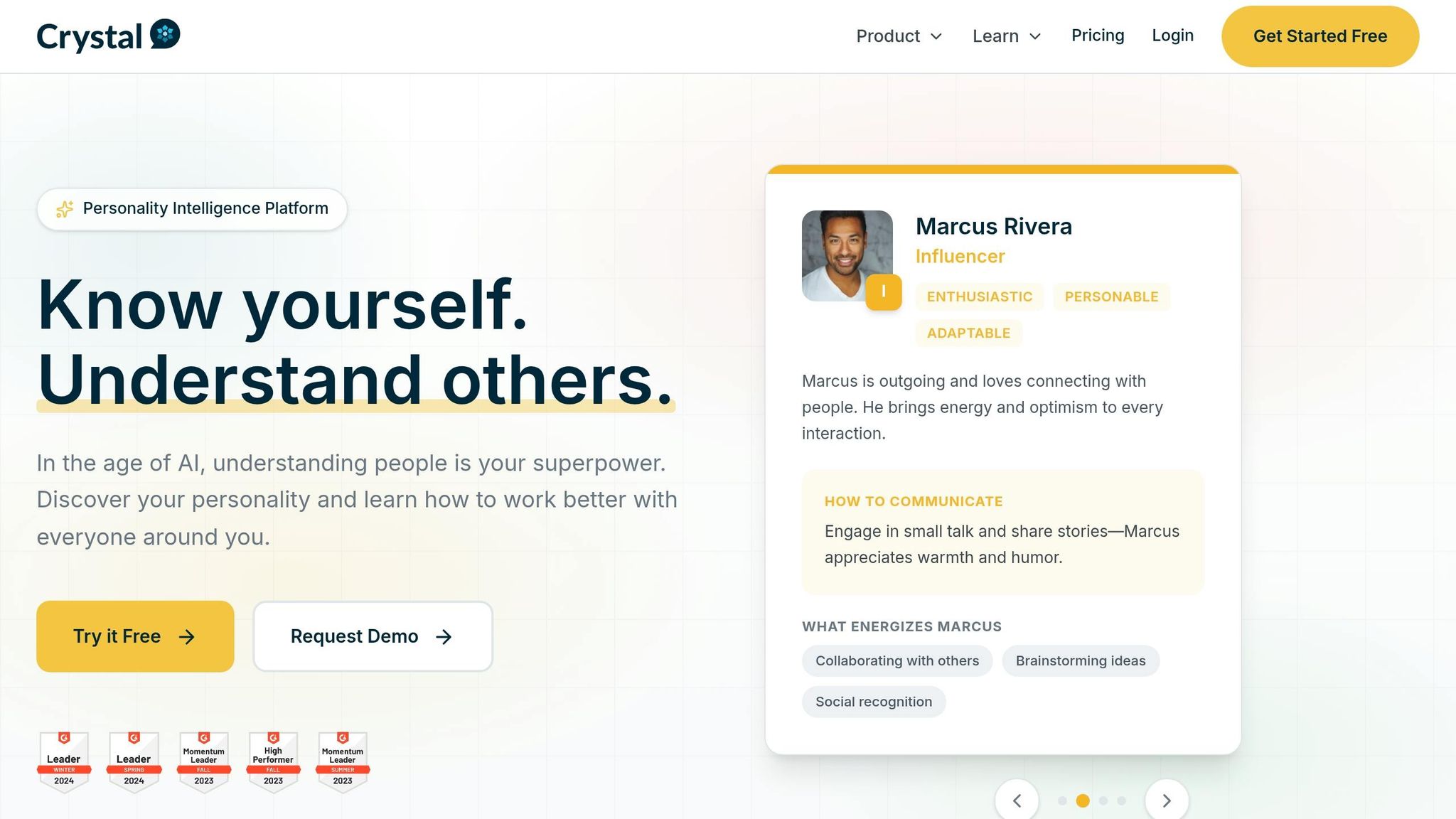
Personos uses a detailed 30-trait model for tailored guidance, but Crystal takes a different approach by focusing on the DISC framework - Dominance, Influence, Steadiness, and Conscientiousness. This method simplifies communication insights, offering a practical alternative for leaders navigating diverse team dynamics. With tools like its Personality AI, Crystal predicts communication styles by analyzing public data, such as LinkedIn profiles. This makes it particularly useful for understanding how individuals prefer to communicate, handle tension, and respond to feedback.
Personalization
Crystal assigns individuals to DISC profiles, providing quick and accessible insights. While this is helpful for a general understanding, it may not fully address the nuances of complex team dynamics within organizations. The tool is best suited for establishing a foundational understanding of communication preferences.
Real-Time Guidance
One standout feature of Crystal is its browser extension, which provides real-time coaching for digital communication. This is especially beneficial for tasks like sales and recruiting. However, it lacks the depth needed to support leaders during live, high-pressure conflicts, where more detailed guidance would be essential.
Cultural Sensitivity
Crystal's recommendations are based solely on DISC types, without considering the specific organizational or cultural contexts of a team. For leaders managing cross-cultural teams or navigating unique internal dynamics, this can be a significant limitation. These gaps become even more apparent when compared to tools that incorporate broader, more flexible frameworks.
Outcome Measurement
Crystal doesn't include tools for tracking long-term behavioral changes or measuring how its recommendations impact team engagement or retention. Its focus is on improving individual interactions rather than demonstrating broader organizational outcomes. This can be a drawback for leaders who need to show tangible results to justify investments in conflict resolution or team-building programs.
3. Hogan Assessments with AI
Hogan Assessments, a well-established name in research-driven personality testing, has taken a structured approach to leadership development by integrating AI into its traditional methods. Unlike AI-first platforms like Personos, Hogan uses AI to enhance its existing tools, tackling challenges such as cross-cultural conflicts by using AI to analyze personality for team success through a blend of established assessments and modern technology.
Personalization
Hogan's suite of assessments - including the Hogan Personality Inventory, Hogan Development Survey, and Motives, Values, Preferences Inventory - offers in-depth personality insights. With AI, these tools now allow leaders to set specific conflict resolution goals, enabling a more tailored experience. However, this personalization is static, meaning it doesn't adjust dynamically during real-time situations. Instead, it encourages a reflective and methodical approach to conflict management, focusing on long-term growth rather than immediate reactions.
Real-Time Guidance
Hogan's AI tools differ significantly from Personos' real-time conversational support. Rather than providing instant guidance during conflicts, Hogan's AI functions as a resource for coaching and development. It compiles and presents key background information for post-conflict analysis, acting as a supplemental coach. This approach is better suited for structured development cycles, contrasting with Personos' dynamic, in-the-moment conflict resolution capabilities [1].
Pros and Cons
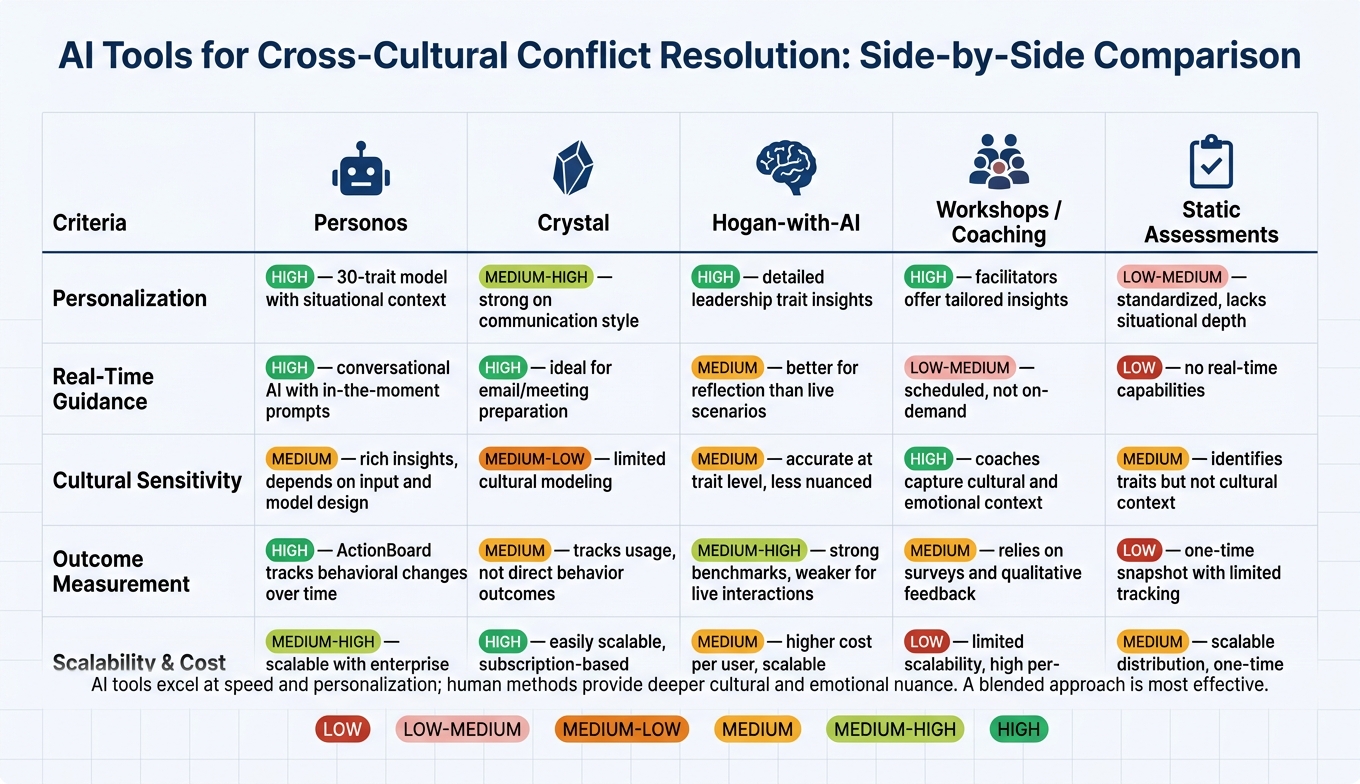
AI Tools for Cross-Cultural Conflict Resolution: Side-by-Side Comparison
Building on the detailed tool assessments above, this section outlines the strengths and weaknesses of each method in practical scenarios.
Different approaches come with their own trade-offs. AI tools like Personos, Crystal, and Hogan-with-AI offer distinct advantages, while traditional methods like workshops, coaching, and static assessments bring their own benefits. Knowing where each method excels - and where it falls short - can help leaders make informed decisions.
AI tools shine when speed and personalized guidance matter most. For instance, Personos provides real-time, situation-specific guidance while also tracking behavioral changes over time. This feature is particularly helpful for U.S. teams needing to show measurable outcomes to leadership or funders. Crystal helps leaders quickly adjust their communication style before sending an email or running a meeting, though its ability to analyze cultural nuances is limited. Hogan-with-AI offers deep insights into leadership traits and benchmarked data, but it’s less effective in managing live conflicts.
However, AI has its blind spots. Tools trained on Western or U.S.-centric data might misinterpret communication styles from high-context cultures or collectivist norms. They can also struggle with non-native English usage. Another concern is over-reliance on AI recommendations - leaders might skip consulting HR, legal advisors, or skilled mediators in sensitive situations involving race, religion, or immigration status. These gaps highlight where human judgment is still essential.
Traditional methods like workshops, coaching, and static assessments fill in the gaps by offering deeper contextual understanding. A skilled facilitator can adapt to the room’s dynamics, address emotional complexities, and consider factors like company history, regional cultural differences, and power structures - nuances that AI struggles to capture. The downside? These methods are costly, episodic, and their impact can fade without consistent follow-up.
| Approach | Personalization | Real-Time Guidance | Cultural Sensitivity | Outcome Measurement |
|---|---|---|---|---|
| Personos | High - 30-trait model with situational context | High - conversational AI with in-the-moment prompts | Medium - rich insights, but depends on input and model design | High - ActionBoard tracks behavioral changes over time |
| Crystal | Medium-High - strong on communication style | High - ideal for email/meeting preparation | Medium-Low - limited cultural modeling | Medium - tracks usage, not direct behavior outcomes |
| Hogan-with-AI | High - detailed leadership trait insights | Medium - better for reflection than live scenarios | Medium - accurate at trait level, less nuanced | Medium-High - strong benchmarks, weaker for live interactions |
| Workshops / Coaching | High - facilitators offer tailored insights | Low-Medium - scheduled, not on-demand | High - coaches capture cultural and emotional context | Medium - relies on surveys and qualitative feedback |
| Static Assessments | Low-Medium - standardized, lacks situational depth | Low - no real-time capabilities | Medium - identifies traits but not cultural context | Low - a one-time snapshot with limited tracking |
This comparison highlights the importance of combining AI tools with human expertise. A blended approach is often the most effective way to navigate cross-cultural challenges.
Conclusion
There’s no magic solution for resolving cross-cultural conflicts. The key lies in choosing the right tools and methods for each situation. AI platforms like Personos, Crystal, and Hogan with AI each offer unique strengths, but they work best when paired with traditional methods like mediation, coaching, and facilitated training - not as replacements.
Here’s the main takeaway: AI excels at preparation and personalization, while human expertise handles the nuance and relationship-building that algorithms can’t replicate. A skilled mediator or coach is critical for navigating the emotional and cultural dynamics that arise in real-world conflicts.
For leaders in the U.S. managing multicultural teams, this means using AI strategically. For example: rely on Hogan with AI for leadership selection and long-term development, turn to Personos for personality-aware insights during live conflicts or high-pressure situations, and leverage Crystal to refine everyday communication like emails and feedback. Together, these tools complement one another, addressing different stages of conflict resolution effectively.
The real danger isn’t picking the wrong AI tool - it’s depending too much on AI alone. AI-generated profiles are starting points, not definitive answers. They should guide your thinking without replacing critical judgment or sidelining HR, legal advisors, or mediators. Recognizing these limits highlights the irreplaceable value of human insight.
AI enhances skilled leadership but can’t substitute for sound judgment. The organizations that succeed treat AI as an assistant - one that identifies patterns, suggests language, and tracks progress - while keeping human decision-making at the forefront. Combining AI with human expertise is what truly drives effective cross-cultural conflict resolution in leadership.
FAQs
When should I use AI vs HR or a mediator in a cross-cultural conflict?
AI can be an excellent support tool for HR teams or mediators, but it shouldn't take their place. Platforms like Personos are designed to analyze personality traits and group dynamics in real time, delivering objective insights and customized strategies to help prevent conflicts from escalating. While HR professionals and mediators bring empathy and ethical decision-making to the table, AI adds value by offering a neutral and efficient perspective. It equips leaders with data-driven solutions, making it easier to address workplace conflicts thoughtfully and effectively.
How do I keep AI advice from reinforcing cultural stereotypes or bias?
To prevent reinforcing stereotypes or biases, it's essential for AI tools to focus on transparency and accountability. Platforms such as Personos achieve this by clearly explaining how their recommendations are formed. They emphasize relevant traits, contextual factors, and established psychological principles.
By leveraging scientifically supported frameworks like the Five Factor Model - a model recognized for its cross-cultural applicability - Personos delivers objective insights. This approach reduces subjective bias, encourages inclusivity, and supports fair, culturally aware practices in areas like conflict resolution and leadership development.
What should I track to prove AI-driven conflict support is working?
To see how well AI-driven tools work in managing conflicts, focus on tracking key areas like relationship and team dynamics, common conflict triggers, communication styles, and the effectiveness of de-escalation strategies. Keeping an eye on these factors helps show how these tools make conflict resolution smoother and more effective.