Personality-Adaptive AI for Crisis De-Escalation
Personality-aware AI helps practitioners adjust tone, pace, and wording to lower escalation while humans retain safety control.
Rachel Johnson

Personality-Adaptive AI for Crisis De-Escalation
The core idea is simple: crisis communication works better when the response fits the person. I’d sum up the article like this: AI can help staff adjust tone, pace, structure, and wording in the moment, but people must still make all safety decisions.
Here’s what matters most:
- Standard de-escalation training has limits. Staff in 988, social work, and emergency settings often face heavy caseloads, stress, and little background on the person in front of them.
- Personality changes how people react under stress. The same script can calm one person and upset another.
- AI can act like a live copilot. It can suggest things like:
- slow down
- use shorter sentences
- give clear next steps
- leave space for silence
- The Five Factor Model helps guide response style. For example, a person high in neuroticism may need a softer tone and lower threat language, while a person high in conscientiousness may want order and clear steps.
- Human oversight is non-negotiable. AI should not handle risk assessment, safety planning, or emergency escalation on its own.
- Personos is positioned as a personality-based tool for helping professionals. The article says it uses 30 traits on an 80-point scale, plus chat guidance, reports, and follow-up tracking.
- The workflow is straightforward: review the profile before contact, use live prompts during the interaction, and document what happened right after.
A few facts stand out. The article notes research across 18 U.S. states linking burnout in social work to heavy caseloads. It also points to settings like 988 call centers and emergency departments, where staff often have very little time to build trust.
If I had to put the full piece into one line, it would be this: better fit beats better scripts.
The article’s main point is not that AI should take over. It’s that small, personality-aware shifts in how you speak can lower the chance of escalation, and AI may help staff make those shifts when pressure is high.
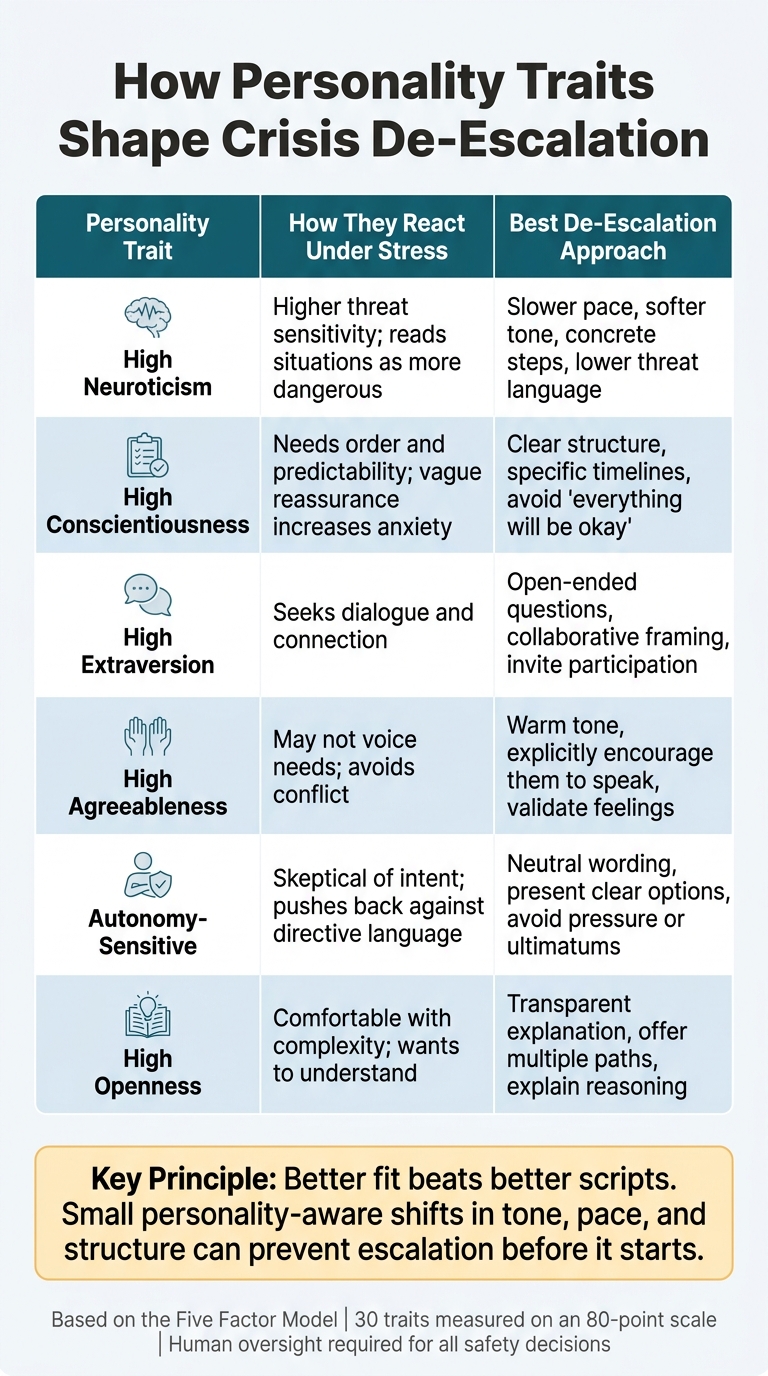
How Personality Traits Shape Crisis De-Escalation: A Practitioner's Guide
AI Roleplay for De-Escalation Training: Build a Custom Simulator Without a Developer
Why personality patterns change what works in a crisis
That gap matters because personality shapes how someone hears the exact same intervention. People don’t calm down in the same way. Threat perception, emotion, and coping style all shift from person to person. So tone, pace, and structure only help when they fit that person’s stress profile.
The Five Factor Model gives us a research-based way to read those differences without boxing people into fixed types.
Research shows that neuroticism has the strongest positive relationship with stress, while extraversion, agreeableness, conscientiousness, and openness are all negatively related to stress perception [1]. If someone is high in neuroticism, they may already read the situation as more threatening. In that case, the wrong tone can push them deeper into distress.
How personality traits shape tone, pace, trust, and response style
In practice, these traits point to different de-escalation moves:
| Trait | Under Stress | Use |
|---|---|---|
| High neuroticism | Higher threat sensitivity | Slower pace, softer tone, concrete steps |
| High conscientiousness | Needs order | Clear structure and timelines |
| High extraversion | Seeks dialogue | Open questions, collaborative framing |
| High agreeableness | May not voice needs | Warm tone, explicit encouragement to speak |
| More autonomy-sensitive | Skeptical of intent | Neutral wording, clear options, no pressure |
| High openness | Comfortable with complexity | Transparent explanation, multiple paths offered |
Why generic responses can make a crisis worse
Generic scripts assume people respond to the same cues in the same way. That’s where things start to go sideways. Overly directive language can trigger pushback in autonomy-sensitive people. Vague reassurance like "everything will be okay" can increase anxiety in someone high in conscientiousness because it clashes with their need for clear, predictable steps. And a high-energy style with someone who’s already overwhelmed can feel like pressure instead of support.
Even small mismatches add up fast. A pace that’s a little too quick. A tone that sounds dismissive. A question that lands as intrusive. In a live crisis, there often isn’t much room to recover before the interaction starts to unravel. The goal isn’t to find a perfect script. It’s to avoid the response style most likely to trigger escalation.
The next question is how AI can detect those patterns fast enough to help in live interactions.
How personality-adaptive AI supports de-escalation in real time
Personality-adaptive AI works like a real-time copilot. It can spot cues, cut down cognitive load, and support the practitioner without taking over clinical judgment. That only works if the system reads the right signals and turns them into prompts fast enough to be useful.
What the AI looks at during a live interaction
In a live interaction, the AI looks at the person's words, voice cues, conversation history, and personality profile.[3][7][8][9] It also flags emotional shifts and risk indicators.[7][10][11] Emotion models can detect states like anger, shame, panic, resignation, or dissociation, and each of those calls for a different kind of response.[8][9][11]
Personality data helps shape how a prompt is phrased. For example, the AI might suggest affirmation for a conscientious person who is expressing guilt. Or it may avoid directive language when trust is low.[3][4][9][11]
The output should stay brief and optional. That can mean prompts like:
- Slow the pace
- Use shorter sentences
- Allow brief silence
- Reframe distress in a way that lowers threat and protects rapport
These suggestions are meant to support the practitioner, not steer the whole interaction.[3][4][6][10] The practitioner can accept them, change them, or ignore them. They only help when the human stays fully in charge of the response.
Where human oversight and safety boundaries must stay in place
AI must not make crisis decisions. Humans are responsible for risk assessment, safety planning, and emergency escalation.[2][3][4] That line matters. General-purpose mental health chatbots can wait too long to refer someone to human help, which is exactly why crisis-facing AI needs hard safety boundaries and human-in-the-loop escalation.[12][13][14]
In U.S. practice settings, that means having a clear escalation pathway that matches SAMHSA's 988 framework and other established protocols. So if the AI flags imminent risk, staff should respond with supervisor consultation, contact with emergency services, safety planning, and correct 988 Suicide and Crisis Lifeline information, instead of leaning on AI suggestions alone.[3][5]
It also means clients should be told what the AI processes, how data is stored and deidentified, and whether opt-out options are available.[3][4][9] Documentation should record the practitioner's reasoning and actions. Organizations should also pair deployment with regular audits, bias assessments, and incident review.[2][3][4][6][9]
The next question is which platforms are built to do this well for helping professionals.
Personality-aware platforms for helping professionals: where Personos fits
AI tools do different kinds of work. So picking a platform isn't just a tech choice. In de-escalation, it's part of the response plan.
General-purpose platforms like OpenAI Presence are built around reliability, policy compliance, and escalation. Personos is built for a different kind of work: helping professionals manage live human conversations.
Personos was made for helping professionals, including social workers, case managers, counselors, and nonprofit staff, who deal with these situations every day. It uses the Five Factor Model to profile 30 traits on an 80-point scale, then uses that profile to shape real-time guidance instead of falling back on the same script every time.
How Personos applies personality psychology to crisis communication
At the center of Personos during a crisis is Personos Chat. A practitioner can describe the client, the situation, and what has already been tried. The AI then returns guidance shaped by the client's personality profile and the relationship context. It shifts tone, pacing, and response style based on that person's traits.
That only matters if it helps someone respond with better fit and less delay. Dynamic Reports give individual, relationship, and group insights, including trauma responses and coping strategies. Prompts send short scheduled nudges that keep personality awareness in view between sessions. The ActionBoard turns those insights into tasks a team can track. Personos also shows the reasoning behind each recommendation, so practitioners can see which traits were used and why.
How Personos compares with general AI coaching and support tools
General tools can handle many issues at scale, but they don't change communication style to match a person's personality in real time. That's the key difference. General platforms are built to work across many industries. Personos is built for the high-stakes moment when a practitioner needs to know how to talk to this person, right now.
Those features matter most when they support a simple workflow before, during, and after the crisis moment.
A practical workflow for using AI in live crisis moments
Before, during, and after the interaction
Once you have the profile, the workflow is pretty straightforward: prepare, respond, document.
Before contact, review the relevant Dynamic Report. Pay close attention to the 30-facet personality profile and likely stress-response patterns. That gives you a better sense of whether the person may shut down or become confrontational when pressure builds. From there, you can choose an opening tone, pace, and level of structure that fits the person in front of you. You can also gauge whether they need more structure, more reassurance, or more room. Done well, that prep leads to faster responses that fit the moment once the conversation begins.
During the interaction, bring the relevant client context into the chat and describe the situation in plain language. The AI then returns situational guidance on tone and pacing based on the person's profile. The key is to match your response to the person's stress pattern, not to a fixed script. If the client is escalating, use silence, name the emotion, slow your pace, and lower your voice. Once the person settles, move right into documentation and follow-up.
After the interaction, document right away. Use one-click task creation in the ActionBoard to turn AI-suggested follow-up steps into items your team can track. Log the key de-escalation moments using your organization's standard documentation format. Note what worked so the next interaction starts from a better place. Supervisors can then review the ActionBoard during debriefs.
Benefits, limits, and what to watch for in practice
Personality-adaptive AI can ease the mental strain and burnout of reading someone's traits while also trying to stop a conversation from falling apart.
| Benefit | Limit or Risk to Watch |
|---|---|
| Lower cognitive load - quick suggestions reduce mental effort under pressure | Overreliance - AI suggestions should inform, not replace, professional judgment |
| Consistent phrasing - helps staff keep a professional tone even when they're tired or stressed | Missed nuance - AI can't pick up subtle non-verbal cues or context that isn't in the text |
| Personality alignment - tailors de-escalation to the person's specific stress-response patterns | Potential bias - personality models can reflect built-in bias if no one is watching for it |
| Trackable follow-up - ActionBoard tracks whether insights lead to actual behavior change | Privacy concerns - sensitive data must be handled in line with U.S. standards, including HIPAA and confidentiality rules |
Personos shows the reasoning behind each suggestion, so practitioners can accept it, adjust it, or ignore it on the spot. The AI supports the response. The practitioner makes the call.
Conclusion: safer de-escalation starts with better fit, not better scripts
Across the whole workflow, the same rule keeps showing up: crisis communication works best when the response fits the person, not a preset script. Different traits need different pacing, tone, and structure. Small personality-aware shifts, like slowing your pace, softening your tone, or naming an emotion before offering a solution, can stop a conversation from sliding into escalation.
This is where AI can help the most. It cuts down on guesswork while keeping control with the practitioner. AI should bring forward personality-aligned prompts, not replace practitioner judgment. That line matters because it keeps the approach tied to the safety and professional standards required in U.S. behavioral health and social services settings.
For helping professionals, Personos adds personality-aware guidance that general AI tools do not provide. Unlike general AI tools, Personos connects guidance to validated personality profiles, with 30 traits measured on an 80-point scale, plus situation-specific chat, Dynamic Reports, and an ActionBoard that turns insights into trackable follow-up. That helps staff handle more cases without replacing professional judgment.
De-escalation works better when responses fit the person. In crisis de-escalation, fit is the safeguard.
FAQs
How does AI infer personality in a crisis?
AI can infer personality by looking at how someone communicates. That includes word choice, sentence structure, tone, and even response speed. From there, it matches those signals to established trait frameworks, including the Five Factor Model, to spot behavior patterns that show up again and again.
Platforms like Personos go a step further. They also look at personal context, such as goals and past interactions, to build dynamic profiles and give situation-specific guidance during a crisis.
What can staff safely let the AI do?
Staff should use AI as a decision-support tool, not as the final authority. People still need to make the call. Before anyone acts on AI guidance, practitioners should review it for accuracy and make sure it fits the situation.
AI can help with pattern analysis, validation prompts, and task lists. That said, staff need to stay involved at every step so responses remain appropriate and ethical.
How should teams validate AI prompts in practice?
Treat AI prompts as a starting point, not the final call. They can point you in a useful direction, but human judgment still needs to do the heavy lifting. Before you act on any suggestion, check whether it’s accurate and whether it fits the situation in front of you.
It helps to use tools like Personos that show the reasoning behind a suggestion instead of giving you a black-box answer. That way, you can see how the system got there and decide whether it makes sense.
A few habits also make a big difference:
- Build feedback loops so people can rate prompts and flag weak outputs
- Audit results for bias across different groups
- Compare AI insights with direct observation and more standard assessments
That last point matters a lot. AI can be useful, but it shouldn’t replace what you can learn from watching, listening, and checking findings against established methods.