How Personality Impacts Crisis Communication
How personality traits shape crisis responses and how tailored communication plus AI tools improve outcomes under stress.
Christian Thomas

How Personality Impacts Crisis Communication
When crises hit, personality traits heavily influence how people communicate and handle stress. Calm individuals may freeze, while outgoing ones might dominate discussions. Understanding these dynamics can help resolve issues faster and prevent conflicts from escalating.
Key takeaways:
- Traits like gentleness and emotional stability improve crisis resolution by fostering trust and calm decision-making.
- Challenging traits, such as narcissism or low emotional intelligence, can worsen communication and delay solutions.
- Tailoring communication to personality types (e.g., introverts vs. extroverts) ensures messages are well-received.
- Tools like AI-powered platforms (e.g., Personos) analyze personality traits using the Five Factor Model in real-time to guide effective crisis responses.
How to Communicate in Crisis: Social Work Edition
Personality Traits That Shape Crisis Communication
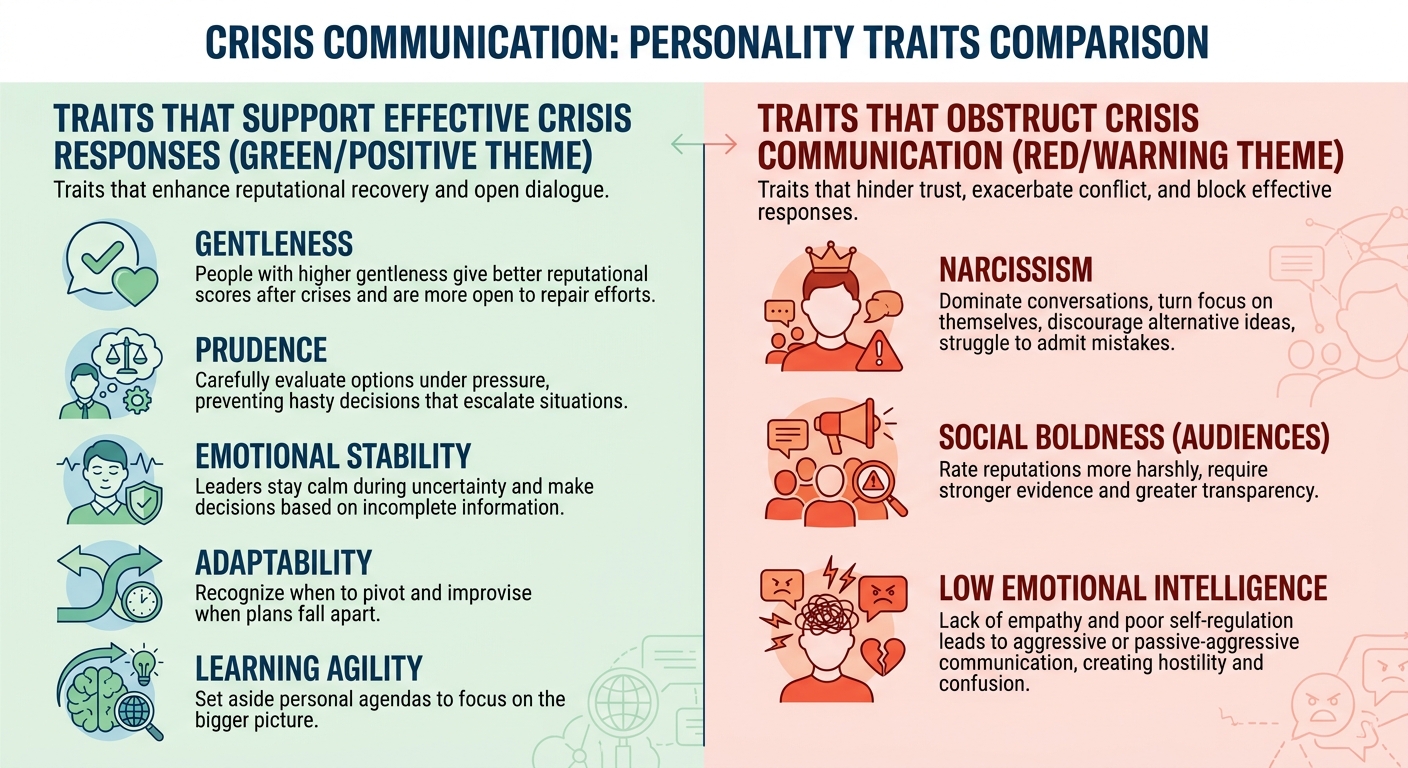
Personality Traits That Help vs Hinder Crisis Communication
Personality traits can either calm a crisis or make it worse. Knowing which traits help resolve issues and which create obstacles is key to handling crises effectively.
Traits That Support Effective Crisis Responses
Gentleness stands out as a critical trait during a crisis. Studies show that people with higher levels of gentleness tend to give better reputational scores to individuals or organizations after a crisis. This suggests they’re more open to repair efforts and less likely to assign blame unnecessarily [1].
Prudence, a part of conscientiousness, is another important trait. Those who are prudent carefully evaluate their options, even under pressure. This thoughtfulness can prevent hasty decisions that might escalate the situation [1].
Emotional stability is vital, too. Leaders who stay calm during uncertainty help stabilize the situation and make decisions based on incomplete information, avoiding delays caused by waiting for perfect clarity [3].
Traits like adaptability and learning agility are also helpful. Effective crisis management often requires recognizing when to pivot and being able to improvise when original plans fall apart, often using personality-based interventions to guide the response. This means setting aside personal agendas to focus on the bigger picture [3] [4].
Traits That Can Obstruct Crisis Communication
Not all traits are helpful in a crisis. For example, narcissism can create significant roadblocks. Narcissistic leaders often dominate conversations, turning the focus on themselves and discouraging alternative ideas. They also struggle to admit mistakes, which is crucial for reputation repair [1] [3].
Social boldness in an audience can also complicate crisis communication. When audiences are socially bold, they tend to rate reputations more harshly, requiring organizations to provide stronger evidence and greater transparency [1].
Lastly, low emotional intelligence - especially a lack of empathy and poor self-regulation - can lead to aggressive or passive-aggressive communication, which AI tools for helping professionals can help identify and mitigate. This behavior often creates hostility and confusion, making it harder to resolve the crisis [2].
How to Assess Personality in Crisis Situations
Understanding personality traits during a crisis is crucial for effective communication and decision-making. In high-pressure scenarios, time is limited, so quick and reliable methods are essential to understand what drives behavior in the moment. While self-reflection can provide immediate insights, structured tools can offer a deeper understanding of personality dynamics.
Identifying Your Own Personality Patterns Under Pressure
After a crisis, take five minutes to journal your reactions to uncover patterns in your behavior. Ask yourself questions like: Did I make decisions quickly, or was I more deliberate? Did I step back from the team, or did I take the lead? These reflections can highlight your natural tendencies under stress.
Your work pace and decision-making style are also telling. For example, a manager who slows down under pressure might prioritize accuracy over speed, which could delay updates. On the other hand, someone who makes intuitive, rapid decisions may handle ambiguity well but struggle with situations requiring strict protocols. To gauge your comfort level with uncertainty, rate yourself on a scale from 1 to 10. A lower score suggests a preference for structure, which might limit adaptability.
Interestingly, research shows that stress can amplify certain aspects of your Big Five personality traits. For instance, high neuroticism may lead to heightened emotional responses, potentially escalating conflicts. Meanwhile, low extraversion might result in withdrawal, hindering team coordination. Studies even indicate that highly conscientious individuals may delay responses by up to 20% when faced with ambiguous situations [5].
Using Personality Assessment Tools for Deeper Understanding
For a more detailed analysis, consider using the Five Factor Model, also known as the Big Five. This framework evaluates Openness, Conscientiousness, Extraversion, Agreeableness, and Neuroticism, accounting for 50–60% of behavioral variance in crises [8]. Tools like the IPIP-NEO provide validated assessments that take about 10 minutes to complete, offering a solid baseline for your personality traits.
AI-powered platforms like Personos enhance this process by providing real-time, actionable insights. Built on the Five Factor Model, Personos evaluates 30 traits on an 80-point scale. It begins with a five-minute onboarding assessment to establish your baseline. During a crisis, you can describe the situation through a conversational AI feature, which then offers tailored communication strategies based on your personality.
Personos also includes features like Dynamic Reports, which provide insights for improving practitioner-client interactions, and the ActionBoard, which translates these insights into actionable tasks. Unlike traditional static personality tests, Personos continuously updates its understanding of your patterns as situations change. This allows it to deliver timely, bite-sized prompts to help you adapt your approach in real time.
Adjusting Communication Based on Personality Types
Once you grasp personality patterns, the next step is tailoring your communication style to align with them, often using AI-guided personality-based interventions. In crisis scenarios, this adaptability can determine whether collaboration thrives or unnecessary conflict arises. It’s important to understand that most communication breakdowns stem not from a lack of information but from mismatched communication styles[10].
Communicating with High vs. Low Extraversion
People with high extraversion process their thoughts by talking them out. Research shows that 96% of highly extraverted individuals perform best in face-to-face conversations[9]. During a crisis, you can support them by encouraging real-time discussions and brainstorming sessions. To ensure balanced participation, try asking open-ended questions like, “What’s your perspective on this?”
On the other hand, low extraverts tend to process information internally, which can make fast-paced interactions challenging. Sharing agendas or data ahead of time gives them space to prepare. For important updates, consider one-on-one meetings or written communication, as these formats allow them to share their thoughts more thoroughly. Additionally, after intense group interactions, it’s helpful to provide downtime to recharge and avoid burnout.
Managing Conscientiousness During Time-Sensitive Decisions
Highly conscientious individuals thrive on structure and precision. They appreciate detailed, clear instructions, as a lack of information can come across as careless or dismissive[10]. In crisis situations, focus on delivering concise updates with well-defined follow-up steps to minimize uncertainty.
In contrast, those with lower conscientiousness often excel in spontaneous, on-the-spot problem-solving but may appear disorganized to more structured team members. When working with them, flexibility is key. Avoid imposing rigid expectations, but make sure to confirm key points and deadlines before wrapping up discussions. Following up with notes can also help ensure alignment.
Building Trust Through Personality-Aware Communication
Adapting your communication style to fit individual preferences can foster trust, especially in high-pressure situations. For example, individuals high in neuroticism may prefer digital communication, as it gives them the space to manage emotions and seek clarification as needed[9].
When dealing with team members lower in agreeableness - who may come across as blunt due to their personality rather than intent - it’s helpful to start with a brief acknowledgment of their contributions before delivering constructive feedback. This approach can prevent unnecessary tension[10]. Conversely, those high in agreeableness often feel more comfortable when explicit permission is given for candid feedback. Creating an environment where their honest opinions are encouraged can help them feel valued and heard[10].
Using AI-Powered Personality Tools for Crisis Communication
How AI Delivers Personality-Based Communication Guidance
AI platforms use the Five Factor Model, which examines 30 personality traits, to provide personalized communication strategies during crises [6]. These tools go beyond static assessments by combining personality data with real-time context - like conversation histories and situational specifics - to offer adaptable strategies that evolve as the crisis unfolds [7]. This ensures responses remain relevant, even as circumstances change.
Take the example of a social worker handling a high-conflict situation with a client displaying low agreeableness and high neuroticism. The AI evaluates these traits alongside factors like time constraints and resistance behaviors. It then suggests practical strategies, such as maintaining calm, empathetic communication while incorporating structured reassurance. This tailored approach has been shown to reduce miscommunication in crises by 25–40% [11].
Personos Features That Help During Crisis Situations
Tools like Personos take AI's adaptability a step further, offering features specifically designed for high-stress environments. Its conversational AI blends personality profiles with contextual data to deliver quick, actionable guidance. For instance, during a crisis call with a suicidal client, a professional can input the client's profile - such as low conscientiousness and high extraversion - along with situational details. Within seconds, the AI provides recommendations, like acknowledging the client’s energy while guiding them toward safety planning.
Other standout features include:
- Dynamic Reports: These provide real-time insights tailored to individuals, relationships (e.g., practitioner-client dynamics), and groups. For example, when a team encounters resistance from a family in crisis, the report might highlight mismatches - like a counselor’s high conscientiousness conflicting with the client’s low extraversion - and recommend using visual aids instead of relying solely on verbal explanations.
- Prompts: These offer quick follow-up suggestions, such as advising a fact-based email for a client with low openness.
- ActionBoard: Tracks both client progress and practitioner goals. For professionals juggling heavy caseloads, this feature automates personalized follow-ups, which has been linked to a 30% reduction in burnout according to nonprofit staff feedback.
By integrating these tools, professionals can manage crises more effectively while maintaining their own well-being.
How Personos Compares to Standard Personality Assessments
Unlike traditional personality assessments, which often provide static, one-time results with 50–70% predictive accuracy [8], Personos offers a more dynamic and precise approach. It measures 30 traits on an 80-point scale and incorporates real-time context, achieving over 85% accuracy [8].
Instead of labeling someone broadly as "high extraversion", Personos delivers situation-specific advice. For example, it might suggest using group debriefs for an extraverted team under stress. Its ability to update guidance as new information emerges ensures that strategies remain effective throughout the crisis.
In one case study involving a nonprofit shelter, a high-conflict resident was de-escalated in under 5 minutes by tailoring communication - mirroring the resident's direct style while introducing collaborative elements. Follow-up reports showed improved trust scores, and resolutions were achieved 35% faster compared to traditional methods. This adaptability highlights how Personos outperforms older assessment tools in real-world crisis management.
Conclusion
Main Lessons for Professionals
Grasping personality traits plays a key role in effective crisis communication. A study of 368 participants highlights that these traits can predict the success of reputation repair efforts, regardless of the communication strategy applied [1].
By adopting a psychographic approach, professionals can anticipate how stakeholders will respond to crisis strategies and fine-tune their methods accordingly. Traits such as gentleness, prudence, and social boldness offer valuable insights into addressing individual psychological needs, which can help reduce potential conflicts. This approach also opens the door for integrating technology to improve crisis outcomes.
How Technology Supports Better Crisis Outcomes
AI-driven tools like Personos are reshaping crisis management by incorporating real-time personality insights. For example, Personos evaluates 30 personality traits on an 80-point scale while factoring in current contexts. This allows the platform to provide tailored, situation-specific recommendations that adapt as conditions evolve.
For professionals like social workers, case managers, coaches, and counselors who often manage emotionally intense and high-volume caseloads, personality-aware technology becomes a game-changer. Tools like these not only offer actionable recommendations but also explain the reasoning behind them, helping professionals enhance their own decision-making skills. At just $9 per user per month, platforms like Personos make this advanced support accessible to organizations working with vulnerable populations.
FAQs
Which personality traits are most important in a crisis?
During a crisis, certain personality traits can make a world of difference. Extraversion, conscientiousness, and agreeableness stand out as particularly crucial. Why? These traits help foster clear communication, encourage organized decision-making, ensure accountability, and build trust. Together, they create the foundation for effective teamwork and collaboration when navigating uncertain situations.
How can I quickly spot my stress patterns?
To get a handle on your stress patterns, start by paying attention to how you feel and react physically and emotionally during stressful situations. Notice if certain moods, behaviors, or physical sensations keep coming up. You can also use tools like personality psychology platforms - Personos is one example - that analyze your traits and how you respond to different situations. These tools can provide real-time insights to help you better understand and manage your stress.
When should I use AI like Personos during a crisis?
AI tools like Personos prove invaluable during crises, especially when real-time data processing, personalized communication, and decision-making support are critical. These tools can sift through massive amounts of data, identify false information, and create alerts tailored to specific audiences. By incorporating personality insights, they ensure messages resonate with individuals' unique traits, fostering trust and enhancing engagement - key factors for effective crisis communication.