Conversational AI in Behavioral Health: Study Summary
Chatbots boost access and short-term mood support but lack strong evidence for long-term outcomes, crisis safety, and equity.
Nick Blasi

Conversational AI in Behavioral Health: Study Summary
Here’s the short answer: conversational AI looks useful for access, staff support, and brief check-ins, but the research is still weak on long-term outcomes, crisis safety, and use across different groups.
If you work in behavioral health, this means you should view these tools as support systems, not stand-alone care. The strongest signal in the research is short-term help with mood symptoms and easier access to support. The weakest areas are suicidal crisis response, serious mental illness, staff burnout, and performance across different populations.
At a glance, I’d boil the article down to this:
- Chatbots can help with access by being available 24/7
- Human review still matters for safety, bias, and bad responses
- Privacy features matter a lot, especially in trauma-related use cases
- About 80% to 90% of people opt out of third-party tracking when they can
- Woebot, Wysa, and Youper should not be ranked against each other from this research
- Staff-facing tools and client-facing tools do different jobs
- Personos fits staff support, not symptom chatbot use
- The biggest research gaps are long-term follow-up, crisis handling, and mixed-population testing
Chatbots as Therapeutic Aides: AI-Powered Conversational Agents in Mental Health / Sena Necla Çetin
Quick Comparison
| Tool or Category | Main Role | Best-Supported Use | Main Limit in Research |
|---|---|---|---|
| General mental health chatbots | Client support | Access, brief guidance, check-ins | Weak long-term proof |
| Woebot / Wysa / Youper | Symptom support | On-demand support | No sound basis for direct ranking |
| Trauma-informed AI systems | Trust-sensitive support | Privacy-focused engagement | No common measurement standard |
| Staff support AI | Workflow and guidance | Notes, triage, hard conversations | Thin evidence on burnout and outcomes |
| Personos | Staff-facing guidance | Hard interactions, crisis moments, team support | Limited published evidence base |
So if you want the plain-English takeaway, it’s this: AI in behavioral health makes the most sense when the scope stays narrow, people stay involved, and privacy and safety rules are built in from the start.
What Studies Show About Mental Health Chatbots
Research on mental health chatbots points in a pretty clear direction. People tend to like them for easy access, short bits of guidance, and support that doesn’t take much effort to use. That matters. If help is hard to reach, many people won’t reach for it at all.
At the same time, the current evidence has limits. Results look promising, but the case is stronger for convenience and access than for lasting clinical change. Put simply, these tools seem good at being there when someone needs a nudge, a check-in, or a moment of support. The harder question is whether they lead to durable mental health outcomes over time.
Systematic Reviews and Meta-Analyses
Systematic reviews and meta-analyses suggest promise, but they do not settle the matter. The evidence is still not definitive when it comes to effect size or long-term durability. That means we should be careful not to oversell what these tools can do.
This is a familiar pattern in digital mental health. Early results can look encouraging because access improves right away. But longer-term clinical impact is tougher to prove, especially across different user groups, symptom levels, and app designs.
Evidence From Woebot, Wysa, and Youper
The evidence provided does not support direct comparison among Woebot, Wysa, and Youper. That’s an important line to hold. It’s tempting to ask which one “wins,” but the current research doesn’t give a solid basis for that kind of ranking.
What does show up across these tools is their main appeal: 24/7 access to support. That around-the-clock availability can make a big difference, especially for users who want private, immediate help between therapy sessions, late at night, or during stressful moments.
Therapeutic Alliance and Generative AI
Human oversight still matters. It’s needed to catch errors, bias, and responses that could be unsafe. Even if a chatbot sounds smooth in conversation, that doesn’t mean it will always respond well in a high-stakes mental health moment.
Privacy is another core issue. Protections like zero-access encryption or local data storage can help protect sensitive conversation data. That’s not a small detail. When people open up about fear, grief, trauma, or self-doubt, the way that data is handled matters a lot.
For helping professionals, the evidence supports a more grounded use case. These tools can help with access, support, and workflow help. What the evidence does not support is treating them as stand-alone care in place of human-led treatment. This approach aligns with how AI and personality psychology can be combined to support professionals. That same logic carries into trauma-informed systems, where trust and safety matter just as much as access.
Trauma-Informed Design and Cultural Fit
Behavioral health tools need more than good outcomes. They need trust first. If people don't feel safe, they won't share private details about trauma, grief, substance use, or mental health.
That's why trauma-informed conversational AI puts a heavy focus on privacy, trust, transparency, and cultural fit. Researchers look at these systems through user-reported trust, perceived safety, data transparency, and cultural fit. Then they test how those ideas hold up in practice through privacy features and user response.
What Trauma-Informed Studies Find
Some platforms try to build trust through clear privacy controls. That can include zero-access encryption, local storage, or auto-delete after each session. The idea is simple: the less exposed a person's data feels, the easier it may be to open up.
For users from underserved or historically disadvantaged groups, AI can also make care feel less alien. It may translate clinical jargon and care-system norms into language that feels easier to understand. That matters because a lot of people don't struggle with the need for care as much as they struggle with the system around it.
Matching systems matter too. When systems match people based on objective skills, preferences, and goals instead of informal networks, they may help reduce bias. In plain terms, the process becomes less about who knows whom and more about what the person needs.
How Researchers Measure Trust, Safety, and Cultural Sensitivity
Researchers measure trust, safety, privacy, and cultural fit through user reports and feature testing. Privacy stands out as a major issue. About 80% to 90% of people opt out of being tracked by third-party apps when given the choice, which makes privacy a core design concern in behavioral health settings.
Cultural fit also depends on whether the system can adjust to the user's communication style and context. A chatbot that sounds fine in one setting can fall flat in another. When conversations involve trauma, grief, or crisis, people are more likely to stay engaged when the system feels private, transparent, and responsive to their needs.
Those same trust and fit demands also affect whether staff will use these tools in day-to-day care. And when AI is used by clinicians, case managers, and other staff, those design limits matter even more.
Staff Support, Implementation, and Where Personos Fits
The same issues around trust, safety, and fit shape AI tools built for staff too. Research on AI support for staff is still limited, but it’s starting to point in a clear direction. The main use cases are easier to see now: real-time help before a hard conversation, during real-time crisis communication, or while handling documentation and triage. AI can also ease mental strain by turning notes and background details into guidance staff can actually use.
When rollout is the hard part, product design matters just as much as the use case. In a U.S. behavioral health or nonprofit setting, adopting any AI tool starts with vendor privacy checks. That includes things like zero-access encryption, local storage, and auto-delete. But privacy isn’t the whole story. Teams also need to look at workflow fit, training, liability, bias, and ROI.
One simple test helps cut through the noise: can the platform work with the team’s own notes and context? If it can, the guidance is much more likely to match how staff already do their jobs.
Personality-Aware Support Tools Such as Personos
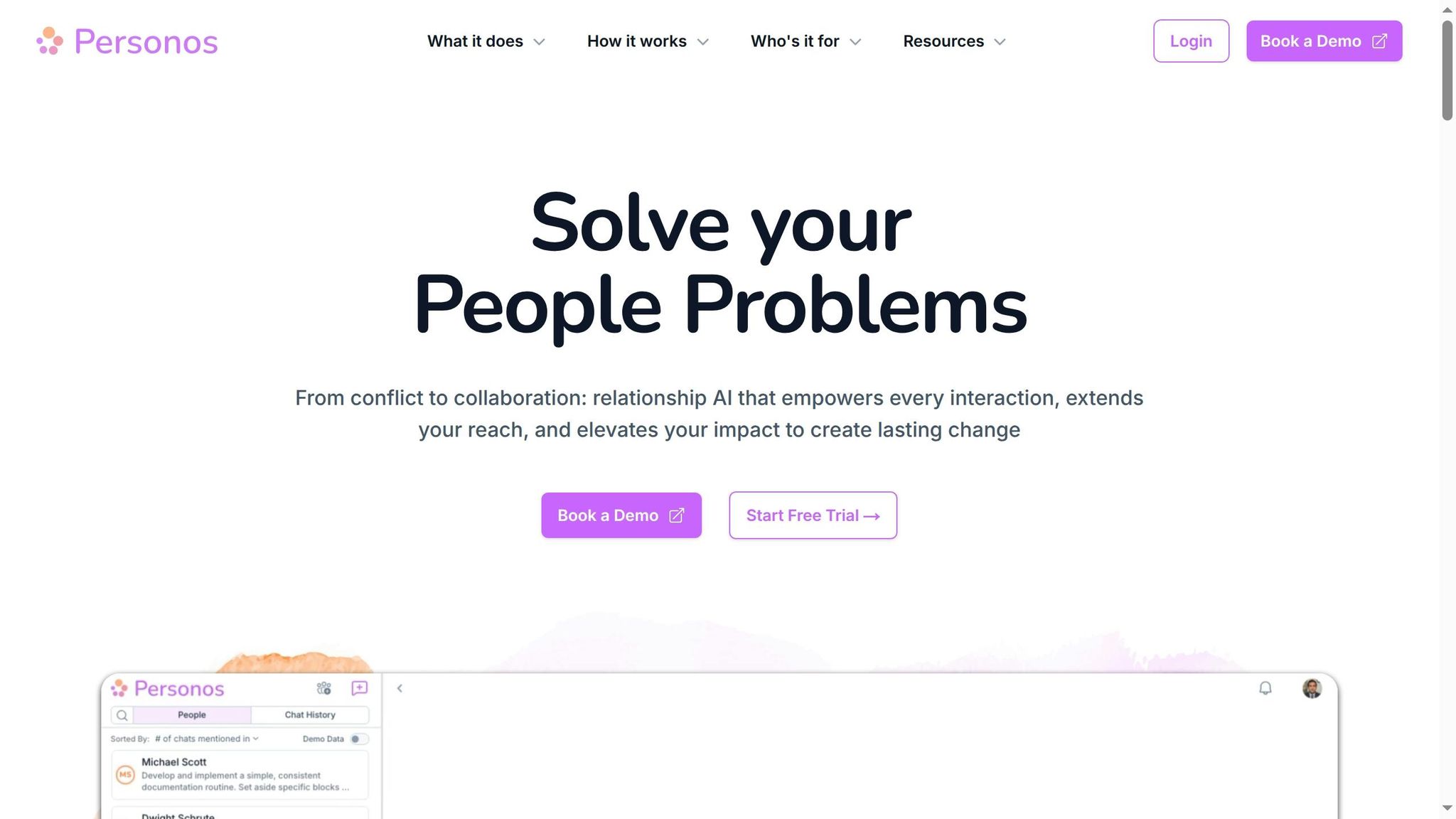
Personos fits a different role than client-facing chatbots. Instead of supporting patients, it supports helping professionals. Personos uses the Five Factor Model and context to give helping professionals context-specific guidance for hard client interactions, crisis moments, trust-building, and team collaboration.
For client-facing symptom support, Woebot and Wysa are more established. For staff support, Personos is the closer fit. That distinction leads directly to the evidence gaps that follow.
Evidence Gaps, Research Limits, and Bottom Line
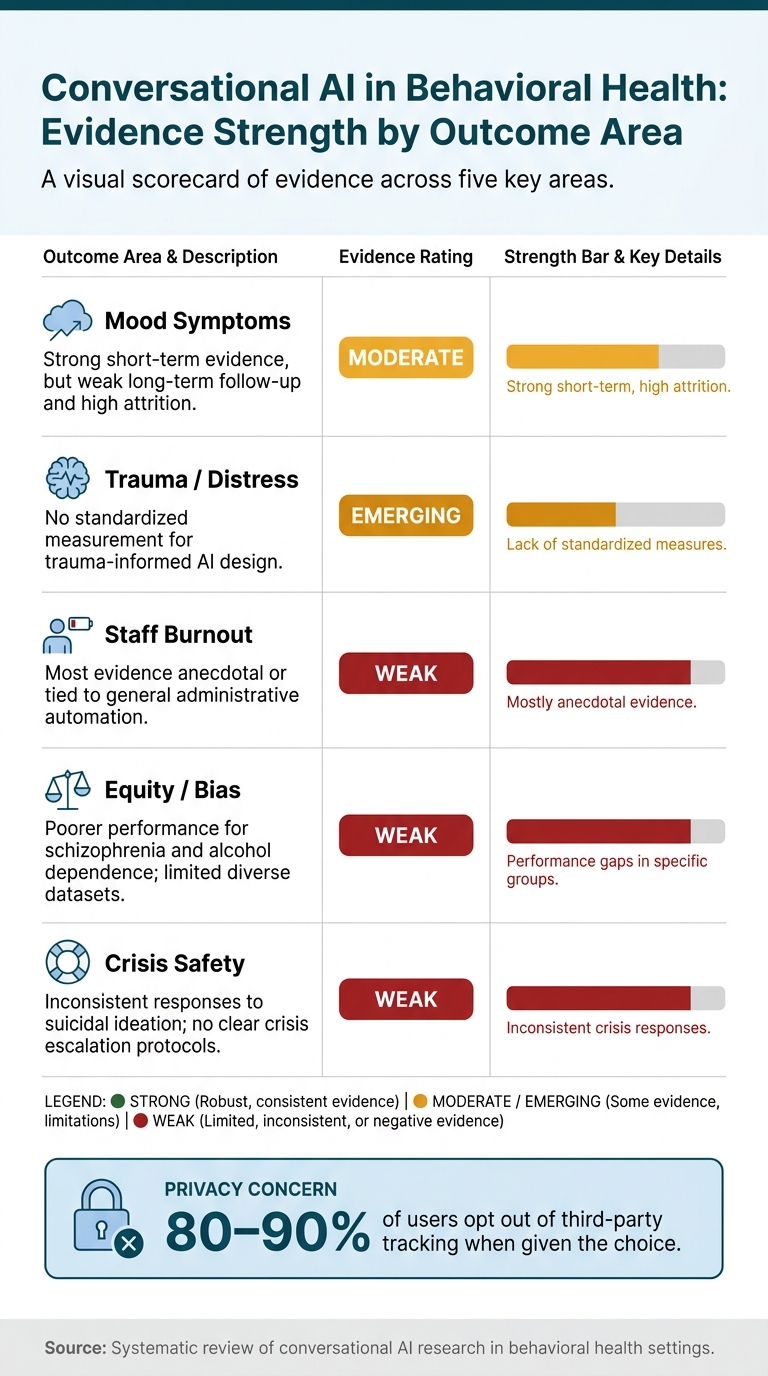
Conversational AI in Behavioral Health: Evidence Strength by Outcome Area
Main Gaps in the Evidence
The big question has shifted. It’s not whether conversational AI can help. It’s where the evidence starts to fall apart.
Right now, the findings look promising, but they’re still too thin to support broad deployment. Three limits stand out most: studies are short-term, samples are made up mostly of people who already chose to use the tools, and attrition stays high [4]. The biggest open areas are long-term outcomes, crisis safety, and how well these systems perform across different populations.
Some gaps are sharper than others. Research on serious mental illness is thin. Research involving culturally diverse populations is thin too. Trauma-informed design also has a measurement problem. Even when a study shows good results, it’s hard to compare one tool with another because there’s no standard way to measure trauma-informed AI design. Research on staff burnout is still weak as well, with most of the support coming from anecdotes or from studies on general administrative automation.
| Outcome Area | Evidence Strength |
|---|---|
| Mood symptoms | Strong short-term; weak long-term follow-up, high attrition [4] |
| Trauma / Distress | Emerging; no standardized measurement for trauma-informed AI design [5] |
| Staff Burnout | Weak; most evidence anecdotal or tied to general administrative automation [6] |
| Equity / Bias | Weak; poorer performance for schizophrenia and alcohol dependence; limited diverse datasets [1][2] |
| Crisis Safety | Weak; inconsistent responses to suicidal ideation; lack of clear crisis escalation rules [2][3] |
What Future Research Should Test
These gaps point to a pretty clear research agenda.
The field needs longer randomized trials with diverse, real-world samples. The goal isn’t just to track short-term symptom change. It’s to see what happens over time, including long-term recovery and the risk of dependency. Studies should also compare general-purpose LLMs with specialized systems that use richer context or personality-aware design. That would help show whether tailored systems cut down on ethical violations and false empathy [1][2].
Researchers also need to look more closely at therapeutic alliance. That means separating real collaboration from systems that simply sound agreeable. It also means testing whether these tools can respond well to a user’s background, lived experience, and cultural context [1][5].
There’s another basic problem here: AI is easier to build and deploy than to validate. Crisis management needs direct testing too, especially whether a system can spot suicidal ideation and route users to the right help through clear duty-to-escalate protocols [2][3].
Key Takeaways for Helping Professionals and Leaders
Short-term symptom relief looks promising. But the evidence base is still too thin to support broad, confident deployment.
Mood symptom reduction is the strongest finding. The rest of the picture is much less settled: trauma outcomes, staff support, equity, and long-term safety all need tougher research.
That line matters even more for staff-facing tools. In that setting, Personos is a better fit than client-facing chatbots because it gives helping professionals context-aware, personality-aware guidance for hard interactions, crisis moments, and collaboration.
AI belongs in behavioral health only when the scope is narrow, humans stay involved, privacy safeguards are in place, and the design fits the role. Without those guardrails, the risks outweigh the benefits.
FAQs
When should AI be used in behavioral health?
AI in behavioral health works best when it supports clinicians, not when it tries to replace them. The sweet spot is simple: help professionals do their jobs with less strain, cut burnout, and keep support going between sessions.
That matters because behavioral health isn't just about what happens in a 50-minute appointment. Some of the hardest moments happen outside the room, in tense, messy, fast-moving situations where timing and tone can change everything.
This is where AI can help most. It can offer real-time, context-aware support in situations like:
- de-escalating crises
- building trust with resistant clients
- shaping communication around a person's personality traits
Tools like Personos are built for exactly that kind of use. The goal isn't generic advice. It's personalized, science-based guidance that helps professionals respond with more care, more precision, and less guesswork.
What safety checks should teams require?
Teams should require enterprise-grade security and strong safety guardrails.
Key checks include:
- Data encryption for sensitive personality and personal information
- Separate, secure authorization providers
- Data masking and active monitoring that stops outputs when safety measures are triggered
Teams also need clear protocols to spot and remove users who show malicious patterns. That helps keep the environment private, secure, and supportive.
Which research gaps matter most right now?
One of the biggest gaps is this: broad AI skills don’t automatically help with the messy, high-pressure, context-heavy work that human professionals deal with every day.
Research points to another need too. People need individualized, personality-aware guidance based on evidence-based frameworks like the Five Factor Model. The goal isn’t to replace human judgment. It’s to help people communicate better, set boundaries, and make sound calls in the moment.
That’s the need Personos is built around.