Context-Aware AI for Hard Client Conversations
Real-time, personality-aware AI helps coaches spot withdrawal, pushback, and hidden doubt to improve pacing and trust.
Nick Blasi

Context-Aware AI for Hard Client Conversations
Hard client talks usually break down in just 3 ways: withdrawal, pushback, and masked concern. If I miss those shifts in the moment, I can mistake silence for agreement, debate for refusal, or polite language for buy-in.
Here’s the core idea in plain English: context-aware AI helps me spot those patterns while the conversation is still in motion. It looks at live signals like pauses, tone shifts, talk time, and repeated language, then checks them against the client’s history, goals, and personality profile. That helps me decide whether to slow down, ask a safer question, or test for doubt before the session stalls.
At a glance, this article shows:
- What usually goes wrong in hard coaching talks
- Why even experienced coaches miss signals during live sessions
- How AI can flag withdrawal, pushback, and hidden doubt
- Why personality data changes what I should say next
- Where general meeting tools fall short for coaching
- How to use AI without hurting privacy or trust
A few points stand out:
- Clients often stop sharing before they openly disagree
- Short answers and long pauses can mean overload, not low effort
- Pushback may be a safety test, not rejection
- “I’ll try” or “maybe” can hide concern
- AI should support my judgment, not replace it
The bottom line: when I use context-aware, personality-aware AI the right way, I get a better read on trust, pacing, and framing. And that gives me a better shot at handling hard conversations without forcing the moment.
How Coaches Can Use AI to Be More Present with Clients
The problem: misreading resistance weakens trust and outcomes
Hard conversations often fall apart when a coach responds before the client feels heard. If the coach moves too fast, like offering reassurance too soon or asking for commitment before the client is ready, the client may go quiet, agree politely, and then pull back.
The problem is that visible cooperation can hide stalled behavior change. On the surface, things look fine. Underneath, nothing is moving. That gap hurts outcomes and can chip away at sponsor confidence. These are the moments where context-aware AI can warn a coach before they overcorrect or miss what’s actually happening.
Withdrawal often looks like low engagement, not resistance
Short answers, long pauses, and vague replies often point to overload, not low commitment. What matters most is the shift, not any one cue by itself. If a client who was once detailed and curious suddenly becomes broad and flat, especially right after a sensitive topic, that usually marks an inflection point.
At that moment, the client needs space, not a new round of questions. Push harder, and the withdrawal often gets worse. A better move is to slow down, name the shift without judgment, and give the client room before coming back to the hard topic.
Real-time signal detection matters here because the best next step is often pacing, not pressure.
Pushback can be a test of safety, not a refusal to change
When a client pushes back on the coach’s framing, questions the premise, or keeps changing the subject, it’s easy to treat that as refusal. But defending the framing usually makes things worse. Direct countering can turn the moment into a contest. And when clients already feel unsure about safety, they tend to protect themselves by digging in further.
It helps to treat pushback as a different kind of question: Is this conversation safe enough for honesty? A coach who responds by acknowledging the challenge, "That may not be the right lens. What part doesn't fit for you?", lowers the threat level without walking away from the work. That small shift keeps things moving without pushing for agreement too soon.
AI can help by showing when resistance is a threat response, not rejection.
Masked concern is the hardest pattern to catch
Polite agreement can hide real doubt. Some clients lean toward accommodation instead of open disagreement, even when they’re unsure. Their words may sound aligned. But tone, pacing, and follow-through language can point somewhere else. That gap can lead a coach to mistake surface compliance for real buy-in.
The risk is clear: false alignment can shape an action plan around unspoken doubt. A direct check, "What feels solid about this, and what still feels unclear?", can bring that doubt into the open before it hardens into a pattern.
That’s where real-time context analysis helps most. It gives the coach a chance to slow down, reframe, or check for concerns the client hasn’t said out loud yet.
The solution: how context-aware AI reads the room during tough conversations
Context-aware AI blends live conversation signals with client history, goals, prior sessions, relationship history, and personality patterns to figure out what a moment means for this client, not just any client. The point isn't more data. It's a faster read on what the coach should do next.
What signals context-aware AI can detect
Context-aware AI can track talk-to-listen ratio, sentiment shifts, pacing changes, repeated objection language, and recurring topics. Those patterns can point to withdrawal, pushback, or concern that's still half-hidden before it locks in. That gives the coach a chance to slow down, reframe, or name the tension while there's still room to work with it.
How AI guidance changes a coach's next move
AI doesn't make the next move for the coach. It spots the pattern and trims down the options.
If sentiment drops and the client's talk time shrinks after a challenge, the system can prompt the coach to slow down and validate before pushing further. From there, the changes are practical and specific:
- Soften or sharpen language based on whether the client is pulling back or downplaying the issue
- Shift from analysis to a reflective question when the client keeps circling the same problem
- Validate lived experience before bringing back a challenge that sparked pushback
The AI flags the pattern. The coach decides how to respond.
Where general conversation tools help and where they fall short
General conversation intelligence tools can help with transcription, keyword tracking, topic tracking, and replay. That's useful. But the gap becomes clear when you look at what those tools were made for.
Their scoring models, dashboards, and prompts are built around sales results like conversion rates, deal movement, and objection handling. That lens doesn't map neatly to coaching, where the aim is psychological safety, behavior change that lasts, and trust that builds session by session.
Most of these tools don't bring in client-specific development context, personality data, or coaching relationship history. And they usually don't give live, coaching-specific prompts for the moment a client goes quiet or starts testing whether the conversation feels safe enough for honesty.
The difference shows up in the adjustment itself: what to say next, how fast to say it, and how direct to be.
| Capability | General Conversation Tools | Context-Aware Coaching AI |
|---|---|---|
| Sentiment analysis | Basic | Coaching-specific |
| Live guidance prompts | Sales-focused | Coaching-focused |
| Client history & goals integration | No | Yes |
| Personality data layer | No | Yes, for example Personos |
| Best for | Sales outcomes | Psychological safety and development |
General tools record the conversation. Coaching AI turns that conversation into live guidance tied to trust, pacing, and framing. The next layer is personality: the same signal calls for different language with different clients.
Personality-aware AI adds the missing layer for language, pacing, and framing
Context-Aware Coaching AI vs. General Conversation Tools: Feature Comparison
Two clients can show the same outward pattern, such as withdrawal, pushback, or hidden concern, while feeling totally different things inside. On the surface, the signal looks the same. But the best response can be very different.
How Big Five personality data improves coaching decisions
The Five Factor Model, or Big Five, uses continuous trait scores instead of type labels.[15][16] That matters in coaching. These scores help a coach adjust pace, framing, and directness when a client resists, shuts down, or goes quiet.
A client high in Neuroticism is more likely to react defensively to feedback through denial, counter-argument, or withdrawal.[17][18] In that case, it often helps to slow down and frame feedback as shared problem-solving instead of coming in with a direct challenge. High Conscientiousness points to a need for structure. Feedback works better when it ties to clear goals, because vague expectations can increase anxiety.[17] High Openness tends to respond better to big-picture framing, while purely procedural feedback can lose them.[15][16] Extraversion also changes timing. High-extraversion clients often do better in live back-and-forth, while low-extraversion clients may need written summaries and time to think before they respond.[15][18]
That shifts "resistance" from a fuzzy signal into a more concrete coaching choice:
- slow down
- add structure
- invite dissent
Personality-aware AI uses these patterns in real time. If a client goes quiet after a challenge, the system does more than note a drop in talk time. It checks that signal against the client's trait profile and suggests what the coach may want to do next, whether that means slowing down and validating, adding structure, or directly inviting disagreement.
Why Personos fits hard coaching conversations
Personos is built for coaches working through high-stakes, trust-sensitive conversations. It is based on the Five Factor Model and measures 30 traits on an 80-point scale.[4][6][1][2][13] That level of detail gives coaches a tighter read on how a client may respond to stress, feedback, and ambiguity.
For live sessions and between-session follow-up, the platform features most tied to in-session coaching are its conversational AI chat, which combines full personality profiles with situational context, and its ActionBoard, which tracks progress and commitments.[4][6][7][3][5][13] Each recommendation shows which personality traits shaped it and why. So the coach can explain the reasoning instead of leaning on a black-box AI answer. Personality scores stay private by default, which helps lower the labeling risk that can make clients uneasy about assessment tools.[6][7][2][13]
That matters most when a coach needs to shift language, pace, or framing on the spot.
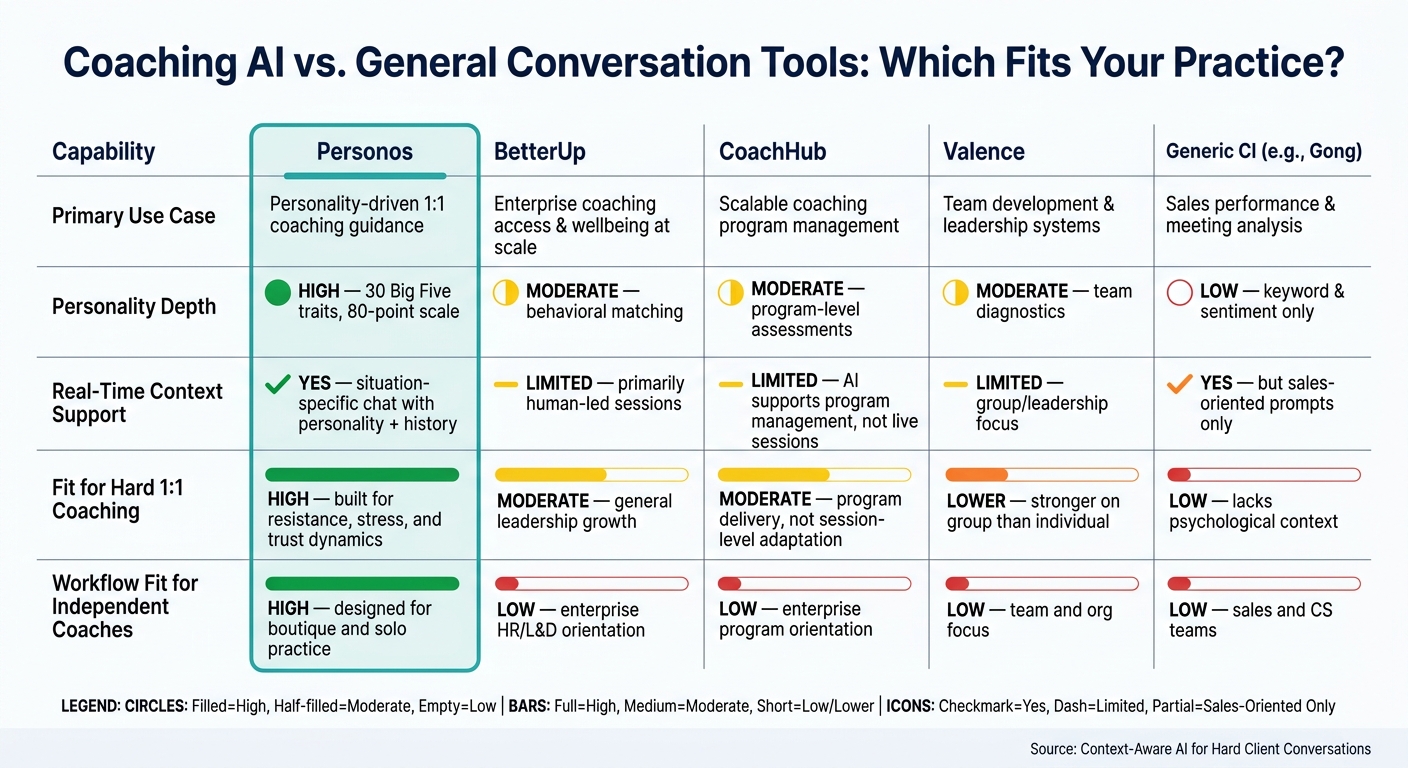
Coaching-specific personality AI vs. enterprise coaching platforms vs. generic conversation intelligence
The table below shows where each tool fits best, not just what it says it can do.
| Personos | BetterUp | CoachHub | Valence | Generic CI (e.g., Gong) | |
|---|---|---|---|---|---|
| Primary use case | Personality-driven 1:1 coaching guidance | Enterprise coaching access & wellbeing at scale | Scalable coaching program management | Team development & leadership systems | Sales performance & meeting analysis |
| Personality depth | High - 30 Big Five traits, 80-point scale | Moderate - behavioral matching | Moderate - program-level assessments | Moderate - team diagnostics | Low - keyword & sentiment only |
| Real-time context support | Yes - situation-specific chat with personality + history | Limited - primarily human-led sessions | Limited - AI supports program management, not live sessions | Limited - group/leadership focus | Yes - but sales-oriented prompts |
| Fit for hard 1:1 coaching | High - built for resistance, stress, and trust dynamics | Moderate - general leadership growth | Moderate - program delivery, not session-level adaptation | Lower - stronger on group than individual | Low - lacks psychological context |
| Workflow fit for independent coaches | High - designed for boutique and solo practice | Low - enterprise HR/L&D orientation | Low - enterprise program orientation | Low - team and org focus | Low - sales and CS teams |
BetterUp and CoachHub are strong when an organization wants to roll out coaching across a large workforce and track program-level outcomes. Valence fits team dynamics and leadership systems more closely. Generic conversation intelligence tools can analyze meetings, but they are built with sales in mind. None of these tools were built around live one-to-one coaching guidance.[10][11][12][14][8][9]
That is the gap Personos fills.
The next issue is practical use: how to apply this guidance in session without crossing privacy boundaries.
How to use context-aware AI responsibly in coaching practice
A simple workflow for live sessions and between-session follow-through
Once you’ve picked the tool, the main issue is simple: how do you use it without weakening trust?
Responsible AI use in coaching works best as a clear step-by-step process. Before the engagement begins, tell the client that AI is part of your method, get written consent, and spell out what the tool can and can’t do. Then create a baseline profile. That profile helps you read stress, pacing, and likely resistance with more context. It should guide both session prep and live prompting.
Before each session, review current commitments and any flagged patterns. During tougher moments, use Personos Chat in the session or right after it to compare the live transcript with the client profile. If you see withdrawal, slow down. If you see pushback, check for safety. If you spot masked concern, ask for clarity. Between sessions, turn those signals into direct follow-through. Short behavior nudges and tracked commitments help both the coach and sponsor see progress more clearly.[3]
Ethical guardrails and privacy expectations
The International Coaching Federation's AI Coaching Framework and Standards state that coaches stay accountable for every interpretation and intervention, even when AI points to the pattern.[3] Put plainly, AI suggestions should be treated as ideas to test with questions, not decisions to act on as-is.
Use these guardrails:
- List every AI tool in the coaching agreement and state what data it touches, where it’s stored, who can access it, and how long it stays on file.
- Get explicit, revocable consent before any session that includes recording or AI analysis, and give clients a real option to continue without it.
- Separate what sponsors see so they get aggregated progress and visible behavior changes, not raw transcripts or detailed personality scores.
Each recommendation should show which traits shaped it and why. That way, the coach can explain the reasoning out loud instead of leaning on a black-box output. This matters most when a client asks why the coach is slowing the pace or why a suggestion was framed in a certain way. Those questions come up more often than many coaches think.
Conclusion: better signals, better adjustments, better outcomes
Hard conversations tend to break down in three predictable ways: withdrawal, pushback, and masked concern. Context-aware AI helps coaches spot these patterns earlier and respond with more precision by adjusting language, pacing, and framing before trust starts to slip.
Personality-aware platforms push this further by moving guidance from generic to specific based on how a client handles stress, feedback, and ambiguity. Used this way, context-aware AI sharpens judgment without replacing the coach-client relationship. The result is better signal reading, faster calibration, and stronger trust in hard conversations.
FAQs
How is context-aware AI different from basic meeting AI?
Basic meeting AI usually handles the basics: transcription, summaries, or a simple record of how the conversation moved.
Context-aware AI, such as Personos, goes further. It uses deeper context to give more personal, action-ready guidance.
It pulls from validated personality models, individual and group history, professional goals, your coaching method, and past notes. That means its suggestions fit the exact dynamics of a high-stakes conversation, instead of giving you generic observations that could apply to almost anyone.
How does personality data change what a coach says next?
Personality data helps coaches move past one-size-fits-all advice and speak to each client in a way that fits the moment. With tools like Personos, coaches get a clearer read on what a client needs to hear, then shape their words around that.
That can mean changing the framing, slowing down or speeding up the pace, and shifting the tone to build trust, lower resistance, and deal with tough moments with more confidence.
How can coaches use AI in sessions without hurting trust?
Coaches can protect and strengthen trust by using AI to support personalized communication that fits a client’s personality and emotional state. Instead of giving generic advice, tools like Personos can suggest context-aware language for de-escalation, reframing, and validation.
Trust also depends on transparency. When AI shows the reasoning behind its suggestions, coaches can use it in a way that feels natural, keep clear boundaries, and stay in control of the client relationship.