How Conscientiousness Shapes Responses to Feedback
Tailor feedback to conscientiousness: set clear standards, agree next actions, track progress, and adjust support—not judge worth.
Nick Blasi

How Conscientiousness Shapes Responses to Feedback
I start with clear expectations, not personality labels. Before giving feedback, I check whether the person has the time, tools, and training to meet the standard. Then I agree on one next action and a review date. This structured approach is a core part of how we help scale executive coaching impact through personality-driven guidance.
Why start there? A 2024 Gallup and Workhuman study of 4,439 U.S. employees found that those who strongly agreed they knew what was expected were 47% less likely to report frequent burnout. That shows a link, not proof of cause.
My approach is simple:
- Keep standards consistent. Offer steps and reminders when follow-through slips, or clear stopping points when someone gets stuck revising.
- Check workload before judging effort. A missed deadline may call for training, fewer tasks, or better tools.
- Track agreed actions, not personal traits. Use shared software for goals and check-ins while protecting private information. AI can help prepare a conversation, but it should not score performance or predict reactions.
The goal: <u>adjust the support, not the person’s worth</u>. Conscientiousness can guide how I give feedback, but observed work and conversation guide what I do next.
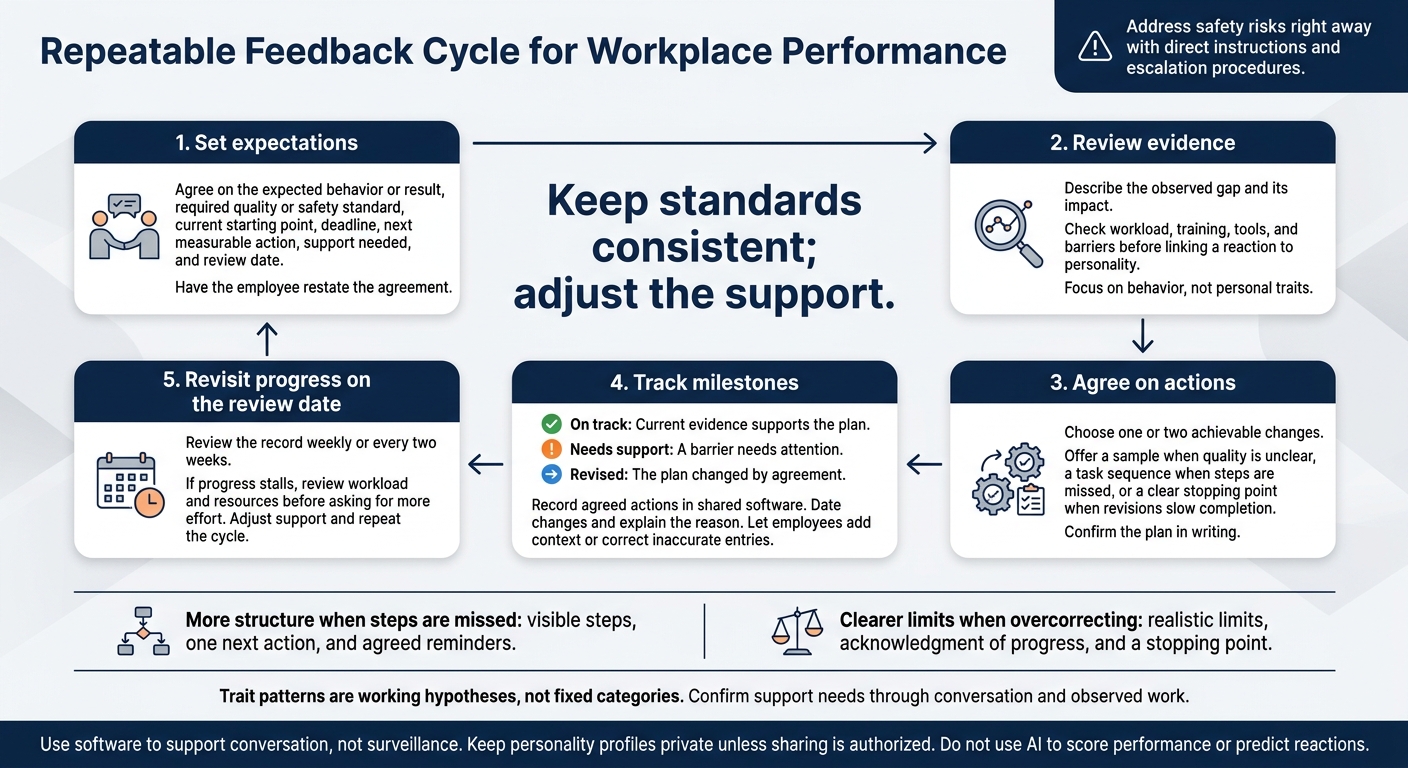
A Fair Feedback Cycle: Clear Standards, Tailored Support
How to Give & Get Constructive Feedback | Dr. Adam Grant & Dr. Andrew Huberman
How Conscientiousness Shapes Reactions to Correction
In the Five-Factor Model, conscientiousness describes organization, dependability, persistence, self-discipline, planning, and achievement orientation. Understanding how personality psychology works in professional settings helps tailor these interactions. It does not measure intelligence, moral worth, technical ability, or commitment.[2] Feedback should therefore fit how someone plans, organizes, and revises their work.
A strong drive to achieve can make correction feel useful. But when someone ties performance to self-worth, a setback can feel like a personal failure.[3]
Strengths, Risks, and Support Across Trait Levels
Use trait patterns to guide how much structure to offer, not to label someone. These are working hypotheses, not fixed categories. Check what support the person needs through AI-powered personality reports, conversation, and observed performance.
| Conscientiousness tendency | Possible strengths | Feedback risks | Support needs |
|---|---|---|---|
| Lower | Flexibility and comfort with changing priorities | May lose track of task order or deadlines | Visible steps, one next action, and agreed reminders |
| Moderate | Balance between structure and flexibility | Follow-through may vary when priorities compete | Clear priorities, completion criteria, and brief check-ins |
| Higher | Planning, persistence, and careful follow-through | May overcorrect, dwell on errors, or pursue perfection | Realistic limits, acknowledgment of progress, and a stopping point |
Unclear standards and heavy caseloads can make trait effects harder to read.
How Unclear Standards and Workload Affect Feedback
Even high conscientiousness cannot make up for vague standards or too much work. Before linking a reaction to personality, check workload, training, tools, and how the person feels they’ve been treated.
Vague criticism, shifting expectations, and inconsistent evidence can make correction feel unfair. Resistance, excessive checking, or withdrawal can happen at any trait level.
Consider whether trauma-related stress may play a role, without diagnosing it or pushing for disclosure. Compare behavior across tasks and over time, ask about barriers, and keep the person’s worth separate from the behavior.
Set Clear Standards and Give Specific Feedback
Once standards and workload are clear, use one repeatable correction process. Highly conscientious employees usually respond best to precise standards. Others need more structure to act on feedback. Keep the standard consistent; adjust the support.
Separate immediate safety corrections from routine coaching and formal reviews. Address safety risks right away with direct instructions and escalation procedures. Use coaching to build skills and check progress. In formal reviews, record observed patterns, prior support, the employee’s response, and policy-based consequences.
Use the same structure for every correction so feedback stays fair and repeatable. Keep the focus on behavior, not personality.
Define Expectations, Starting Points, and Review Dates
Use a short written checklist covering the expected behavior or result, required quality or safety standard, current starting point, deadline, next measurable action, support needed, and review date. Explain why the work matters. For example, timely case notes preserve continuity of care. Then have the employee restate the agreement.
For familiar work, set a specific outcome goal, such as complete progress notes within two business days for four weeks. For unfamiliar tasks, use stages: review the template, complete one supervised example, then submit three cases for early review. Give each stage a success criterion and check-in date.
Use that same format for every follow-up.
Describe the Gap, Impact, and Next Steps
Describe the observed gap between the work and the standard. Explain how it affects handoffs or service delivery, then discuss one or two achievable changes. Identify likely barriers and confirm the plan in writing. Match support to the evidence:
Clarify what counts as sufficient when unnecessary revisions slow completion; provide a sample when quality is unclear; offer a task sequence and earlier check-in when steps are missed.
These choices account for differences in conscientiousness without changing the required result.
Set Realistic Goals Under High Caseloads
Hypothetical case-management example: A staff member has several late progress notes during a high-caseload period. Before setting milestones, the supervisor reviews required documentation and safety deadlines, the number and complexity of cases, time spent on direct service, administrative duties, coverage, and software barriers. The agreement might be: All safety-critical entries remain same-day; complete the five oldest routine notes by Friday, reserve two documentation blocks next week, and review progress on Wednesday.
The goal is compliance with the standard, not a moral judgment about effort.
Do not use overtime to mask a capacity problem. If required work still exceeds available time, escalate the need for staffing, reprioritization, or supervisory support.
Keep staff duties separate from client outcomes. Hold employees accountable for offering options, documenting informed choices, and following safety procedures, not for forcing client acceptance or results outside their control.
Track Feedback and Progress in Shared Software
Once you’ve agreed on the standard and review date, put the agreement in shared software. This creates a visible feedback record, giving people who need structure a clear next step. It also gives highly conscientious employees a reference without constant check-ins. Use the software to support conversation, not replace it.
Record Goals, Milestones, and Changes
Keep one short record for each goal. Include the outcome, starting point, success measure, milestones, owner, deadline, evidence, obstacles, and any changes to scope or support.
Give each status a clear meaning:
- On track: Current evidence supports the plan.
- Needs support: A barrier needs attention.
- Revised: The plan changed by agreement.
Date every status change and explain the reason.
Review the record weekly or every two weeks. Note completed milestones, flag obstacles, and adjust support. Let employees add missing context or correct inaccurate entries. Recording barriers helps separate a skill gap from a workload problem. OPM recommends regular check-ins and documenting incremental progress.[5]
Prepare for Feedback with Personos
Use the record to plan your next feedback conversation. Personos can help you prepare, organize individual or team patterns to resolve team conflicts, and track agreed actions.[6] Use these tools to plan the discussion, not to predict someone’s response from a conscientiousness score.
Before enabling coaching access, explain what information will be used, who can see profiles and actions, how long records will remain, and whether participation is optional. Obtain appropriate consent, and keep private preparation separate from shared commitments. Declining an optional feature should not count as poor performance.
AI guidance supports professional judgment. It does not guarantee improvement or replace formal performance procedures.
Protect Privacy and Avoid Surveillance
Use shared software for accountability, not surveillance. Keep personality profiles private unless sharing is authorized. Personality data should guide preparation, not performance scoring.
Share only the minimum information needed, and keep development records separate from client records. Before entering sensitive data, verify privacy, security, retention, and regulatory rules. Product claims alone do not establish compliance. Track meaningful progress, not logins, keystrokes, or update counts.
Conclusion: Repeat the Feedback Cycle
Once expectations, support, and tracking are in place, repeat the feedback cycle until the work stabilizes. Follow a manager feedback checklist to set expectations, review evidence, agree on actions, track milestones, and revisit progress on the review date. Goals work better when paired with feedback and progress checks.[7][1][8]
Before ending the conversation, ask the employee to restate the plan and choose one or two milestones. Set aside five minutes of an existing weekly meeting to check in. If progress stalls, review workload and resources before asking for more effort.
Let conscientiousness guide communication, not judgment. Employees with lower conscientiousness often need more structure. Those with higher conscientiousness often need clearer limits and reassurance that improvement doesn't mean perfection. Ask whether more detail, smaller steps, or reminders would help. Keep standards consistent, adjust goals when conditions change, and address behavior respectfully, with steady improvement rather than perfection as the goal.[4]
FAQs
How can I distinguish workload problems from follow-through issues?
Use objective progress tracking to check whether unfinished tasks line up with high-stress periods or point to recurring gaps in follow-through. Personos’s ActionBoard uses Kanban-style task management to track action items created from feedback.
Personos also adds personality context to help you assess whether incomplete work may stem from capacity limits or trait-based tendencies.
How do I prevent progress tracking from becoming micromanagement?
Put transparency and shared accountability ahead of surveillance. Make expectations and milestones clear to both you and your clients so they can track their own progress.
Tools like the Personos ActionBoard let you track progress together, keep things moving between sessions, and offer support without overstepping.
What if an employee keeps missing goals despite support?
When an employee keeps missing goals despite support, the issue may relate to how they process information or handle pressure. Personos offers personality-based guidance to help ease tension and agree on next steps.
Its ActionBoard gives teams a shared space to clarify expectations, set realistic goals, monitor progress, and track milestones. This connects feedback with continued support and accountability.