Top Conflict Triggers by Personality Type
Personality differences drive workplace conflict; apply Big Five, MBTI, DiSC and Enneagram insights to prevent escalation.
Nick Blasi

Top Conflict Triggers by Personality Type
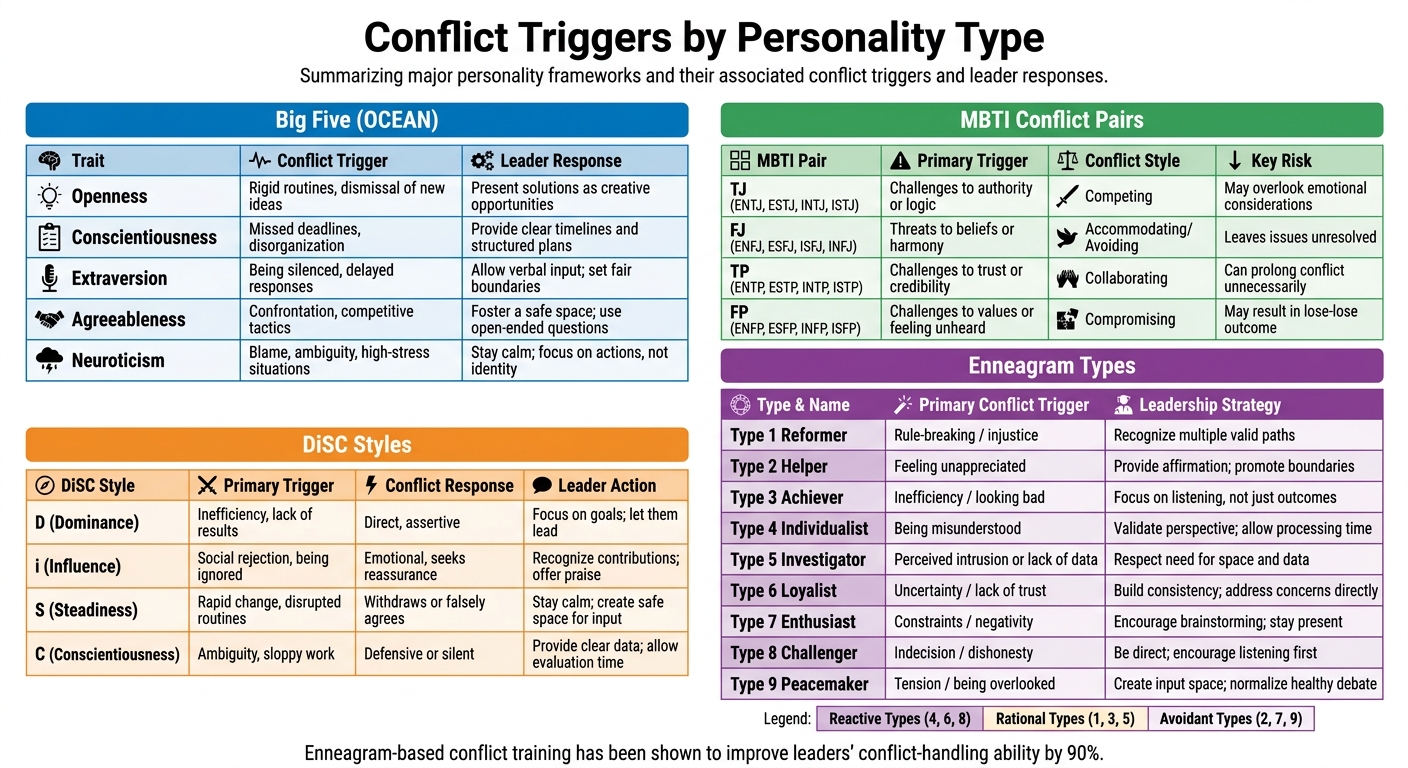
Conflict at work often stems from personality differences rather than poor decisions. By understanding common conflict triggers tied to personality traits, leaders can address issues before they escalate. Tools like the Big Five, MBTI, DiSC, and Enneagram provide insights into why people clash and how to manage these situations effectively. Here's a quick breakdown of triggers and responses:
- Big Five Traits: High Openness dislikes rigid routines, while high Conscientiousness is irritated by disorganization. Extraverts need space to express themselves, Agreeable types avoid confrontation, and Neurotic individuals react strongly to stress or criticism.
- MBTI Pairs: Thinking/Judging types value authority and logic, while Feeling/Perceiving types prioritize harmony and values. Triggers vary by type, from challenges to authority to feeling unheard.
- DiSC Styles: Dominance types dislike inefficiency, Influence types need recognition, Steadiness types avoid rapid change, and Conscientiousness types require clarity and precision.
- Enneagram Types: Each type has unique drivers and triggers, like Type 1’s focus on integrity or Type 8’s intolerance for indecision.
AI tools like Personos simplify applying these frameworks by offering real-time advice tailored to individual personalities. At $9 per seat per month, it helps leaders resolve conflicts efficiently by addressing deeper personality-driven issues. Understanding personality triggers transforms conflict into opportunities for better collaboration.
Conflict Triggers by Personality Type: Big Five, MBTI, DiSC & Enneagram
Masterclass: Strategies for Handling Personality Differences at Work
1. Conflict Triggers by Big Five Personality Traits
The Big Five (OCEAN) model categorizes personality into five traits: Openness, Conscientiousness, Extraversion, Agreeableness, and Neuroticism. Recognizing how these traits influence conflict triggers can help leaders address issues effectively. Below is a breakdown of each trait, its triggers, and practical ways leaders can respond.
Openness - People with high levels of Openness thrive on creativity and exploration. They can feel frustrated by phrases like "this is how we've always done it" or rigid routines that stifle innovation. To ease tensions, frame solutions as opportunities for creativity and focus on future possibilities rather than enforcing strict rules [2][4].
Conscientiousness - Highly conscientious individuals value structure, planning, and organization. Missed deadlines or chaotic environments can be major irritants. Leaders can reduce conflict by offering detailed plans, setting clear expectations, and sticking to timelines [2].
Extraversion - Extraverts prefer verbal communication and may become frustrated if they feel silenced or encounter delayed responses. This can sometimes be perceived as aggression by more introverted colleagues. To manage this, allow extraverts the space to express themselves while ensuring everyone has a chance to contribute [2][4].
Agreeableness - Those high in Agreeableness often avoid confrontation, which can lead to unresolved issues building up over time. Leaders can support these individuals by fostering a safe and open environment where concerns can be shared without fear of conflict. Open-ended questions can encourage them to voice their thoughts [5].
Neuroticism - High levels of Neuroticism are linked to heightened emotional responses, especially in stressful or ambiguous situations. Blame and criticism can escalate tensions quickly. Leaders should focus on maintaining a calm tone and addressing behaviors rather than personal attributes to de-escalate conflicts effectively [2].
| Trait | Triggers | Leader Response |
|---|---|---|
| Openness | Routine, dismissal of new ideas | Present solutions as creative opportunities |
| Conscientiousness | Missed deadlines, disorganization | Provide clear timelines and structured plans |
| Extraversion | Being silenced, delayed responses | Allow verbal input; set fair boundaries |
| Agreeableness | Confrontation, competitive tactics | Foster a safe space; use open-ended questions |
| Neuroticism | Blame, ambiguity, high-stress situations | Stay calm; focus on actions, not identity |
2. Conflict Triggers by MBTI Personality Preferences
Research highlights that the Thinking/Feeling (T/F) and Judging/Perceiving (J/P) aspects of MBTI types often play a significant role in workplace conflict [6][7]. These distinctions, sometimes referred to as "conflict pairs", shape how individuals interact and respond during disagreements.
"The last two letters of your MBTI type are known as the conflict pairs. When there are differences in the last two letters of your personality type compared to someone else, you're more likely to have a conflict." - Melissa, MBTI Marketing Manager [6]
Much like the Big Five personality traits, MBTI offers a detailed framework for understanding how individuals approach and handle conflict. The following table provides a breakdown of the primary triggers, conflict styles, and risks associated with each conflict pair:
| MBTI Conflict Pair | Primary Trigger | Conflict Style | Key Risk |
|---|---|---|---|
| TJ | Challenges to authority or logic | Competing | May overlook emotional considerations |
| FJ | Threats to beliefs or harmony | Accommodating / Avoiding | Leaves issues unresolved |
| TP | Challenges to trust or credibility | Collaborating | Can prolong conflict unnecessarily |
| FP | Challenges to values or feeling unheard | Compromising | May result in a lose-lose outcome |
How Each Type Handles Conflict
- TJ Types (ENTJ, ESTJ, INTJ, ISTJ): These individuals are likely to react strongly to challenges against their authority or logic. Their competitive approach can lead to efficient problem-solving but may risk ignoring emotional nuances, potentially straining relationships.
- FJ Types (ENFJ, ESFJ, ISFJ, INFJ): Threats to their core beliefs or disruptions to harmony can trigger conflict for FJ types. They often lean toward accommodating or avoiding styles, which can help maintain peace in the short term but may leave deeper issues unresolved.
- TP Types (ENTP, ESTP, INTP, ISTP): Credibility or trust concerns often ignite conflict for TP types. Their collaborative nature helps in finding solutions, but overanalyzing or playing devil's advocate can unnecessarily extend disagreements.
- FP Types (ENFP, ESFP, INFP, ISFP): These types are particularly sensitive to feeling dismissed or when their values are undermined. They often opt for a compromising approach, but this can result in unresolved resentment if the underlying issue isn’t fully addressed.
Practical Tips for Leaders
Understanding these triggers allows leaders to adapt their conflict management strategies to individual needs. For example:
- Use persuasion rather than directives with TJ types to avoid resistance.
- Encourage FJ types to express their concerns openly to avoid unresolved issues.
- Set clear time limits with TP types to prevent drawn-out debates.
- Ensure FP types feel genuinely heard before moving forward with a decision.
3. Conflict Triggers by DiSC Styles in Teams
DiSC categorizes personality into four styles: Dominance (D), Influence (i), Steadiness (S), and Conscientiousness (C). Each style has distinct conflict triggers tied to pace, people, and process. Conflict expert Michael Gregory highlights the root of many disputes:
"In 90% of the cases, there are miscommunications that either caused or are fueling the conflict. So if I can talk to the two different parties, if I can get the two different parties to listen to each other without judgment, we can nearly always make progress." [7]
The table below breaks down each DiSC style's key conflict trigger, typical response, and a suggested approach for leaders to manage the situation:
| DiSC Style | Primary Conflict Trigger | Conflict Response | Recommended Leader Action |
|---|---|---|---|
| D (Dominance) | Inefficiency, lack of results, loss of control | Direct, assertive; pushes hard for their position | Focus on goals; let them take charge where possible |
| i (Influence) | Social rejection, being ignored, micromanagement | Emotional, scattered; seeks reassurance | Recognize contributions; offer public praise |
| S (Steadiness) | Rapid change, confrontational tone, disrupted routines | Withdraws or falsely agrees to avoid tension | Stay calm; encourage their input in a safe space |
| C (Conscientiousness) | Ambiguity, sloppy work, rushed decisions | Defensive, overly critical, or silent compliance | Provide clear data; allow time for detailed evaluation |
These traits reveal potential friction points, especially between certain pairings. For example, D vs. S conflicts often arise over pace - D-types push for quick decisions, while S-types prefer thoughtful deliberation. Similarly, i vs. C clashes stem from differing views on structure - i-types thrive on spontaneous brainstorming, which C-types may see as chaotic.
The Center for Leadership Studies suggests reframing conflict as an opportunity:
"See collisions as data, not drama. They signal to leaders that an adjustment is needed to drive better outcomes." [8]
Leaders can prepare for these dynamics by proactively assessing team members' DiSC styles. For example, if a D and an S are co-leading a project, setting clear decision-making timelines upfront can ease tension. Regular check-ins ("friction checks") during the project can also help S-types voice concerns they might otherwise keep to themselves. The aim isn't to avoid conflict entirely but to channel it productively - allowing D-types to drive urgency while S-types ensure careful consideration. [8]
4. Conflict Triggers by Enneagram Types in Leadership
The Enneagram outlines nine personality types, each driven by a specific core motivation. In leadership, conflicts often arise when this core drive feels threatened. Leadership coach Samantha Mackay explains it well:
"Conflict is a perception (even if only you are experiencing it) triggered by feeling you have something to lose in some way." [9]
A real-world example highlights this: in June 2025, an acute hospital's executive team used the iEQ9 assessment to address disagreements over patient flow. While five Type 8 leaders thrived on intense debates, four others (Types 9, 2, 5, and 3) found the discussions overwhelming. By understanding these dynamics, they shifted from gridlock to productive dialogue. [10]
Here's a breakdown of each Enneagram type's leadership strengths, conflict triggers, and strategies to manage challenges:
| Enneagram Type | Core Leadership Gift | Primary Conflict Trigger | Leadership Strategy |
|---|---|---|---|
| 1 – Reformer | Integrity & quality | Rule-breaking / injustice | Recognize multiple valid ways to achieve goals |
| 2 – Helper | Team cohesion | Feeling unappreciated | Provide verbal affirmation; promote healthy boundaries |
| 3 – Achiever | Goal execution | Inefficiency / looking bad | Focus on listening fully, not just outcomes |
| 4 – Individualist | Creative insight | Being misunderstood | Validate their perspective; give time to process |
| 5 – Investigator | Analytical depth | Perceived intrusion or lack of data | Respect their need for space and data |
| 6 – Loyalist | Risk assessment | Uncertainty / lack of trust | Build consistency; address their concerns directly |
| 7 – Enthusiast | Idea generation | Constraints / negativity | Encourage brainstorming; help them stay present in challenges |
| 8 – Challenger | Decisiveness | Indecision / dishonesty | Be direct; encourage them to slow down and listen first |
| 9 – Peacemaker | Mediation | Tension / being overlooked | Create space for their input; normalize healthy debate |
To simplify, these types can be grouped by their conflict styles:
- Reactive Types (4, 6, 8): Tend to engage emotionally in conflict.
- Rational Types (1, 3, 5): Lean on objectivity and logic.
- Avoidant Types (2, 7, 9): Prefer to minimize tension.
These insights align with broader personality frameworks, helping leaders adapt their conflict responses before tensions escalate.
Research backs the effectiveness of this approach: Enneagram-based training has been shown to improve leaders' ability to handle conflict by 90%, transforming disagreements into opportunities for growth. [10] As Margaret Heffernan, author and entrepreneur, notes:
"In high-performing teams, conflict is frequent - because candour is safe." [10]
The goal isn't to avoid conflict but to channel it into something constructive.
Using AI-Powered Personality Insights to Prevent Conflict
Understanding personality frameworks is one thing. Applying them effectively in high-pressure situations - like tense meetings or delivering tough feedback - is a whole different challenge. This is where tools that work in real time during conflicts can make a huge difference.
Jim Guinn, President of the Resolution Resource Group, explains this well:
"We try to jump in and we try to fix it to get it off our plate, but we are resolving superficial issues that aren't really the true trigger [of the conflict]." [11]
Leaders often focus on surface-level problems, missing the deeper personality traits and friction points that drive conflict. That’s where personality-aware AI tools step in to bridge the gap.
Take Personos (https://personos.ai) as an example. It goes beyond the basics by using the Five Factor Model at a subfacet level, analyzing 30 distinct traits instead of just five broad categories. Why does this matter? Because not all high-Conscientiousness individuals are the same. One person might value orderliness, while another prioritizes achievement-striving. These subtle differences can lead to misunderstandings or tension [13].
What makes Personos stand out is its real-time, role-specific guidance. You can describe a situation, and it offers tailored suggestions based on your role and your organization’s communication style. Unlike other tools that provide static personality insights, Personos offers Dynamic Relationship and Team Reports. These reports link specific personality triggers to actionable strategies, helping leaders address conflicts faster and more effectively - right when it matters most [1].
Conclusion
Conflict often unfolds in ways that align with personality-driven behaviors. Whether someone retreats during disagreements, reacts strongly, or takes time to reflect before responding, these tendencies are often shaped by their personality. Understanding these patterns is what sets proactive leaders apart from reactive ones.
As Marc H. Anderson, Assistant Professor at Iowa State University, explains:
"Developing our understanding of how group personality composition affects both of these types of conflict is necessary to better enable groups to manage conflict, and thereby lessen potentially harmful outcomes resulting from conflict." [12]
The frameworks discussed in this article provide valuable tools for identifying conflict before it escalates. Each one offers a unique perspective, helping leaders understand the underlying causes of friction and address them effectively.
On top of this, AI-driven tools are now stepping in to provide real-time solutions. For example, Personos connects personality traits to tailored communication strategies and conflict triggers through its Dynamic Relationship and Team Reports. At just $9 per seat per month, it’s an accessible option for teams looking to integrate personality-aware strategies into their workflow. This kind of forward-thinking approach turns conflict into an opportunity to strengthen collaboration.
"The goal isn't to override your personality - it's to develop enough range to choose the style that serves the specific conflict." [3]
FAQs
Which personality model should I use first for workplace conflict?
The Five Factor Model (FFM) is a great foundation for understanding workplace conflict. This scientifically backed framework highlights how personality traits influence behavior and approaches to resolving conflict. Personos, which is based on the FFM, delivers real-time, personalized advice to help navigate team dynamics effectively. While tools like the Thomas-Kilmann Conflict Mode Instrument (TKI) emphasize conflict resolution styles, the FFM digs deeper, offering insights into personality that support proactive conflict management.
How do I handle conflict when two types clash (like DiSC D vs S)?
When handling conflicts between personality types like high-Dominance (D) and high-Steadiness (S), it's important to approach the situation thoughtfully. D-types often prioritize speed and direct communication, while S-types lean toward maintaining harmony and working at a more measured pace. To find common ground, aim for a balance: use communication that is both direct and considerate, encourage S-types to express their needs early on, and help D-types understand the value of slowing down to ensure better collaboration. Tools such as Personos can offer personalized insights to help navigate these dynamics effectively.
How can Personos help in real time during a tense conversation?
Personos acts as a virtual coach, providing real-time, customized guidance designed to match the unique personalities in a conversation. By simply typing "@" into the conversational AI, you can access instant advice on:
- Reframing feedback effectively
- Using specific language to de-escalate tense situations
- Balancing empathy with directness
It even helps you anticipate emotional responses, like recognizing when someone might be reaching their limit. This allows you to adjust your approach and keep the discussion on track and constructive.