Comparing Conflict Tactics for Opposite Traits
Leader's guide to diagnose urgency, empathy, and communication clashes and match conflict tactics with clear structure.
Christian Thomas

Comparing Conflict Tactics for Opposite Traits
Most work conflict follows a pattern. When one person moves fast, another slows down, one leads with feelings, another leads with facts, often rooted in personality traits, or one speaks plainly while another hints, friction is likely.
I’d sum up the article like this:
- Spot the type of clash first
- High urgency vs. low urgency
- High empathy vs. low empathy
- Direct vs. indirect communication styles
- Pick the response based on the moment
- Competing when time is short and a call must be made
- Collaborating when the issue is complex and the relationship matters
- Compromising when both sides need a middle ground
- Avoiding when emotions are too high for a useful talk
- Accommodating when the relationship matters more than the point at hand
- Separate task conflict from relationship conflict
- Task conflict can help decisions
- Relationship conflict usually hurts trust and team output
- Use structure to lower tension
- Set deadlines
- Define what info is enough to act
- Set shared communication rules
- Follow up with clear next steps
The stakes are not small. U.S. companies lose about $359 billion a year to conflict-related paid time, and managers spend about 25% to 40% of their time dealing with conflict. For helping professionals, that can cut into time for clients and staff support fast.
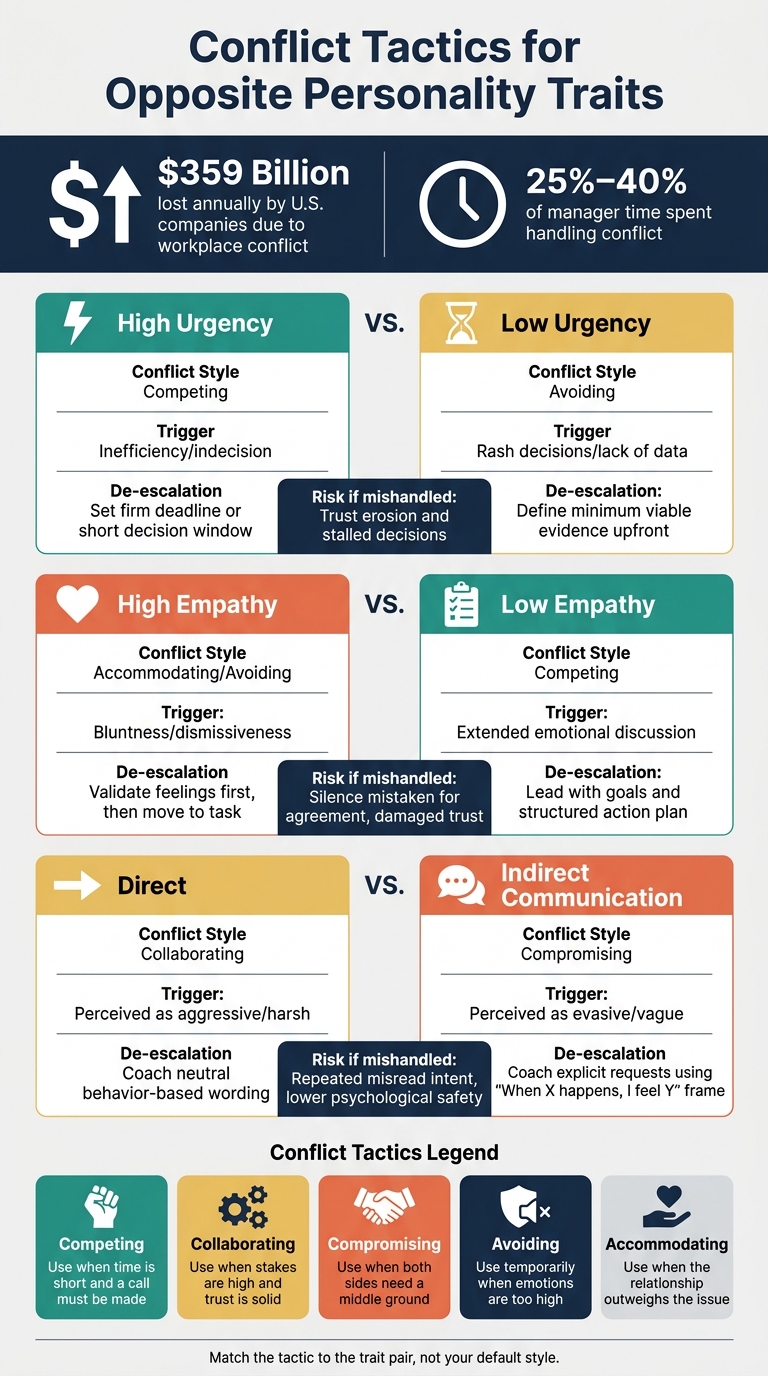
Conflict Tactics for Opposite Personality Traits: A Leader's Quick Reference Guide
Masterclass: Strategies for Handling Personality Differences at Work
Quick Comparison
| Trait clash | What usually goes wrong | What I’d do first | Main risk if handled poorly |
|---|---|---|---|
| High urgency vs. low urgency | One side sees delay as drag, the other sees speed as careless | Set a decision window and define the minimum facts needed | Trust drops and decisions either stall or get pushed through |
| High empathy vs. low empathy | One reacts to tone, the other to task failure | Name impact, then move to goals or behavior | Hurt feelings, silence, or hard pushback |
| Direct vs. indirect communication | One sounds harsh, the other sounds vague | Set shared wording rules and coach each side | Repeated misread intent and lower psychological safety |
My main takeaway: I would not treat personality conflict as random. I’d look at the trait pair, the time pressure, the issue at stake, and the relationship risk, then match the conflict tactic to that setup.
High Urgency vs. Low Urgency: How Speed Differences Cause Conflict
Speed gaps often turn into trust gaps. The faster person can read a delay as disengagement. The slower person can read urgency as recklessness. Once that difference in pace is out in the open, the leader needs to set the decision tempo before frustration starts to harden.
How Each Side Behaves Under Deadline Pressure
High-urgency individuals tend to move fast by default. Under deadline pressure, that pace gets even stronger. They push for immediate decisions and often shift into a Competing style, driving toward resolution as fast as possible [6][7].
Low-urgency individuals tend to do the opposite under pressure. They pull back, ask for more context, and want more clarity before they commit. A rushed timeline can feel like a setup for error. Under stress, they often shift toward Avoiding by stepping back, asking for more data, or going quiet until they feel ready to commit [6][7].
Neither response is wrong. But from the other side, each one can look wrong. The high-urgency colleague may see deliberation as slowness or disengagement. The low-urgency colleague may see urgency as careless or aggressive [6][7]. If no one manages that gap, a process disagreement can turn into damaged trust.
Leader Responses That Balance Speed With Thoroughness
Don’t take sides. Set up the exchange so speed and rigor both have room. The best move depends on what the moment calls for: faster action, more evidence, or a bit of both.
The table below shows each urgency profile, how it tends to react under stress, which is helpful when trying to read personality types in meetings, what usually sets off conflict, and what a leader can do to keep things from escalating:
| Trait Profile | Likely TKI Style Under Stress | Common Conflict Triggers | Effective Leader Response | Risk if Mishandled |
|---|---|---|---|---|
| High Urgency | Competing [2][4] | Inefficiency, indecision, lack of action [6] | Acknowledge the drive for results; set a firm deadline or a short decision window [6] | Steamrolling, damaged trust, and loss of psychological safety [2] |
| Low Urgency | Avoiding [6][4] | Poor process, lack of data, rash decisions [6] | Define "minimum viable evidence" - agree upfront on what data is enough to act; create a safe one-on-one space and agree on a timeline [6] | Delayed decisions, silent resentment, conflict goes underground [2] |
Two simple structure moves can stop things from getting worse. Time-box the discussion, and split the work: rapid triage for the fast mover, follow-through review for the deliberate one [1][4][6]. That gives each person a lane that fits how they work, instead of pushing both people to battle over the same step.
For high-urgency individuals, a phrase like I see this is time-sensitive; let's look at the fastest path forward can redirect their energy without brushing it off. It gives them speed, but not steamrolling [7].
For low-urgency individuals, I respect your perspective; can you share the risks so we can factor them in? makes room for rigor without letting the process stall. It supports caution, but not drift [7].
High Empathy vs. Low Empathy: Relationship Focus vs. Task Focus
When urgency creates conflict over speed, empathy creates conflict over tone. Under stress, the gap often shows up in a simple way: one person reacts to how something was said, while the other reacts to what was said.
A leader's job is to sort out hurt feelings from actual task failure before the conflict locks in. That means reading the situation early. Is this about the quality of the work, or the social impact of how people are treating each other? Leaders need to know that before they step in.
People with high empathy tend to protect harmony. So blunt language can feel personal, which can push them toward Accommodation or Avoidance [2][8]. People with low empathy tend to focus on facts and closure. Under pressure, they often shift into Competing [2][8].
Once you see that interpretation gap, the next step is simple: respond to the person's default pattern instead of forcing the same approach on everyone. The table below shows the usual reactions and the best way for leaders to respond.
| High Empathy (Relationship-Focused) | Low Empathy (Task-First) | |
|---|---|---|
| Likely Conflict Mode | Accommodating or Avoiding [2][8] | Competing [2][8] |
| What Escalates Tension | Bluntness, perceived dismissiveness, ignoring the human element [2][3] | Extended discussion of feelings, indecision, lack of clear logic [3][6] |
| What De-escalates Tension | Validation, psychological safety, private check-ins [5][6] | Clear action plans, factual focus, clear deadlines [5][6] |
| Best Leader Response | Start with feelings; validate before moving to the task [5][3] | Start with goals; provide a structured roadmap and clear behavior standards [3][5] |
The most important move here is separating intent from impact in both directions. A high-empathy person may need help seeing that a low-empathy coworker's bluntness was meant to save time, not insult anyone. At the same time, the low-empathy person may need to hear that their efficient tone still came with a cost to team trust [3][6].
Silence from high-empathy people should not be read as agreement. In many cases, it just means they don't feel safe pushing back in the moment. Private check-ins make it easier for them to say what they actually think [5]. Start by naming the human impact, then shift to the task. With low-empathy cases, flip the order: begin with the goal, then set the behavior standard [3][1].
Direct vs. Indirect Communication: When Message Style Causes Misread Intent
How Direct and Indirect Styles Trigger Different Conflict Reactions
Sometimes conflict has nothing to do with empathy or tone. It comes down to communication style.
Some people speak plainly and get right to the point. Others soften what they mean and lean on context to carry part of the message. When those two styles meet, each side often misreads both the message and the intent [1][2]. This shows up again and again in feedback, supervision, and client conversations.
The pattern is pretty consistent. The direct communicator tends to hear hedging as vague. The indirect communicator tends to hear blunt wording as abrupt [1][2]. That matters, because what looks rude to one person may feel honest to another. What sounds polite to one person may sound slippery to someone else.
Leaders need to treat this as a style mismatch, not a character problem on either side [1][2].
Leader Responses That Make Both Communication Styles Work Together
If tone isn’t the issue, wording usually is.
The most useful first step is to set shared communication norms to resolve conflict and strengthen teams before conflict starts. A simple team agreement can go a long way. For example:
- “When someone is avoiding an issue, any team member can name it directly.”
- “Acknowledge the relational concern before diving into data.”
That kind of shared language gives indirect speakers a safer structure. It also gives direct speakers a clear signal that the issue is real, not fuzzy [2][9]. Without it, the same friction tends to show up across projects and topics [1].
Leaders can also coach each style a bit differently. Direct speakers often do better with neutral, behavior-based wording. Indirect speakers usually need support saying requests and concerns more plainly [1][2].
| Communication Style | Common Misunderstanding | Recommended Conflict Mode | Leader Intervention | Likely Effect on Psychological Safety |
|---|---|---|---|---|
| Direct (task-oriented, blunt) | Perceived as aggressive, disrespectful, or insensitive [2][1] | Collaborating | Coach to use neutral wording and ask for the other person's perspective first [1][2] | Higher if softened; lower if it feels like a power play |
| Indirect (diplomatic, context-heavy, people-oriented) | Perceived as evasive, dishonest, or not getting to the point [1][2] | Compromising | Coach to make requests and concerns explicit; use the "When X happens, I feel Y" frame; normalize "I need time to think about this" so they can pause without appearing to withdraw [9] | Higher when concerns are explicit; lower when candor feels forced |
This is where personality-aware guidance helps leaders match the message style to the moment.
Personality-Aware Tools and a Final Decision Guide for Leaders
How Personos Helps Helping Professionals Manage Opposite-Trait Conflicts
Leaders often create conflict they could have sidestepped. It happens when they react first and diagnose later. A better starting point is not, "What worked last time?" It's: "What kind of conflict is this, and what does this pair need right now?" Once the trait clash is clear, the next step is to use a response that fits the moment instead of falling back on a generic script.
That’s where live, situation-specific guidance can make a big difference. Personos is built for helping professionals who deal with hard human dynamics every day. It uses the Five Factor Model, measures 30 traits on an 80-point scale, and turns those results into guidance tied to the situation in front of you. That means it can help leaders handle urgency gaps, empathy gaps, and direct-versus-indirect communication clashes.
Its main features line up closely with opposite-trait conflict:
- Personos Chat gives real-time phrasing for specific interactions, like a high-urgency client clashing with a low-urgency colleague.
- Dynamic Reports show how friction patterns shift across a relationship instead of locking people into a one-time label.
- Prompts offer short, actionable nudges between sessions.
- ActionBoard turns insights into trackable follow-through, so conflict work doesn’t stop once the conversation ends.
Unlike static assessments, Personos gives real-time guidance for the exact trait clash in front of you.
Privacy matters here. Labels tend to travel faster than context, and that creates its own problems. When personality results are shared too widely, people can get boxed in instead of understood. Personos keeps scores private by default unless the person chooses to share them.
Conclusion: Match the Tactic to the Trait Pairing, Pressure Level, and Relationship Risk
The same core logic applies across pairings: urgency needs tempo control, empathy needs validation, and communication style needs shared wording. A simple decision guide can help leaders cut down on guesswork.
1. Assess the situation.
Look at the issue’s complexity, how much it matters to each person, the time pressure, the trust level, and the value of the relationship. Before stepping in, separate task conflict from relationship conflict, because those call for different responses.
2. Choose the tactic that fits the trait pairing.
Use competing when urgency is high, time is short, and the leader has the right expertise. Use accommodating when the relationship matters more than winning the issue. Use compromising when urgency and importance sit in the middle and a fast middle ground is needed. Use collaborating when the issue carries high stakes, trust is solid, and there’s time to work toward a win-win result. Use avoiding only as a temporary move when emotions are too high for productive dialogue.
3. Focus on behavior, not labels.
Keep the conversation tied to what happened, not identity-level judgments.
4. Follow through.
Use trackable next steps so the same conflict doesn’t keep coming back.
Match the tactic to the trait pair, not to your default style.
No single tactic works for every opposite-trait pairing. But leaders who diagnose first, match the response to the situation, and follow through with consistency are far more likely to turn conflict into collaboration. Personality-aware tools like Personos make that process faster, more precise, and less dependent on guesswork.
FAQs
How do I tell task conflict from relationship conflict?
Task conflict is disagreement about the work itself, like priorities, deadlines, roles, or the way something should get done. Relationship conflict is more personal. It shows up as friction between people, clashing styles, or simple dislike.
At first glance, task conflict can seem purely work-related. But that isn’t always the whole story. A debate about process or ownership can slowly turn into a personality issue, or get mistaken for one from the start.
That’s where tools like Personos can help. They can make it easier to spot whether the tension is coming from the work itself or from a personality-driven reaction that calls for a more empathetic response.
Which conflict tactic should I use first?
Start with a direct, structured conversation about specific work behaviors and the effect those behaviors have. Keep the focus on actions and outcomes, not personal character.
Beforehand, pause and think about how traits like urgency or empathy might shape the other person’s reaction. If it helps, Personos can give you real-time, personality-aware prompts so you can reframe your language, lower tension, and build alignment.
What if both people show multiple trait clashes?
When both people clash across several traits, the tension usually runs deeper than one disagreement. It can lead to repeated friction, shaping both the way work happens and the level of trust between them.
Personos helps by looking at combinations of 30 personality traits on an 80-point scale. It then gives real-time, situation-specific guidance that takes those overlapping dynamics into account.