Why Clients Resist Feedback Under Stress
Treat resistance as information: slow the pace, ask permission, name one clear behavior, and make feedback small, safe, and usable.
Christian Thomas

Why Clients Resist Feedback Under Stress
When people are under stress, feedback can feel like a threat, not help. In plain terms, a client may go quiet, agree too fast, miss the next step, or push back because their brain is locked on risk.
Here’s the short version:
- Stress cuts mental bandwidth
- Trauma can turn neutral feedback into danger
- Shame can make one comment feel like “I’m the problem”
- Fear of losing housing, benefits, custody, or treatment can lead to surface agreement
- Mistrust can make even calm feedback hard to hear
If I want feedback to work, I need to do four things first:
- Check readiness
- Ask permission
- Name one clear behavior
- Listen for what is getting in the way
A few facts from the article stand out. Acute stress can weaken working memory, focus, and mental flexibility, which are the same skills people need to hear feedback and act on it. And in many helping settings, feedback happens during crisis, when those skills are already strained.
The core idea is simple: I should treat resistance as information, not defiance. Then I can slow the pace, keep feedback short, protect dignity, and build a plan the client can actually use.
That is the lens for the rest of the piece.
Emotional and Behavioral Responses to Stress | Psychology
Why Feedback Feels Unsafe: Trauma, Shame, Fear, Overload, and Mistrust
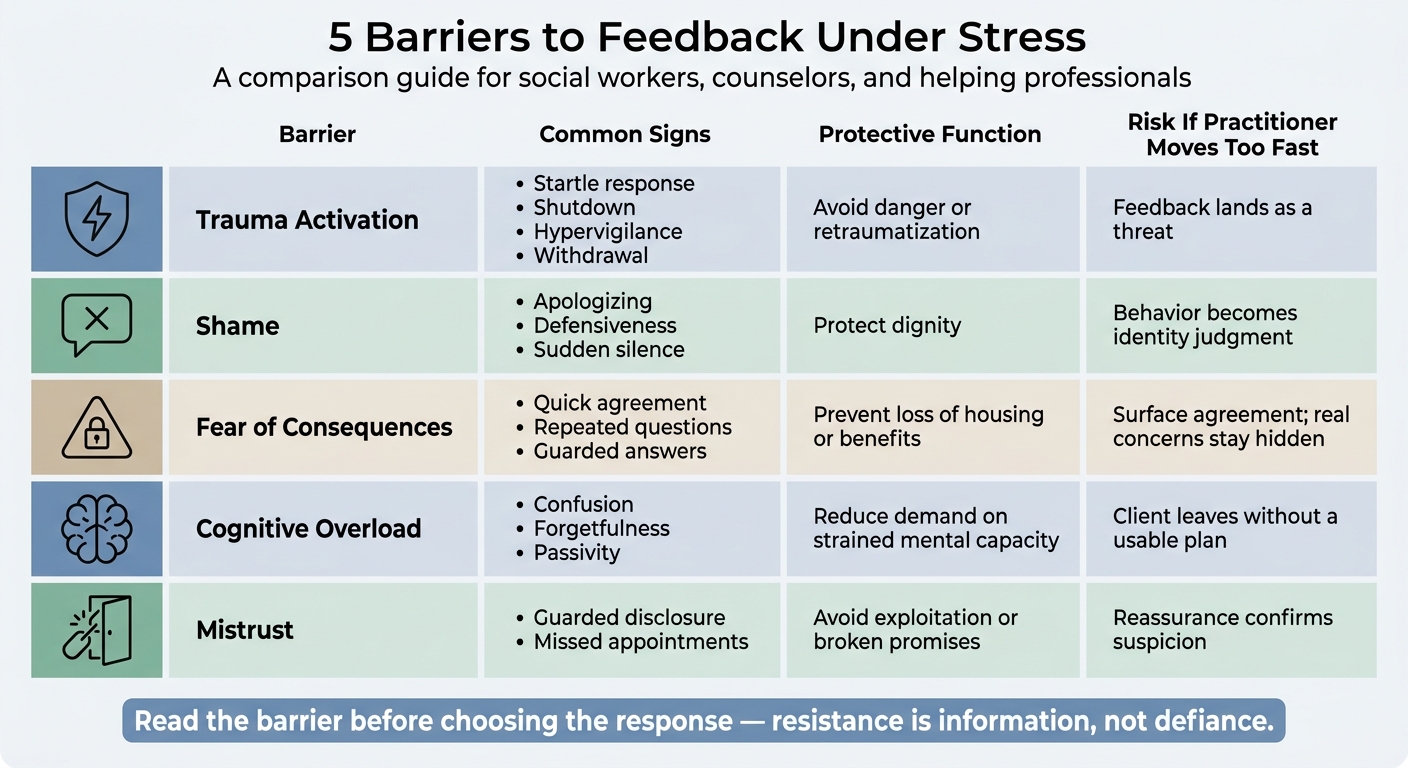
5 Barriers to Feedback Under Stress: Signs, Functions & Risks
This barrier tends to show up in five predictable forms: trauma, shame, fear, overload, and mistrust. Each one changes what a client can take in at that moment. And each one creates a different kind of risk if the practitioner pushes too hard, too soon.
How Trauma and Shame Turn Feedback Into a Threat
Trauma trains the nervous system to look for danger. If a client has a history of punishment, coercion, or harsh criticism, even a simple comment about a missed appointment may not land as routine feedback. To the practitioner, it may sound neutral. To the client, it may sound like a warning. The same sentence can feel like correction on one side of the room and danger on the other. Because trauma histories are common, a strong reaction should not be read as defiance. If trauma seems likely, slow the pace.
Shame works in a different way, but the damage can look similar. Trauma tells a person they may not be safe. Shame tells them they are the problem. A comment like The form is incomplete can turn into a much larger message in the client's mind: I can't do anything right. That shift happens fast. Shame often shows up as defensiveness, silence, apologizing, or a sudden change of subject. In those moments, protecting dignity needs to come before naming the problem.
How Fear, Overload, and Mistrust Block Processing
Fear narrows attention to what might happen next. A client who is worried about losing housing, benefits, custody, or access to treatment is not refusing to cooperate. They're calculating risk. If the practitioner has power over eligibility, referrals, or mandated reporting, the client may agree right away just to get through the exchange. That kind of fast compliance can look smooth on the surface, but it is not the same as understanding. It's self-protection. Before giving feedback on a sensitive issue, spell out your role, the limits of confidentiality, and any actual consequences tied to the issue.
Cognitive overload reduces how much a person can process. This is a common factor in burnout among social workers and other helping professionals. Stress, poor sleep, pain, and crisis all shrink mental bandwidth. When someone is overloaded, too much feedback in one sitting won't help. It just piles on. In those cases, keep the message short and limit how much you cover in one session.
Mistrust is often a reasonable response to past harm. Clients may not be resisting. They may be protecting themselves. For people who have been harmed by racism, ableism, stigma, or language barriers, caution often makes sense. Reassurance by itself usually doesn't fix that. Steady, clear behavior does. If trust is low, be more transparent before you get more direct.
These patterns make it easier for practitioners to match the response to the barrier in front of them.
| Barrier | Common signs | Likely protective function | Risk if practitioner moves too fast |
|---|---|---|---|
| Trauma activation | Startle, shutdown, hypervigilance, withdrawal | Avoid danger or retraumatization | Feedback lands as threat |
| Shame | Apologizing, defensiveness, sudden silence | Protect dignity | Behavior becomes identity judgment |
| Fear of consequences | Quick agreement, repeated questions, guarded answers | Prevent loss of housing or benefits | Surface agreement; real concerns hidden |
| Cognitive overload | Confusion, forgetfulness, passivity | Reduce demand on strained capacity | Client leaves without a usable plan |
| Mistrust | Guarded disclosure, missed appointments | Avoid exploitation or broken promises | Reassurance confirms suspicion |
Read the barrier before choosing the response. Once you can spot what's getting in the way, you can reduce friction before giving feedback.
How to Lower Friction Before Giving Feedback
Once you know what's getting in the way, address common conflict triggers and dial down the pressure before you bring up the issue. Stress shrinks a person's focus. So if you want feedback to land, the conversation usually needs to get smaller and safer first, not tougher.
Control the Pace and Ask Permission First
Start with the setting. Pick a private, fairly quiet place and keep your tone calm and steady. Before you bring up anything hard, check whether the client is settled enough to take it in. If they're exhausted, in pain, or dealing with housing or safety worries, a short pause or even a glass of water may help more than jumping into feedback right away.
Then ask permission. And mean it. Try: "Would now be an okay time to talk about something I noticed?" or "Would you like feedback, or would it be more useful to first talk through what happened?" Let them know what comes next so they aren't left guessing: "I want to talk about something I noticed, hear your perspective, and decide together what - if anything - we want to do."
That approach lines up with the barriers already covered: pacing helps with overload, permission eases fear, and transparency helps with mistrust. If a client says "not now", keep it simple: "That's okay. We can come back to it later, or decide together it's not the right focus today."
Once the client is ready, shift from telling to asking.
Lead With Questions and Keep Information Small
Before you name the concern, ask the client what they noticed. Open-ended questions such as "What was happening for you just before that?" or "What was hardest in that moment?" make room for their side of the story without sounding like a verdict.
Then reflect back the meaning, not just the words. For example: "It felt cornered, and leaving was the fastest way to regain control. Did I get that right?" That kind of response shows you're trying to understand, not just waiting to correct them.
After you've heard them out, keep the feedback itself small. AHRQ recommends limiting any single encounter to one to three key points to avoid information overload. [4][5] Think of it as: check in, share one point, then check again. For example: "When the meeting got tense, you left before we confirmed the safety plan. What stands out to you about that?" One point, then pause.
Protect Dignity While Naming the Issue
Once the client feels heard, name the issue without turning it into a label about who they are. Stick to what you observed, not what you think it says about them. "The medication plan has been hard to follow - what got in the way?" lands very differently from "You're noncompliant." The first opens the door. The second shuts it.
Validation and agreement are not the same thing. You can recognize the client's feelings without approving the behavior: "It makes sense that you felt angry after being dismissed. Threatening someone is still not safe here, so let's find another way to express that."
After that, offer a small set of realistic options. For example:
- "We could role-play what to say to the landlord"
- "Write a short message together"
- "Come back to this next week"
Make it clear that saying no is still a real choice, not a sign they've failed. And if program rules limit the options, say that plainly. Spell out what's fixed and what's flexible. Clear limits, plus real choices, usually feel safer than pretending the client has more say than they do.
A Repeatable Feedback Structure That Protects Rapport
Use the same sequence each time so feedback stays usable when stress is high. In tense moments, structure helps because it makes the conversation easier to follow. The goal isn't a stiff script. It's a pattern you can return to.
Connect, Observe, and Explore First
Start by rebuilding safety and shared purpose. A simple opener like, "Would it be okay if we looked at what happened during yesterday's appointment?" sets a collaborative tone. It says you're working with the client, not judging them.
Next, name what you saw using plain, neutral facts. Say when it happened, what happened, and what that changed in practical terms. "The housing application wasn't submitted by Friday, so we couldn't move to the next step" lands very differently from a comment about attitude or effort.
Then stop and ask. One open question like, "What was happening for you that day?" often does more than a long explanation ever could. Use more reflections than questions. A higher reflection-to-question ratio is linked to better client outcomes.[3] Before you draw any conclusion, reflect back what you heard: "You were worried submitting the form might affect your benefits, and that concern took priority - did I get that right?"
The sequence is simple: connect → observe → ask → reflect.
Collaborate, Confirm, and Pause When Needed
Once the client feels heard, move to the next step together. Instead of handing down a task, invite the client into the choice: "Would you rather complete the first section together now, or schedule 15 minutes tomorrow?" Two or three realistic options are plenty. You're aiming for a plan the client understands and can follow.
After that, confirm the plan without turning it into a test. Briefly sum up what you agreed on: the action, who will do it, when it will happen, and what the backup plan is. Then ask the client to say it back in their own words. You might say, "What are you taking from this conversation?" or "What might make this plan hard to follow?" If their version doesn't match yours, clarify it. Don't treat it like a correction.
If the client gets agitated, goes quiet, or seems to stop processing, pause. Shift into stabilization. Lower your voice, say less, and give the moment some room. Rescheduling is not avoidance when the client can't use the feedback. It protects the relationship and the plan.
This is bigger than using softer words. What matters is the sequence. It keeps the client engaged long enough to do something with the feedback.
High-Friction Feedback vs. Low-Friction Feedback
The gap between feedback that helps and feedback that shuts someone down often comes from small choices in wording and timing. This table shows the patterns that matter most, tied to the article's main logic: low threat, low overload, shared control, and dignity.
| High-Friction Approach | Lower-Friction Alternative |
|---|---|
| Assuming intent: "You don't care" | Ask what happened and what made the step difficult |
| Continuing after shutdown or agitation appears | Pause, stabilize, and return when the client can engage |
| Ending with "Do you understand?" | Ask: "What's your understanding of the plan?" |
| Assigning the next step without input | Offer two or three realistic options and let the client choose |
These lower-friction alternatives put trauma-informed care into practice by stressing safety, transparency, power-sharing, empowerment, voice, and choice.[1][2]
Tools like Personos can help practitioners gauge whether a client may need a slower pace, fewer choices, or more reassurance before hard feedback.
Conclusion: Give Feedback in Ways Clients Can Actually Use
Once the structure is there, the last test is simple: can the client do anything with the feedback?
When a client pushes back, goes quiet, or shuts down, take that response as information, not defiance. In many cases, it points to safety concerns, shame, fear, overload, or mistrust.
The aim is usable feedback. That means feedback that is specific, tied to the client’s goals, and paced to what they can handle in that moment. A client who says, "I still disagree, but I understand what you mean", has still made real progress, even if nothing seems settled on the surface.
When caseloads are high, tools can help practitioners get ready for likely stress responses before the conversation starts. Personos can help practitioners anticipate how a client may respond to stress or criticism, but it should support, not replace, clinical judgment, supervision, and trauma-informed care.
Key Points for Frontline Practice
Use this final check before ending the conversation: assess readiness, ask permission, name one observable behavior, and listen for the barrier underneath the resistance.
If the client is too distressed to use the feedback, pause, stabilize, and set a specific time to come back to it. That keeps accountability in place while recognizing that feedback only works when the client has enough safety and trust to use it.[1][6][7]
FAQs
How can I tell if a client is overwhelmed or resistant?
Look for signs like shutting down, a drop in motivation, or a session getting harder to navigate. Those moments often mean the client is having a hard time processing emotions or feedback right then and there.
Personos can help by offering real-time, personality-tuned guidance and language prompts for validation and reframing. That support can help protect trust and keep the relationship steady.
What should I say before giving difficult feedback?
Before giving hard feedback, start with de-escalation, validation, and reframing. That gives the other person a better shot at hearing the message instead of shutting down or getting defensive.
A one-size-fits-all script usually falls flat. People process stress in different ways, so it helps to adjust your language based on the person’s style and emotional state. That small shift can build trust and make the conversation feel less like a clash and more like a problem-solving moment.
Personos supports this with AI-powered, personality-informed prompts built for high-pressure moments. The goal is simple: lower tension and help keep the relationship productive.
When should I pause feedback and return later?
If a session starts to feel heavy, the client shuts down, or motivation slips, pause the feedback. Pushing through in that moment can backfire.
Use Personos instead for real-time guidance that fits the client’s personality. It can help with de-escalation, validation, and reframing.
That gives you a better read on how the client processes emotion, helps you protect rapport, and makes it easier to tell when the feedback is worth revisiting.