Client-Centered Communication in Social Work
Prioritize clients' goals: check privacy, assess safety, address access needs, and agree on clear next steps.
Nick Blasi

Client-Centered Communication in Social Work
I put the client’s goals first: listen, explain choices and limits, and agree on a clear next step. Across intake, crisis response, and follow-up, I focus on 3 questions: What matters to you? What could block the plan? What happens next?
That means I:
- Check privacy, language needs, and access before discussing sensitive details.
- Offer choices while explaining service rules, consent, and confidentiality limits.
- Assess safety directly when a crisis arises, rather than relying on reassurance.
- Treat missed visits, silence, and anger as reasons to ask about barriers, not assign blame.
- Record facts and agree on who will do what, by when.
- Use AI tools, including Personos, only within agency rules, check their output, and keep decisions with qualified staff.
Client choice does not remove safety or legal duties. My aim is to <u>keep the client involved</u>, even when options are limited.
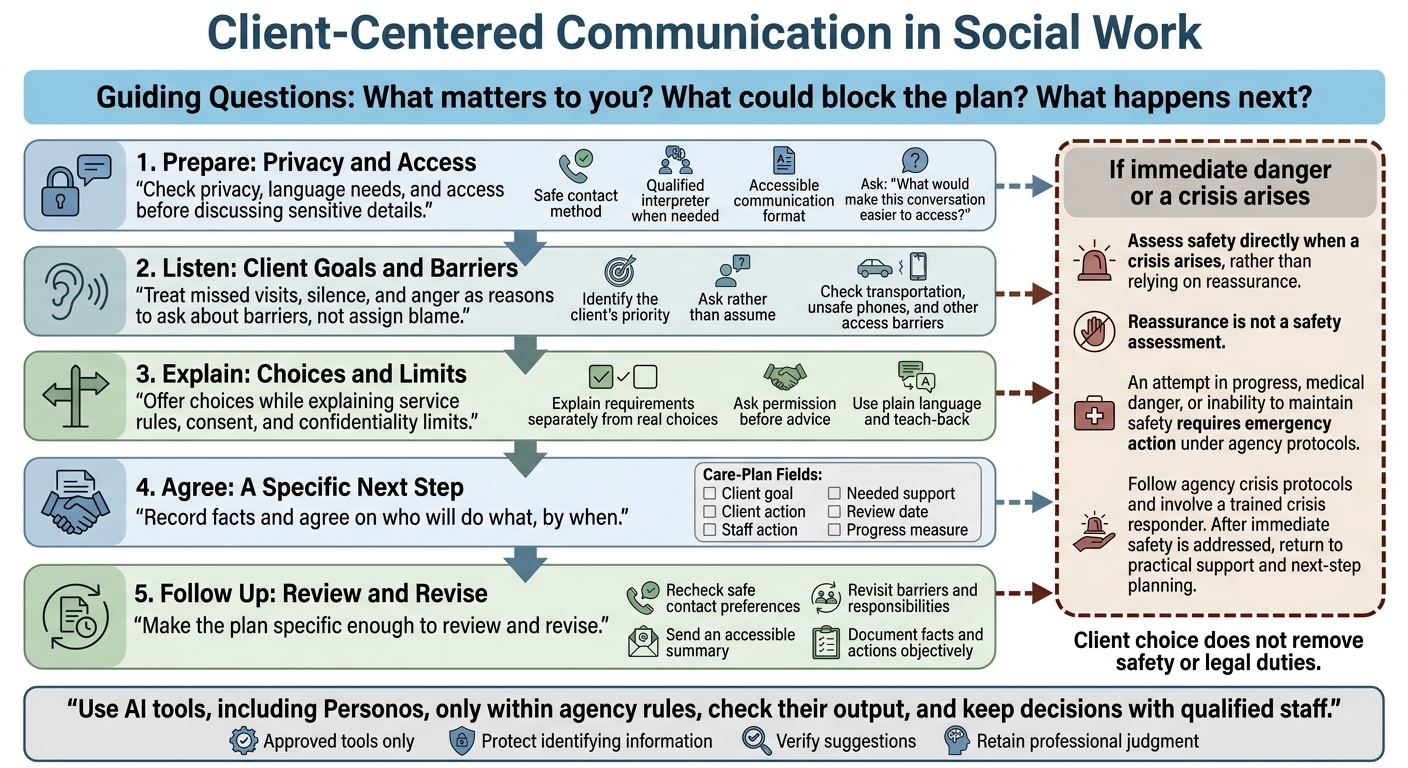
Client-Centered Communication in Social Work
A Person-Centered IPP: What Does Person-Centered Mean?
Communication From Intake Through Care Planning
Client-centered communication shifts with each stage of care. Intake focuses on access, crisis response on safety and common conflict triggers, and follow-up on next steps the client can carry out.
Intake: Check Privacy and Set Priorities
Scenario: Housing intake involving domestic violence. A client seeking emergency housing says their partner monitors their phone. If monitoring is possible, move to a safer channel or location. Ask, “What would feel safe to discuss today?” Before asking sensitive questions, explain what housing eligibility information is required, who may receive it, and which confidentiality limits apply. Let the client choose how much detail to share, and collect only what the service requires. Arrange a qualified interpreter if needed, not a child or partner. Check immediate safety and transportation needs before starting the routine assessment. Ask permission to return to the form, then agree on a safe contact method and callback time. Keep immediate housing needs at the center of the conversation.[2][6]
If access needs give way to immediate danger, move directly to a safety assessment.
Crisis Response: Acknowledge Distress and Assess Safety
Scenario: Eviction crisis involving suicidal thoughts. During an eviction-prevention appointment, a client says, “If I lose my apartment, I might as well end it.” Respond calmly: “That sounds overwhelming, and I’m glad you told me.” Ask directly, “Are you thinking about suicide right now?” Where safety allows, offer choices about who to call, who stays present, and what happens next. Clarify intent, plan, access to means, and any steps already taken. Follow agency crisis protocols and involve a trained crisis responder. When appropriate, offer to call the 988 Suicide & Crisis Lifeline together or contact an available mobile crisis team. Explain any required safety step.[5][7][8]
Reassurance is not a safety assessment. An attempt in progress, medical danger, or inability to maintain safety requires emergency action under agency protocols.[5][7][8] After addressing immediate safety, return to practical support and next-step planning, including housing support and follow-up.
Follow-Up and Care Planning: Agree on Next Steps
Scenario: Two missed care-management visits. A client’s phone service was interrupted, and their bus route changed. Ask, “What would make the next appointment easier to attend?” Recheck safe contact preferences before further outreach. Use an agreed alternative that follows consent and agency policy, and avoid detailed voicemail on a monitored device. Record missed appointments and barriers as facts. Treat access barriers as part of the plan, not as a client failure.[6]
Make the plan specific enough to review and revise.
Plan element Agreed detail Client goal Remain safely housed Client action Submit rental-assistance application by Oct. 12, 2026 Staff action Provide Spanish application and confirm documents by Oct. 8 Needed support Bus pass; private callback window Review date Oct. 15, 2026 Progress measure Application submitted; safe housing plan in place
Address Trauma, Access Needs, and Distrust
When distress, distrust, or access barriers interrupt communication, adjust the conversation rather than push for faster answers.
Trauma-Informed Conversations: Offer Safety and Choice
Ask what helps. Don’t assume needs based on a diagnosis, identity, appearance, or history. SAMHSA’s trauma-informed principles emphasize safety, trustworthiness, transparency, collaboration, empowerment, voice, and choice. Explain transitions before they happen, whether that means a new worker, referral, or change in placement. Ask what could trigger distress, and acknowledge power differences. Compliance alone does not prove trust or recovery.[9][4]
Request detailed trauma accounts only when needed for the service decision, and collect only the information that decision requires. Offer breaks, grounding options, a different setting, or a later appointment. If distress increases, stop pursuing the topic and check immediate safety. Do not touch the client without permission.[9][4]
In mandated services, separate requirements from actual choices. Verify what the court or agency requires. Explain what must be disclosed, who receives that information, and what could happen if requirements go unmet. Offer only choices you can honor, such as a meeting format or a support person when allowed.[9][4]
Meet Language, Disability, and Processing Needs
Access is part of safety. Ask every client which language they prefer for speaking, reading, and written follow-up. Don’t guess based on appearance, name, accent, or immigration status. Confirm whether they want an interpreter and need a particular dialect or communication mode.[11][12][14][15]
Conversational English may not be enough for legal, safety, or emotionally complex discussions. Use a qualified interpreter for sensitive, complex, or high-stakes conversations, not children or untrained relatives. Speak directly to the client in short chunks, pause for interpretation, and avoid jargon. Check understanding with open-ended questions. Where applicable, provide language assistance at no cost and explain its availability both orally and in writing.[11][12][14][15]
Check whether the accommodation works for this conversation.
“What would make this conversation easier to access?”
Options include a qualified sign-language interpreter, captioning, reader support, large-print or screen-reader-compatible documents, written instructions, visual schedules, extra processing time, shorter meetings, breaks, reduced background noise, or an alternative communication device. Confirm the client’s preferred format and whether it works for the discussion. A written note, for instance, may not be enough for a complex legal or crisis conversation.[10][13]
Use teach-back to check how well you explained something, not to test the client. Document accommodations and arrange them before the appointment when possible.[10][13]
Send a brief summary in the client’s accessible format. Include the plan, deadlines, contact information, and how to request accommodations.
Respond to Anger, Silence, and Mixed Feelings
What looks like resistance may be fear, overload, or a barrier you haven’t identified. Treat behavior as information, not resistance. Anger, silence, and inconsistent information may point to unmet needs rather than defiance. Ask about prior institutional harm, fear of losing housing or custody, transportation problems, unsafe phones, cognitive overload, disability-related barriers, work schedules, or concerns about disclosure.
Allow silence without pressing for answers. Respond to anger without escalating, while keeping clear safety boundaries. When clients have mixed feelings, don’t force agreement. Ask permission to discuss both sides and offer small next steps.
Use direct language that reduces pressure and keeps the focus on barriers. Use these as models, not scripts.
Situation Unhelpful response Client-centered alternative Purpose Missed appointments “You are not committed to getting help.” “We have not connected for two appointments. What barriers came up, and would a different time, location, or contact method work better?” Find barriers; rebuild collaboration. Anger “Calm down, or I will end this.” “I hear that you are angry about the delay. I want to understand it; we can continue if we speak without threats.” Acknowledge concerns; maintain safety. Silence “If you will not talk, I cannot help you.” “You do not have to answer immediately. Would you prefer a pause, writing, yes-or-no questions, or another appointment?” Return control; lower pressure. Declined referral “You are refusing the help you need.” “What concerns you about this referral? We can compare other options, or decide what information would help you reconsider.” Discuss concerns and alternatives. Inconsistent information “You are changing your story.” “Some details differ from what I previously heard. Let’s review what you remember, what is uncertain, and what we need to verify.” Clarify facts without blame. Agency distrust “We are trying to help; you need to trust us.” “You may have reasons not to trust agencies. I can explain my role, what I must report, what remains private, and how you can raise concerns.” Clarify limits and accountability.
These alternatives reflect trauma-informed principles of safety, transparency, collaboration, and empowerment.[9][4]
Ethics, Records, and AI Communication Support
Client-centered communication doesn't end with the conversation. It also guides consent, recordkeeping, and tool use.
Explain Consent and Confidentiality, and Keep Objective Records
Consent is a conversation, not a signature. Explain the service’s purpose, likely benefits and risks, alternatives, costs, and who may be involved. Describe how information will be used or shared, along with the client’s right to ask questions, refuse, or withdraw consent where allowed. Confidentiality limits depend on the setting and law. Check agency policy and applicable rules, consult supervision or legal resources promptly, and don't delay required action.[2][17][19]
Write accurate notes promptly. Keep client statements, observations, collateral information, professional assessment, and actions separate. Describe behavior and context rather than using labels like “noncompliant” or “manipulative.” Clear records help maintain continuity from intake through crisis response, safety planning, and follow-up.[17][20]
Document what you shared, with whom, and why. A signed release isn't the only check before disclosure. Verify the recipient, purpose, scope, expiration, and revocation status. HIPAA, Part 2, or both may apply, depending on the setting. Confirm which rules govern the record before sharing it.[18][21][22]
Digital tools must meet these same standards. They can support the work, but they must never replace professional judgment.
Use Personos as Optional Communication Support
Personos is an optional AI-powered personality psychology tool for helping professionals. Its chat, reports, prompts, and ActionBoard can support reflection, planning, and follow-up. They don't replace supervision, documentation, or clinical judgment. Treat personality insights based on the Five Factor Model as tentative, not as diagnoses or conclusions that determine decisions.
Before entering client information, confirm that any AI support meets agency privacy rules.
Protect Data and Verify AI Output
Don't upload identifying details, or combinations of details that could identify someone, unless the agency has approved the tool and its safeguards. Use approved accounts, follow retention and deletion rules, and confirm whether the vendor uses client data to train models.[16][22][23]
Check every AI suggestion against verified facts, client goals, access needs, professional competence, and policy. Reject unsupported diagnoses, stereotypes, and coercive wording. Keep safety-critical decisions with qualified professionals working under applicable law, policy, training, and supervision. Document your assessment and actions rather than treating generated advice as an authoritative finding.[17][19][24][25]
Conclusion: Common Mistakes and a Practice Checklist
Use this final check to keep intake, crisis response, follow-up, care planning, and documentation focused on the client.
Common Communication Mistakes and How to Fix Them
When a conversation stalls, these corrections can help.
Common mistake Corrective action Sample wording or practice Talking too much or solving before listening Pause, ask one open question, reflect the answer, then respond. Ask what matters most; reflect the answer. Giving advice too soon Ask permission before offering advice. “Would it be helpful if I shared two options?” Using jargon Use plain language, then ask for teach-back. Explain the assessment’s purpose without technical terms. Asking unexplained or intrusive questions Explain the purpose, ask only what you need, and say how you’ll use the information. Explain why housing information matters. Calling a client “noncompliant” Check for barriers before applying that label. Ask what blocked the plan. Overpromising outcomes or confidentiality Explain limits, reporting duties, and service constraints plainly. Promise effort, not housing availability or secrecy. Ignoring power differences Offer real choices and clearly state agency requirements. Explain referral choices and their effects on eligibility. Treating nonverbal behavior as proof of emotion or intent Describe what you observed and ask rather than assume. “I noticed you became quiet. What is happening for you?” Entering sensitive information into an unapproved AI system Follow policy, limit data, check outputs, and leave decisions with staff. Never paste identifiable case details into public AI; use approved tools or supervision.
Choice does not erase limits. When safety duties or legal requirements restrict an option, explain what must happen and keep choices available wherever possible. Share only the minimum information needed under applicable rules.[6][2]
Make these practices part of each conversation, from preparation through follow-up.
Checklist: Before, During, and After Each Conversation
Use this checklist for intake interviews, crisis calls, home visits, and follow-up calls.
- Before: Check privacy, access needs, available time, and the client’s first priority.
- During: Listen, ask permission before giving advice or discussing sensitive topics, explain options, and use teach-back.
- After: Document facts, choices, responsibilities, referrals, safety steps, and follow-up.[26][6] Use technology to track tasks while keeping ethical judgment and the client’s voice at the center.
FAQs
How can I measure whether clients feel heard?
Track progress across sessions, not just how well you connect in the moment. Use shared ActionBoards so clients can see their progress while you monitor outcomes [1][2]. On client dashboards, pair updates on what clients have expressed and agreed to with clear milestones and feedback. This helps you see whether feeling heard leads to follow-through, completion, and continued momentum [1][2][3].
How can I stay client-centered with a high caseload?
Use quick guidance tailored to each situation, along with imported client and relationship context and a searchable history, to keep sessions connected. Turn that guidance into one-click tasks assigned to clients, and make progress easy to track.
Schedule prompts between visits to reinforce communication skills, de-escalation language, and resource matching. Monitor empathy fatigue and boundaries to help prevent burnout [1][2].
For AI support, Personos Chat and ActionBoards support this workflow [2][1].
How can I rebuild trust after a communication mistake?
Rebuild trust by acknowledging the client’s feelings and taking responsibility. Adjust your communication to their personality and emotional needs, with a focus on easing tension and making your approach personal [1][2].
Personos provides real-time, personality-aware guidance through its conversational AI. It can suggest wording that validates the client’s feelings and shows accountability, tailored to their profile. This helps you move from conflict to collaboration with more confidence [1][3][4].