Case Study: CEO-CFO Personality Clash
CEO-CFO trait gaps can stall capital approvals; written pre-reads, staged funding, and clear decision rights restore speed and alignment.
Nick Blasi

Case Study: CEO-CFO Personality Clash
When the same CEO-CFO fight keeps coming back, the issue often is not the budget. It is the trait gap. In this case, a CEO pushing for growth and a CFO pushing for control kept colliding over a $50 million product bet, while the company already had $150 million in long-term debt and covenant limits that left little room for error.
If I had to boil the case down, it comes to this:
- The CEO moved fast and was fine making calls with incomplete data
- The CFO wanted more review, more modeling, and tighter approval steps
- The clash showed up in pace, risk, and decision control
- Delays stretched capital approvals from 2 to 3 weeks to 6 to 8 weeks
- Side-taking spread across the senior team
- The fix was not “communicate better”
- The fix was to change how decisions got made
What helped most:
- written-first investment reviews
- pre-meeting alignment
- staged funding with clear milestones
- a no-surprise rule before board meetings
- clear decision rights between CEO and CFO
- trait-level coaching tied to live decisions
If you work with senior leaders, this case is a simple reminder: name the repeating pattern early, then redesign the workflow around it. That is how you cut delay, mixed messages, and repeat blowups.
CFO vs CEO: Mastering the Relationship
The Case: Business Context and First Signs of Strain
This hypothetical case uses made-up names and details, but the pattern follows what research often shows in CEO-CFO relationships.
Apex Industrial Solutions is a U.S. manufacturing company with $500 million in annual revenue. The board has handed down an aggressive growth target: 15% to 20% year-over-year revenue growth while limiting EBITDA margin deterioration to no more than 200 basis points. To get there, the board wants the company to put $50 million into a new product line aimed at an adjacent market, especially after a competitor announced a similar move.
Growth Mandate vs. Capital Discipline: The Operating Environment
Apex already carries $150 million in long-term debt. Its debt covenants require a minimum interest coverage ratio of 3.0x and a maximum net leverage of 3.5x EBITDA. If the company commits the full $50 million at once, leverage would move close to those limits during the buildout phase. That puts pressure on every decision.
The incentive structure makes the tension even sharper. The CEO's pay is tied to top-line growth and market share gains. The CFO is rewarded more for free cash flow conversion and balance sheet health. So the two roles are, in plain terms, paid to pull in different directions.
CEO and CFO Personality Profiles at a Glance
The CEO, Marcus, scores high on Openness to Experience, especially the Adventurousness and Ideas facets. He also scores high on Extraversion, mainly Assertiveness and Excitement-Seeking. He can live with incomplete data, believes execution can clear up uncertainty, and sees delay as the bigger danger.
The CFO, Diana, scores high on Conscientiousness, with strong Order, Deliberation, and Dutifulness facets. She pays close attention to downside risk. She is open to innovation, but she wants it backed by proven models, sensitivity testing, and stage-gated funding.
Neither profile is the problem. The friction comes from the gap between them. One leader is built for speed. The other is built for control, highlighting the importance of balancing openness with other personality traits to maintain momentum.
| Trait Area | Marcus (CEO) | Diana (CFO) |
|---|---|---|
| Openness | High - drawn to new markets, unconventional deals | Moderate - prefers benchmarked, validated assumptions |
| Extraversion | High - assertive, drives decisions in meetings | Lower - less drawn to high-variance opportunities |
| Conscientiousness | Moderate - ambitious targets, lighter on process | High - structured approvals, documented risk stages |
| Risk Orientation | Comfortable with uncertainty; manageable downside | Vigilant; focused on covenant safety and worst-case scenarios |
These differences start to show up in how they handle pace, risk, and control.
Early Warning Signs Before the Conflict Goes Public
The first signs did not look dramatic. They showed up as patterns.
Capital requests that once took 2 to 3 weeks started taking 6 to 8 weeks. Diana's team added risk memos, deeper scenario models, and extra sign-offs from treasury and legal. In response, Marcus started asking for 90-day pilots to get around the full approval process.
The tension also showed up after meetings. A leadership session would end with rough agreement on the $50 million investment. Then Diana would reopen the issue in follow-up emails, pointing to updated models. Marcus saw that as backtracking.
After that, the stories inside the company began to split. Commercial and product leaders started saying Diana was blocking growth. Operations and risk leaders said Marcus was too cavalier with the numbers.
Research on CEO-CFO dyads backs up this kind of pattern. Firms with more extraverted CEOs tend to take on higher leverage, while greater CFO conscientiousness can moderate that pull [1]. Those labels are not just office politics. They point to clear trait gaps around pace, risk, and control. The next section breaks those labels down to the facet level.
What the Personality Data Shows at the Facet Level
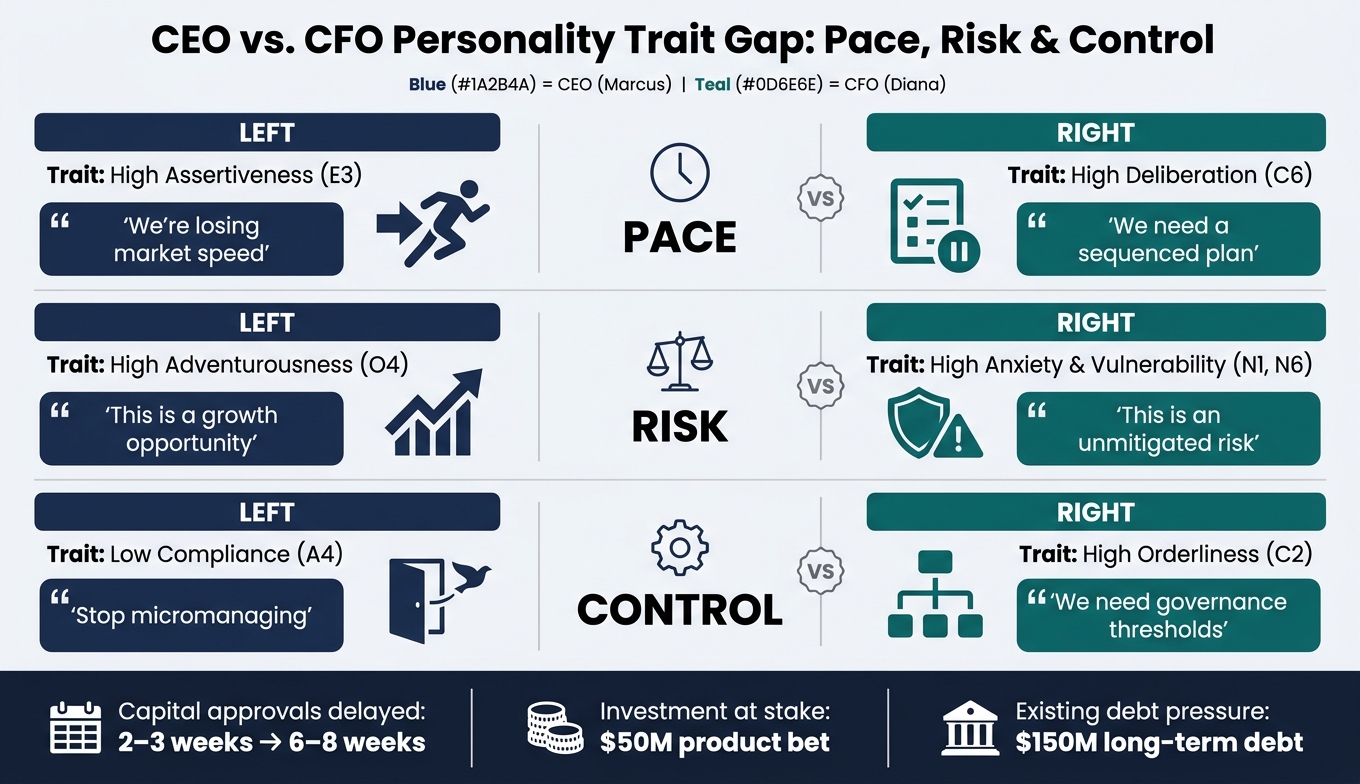
CEO vs CFO Personality Trait Gap: Pace, Risk & Control
Domain-level trait labels sound neat, but they usually miss the part that actually causes friction. The Big Five includes five domains and 30 facets, and the mismatch tends to show up in those lower-level facets, not in the broad label at the top. That's why the same investment can feel urgent to the CEO and risky to the CFO.
How Pace, Risk, and Control Map to Specific Trait Gaps
This CEO-CFO conflict falls into three clear themes. And each one ties back to a facet mismatch, not just a broad personality split.
| Conflict Theme | CEO Facet | CFO Facet | The Recurring Argument |
|---|---|---|---|
| Pace | High Assertiveness (E3) | High Deliberation (C6) | "We're losing market speed" vs. "We need a sequenced plan." |
| Risk | High Adventurousness (O4) | High Anxiety and Vulnerability (N1, N6) | "This is a growth opportunity" vs. "This is an unmitigated risk." |
| Control | Low Compliance (A4) | High Orderliness (C2) | "Stop micromanaging" vs. "We need governance thresholds." |
On pace, the CEO's high Assertiveness pushes decisions ahead in the moment. The CFO's high Deliberation creates a need for more time to think things through before making a call. Same meeting, same topic, very different internal clock.
On risk, the CEO's Adventurousness makes uncertainty feel easier to tolerate. The CFO's higher Anxiety and Vulnerability scores push attention toward downside cases, edge cases, and what could go wrong. So one person sees upside. The other sees exposure.
On control, low Compliance can make approval steps feel like interference. High Orderliness makes those same steps feel like plain governance. In practice, that turns into a familiar tug-of-war: one side wants room to move, the other wants clearer guardrails.
Those facet gaps explain the argument. The next issue is why each exchange heats up instead of settling down.
Why Their Conflict Styles Keep Colliding
The facet gaps explain what they disagree about. The conflict style mismatch explains why those disagreements keep coming back.
One leader pushes harder during conflict. When resistance shows up, high Assertiveness adds more urgency and more pressure. The other steps back, gathers more data, and comes back later, often in writing. You can probably picture how that goes. One person thinks, "We're stuck." The other thinks, "We're not ready."
That style gap keeps the same arguments alive across meetings, emails, and follow-up threads.
Once that pattern hardens, the friction spills beyond the dyad.
How the Clash Spreads and What Reduces the Heat
How the Conflict Affects the Broader Senior Team
A CEO-CFO clash almost never stays contained. The mix of speed, risk, and control that creates tension at the top starts to change how the rest of the senior team works.
Sales, Product, and Marketing often drift toward the CEO. Finance, Operations, and Compliance tend to move toward the CFO. At that point, leaders spend more time pre-briefing than solving the actual problem.
Decision-making slows down. A proposal gets debated in side meetings, then debated again in formal meetings and board sessions. That can push back market entry and stall deals. Directors start hearing mixed messages about growth and risk, which adds concern about alignment and execution. VPs notice this fast, and many start avoiding any visible tie to either leader. Trust falls.
Once that split spreads across the senior team, the same gap in style starts to shape meeting behavior and slow decision speed.
Communication Moves That Work for This Pair
The fix starts with changing the format of the interaction so the same gap does not keep leading to the same fight.
For the CEO, that means sending a short brief a few days before major capital decisions. The brief should cover the thesis, the main assumptions, and the downside case. It also helps to use staged bets with clear go/no-go milestones.
For the CFO, the move is to flag risks early and present them as conditions for approval. A 1:1 pre-meeting with the CEO can bring up concerns before the full team meeting, which keeps friction out of the room. The discussion should stay tied to the revenue thresholds, margin floors, cash runway, and debt covenant buffers that make an investment financeable. The CFO can also offer phased funding or milestone-gated approval.
Process Fixes That Cut Repeat Conflict
A few process changes can stop the same conflict from showing up over and over:
- Use a written-first process for major investments
- Set a no-surprise rule before board meetings
- Clarify decision rights for the CEO, CFO, and joint review calls
These steps make the team less dependent on personality fit when decisions need to be made. They also cut friction before it spills into the room.
Tools, Outcomes, and Lessons for Other Leadership Teams
Using Personos to Guide Live Executive Conflict
After the process is redesigned, the next issue is practical: what tool helps both leaders use that process in real time? Static personality reports can help in workshops. But they are often too slow when a CEO-CFO dispute needs direction before the next capital review.
The table below compares the most common tools on the points that matter most in live executive conflict.
| Tool | Model Type | Level of Detail | Relationship Guidance | Real-Time Situation Support | Best Fit |
|---|---|---|---|---|---|
| Personos | Five Factor Model (FFM) | High - 30 traits on an 80-point scale | Relationship reports for two people | Yes - conversational AI with full personality context | Live executive conflict, ongoing coaching, ROI tracking |
| DiSC | Behavioral style model | Low - 4 dimensions | General style comparison | No - static reports | Team workshops, basic communication training |
| Myers-Briggs (MBTI) | Type-based model | Moderate - 16 types | Type-interaction overviews | No - static reports | Self-awareness, team-building retreats |
| Hogan | FFM-derived trait model | High - derailers and leadership risk | Usually interpreted by a coach or consultant | No - primarily static profiles | Selection, succession, leadership risk screening |
At Apex, the issue was not spotting the trait gap. The issue was using that insight before each funding decision turned into another standoff. Personos gets down to the facet level behind this clash and adds live guidance. DiSC and MBTI are too broad for that job, and Hogan still leans on static reports and expert interpretation. That's the line between having a profile on file and having guidance in the room before a decision falls apart.
Personos combines FFM facet-level data with conversational AI that a coach or HR leader can query in real time, whether that's before a meeting, during a debrief, or right after a surprise veto derails the room. Its relationship-level Dynamic Reports surface the exact friction points between two people, not just stand-alone profiles. Prompts help reinforce commitments between sessions, and the ActionBoard tracks follow-through.
What Changed After the Intervention
With live guidance in place, the case moved from repeat delays to a cleaner decision flow. Early pre-alignment cuts down surprise vetoes. Capital decisions that used to drag across six to eight weeks move closer to three to four weeks for projects under a defined cap, because both sides now work from shared assumptions and a set decision deadline.
Board communication gets tighter too. Instead of the CEO selling upside while the CFO signals doubt in the same meeting, both leaders present one shared risk narrative. Forecasts become more consistent as assumptions line up. Across the senior team, less backchanneling and fewer side-taking patterns free up time and help bring candid debate back into executive meetings.
The payoff shows up in a few clear ways:
- Faster capital decisions
- Fewer surprise objections
- Cleaner board communication
Conclusion: Name the Trait Gap, Then Redesign the Work
The results lead to a simple rule for leadership teams. CEO-CFO tension around pace, risk, and control is normal. In many ways, it's built into the roles. They are supposed to pull in different directions. The trouble starts when that tension goes unnamed until it becomes expensive.
Facet-level data turns a fuzzy disagreement into a clear design problem. Once the pattern has a name, leaders can build around it through decision rights, pre-read requirements, time-boxed risk reviews, and no-surprise rules, instead of relying on better communication intentions alone.
For coaches and HR leaders, the takeaway is direct: identify the recurring trait gap, then build the process around it. Personality insight that sits in a one-time report and rarely shapes day-to-day decisions won't change behavior. Insight built into the way decisions are made can.
FAQs
How can you tell when a CEO-CFO conflict is really a trait gap?
Look at their specific personality facets and risk patterns, not generic labels. If friction keeps showing up around pace, risk, control, or communication style, that may point to a trait gap, not just a one-off disagreement.
Using the Five Factor Model, Personos maps those differences with more nuance than static type-based assessments. That makes it easier to spot where styles clash and figure out how to lower tension.
What should the CEO and CFO decide jointly?
The source doesn’t spell out which decisions a CEO and CFO should make together.
When tension runs high around risk, speed, and control, Personos uses Five Factor Model personality data to show trait gaps and give tailored, real-time communication guidance. The goal is simple: help leaders move from conflict to collaboration.
How do you reduce conflict without slowing growth?
Cut conflict without slowing growth by matching communication to how each person takes in and responds to information, instead of leaning on one-size-fits-all methods.
Tools like Personos use scientifically validated personality data to surface language cues and behavior prompts that ease tension, clear up expectations, and help teams stay centered on shared goals, productivity, retention, and smoother workflows.