How to Build Trust with Personality-Aware Communication
Tailor communication to others' Big Five traits to build competence, care, and integrity-based trust at work.
Rachel Johnson

How to Build Trust with Personality-Aware Communication
Trust at work isn’t one-size-fits-all. People’s personalities shape how they communicate, process feedback, and build relationships. personality-aware communication is about tailoring your interactions to resonate with others, using frameworks like the Big Five Personality Traits (Openness, Conscientiousness, Extraversion, Agreeableness, Neuroticism).
Key Takeaways:
- Trust has three elements: competence (can they do the job?), benevolence (do they care?), and integrity (are they honest?).
- Personality shapes communication: For example, extroverts prefer verbal discussions, while introverts may need time to process.
- AI tools like Personos help professionals navigate workplace dynamics by offering personality-based communication advice.
Quick Tips:
- Observe behaviors: Notice preferences in communication (e.g., verbal vs. written, detail-oriented vs. big-picture).
- Adjust your style: Match your approach to their personality (e.g., use clarity for high Neuroticism or warmth for high Agreeableness).
- Use tools wisely: Leverage AI tools like Personos for tailored guidance while respecting privacy.
Building trust means understanding others’ needs and communication styles, then taking deliberate steps to connect effectively.
How To Build Trust In Social, Personal and Professional Relationships ¦ Vanessa Van Edwards
How Personality Shapes Workplace Communication
Personality plays a big role in how people exchange information at work. The same message can be understood in completely different ways depending on the recipient's personality. This isn’t necessarily a failure - it's often just a mismatch in communication styles. As JobCannon put it:
"Most communication failures are not failures of information... They are failures of style: one person communicated in a way that the other person's personality does not receive well." [4]
Recognizing this difference is the foundation of building genuine trust.
The Big Five Personality Traits at a Glance
The Big Five Personality Traits provide a helpful framework for understanding workplace communication styles. Here's a quick breakdown:
| Trait | High Expression | Low Expression |
|---|---|---|
| Extraversion | Prefers verbal, real-time communication; processes ideas by talking | Prefers written, asynchronous communication; processes ideas by thinking |
| Agreeableness | Tends to be diplomatic, indirect, and avoids conflict | Gives direct, blunt feedback and doesn’t shy from conflict |
| Conscientiousness | Focuses on details, data, and thoroughness | Prioritizes brevity, outcomes, and the big picture |
| Openness | Leans toward abstract, theoretical, and exploratory ideas | Sticks to concrete, practical, and specific concepts |
| Neuroticism | Sensitive to ambiguity and emotionally reactive | Emotionally stable and less reactive to uncertainty |
Misinterpreting these differences as personal flaws can create unnecessary friction. Instead, understanding these traits helps explain why some people seem resistant or guarded in certain situations.
How Resistant or Guarded Individuals Typically Behave
When a colleague seems withdrawn or hard to engage, they’re often labeled as difficult coworkers. But their behavior frequently ties back to personality traits. For example, someone low in Extraversion may stay quiet in meetings because they need time to process their thoughts. Similarly, a highly Conscientious person might resist a vague plan - not to be difficult, but because they need clearer details to deliver quality results.
Neuroticism also plays a part. People with higher levels of this trait may interpret ambiguous communication negatively. A short email might feel cold, or a delayed response could be seen as disapproval. Research even shows that individuals high in Neuroticism often feel more emotionally secure communicating through digital channels rather than face-to-face [3]. This is a practical takeaway for improving workplace interactions.
If unchecked, this guardedness can lead to silos, miscommunication, stalled projects, higher turnover, and weaker team cohesion [2].
Why Self-Awareness Matters for Building Trust
Recognizing how personality shapes communication encourages self-awareness, which is crucial for adapting your approach. Your personality influences how others perceive you, just as their traits shape their responses. For instance, a direct communicator (low Agreeableness) might unintentionally come across as harsh to someone who values warmth. Similarly, an extrovert who processes ideas out loud during meetings could unintentionally pressure an introvert to respond before they’re ready.
Self-awareness allows you to bridge these gaps. By understanding your natural tendencies - like your preferred communication style, how you build trust, and what stresses you out - you can make intentional adjustments. For example, mapping out potential friction points with colleagues and tailoring your approach can make a big difference [4].
Tools like Personos can help by turning personality insights into practical guidance for specific situations, making it easier to navigate workplace dynamics with intention and clarity.
Practical Strategies for Trust Building Through Personality-Aware Communication
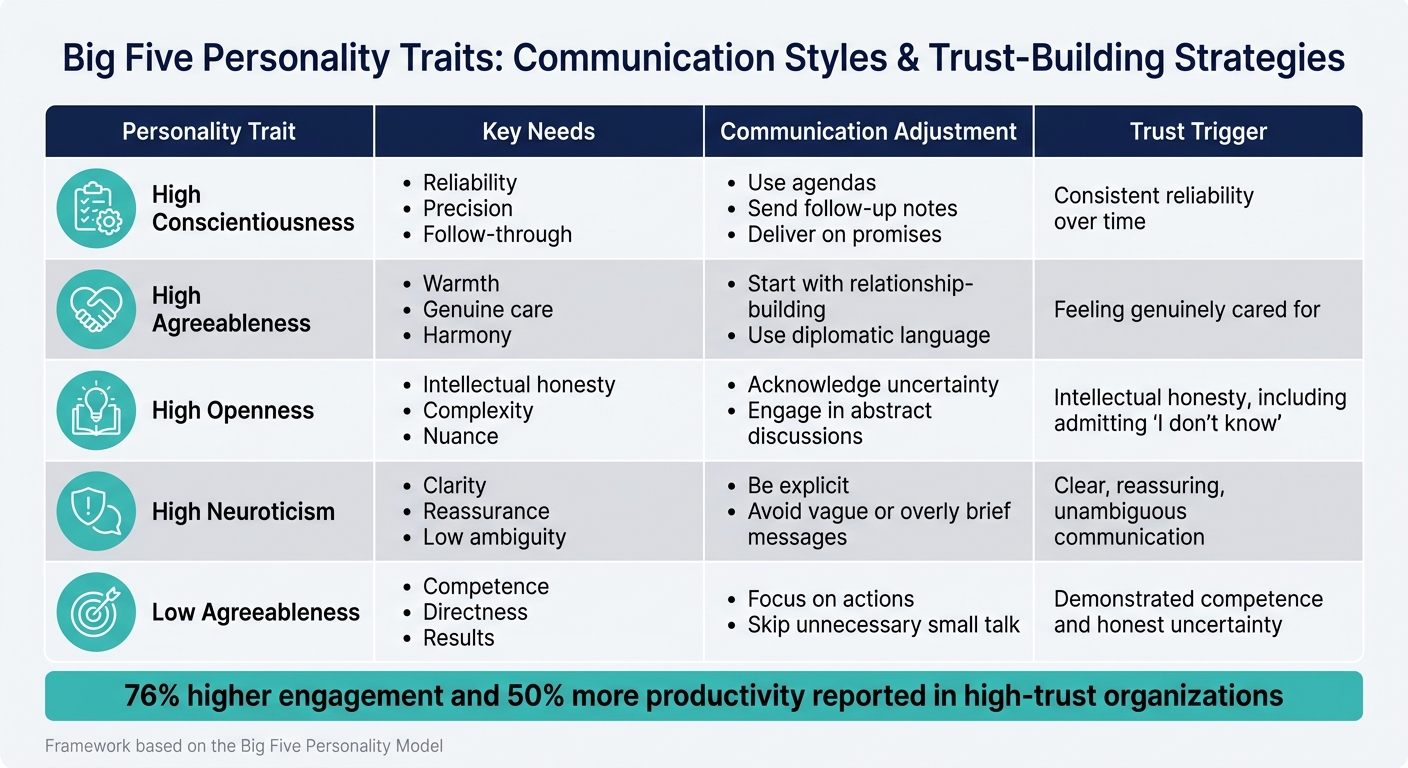
Big Five Personality Traits: Communication Styles & Trust-Building Strategies
Building trust in the workplace hinges on understanding personality traits and tailoring communication styles to suit them. Here’s a practical guide to connecting with individuals, especially those who may be more reserved or cautious, by aligning your approach with their preferences.
How to Read Personality Traits Without a Formal Assessment
You don’t need a formal test to pick up on someone’s personality - everyday interactions can tell you a lot.
"The way we communicate is not just a learned skill, it is deeply rooted in who we are." [3]
For instance, someone who dives into conversations, thinks out loud, and handles interruptions well likely leans toward Extraversion. On the other hand, a quiet colleague who later sends a detailed follow-up email may prefer internal processing [3].
Pay attention to preferences in communication. Does someone value structure and documentation? That could signal high Conscientiousness. Each personality type has its own trust triggers: those high in Conscientiousness value reliability, individuals high in Agreeableness need genuine care, and people with high Openness appreciate nuanced discussions over oversimplified answers [1]. Understanding what someone values most can help you build trust in a way that feels natural and meaningful.
These observations allow you to fine-tune your communication approach for better connections.
Adjusting Your Communication Style to Fit Different Personality Traits
Once you’ve identified key personality traits, adapt your communication to meet their needs. Below are practical strategies for different personality types:
| Personality Trait | Key Needs | Adjustment Strategy |
|---|---|---|
| High Conscientiousness | Reliability, precision, follow-through | Use agendas, send follow-up notes, and deliver on promises |
| High Agreeableness | Warmth, genuine care, harmony | Start with relationship-building; use diplomatic language |
| High Openness | Intellectual honesty, complexity | Acknowledge uncertainty; engage in abstract discussions |
| High Neuroticism | Clarity, reassurance, low ambiguity | Be explicit; avoid vague or overly brief messages |
| Low Agreeableness | Competence, directness, results | Focus on actions; skip unnecessary small talk |
For example, when working with someone high in Neuroticism, unclear messages can easily cause stress. A simple clarification - like mentioning that a follow-up is routine rather than urgent - can go a long way [3]. Similarly, with a low-Agreeableness colleague, skipping pleasantries and emphasizing tangible outcomes builds trust faster. As JobCannon explains, "Nothing builds trust with these types faster than saying 'I'm not certain about that' when you're genuinely not." [1]
Adjusting your style helps create an environment where trust can grow.
Creating Psychological Safety for Guarded Individuals
Psychological safety is key to team success. Google’s Project Aristotle found it to be the most critical factor for high-performing teams, and employees in high-trust organizations report 76% higher engagement and 50% more productivity compared to those in low-trust environments [2].
For more reserved individuals, psychological safety develops through consistent actions and respect for their need to process information. Introverts, for example, often thrive when given time to think or when communication happens in writing rather than on the spot. For those high in Conscientiousness, trust is built through ongoing reliability rather than one-time gestures [1].
When conflicts arise, avoid labeling someone as "difficult." Instead, consider their underlying needs - whether it’s a preference for structure or a desire for honest communication over excessive warmth. This shift in perspective can lead to more productive and trusting relationships [2].
Using AI Tools to Support Personality-Aware Communication
AI tools like Personos bring personality-aware strategies to life, offering practical support in real-world situations.
What AI-Powered Personality Tools Offer
Platforms such as Personos provide real-time guidance tailored to specific situations. Whether you're navigating a tense client meeting, preparing for a challenging conversation, or building trust with a hesitant colleague, these tools offer actionable insights to improve communication.
Personos operates on the Five Factor Model, analyzing 30 personality traits on an 80-point scale to create detailed profiles. It offers Dynamic Reports that adapt to individual, relationship, and group dynamics, while its Prompts feature delivers quick, timely reminders to keep personality insights fresh. Additionally, its conversational AI feature allows users to describe a specific scenario - like working with a reserved client uncomfortable in group settings - and receive tailored advice. This shifts the perception of behavior from being "difficult" to understanding the motivations behind it [2].
"Personos gives people the confidence to communicate with empathy, not just efficiency. It's about using AI to strengthen the skills that make us human." - Nick Blasi, Co-Founder and COO, Personos [7]
By blending psychological theory with practical application, Personos helps professionals approach interactions with greater empathy and understanding.
Personos vs. Competitors: A Side-by-Side Comparison
Personos is specifically designed for professionals managing complex interpersonal dynamics, setting it apart from tools focused on sales or hiring. Here's how it compares to other popular solutions:
| Tool | Primary Use Case | Key Features | Strengths | Limitations |
|---|---|---|---|---|
| Personos | Supporting professionals in complex dynamics | 30 trait-level insights, context-specific guidance, privacy-first design | In-depth insights, ethical approach, tailored advice | Focused on professional use cases |
| Crystal Knows | Sales and team communication | Personality insights for sales and hiring | Seamless CRM integration | Limited depth in personality modeling |
| Humantic AI | Sales and hiring enablement | Behavioral predictions for hiring | Strong predictive analytics | Not designed for nuanced interpersonal scenarios |
Crystal Knows excels in CRM integration, making it ideal for sales teams, while Humantic AI focuses on predictive analytics for hiring. However, neither tool is built for high-stakes, trust-focused interactions. Personos stands out by prioritizing depth and privacy. Unlike competitors that share raw personality scores, Personos offers only actionable insights - such as suggesting brainstorming involvement for creative individuals - while safeguarding sensitive data. Identifying details are masked before processing, making it a thoughtful choice for working with vulnerable groups [6].
Ethical Guidelines for Using AI Personality Tools
Maintaining trust and confidentiality is critical when using AI for personality-driven communication. Here are some key ethical practices:
- Avoid classification over understanding: Use personality data to guide thoughtful interactions instead of making assumptions. For example, a high Neuroticism score should encourage empathy and careful communication rather than judgments about competence.
- Gain explicit consent: Inform individuals that personality insights are used solely to enhance connection. Personos enforces this by keeping scores private by default and requiring consent before sharing full profiles with practitioners [6].
"Trust building isn't an adjacent task to AI transformation, it is the transformation." - Micela Leis, PhD, Senior Innovation Solutions Associate at CCL [5]
Being transparent about AI’s role ensures it enhances human judgment rather than replacing it, fostering trust and meaningful communication.
Conclusion: Putting Personality-Aware Communication to Work
Key Takeaways
Earning trust requires consistent, deliberate actions - and what builds trust can vary based on personality. For example, individuals with high conscientiousness value competence and integrity. Those with high agreeableness need to feel genuinely cared for, while highly open individuals appreciate intellectual honesty, including the humility to admit, "I don't know."
The numbers speak for themselves: employees in high-trust workplaces report 76% greater engagement and are 50% more productive [2]. These aren't abstract perks; they're tangible outcomes that start with truly understanding the person you're communicating with - not just their job title.
Equally important is self-awareness. Recognizing your own communication tendencies - whether you're overly direct, reserved, or detail-oriented - helps you adapt and connect more effectively. The best communicators don't rely on a specific personality type; they succeed by bridging gaps with intention and skill.
These principles lay the groundwork for small, everyday actions that build trust over time.
Next Steps
Turn these ideas into practice by weaving them into your daily interactions. Before your next tough conversation, ask yourself which trust factor - ability, benevolence, or integrity - matters most to the other person and focus on that.
For those seeking extra guidance, Personos offers practical tools to keep these concepts actionable. Its Prompts feature provides daily, bite-sized reminders to reinforce personality insights, while the ActionBoard turns those insights into manageable tasks. At just $9 per seat per month, it's a helpful resource for professionals juggling multiple relationships and priorities.
"When insights about yourself and your teammates are readily available - rather than buried in PDFs or saved for pieces of training - teams can use them in honest conversations, decisions, and challenges." - Training Magazine [2]
At its core, personality-aware communication isn't about having all the answers. It's about staying curious, asking meaningful questions, and being flexible enough to adapt when the answers surprise you.
FAQs
How can I tell someone’s personality at work without a test?
You can get a sense of someone’s personality at work without needing a formal test by simply observing how they communicate and behave. Notice whether they prefer verbal conversations or written messages. Watch how they approach conflict or teamwork - do they lean toward compromise, assertiveness, or diplomacy? Also, consider what they prioritize when building trust, such as competence, warmth, or integrity. By paying attention to how they consistently react in various situations, you can uncover important traits that help you adjust your approach and strengthen your working relationship.
What should I say to build trust with a guarded or resistant coworker?
To connect with a guarded coworker, prioritize clear and open communication. Be consistent in your actions and dependable in fulfilling commitments. Tailor your approach to align with their preferences, and remain calm in challenging situations. Show genuine interest in their perspective and needs. Understanding what matters most to them - whether it’s competence, integrity, or something else - can help you navigate interactions effectively. Over time, empathetic and transparent behavior can help break down barriers and build trust.
How can I use Personos without crossing privacy or consent lines?
To use Personos responsibly, always secure informed consent before analyzing any communication data. Make sure clients or colleagues are fully aware of how their data will be utilized and share any insights in a clear and open manner. Stick to professional uses only, respecting individuals' privacy and steering clear of any unauthorized monitoring. Prioritizing data security and following strict confidentiality standards helps build trust while ensuring compliance with both legal and ethical requirements.