How to Break the Pursuer-Distancer Cycle in Conflict
Four-step plan to stop pursue-withdraw conflicts: name the pattern, pause with a set return time, state one need/request, then reconnect—safety first.
Nick Blasi

How to Break the Pursuer-Distancer Cycle in Conflict
When one person pushes for answers and the other pulls away, I focus on 4 steps: name the pattern, pause with a return time, share one need and one request, and reconnect to discuss one issue. The goal isn’t to settle everything at once. It’s to stop feeding the same argument.
Here’s the plan:
- Name what’s happening, without labeling either person.
- Make the pause predictable: “I need 30 minutes. I’ll return at 7:30 p.m.”
- Ask for one action, rather than an immediate solution.
- Return, listen, and agree on one next step. Practice when calm, and review missed return times without assuming motives by applying emotional intelligence solutions to common triggers.
I put safety before communication practice. <u>A shared pattern does not mean equal responsibility for harm.</u> If you fear threats, control, or retaliation, skip joint exercises and seek private safety support. Counseling can help assess whether this plan fits; AI tools cannot replace that judgment.
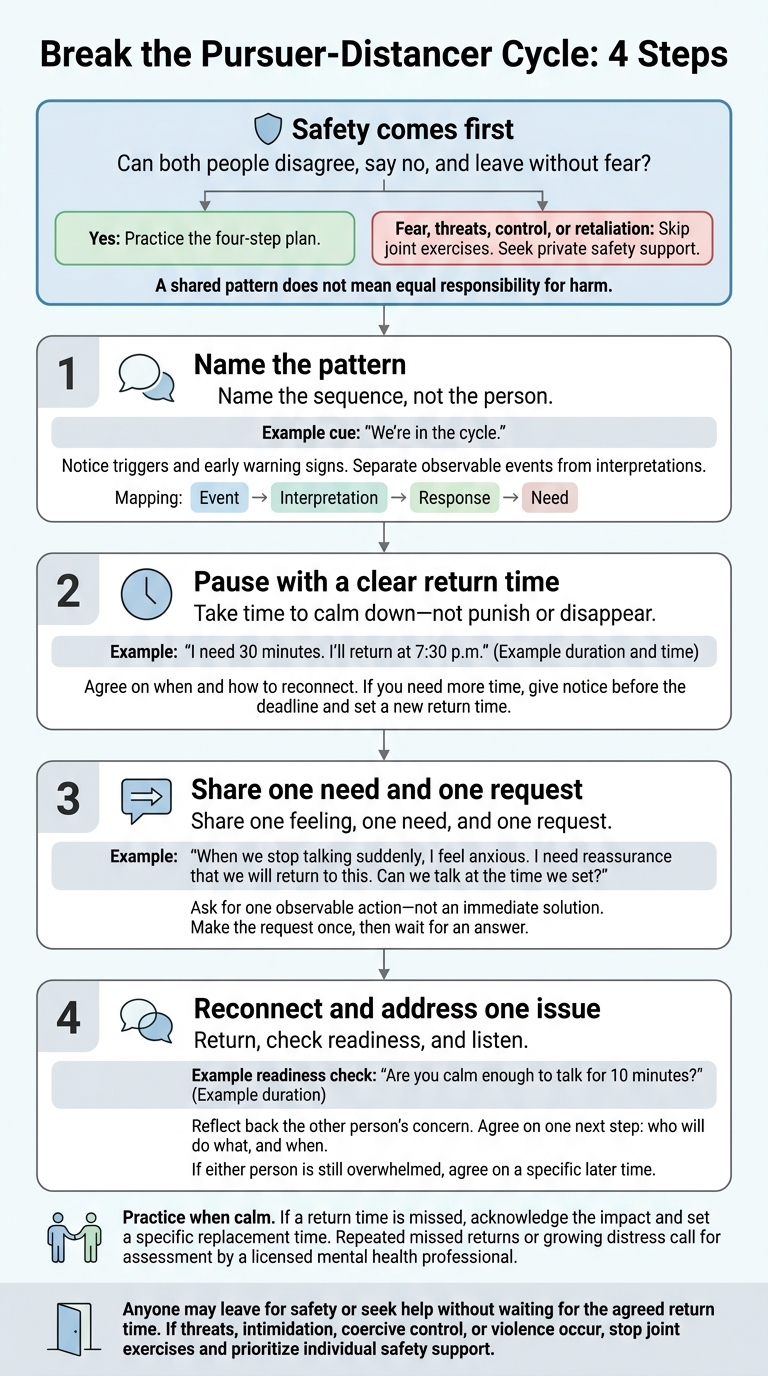
Break the Pursuer-Distancer Cycle: 4 Steps
Stop Having the Same Fight Again and Again - How to Break the Pursuer Distancer Cycle
Check Safety Before Practicing Together
Before teaching the conflict plan, check for coercion and harm. Can both people disagree, say no, and leave without fear? Phone monitoring, restricted access to money, sexual pressure, blocked exits, and threats to children or pets are safety concerns, not communication problems.[1][2] Attachment language never excuses harm.
Counselors should speak with each person privately and explain confidentiality limits before asking questions. Ask about fear, stalking, unwanted sexual contact, physical harm, and retaliation for setting limits. Never ask these questions in front of a potentially controlling partner. Also ask whether counseling or returning home could increase danger. These answers help determine whether the four-step plan is appropriate at all.[3]
If abuse is present or suspected, stop joint conflict practice and arrange an individual safety assessment with domestic violence advocates. Help the person plan for safe places, trusted contacts, transportation, medication, important documents, children, and pets. Offer choices. Don’t pressure them to confront a partner or leave immediately.
A pause must never involve retaliation or losing access to a phone, money, transportation, or other people. Anyone may leave for safety or seek help without waiting for the agreed reconnection time.[1][2] The four-step plan is useful only when these safety conditions are met.
In the United States, contact the National Domestic Violence Hotline at 800-799-SAFE (7233) or text START to 88788.[3] If monitoring is a risk, use a safer device and confirm which contact methods are safe. Call 911 if you are in immediate danger.
If both people can participate safely, move to Step 1: name the pattern.
Step 1: Name the Pursuer-Distancer Cycle
Name the sequence, not the person. One person seeks reassurance or resolution. The other goes quiet, delays, or leaves. Pursuit and withdrawal are behaviors people can change, not fixed traits. Agree on a neutral cue, such as:
We’re in the cycle.
Identify Triggers and Responses
Ask each person to name two or three early warning signs they notice, such as repeated questions, delayed replies, changing the subject, or leaving. Note what happened just before those signs appeared. Was there an unresolved decision or a change in plans?
Check the context before assigning a motive. Fatigue, pain, work demands, or a need for time to think can shape someone’s response. Not every silence is withdrawal, and not every request for an answer is pursuit.
Map Events, Interpretations, Responses, and Needs
Choose one recent disagreement to map the pattern. Have each person fill out the worksheet separately. Keep observable events separate from interpretations. An interpretation can feel true without being the only explanation.
| Part | What to record |
|---|---|
| Event | What happened? Stick to observable facts, including the time and words used, if remembered. |
| Interpretation | What did I tell myself it meant? |
| Response | What did I say or do next? |
| Need | Was I seeking reassurance, clarity, space, predictability, or time? |
Draw arrows to show how each response triggered the next. Then read the map aloud and check interpretations rather than assigning motives.
Choose one behavior each person can change. Then move to Step 2: pause with a clear return time.
Step 2: Pause With a Clear Return Time
Once you’ve named the pattern, the next step is to stop the argument from escalating without adding uncertainty. Use your pattern map to spot when to pause. Setting a clear return time helps interrupt the reassurance-seeking/withdrawal loop.
A pause is time to settle emotions, not punish or disappear. When you’re both calm, agree on a pause signal, where each person will go, whether texting is allowed, and exactly when and how you’ll reconnect.
Agree on When and How to Return
Set the break length and a firm return time while you’re calm. A commonly cited guideline allows at least 20 minutes for the body to calm down. Some Gottman-based guidance recommends returning within 24 hours. These are guidelines, not a schedule that works for everyone.[4][5] Choose a specific time and place:
“I need a pause so I can stay constructive. I’ll come back at 7:30 p.m., and we can talk in the living room.”
If you need more time, say so before the deadline and set a new return time. Include this option in your agreement so neither person has to guess whether the conversation will happen.
Use the Break to Calm Down
Take a walk, stretch, notice your surroundings, or breathe out slowly. Avoid rehearsing accusations, drafting rebuttals, or sending repeated messages. The break is for calming down, not keeping the argument going.
Being ready means you can listen and speak respectfully, even if you still feel uneasy. If either person still feels close to losing control, extend the pause and follow the safety plan.
Distinguish Withdrawal From a Planned Pause
Describe what happened and how it affected you without assuming intent. A clear commitment to return makes time apart more predictable. Silence alone doesn’t.
| Behavior | Impact | Replacement phrase |
|---|---|---|
| Leaving without explanation | Creates uncertainty and may intensify reassurance-seeking | “I need space to calm down. I will check in by 7:30 p.m.” |
| Leaving while sending angry texts | Keeps the argument active | “I’m pausing messages too. I’ll contact you at the agreed time.” |
| Saying “I’m done” without a return plan | May sound like permanent rejection | “I want to continue this conversation, but I need a break first.” |
| Taking a timed pause with a commitment to return | Helps both people calm down while keeping a path back to the conversation | “I’m taking a break so I can listen better. Let’s resume at 7:30.” |
When both people can pause and return on time, move to Step 3: express one need and one request.
Step 3: Express 1 Need and 1 Request
After the pause, share one feeling, one need, and one request. Name your emotion, explain the need behind it, and ask for an action you can observe. An “I” statement can still blame if it judges the other person rather than describes your experience. Avoid “always” and “never.”
Ask for Reassurance Without Demanding Resolution
When we stop talking suddenly, I feel anxious. I need reassurance that we will return to this. Can we talk at the time we set?
Ask for a plan, not a solution on the spot. Make your request once, then wait for an answer. If the proposed time doesn't work, the other person can suggest another.
Ask for Space Without Signaling Rejection
I hear this feels unresolved. I’m too worked up to discuss it well. I need 30 minutes to calm down, and I’ll come back at 7:30 p.m.
Acknowledging someone's concern doesn't mean agreeing with every interpretation. When it's safe, explain what you need before leaving. Make clear that the break is for calming down, not punishment.
Counselors can help people practice with a minor disagreement. Each person shares a feeling, a need, and a request in two or three sentences, then they swap roles. Stop if the exchange shifts into blame or repeated demands.
Step 4: Reconnect and Address 1 Issue
Return at the time you agreed on, and start with a readiness check:
“Are you calm enough to talk for 10 minutes?”
If either person still feels overwhelmed, say so and agree on a specific later time. If you’re both calm, begin the repair conversation.
Make the goal clear:
“We are here to understand what happened and decide what to do next - not to prove who is right.”
Own your part. Before responding, reflect back the other person’s concern.
Practice a Short Repair Conversation
A counselor can model this script and help you both practice listening without interrupting:
“I think we got caught in our pattern. I can see that my repeated questions may have felt overwhelming. Did you experience it that way, or was something else happening?”
Name the one issue you agreed to discuss, then continue:
“If we become overwhelmed, let’s pause and return at 7:00 p.m. My request is that you tell me directly when you need space and reassure me that you intend to come back.”
Before ending, agree on one concrete next step: who will do what, and when. Save other issues for another conversation, and have each person repeat the agreement in their own words. Close with appreciation if it feels natural. Neither person has to hug, forgive, or agree right away.
Address a Missed Return Time
If someone misses the return time, acknowledge it, explain its impact, and set a specific replacement time. This helps keep the pause predictable.
Once you’re calm, discuss what got in the way. Was someone still too worked up to talk constructively? Was the schedule unrealistic? Did an unexpected obligation come up, or was someone avoiding the conversation? Agree on how you’ll give notice and propose a new time if you can’t follow the plan. Then return to the single issue you had agreed to discuss.
Repeated missed returns need follow-up. If return agreements keep falling through or distress grows, seek an assessment from a licensed mental health professional before continuing the four-step plan. If conflict includes threats, intimidation, coercive control, or violence, stop joint communication exercises. Put individual safety planning and specialized support first.
Practice Between Counseling Sessions
Rehearse the plan during calm moments between sessions so it’s easier to use under stress. Repetition outside conflict helps partners get familiar with the steps before the next argument.
Practice isn’t a pass-fail test. Noticing escalation sooner counts as progress, even when partners still need help settling down.
Track Triggers and Follow-Through
Use the log to spot patterns, not grade performance. Keep brief notes on triggers, early warning signs, interpretations or emotions, responses, and the pause plan. Record whether partners reconnected on time and addressed the original issue. Describe actions, not labels, and note one adjustment for next time.
At the next session, review one or two entries to see what helped or blocked reconnection. Acknowledge specific improvements before discussing setbacks. Treat a missed return time as a problem to work through, not proof of bad faith.
If practice repeatedly increases distress or leads to intimidation or other safety concerns, pause the assignment. Reassess safety and whether joint practice is appropriate.
Use Optional Practitioner Tools With Consent
An AI tool can help a counselor organize the plan, but it cannot replace clinical judgment. Personos is an optional aid for organizing communication suggestions, notes, reminders, and follow-through. It should not replace therapy or safety assessment. Do not use personality profiles to diagnose attachment patterns or assign blame.
Before entering client information, obtain informed consent and verify that the tool meets the organization’s confidentiality and security requirements. Use only the minimum data needed.
Conclusion: Follow the 4-Step Conflict Plan
Name the cycle without blaming either partner. Take a pause and set a specific time to return. Share one need and one request. Then reconnect, work through one issue, and agree on one next step.
Aim for progress, not perfection. Success means interrupting the loop more often. Neither reassurance-seeking nor withdrawal has to decide what happens next.
Safety comes first: If either partner fears retaliation, threats, or coercive control, seek private professional support and use an individual safety plan.[6][7][8]
FAQs
Can we switch pursuer and distancer roles?
Yes. People can switch between pursuer and distancer roles depending on the situation and who they’re interacting with. These patterns are often reactions, rather than fixed roles.
Counselors can use tools like Personos to better understand the personality-driven motivations behind pursuing or pulling away. Looking at each relationship’s dynamics and communication history can help counselors tailor their guidance so clients can break the cycle, work better together, and reduce recurring stress.
What if my partner won’t try the plan?
If your partner won’t participate, focus on your own responses and emotional needs. You can’t force them to engage, but changing how you respond may help shift the dynamic.
For helping professionals working with clients, Personos offers tailored guidance based on the Five Factor Model. It helps address resistance, improve communication, and support progress when one partner is hesitant to work together.
How can I distinguish withdrawal from coercive control?
Telling withdrawal apart from coercive control means looking closely at power dynamics and intent. Withdrawal is often a way to avoid feelings that seem overwhelming. Coercive control, by contrast, involves repeated manipulation meant to limit someone’s autonomy and make them dependent.
Personos can give professionals real-time guidance based on the situation and informed by personality profiles. This can help them understand these dynamics and tailor their interventions.