Big Five Traits and Relationship Quality
Low Neuroticism plus high Agreeableness and Conscientiousness link to better relationships; facet-level insights show what to improve.
Christian Thomas

Big Five Traits and Relationship Quality
If you want a short answer, here it is: low Neuroticism, high Agreeableness, and high Conscientiousness tend to link most often with better relationship quality. Across research, Emotional Stability and Agreeableness each show links near r = .29 with relationship satisfaction, while Conscientiousness is close behind at r = .25. By contrast, Extraversion is usually smaller at r = .17 to .22, and Openness is often around .10 or lower.
If I were boiling this down for you, I’d say:
- Emotional Stability helps keep trust steady and conflict from spinning up
- Agreeableness supports cooperation, calm feedback, and lower friction
- Conscientiousness helps people follow through, which makes relationships feel steady
- Extraversion can help people connect early, but it does not always improve relationship quality
- Openness may help with perspective-taking, but its direct link is weaker
There’s one more point that matters: broad trait scores show general risk, but facet scores show where to act. For example, anxiety and angry hostility can both sit under Neuroticism, but they point to different problems. Research also shows that your own traits usually matter more than simple trait matching, with actor effects explaining about 6% of relationship satisfaction, partner effects about 1% to 3%, and similarity adding little after that.
In plain English: if you want better work relationships, don’t just ask “What trait is this?” Ask “Which part of the trait is showing up in day-to-day behavior?”
| Trait | Usual link with relationship quality | What it tends to affect most |
|---|---|---|
| Emotional Stability | r = .29 | Trust, calm under stress, steadier interactions |
| Agreeableness | r = .29 | Cooperation, lower conflict, easier feedback |
| Conscientiousness | r = .25 | Reliability, follow-through, clarity on commitments |
| Extraversion | r = .17 to .22 | Starting conversations, social energy |
| Openness | .10 or less | Perspective-taking, new ways of thinking |
That’s the core message of the article: three traits carry most of the signal, facet-level detail gives you better direction, and behavior matters more than simple personality matching. Professionals can leverage these personality insights using AI to improve client outcomes.
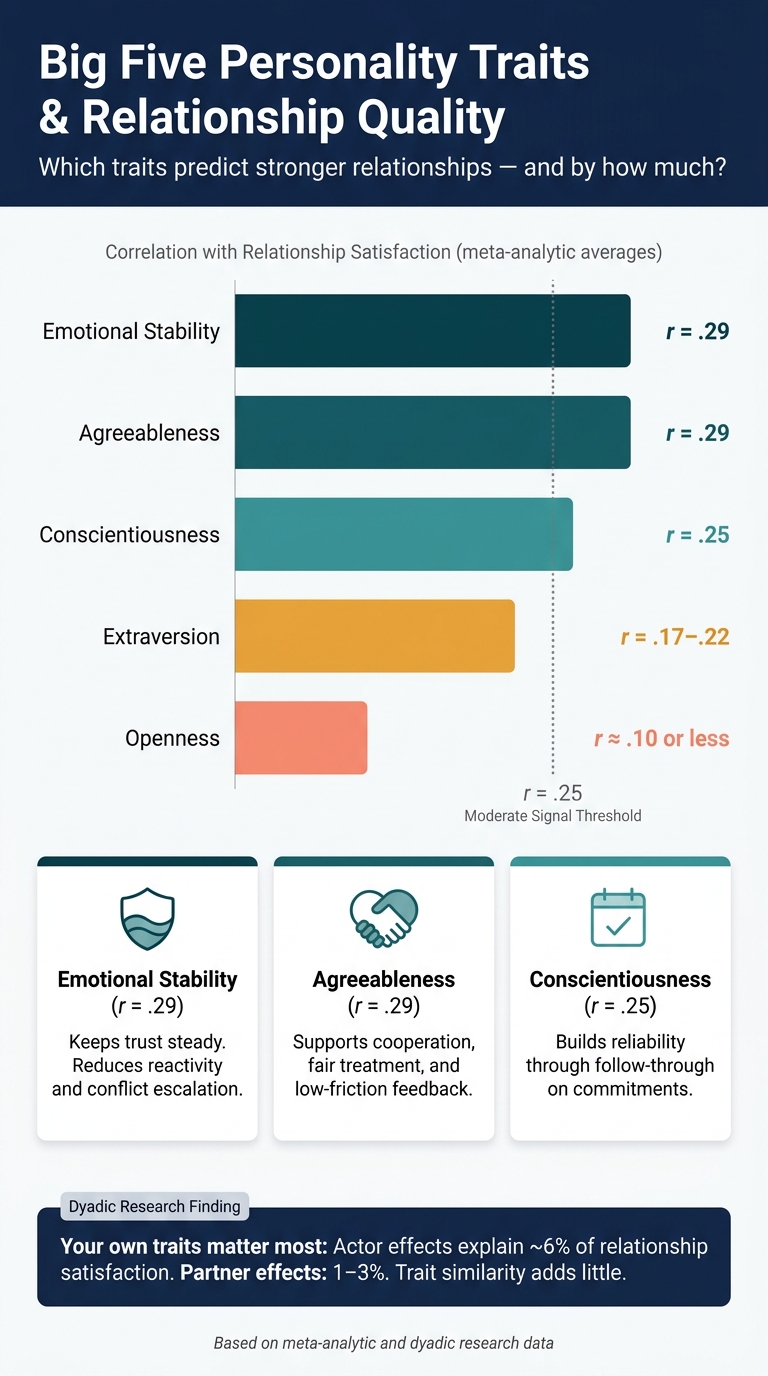
Big Five Personality Traits & Relationship Quality: Correlation Scores Explained
The Big 5 in Romantic Relationships | With William Lorey
Which Big Five Traits Predict Stronger or Weaker Relationships
At the broad-trait level, three patterns stand out most: Emotional Stability, Agreeableness, and Conscientiousness carry most of the signal. Extraversion and Openness matter too, but their effects are smaller and depend more on the setting. That sets up the next step: which facets make these patterns even sharper?
Neuroticism, Agreeableness, and Conscientiousness: The Clearest Patterns
Neuroticism is the trait most consistently tied to relationship strain. Higher emotional reactivity, stronger threat sensitivity, and more defensiveness under pressure can slow trust-building and add friction during feedback conversations. In coaching and leadership settings, this often shows up as unpredictability and trouble maintaining psychological safety across a team or engagement.
Agreeableness helps support trust, fair treatment, and low-conflict teamwork. Agreeable leaders are often seen as fair, calm, and easy to approach. That helps build the psychological safety needed for honest conversations. Its correlation with relationship satisfaction (r = .29) [1] is among the strongest across the five traits.
Conscientiousness completes the top three. Follow-through cuts down on ambiguity and conflict around goals and deadlines [1]. In a coaching engagement or a manager-report relationship, that kind of reliability adds up over time and creates a steady base for growth.
Extraversion and Openness: Smaller and Less Consistent Effects
The other two traits tend to matter less for relationship quality itself and more for how relationships begin or adjust over time.
Extraversion can help relationships get off the ground fast. It supports proactive communication and social engagement, and meta-analytic data places its correlation with relationship satisfaction in the small range, around r = .17 to .22. [1] [4] That said, high Extraversion can also take over a discussion or crowd out quieter voices if active listening is missing. So yes, it helps, but not in every case.
Openness to Experience has the weakest and least consistent link of the five traits. Its main contribution is perspective-taking. It can help someone seriously consider another person’s point of view. But that effect depends a lot on context, and its direct link to day-to-day relationship quality is weaker than Emotional Stability or Agreeableness. [1] [4]
| Trait | Correlation with Relationship Satisfaction | Primary Mechanism |
|---|---|---|
| Emotional Stability | r = .29 [1] | Reduces reactivity; stabilizes trust |
| Agreeableness | r = .29 [1] | Cooperation, fair treatment, low conflict |
| Conscientiousness | r = .25 [1] | Reliability and follow-through |
| Extraversion | r = .17–.22 [1] [4] | Communication initiation; context-dependent |
| Openness | r ≈ .10 or less [1] [4] | Perspective-taking; weakest, least consistent |
Big Five vs. Attachment Frameworks: What Each Explains
Attachment frameworks focus on anxiety about abandonment and avoidance of closeness. They often explain more variance in close relationship outcomes than the Big Five alone, especially when trust problems or relational distress are at the center.
The Big Five still has a clear practical edge in coaching and leadership work. These traits are stable, observable, and tied to behaviors people can work on directly. That makes them a strong structural backbone for long-term development plans. And that difference matters, because the next section shifts from broad traits to the facets that predict relationship outcomes with more precision.
Why Facets Predict Relationship Outcomes Better Than Broad Trait Scores
Broad traits point to the general risk. Facets show what to work on.
A domain score gives you the overall tilt. A facet score shows which day-to-day behaviors are driving that pattern, and that changes the next step. If you only know someone is high in a trait, you get a rough signal. If you know the facet pattern under that trait, you can make a much better call about coaching, feedback, or leadership support.
Facet-level models predict outcomes a bit better than domain scores. Across studies, facet-level models explained about 18.0% of variance compared with 16.6% for domain-level models, which works out to about 14% more variance explained on average.[11][14] Other studies found facet-based prediction was about 20% stronger than domain-based prediction.[12][13] The lift is not huge, but it matters when you're deciding how to respond.
This gap stands out most in Neuroticism, Agreeableness, and Conscientiousness.
The Facet-Level Signals That Matter Most
Two people can score equally high on Neuroticism and still look nothing alike at work. One may run on anxiety and vulnerability. Another may run on angry hostility. The domain score only tells you that both are emotionally reactive. The facets tell you whether the problem is better handled with anxiety regulation or anger control.
The same thing happens with Agreeableness. Trust and compliance can look close at the domain level, but they point to different patterns. High compliance can help someone accept feedback, yet it can also drift into over-accommodation, where needed pushback never shows up. High trust tends to speed up information-sharing and strengthen psychological safety.
Within Conscientiousness, dutifulness and self-discipline are the facets most tied to reliability. Low dutifulness usually points to a need for clearer accountability. Low self-discipline often points more to energy or motivation than simple carelessness.[18]
Actor, Partner, and Similarity Effects in Dyadic Research
In actual relationships, these facet signals show up through actor, partner, and similarity effects. Dyadic research separates them into three buckets:
- Actor effects: how your own traits shape your experience
- Partner effects: how your traits affect the other person
- Similarity effects: whether matching on traits helps
Actor effects are usually the strongest. Across large cross-national samples, a person's own personality explained about 6% of variance in relationship satisfaction. Partner effects explained 1% to 3%, and trait similarity added little once actor and partner effects were controlled.[3][7]
That has a plain-English takeaway. If poor relationship quality keeps repeating across teams or managers, start with the person's own facets, especially hostility, anxiety, and low trust. In manager-report, peer-to-peer, or coach-client relationships, partner effects still matter. A counterpart high in trust and dutifulness can increase psychological safety for the other person. But simple trait matching is a weak base. Shared high hostility, for example, tends to intensify conflict instead of smoothing things over.
Evidence Tables: Traits, Facets, and Dyadic Effects
The tables below condense the main signals and what they suggest for coaching decisions.
Table 1: Domains, Key Facets, and Relationship Outcomes
| Domain | Key Facets | Common Positive Outcomes | Common Risks | Typical Evidence Sources |
|---|---|---|---|---|
| Neuroticism | Anxiety, angry hostility, depression-related affect, vulnerability | Risk awareness; empathy under stress | Elevated conflict (hostility); reassurance needs (anxiety); disengagement (depression) | Dyadic studies, meta-analyses (r = −.222 across 160 samples)[17] |
| Agreeableness | Trust, compliance, altruism | Cooperative conflict resolution; openness to feedback | Over-accommodation; avoidance of necessary confrontation | Organizational surveys, facet-level prediction studies |
| Conscientiousness | Dutifulness, self-discipline, orderliness | Reliability; perceived integrity | Rigidity at very high levels | Work-personality research; 15 facets outperformed 5 domains[15][16] |
| Extraversion | Assertiveness, warmth, activity | Proactive communication; faster relationship initiation | Dominating discussions; crowding out quieter voices | Meta-analytic summaries |
| Openness | Cognitive flexibility, imagination | Perspective-taking; problem-solving from new angles | Making simple situations harder than needed | Relationship satisfaction studies |
Table 2: Actor, Partner, and Similarity Effects by Facet
| Facet | Actor Effect | Partner Effect | Similarity Effect | Coaching Implication |
|---|---|---|---|---|
| Anxiety | High anxiety → more perceived threat; lower satisfaction | Makes interactions feel more emotionally demanding | Shared high anxiety reinforces avoidance | Use structured feedback and normalize emotion. |
| Angry Hostility | High hostility → more conflict; lower satisfaction | Triggers caution and guardedness in others | Shared hostility escalates conflict | Set explicit norms for disagreement; use curiosity-based questions. |
| Trust | High trust → faster alliance-building; more information-sharing | Increase psychological safety for others | Shared high trust accelerates relationship quality | Prioritize transparency and fair-process decisions. |
| Compliance | High compliance → cooperative conflict resolution | Reduces friction in teams | Shared high compliance may suppress necessary confrontation | Build assertiveness; design space for honest pushback. |
| Dutifulness | High dutifulness → perceived as reliable | Increases others' confidence in commitments | Shared low dutifulness creates accountability gaps | Co-design action plans with clear deadlines and check-ins. |
| Self-Discipline | High self-discipline → smoother goal follow-through | Reduces ambiguity around execution | Shared low self-discipline weakens follow-through | Set smaller execution steps; add visible progress tracking. |
What the Findings Mean for Coaching, Leadership, and Team Practice
These findings change how coaches, leaders, and teams communicate. The value shows up when those signals shape what you do next.
Using Traits and Facets to Guide Coaching Conversations
Use trait signals to adjust how you communicate. Add more predictability for people high in Neuroticism. Set clear tone and listening norms for people low in Agreeableness to improve workplace conflict outcomes. Use tighter milestones and visible tracking for people low in Conscientiousness. Set directness norms early so candor doesn't slide into defensiveness.[20][21][24][2][10][22][25][28]
For Conscientiousness, high scorers tend to do well with clear milestones and measurable targets. Lower scorers usually do better with shorter execution steps and outside accountability.[19][20][22][23]
You can use the same actor-partner lens with the coach-client pair. If a coach is more emotionally reactive, they may need to build more safety and predictability to support honest disclosure in coach-client, manager-report, and peer-to-peer relationships.[5][26][27]
This is where AI support comes in. It turns trait data into live guidance during the conversation.
How AI Platforms Turn Personality Research Into Day-to-Day Guidance
Personos uses the Five Factor Model, 30 traits, and contextual AI to turn full personality profiles into real-time guidance for individuals, relationships, and groups. Its Dynamic Reports work at three levels: individual, relationship (coach-to-client, manager-to-report, peer-to-peer), and group. That setup reflects the actor-partner logic from dyadic research by surfacing likely friction points and communication strategies for each pairing. The ActionBoard then turns those insights into trackable tasks so development goals stay active between sessions.
That's the gap between a profile you read once and a system you can actually use.
Static Assessment Tools vs. Relationship-Focused Platforms: A Direct Comparison
Static tools can help with self-awareness, but they stop at a snapshot.
| Feature | Static Tools (e.g., DiSC, Myers-Briggs, 16Personalities) | Relationship-Focused Platforms (e.g., Personos) |
|---|---|---|
| Model Depth | Broad types or simplified trait categories | Five Factor Model with 30 facets on an 80-point scale |
| Facet Coverage | Minimal or none | Full facet-level scoring for more precise behavioral prediction |
| Guidance Type | Static, one-time descriptions | Real-time, situational, role-specific AI guidance |
| Relationship Analysis | Individual profiles only | Dynamic reports for dyads and groups |
| Action Tracking | None | Integrated ActionBoard with trackable tasks and milestones |
| Context Awareness | Generic | Incorporates relationship notes, history, and goals |
| Privacy | Varies | Privacy-first; scores remain private unless explicitly shared |
For relationship quality, the better tool is the one that changes the next conversation, not just the label.
Conclusion: The Clearest Research-Backed Takeaways
The evidence points in the same direction. Across meta-analyses and dyadic studies, Emotional Stability, Agreeableness, and Conscientiousness are the steadiest predictors of relationship quality. That fits the main pattern in this article: broad traits show the general direction, while facets help you make better calls. Extraversion and Openness matter as well, but their links are weaker and less consistent. They can help with networking and engagement, but they are not the main forces behind trust or reliability.[2][4]
Broad traits show risk. Facets show where to act. A facet-level score does more than label a trait. It points to the next step.[2][5]
That same level of detail matters in dyads. In most cases, your own traits matter more than simple personality matching. Put plainly, relationship outcomes are usually shaped more by who each person is and how each person behaves than by trying to pair people with similar profiles.[9][8][6] For coaching and team design, that means self-awareness and behavior change tend to matter more than trying to line up traits on paper.
The practical issue is simple: does this insight stay stuck in a report, or does it become part of daily work? For coaches and leaders, personality data has the most impact when it helps shape the next conversation. A static report can describe personality. Personos pushes it into day-to-day use with live, relationship-specific guidance and action tracking.
Best practice brings together facet-level insight, actor-focused development, and ongoing use at the relationship level. Used this way, personality data can help teams build better trust, handle conflict with more clarity, and improve performance.
FAQs
Which Big Five trait matters most for relationship quality?
The Five Factor Model doesn’t single out one trait as the main driver of relationship quality. Instead, it shows that all five dimensions, along with their 30 facets, work together to shape how relationships play out.
That’s why Personos doesn’t zero in on just one trait. It uses the full 30-facet profile to give more precise, situation-specific guidance for communication and collaboration.
Why do facets predict relationships better than broad traits?
Facets give you a more precise view of personality than broad trait labels. The Five Factor Model has five main dimensions, but its 30 facets show far more of what sits underneath day-to-day behavior.
That extra detail makes it easier to spot patterns in relationships and communication. Personos measures those 30 traits on an 80-point scale, which gives a sharper read than broad, generic typing systems.
Does personality matching improve relationship quality?
Yes. Personality matching can improve relationship quality by helping people communicate, work together, and build trust more effectively.
Research suggests that personality traits can help predict relationship dynamics and leadership effectiveness. Using the Five Factor Model, tools like Personos move past one-time assessments by offering real-time, context-aware guidance and more personalized, actionable advice.