Big Five Traits and Conflict Triggers
Big Five traits predict who escalates or resolves workplace conflict, showing how personality profiles shape dispute behavior.
Rachel Johnson

Big Five Traits and Conflict Triggers
Understanding how personality differences can resolve team conflicts is essential, especially in workplaces. The Big Five personality traits - Openness, Conscientiousness, Extraversion, Agreeableness, and Neuroticism - shape how we perceive and handle disputes. Here's what you need to know:
- Neuroticism: High levels often lead to frequent conflict perception and emotional outbursts. Strategies like staying calm and offering reassurance can help manage interactions.
- Agreeableness: Highly agreeable individuals focus on resolving conflicts constructively but may perceive more interpersonal disputes.
- Extraversion: Can drive collaboration or escalate tension, depending on how assertiveness is directed.
- Conscientiousness: Brings structure and emotional regulation, reducing impulsive reactions during disagreements.
- Openness: Encourages flexible thinking, helping uncover solutions others might miss.
Professionals can use tools like Personos to leverage these traits for better conflict management. These platforms analyze personality profiles to provide tailored strategies for navigating disputes effectively.
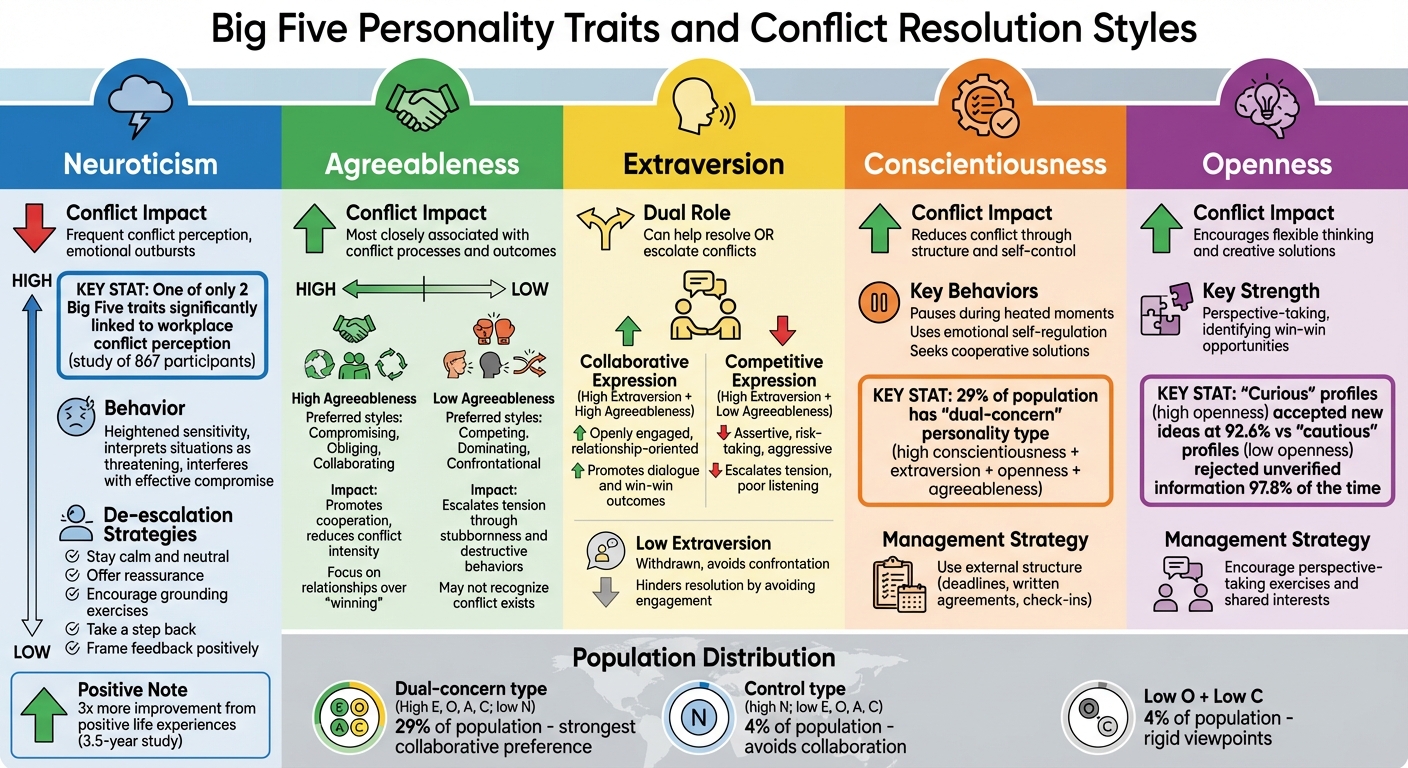
How Big Five Personality Traits Influence Conflict Resolution Styles
Personality: “Big 5” Traits (Openness, Conscientiousness, Extraversion, Agreeableness, Neuroticism)
Neuroticism and Conflict Frequency
Neuroticism is a strong predictor of how often individuals perceive and experience conflicts. A study involving 867 participants found neuroticism to be one of only two Big Five traits significantly linked to workplace conflict perception [5]. People with high levels of neuroticism often interpret everyday situations as more threatening than they actually are [7].
"Individuals who score higher on agreeableness and neuroticism, perceive more interpersonal conflict in the workplace compared to those that score lower on each dimension." – Emily Rivera and Toni DiDona [5]
This heightened sensitivity doesn't just stop at perception - it also influences behavior. For instance, neuroticism can interfere with effective compromise during negotiations, making it harder for individuals to find balanced solutions [4]. The following sections explore how this sensitivity plays out emotionally and offer strategies to manage conflict more effectively.
Emotional Reactivity and Hostile Communication
People with high neuroticism often experience intense emotional reactions, which can lead to unproductive behaviors like criticism or blame. When overwhelmed, they may lash out instead of addressing issues constructively. This stems from a tendency to become easily upset, anxious, or worried in response to stress [7]. Different aspects of neuroticism contribute to distinct reactions: anxiety encourages passivity, anger leads to vindictive behavior, depression results in withdrawal, and impulsiveness can cause sudden outbursts [7].
De-escalation Techniques for High-Neuroticism Individuals
Managing conflicts with highly neurotic individuals requires thoughtful approaches. Here are some effective techniques:
- Stay calm and neutral: Responding to emotional outbursts with a steady demeanor can help prevent further escalation [6].
- Offer reassurance: Repeated affirmation and clear communication can ease fears of rejection or insecurity [6][7].
- Encourage grounding exercises: Techniques like deep breathing can calm the nervous system and interrupt cycles of escalating emotions [6][7].
- Take a step back: Briefly pausing can help break patterns of racing or ruminating thoughts [6].
- Frame feedback positively: Presenting criticism as an opportunity for growth can reduce avoidance and self-criticism, which are common among neurotic individuals [6][7].
Interestingly, a 3.5-year study revealed that neurotic individuals with depression showed three times more improvement in response to positive life experiences compared to their less neurotic peers [7]. This suggests that their heightened sensitivity to positive changes can be used to build better relationships and improve conflict resolution outcomes.
Agreeableness and Conflict Resolution
Agreeableness is the Big Five trait most closely tied to how conflicts are resolved. While neuroticism amplifies the perception of conflict, agreeableness influences a constructive approach to managing it. Studies indicate that this trait plays a key role in maintaining positive relationships, making it a strong predictor of conflict outcomes [8]. Interestingly, while agreeable individuals may perceive more conflict in the workplace, their focus on relationships often drives them to resolve disputes in a productive manner [5].
"Among the Big Five dimensions, Agreeableness was most closely associated with processes and outcomes during interpersonal conflict." – Jensen-Campbell and Graziano [8]
The following sections explore how empathy aids in resolving disputes and how low agreeableness can lead to more confrontational behaviors.
Empathy and Cooperation During Disputes
People who are highly agreeable tend to prioritize preserving relationships over "winning" a disagreement. This mindset leads them to favor non-confrontational conflict styles, such as compromising, obliging, or collaborating [4]. In negotiations, they avoid assigning blame and instead focus on finding solutions that benefit all parties involved [9]. Agreeableness also moderates emotional responses during conflicts [8]. For example, while someone with high neuroticism might react with anger or anxiety, an agreeable individual often redirects those emotions into strategies that de-escalate the situation and shorten the duration of the conflict [8].
To apply this trait effectively, consider asking open-ended questions like, "When did you first feel upset?" to uncover deeper issues beyond the surface-level disagreement [9]. Shifting the conversation away from personal blame and toward cooperative problem-solving can also help. Encouraging everyone involved to suggest specific changes that could improve the situation fosters collaboration [9]. Active listening techniques, such as acknowledging statements with simple phrases like "I see" or "uh huh", can further demonstrate fairness and encourage open dialogue [9].
Managing Low Agreeableness in Conflict
While high agreeableness fosters empathy and resolution, low agreeableness often results in a more competitive approach to conflict. Individuals with lower levels of this trait are more likely to use confrontational strategies, such as competing or dominating [4]. They also tend to resort to destructive tactics during disputes [8], focusing on their own goals at the expense of maintaining relationships - an approach that can quickly escalate tensions.
"Agreeableness is positively related to non-confrontational styles but negatively related to confrontational styles." – Zhenzhong Ma [4]
When dealing with individuals low in agreeableness, expect a more competitive stance rather than collaboration [4]. Establishing clear communication rules can help prevent conflicts from spiraling, as these individuals are more prone to using harmful tactics [8]. Additionally, while high-agreeable individuals often feel significant distress during interpersonal friction, those with low agreeableness may not even recognize the presence of conflict [5].
| Agreeableness Level | Preferred Conflict Style | Impact on Resolution |
|---|---|---|
| High Agreeableness | Compromising, Obliging, Collaborating | Promotes cooperation, reducing conflict intensity [8] |
| Low Agreeableness | Competing, Dominating, Confrontational | Escalates tension through stubbornness and destructive behaviors [4, 8] |
For professionals managing complex interpersonal situations, recognizing these personality traits is crucial. Platforms like Personos leverage the Five Factor Model to provide real-time guidance for navigating challenging interactions. These tools offer tailored strategies based on full personality profiles, helping professionals like social workers, case managers, and counselors adapt their approaches. Whether it’s preparing for a competitive style with a low-agreeable client or using a high-agreeable team member to mediate, understanding these dynamics can make all the difference.
Extraversion's Mixed Effects on Conflict
Extraversion can play a dual role in conflicts - it can either help resolve issues or make them worse, depending on how the energy of an extravert is directed. Studies show that high extraversion is linked to both "collaboration" and "competition" as ways of handling conflict [2]. While their assertiveness and strong communication skills can bring people together, these same traits can also lead to dominance and confrontation [4].
The key lies in how extraverts use their energy. When paired with qualities like agreeableness and openness, extraversion promotes productive conversations and strengthens relationships [2]. On the flip side, if an extravert focuses purely on winning or rushing through issues, their intensity can overwhelm others and escalate tensions. Let’s explore how extraversion influences both collaborative and competitive approaches to conflict.
How Extraversion Helps Resolve Conflict
Extraverts excel at engaging with others, which makes them effective at resolving conflicts. A meta-analysis of six studies found that collaboration is strongly associated with high extraversion, as well as traits like agreeableness, openness, and conscientiousness [2]. Unlike introverts, who might shy away from confrontation due to discomfort or hesitation, extraverts bring the energy needed to openly discuss problems and share ideas [10].
"It seems that collaborating requires a little extra energy in interacting with others (sharing ideas and discussing concerns), while avoiding naturally involves an element of shyness or aloofness in an interpersonal situation." – Ralph Kilmann, CEO and Senior Consultant, Kilmann Diagnostics [10]
This willingness to engage often drives extraverts to invest the time and effort needed for collaborative problem-solving, rather than letting issues fester [10]. Their ease of communication and natural enthusiasm can make them effective relationship builders, helping others feel valued and relaxed enough to lower their defenses [1].
When working with an extraverted collaborator, it’s helpful to acknowledge their need for group involvement and avoid an overly task-focused approach. Extraverts tend to thrive when addressing "people" challenges [1]. Meanwhile, introverts can benefit from adopting some extraverted behaviors, like making a conscious effort to engage in discussions and share their thoughts openly when collaboration is required [10]. However, extraversion's strengths can become liabilities when misapplied.
When High Extraversion Creates Problems
On the flip side, extraverts can sometimes adopt a competitive approach that worsens conflicts. Research shows that among younger adults, high extraversion is a strong predictor of a "competitive" conflict style [2]. This style often involves pushing boundaries and sometimes resorting to aggressive tactics to resolve problems quickly. While extraverts are comfortable expressing their opinions, this can come across as overbearing or domineering during disagreements.
One notable downside is that extraverts are often perceived as poor listeners compared to individuals with lower levels of extraversion [11]. This can leave others feeling ignored or dismissed. Additionally, their tendency to command attention may be seen as self-centered, which can alienate others in the middle of a conflict [11].
"A competitor is always pushing the envelope and prone to taking risks. They often have the reputation of being aggressive." – Jim Guinn and John Eliot, Authors and Conflict Coaches [1]
Even extraverts who aim to collaborate can unintentionally escalate tensions. Their inclination to deeply explore others’ thoughts and feelings might come across as intrusive, triggering defensive reactions [1]. To navigate interactions with competitive extraverts, it can be helpful to set clear deadlines and offer small, early wins to satisfy their need for quick resolutions [1]. For those seeking tailored strategies, tools like Personos provide real-time guidance based on personality profiles, enabling you to either counter a competitive extravert’s intensity or harness a collaborative extravert’s strengths.
The table below highlights how different expressions of extraversion influence conflict resolution.
| Extraversion Expression | Conflict Style | Key Behaviors | Impact on Resolution |
|---|---|---|---|
| High Extraversion + High Agreeableness | Collaborating | Openly engaged, emotionally perceptive, relationship-oriented | Promotes dialogue and win-win outcomes [2] |
| High Extraversion + Low Agreeableness | Competing | Assertive, risk-taking, focused on deadlines, aggressive | Escalates tension through dominance and poor listening [1][11] |
| Low Extraversion | Avoiding | Withdrawn, reflective, uncomfortable with confrontation | Hinders resolution by avoiding engagement [10] |
Conscientiousness and Openness in Conflict Situations
While traits like extraversion often take center stage during conflicts, conscientiousness and openness play quieter yet crucial roles in preventing disputes and fostering creative solutions. Conscientiousness brings structure and self-control, while openness encourages flexible thinking. Research consistently shows that these traits are strong indicators of collaborative conflict resolution, though they operate in distinct ways [2][3].
Understanding these differences is key in handling tense situations. Conscientious individuals rely on careful planning and emotional regulation to sidestep impulsive reactions. On the other hand, those with high openness are more likely to uncover win-win scenarios that others might miss.
How Conscientiousness Reduces Conflict
Conscientious individuals excel at minimizing conflict through self-discipline and a preference for structure. They are more likely to pause during heated moments, using mindfulness and emotional self-regulation to prevent escalation [3]. Their adherence to social norms also helps avoid impulsive disagreements.
Studies reveal that higher levels of conscientiousness in one or both parties are associated with fewer conflicts [12]. These individuals seek cooperative solutions that address everyone’s concerns, rather than resorting to competitive tactics.
"Highly committed individuals are likely to place more emphasis on co-operative strategies that satisfy the concerns of both parties than on competitive strategy at the other party's expense." – Scientific Reports [3]
Interestingly, the influence of conscientiousness grows with age. Research indicates it becomes a stronger predictor of collaborative and avoidance strategies in older adults compared to younger individuals [2]. For example, a study of 975 university students found that the "dual-concern" personality type - marked by high levels of conscientiousness, extraversion, openness, and agreeableness - was present in 29% of participants and showed the strongest preference for collaborative resolutions [3].
In professional settings, pairing conscientious individuals can help reduce interpersonal conflict [12]. When working with someone less conscientious, introducing external structures like clear deadlines, written agreements, or regular check-ins can mitigate impulsive behaviors and create steadier interactions [3].
While conscientiousness provides stability, openness brings adaptability to the table.
Openness and Flexible Problem-Solving
Openness complements conscientiousness by fostering cognitive flexibility and a willingness to explore diverse perspectives. This trait enables individuals to spot cooperation opportunities that others might overlook, paving the way for creative resolutions [3].
"Openness helps to overcome the bias of ignoring potential win-win opportunities in a conflict. It allows people to see potentially missed cooperation opportunities and be more receptive to the other party's point of view." – Scientific Reports [3]
This ability to take on different perspectives is vital for innovative problem-solving. While conscientiousness ensures reliability, openness encourages fresh approaches by considering alternative solutions. Meta-analysis findings highlight that openness, alongside traits like extraversion, agreeableness, and conscientiousness, consistently predicts collaborative outcomes through its role in creative conflict resolution [2].
On the other hand, individuals who score low on both openness and conscientiousness - about 4% of the population - tend to avoid collaboration due to rigid viewpoints [3].
For professionals managing complex dynamics, tools like Personos can help identify personality patterns and provide real-time, tailored guidance. When working with individuals low in openness, encouraging them to engage in perspective-taking exercises or identify shared interests can help develop the cognitive flexibility needed for effective conflict resolution. For highly open individuals, tapping into their natural creativity - such as by asking open-ended questions - can enhance collaborative efforts.
| Trait | Resolution Approach | Key Strength | Management Strategy for Low Scores |
|---|---|---|---|
| High Conscientiousness | Structured, methodical cooperation | Self-control, planning, emotional regulation | Use external structure (clear deadlines, written agreements, check-ins) [3] |
| High Openness | Creative, flexible problem-solving | Perspective-taking, identifying win-win opportunities | Encourage perspective-taking and shared interests [3] |
| Low Conscientiousness + Low Openness | Avoidance, rigid viewpoints | Limited | Combine structure with flexibility training [3] |
Applying Personality Insights to Prevent Conflict
Building on the idea of using personality-driven insights to manage conflict, AI-powered tools now offer refined strategies to prevent tensions from escalating. These platforms transform Big Five personality data into practical, real-time advice for managing sensitive interactions. By identifying personality patterns and predicting conflict triggers, tools like Personos provide tailored strategies to address individual needs effectively.
AI-Powered Conflict Trigger Identification
AI platforms use the Big Five personality model to analyze how traits influence conflict susceptibility in social settings. They predict triggers by examining the relationship between observed behaviors and underlying thoughts [13].
For instance, Openness to Experience plays a major role in how individuals accept or reject information. In AI simulations, "curious" profiles (high openness) accepted new ideas at a rate of 92.6%, while "cautious" profiles (low openness) rejected unverified information 97.8% of the time [13]. This demonstrates that people with low openness may respond skeptically to novel suggestions, whereas those with high openness are more likely to embrace them.
"Openness to Experience had the strongest impact on information acceptance, with curious agents showing high acceptance rates and cautious agents displaying strong skepticism." – Minjun Ren and Wentao Xu, Researchers [13]
Platforms like Personos apply Big Five research to offer real-time guidance in challenging scenarios. Built on the Five Factor Model, which evaluates 30 personality traits on an 80-point scale, Personos uses conversational AI to integrate full personality profiles with situational context. For example, a social worker handling a resistant client or a coach managing team tension can rely on the platform to identify personality-driven triggers. These might include high neuroticism leading to emotional reactivity, low agreeableness causing reduced cooperation, or differing levels of openness affecting communication styles.
A standout feature of Personos is Transparent Reasoning, which explains how personality traits and psychological principles shape its recommendations. This helps professionals understand the "why" behind the advice, rather than simply following it. This is particularly helpful when dealing with "control" personality types - individuals with high neuroticism and low scores in other traits - who make up about 4% of the population [3].
These insights allow for more precise, personality-informed communication strategies.
Better Outcomes Through Personality-Based Communication
Adapting communication to align with personality profiles can build trust and prevent conflicts from escalating, particularly in high-pressure situations. Research shows that "dual-concern" individuals - those who score high in extraversion, openness, agreeableness, and conscientiousness, but low in neuroticism - account for about 29% of the population and are more inclined toward collaborative problem-solving [3].
Personality-based tools can predict potential friction points and help mitigate them before they worsen [10]. Ralph Kilmann, CEO of Kilmann Diagnostics, notes:
"With that awareness, people can then consciously compensate with their conflict-handling behavior" [10].
For example, an introverted team member might make an effort to engage in collaboration rather than withdrawing.
Personos enhances these efforts with Dynamic Reports, which provide up-to-date, personalized insights for individuals and teams. Unlike traditional static assessments, these reports incorporate evolving contextual factors, enabling professionals to pinpoint friction points and adjust their communication strategies in real time. Additionally, the Prompts feature offers concise, actionable advice on a set schedule, ensuring that personality insights remain accessible even during busy periods.
With tools like these, professionals are better equipped to de-escalate conflicts, especially when working with individuals who exhibit high levels of neuroticism [3].
Conclusion
The Big Five personality traits play a measurable role in shaping how individuals handle and respond to conflict. Neuroticism often leads to emotional outbursts and avoidance, while Agreeableness encourages collaboration but can also heighten sensitivity to workplace disputes. Extraversion brings both active participation and the potential for confrontational approaches. On the other hand, Conscientiousness and Openness support cooperative problem-solving, often leading to solutions that benefit all parties involved [3].
Personality traits don’t operate in isolation - they interact in ways that influence conflict outcomes. For example, individuals with high levels of extraversion, openness, agreeableness, and conscientiousness, combined with low neuroticism, are more likely to resolve conflicts constructively. In contrast, those with high neuroticism often face challenges in managing disputes effectively. These combinations not only affect behavior during conflicts but also influence how disagreements are perceived. As Emily Rivera and Toni DiDona explain:
"Research shows that personality constructs underline individual differences in processing conflict and interpersonal relations" [5].
This understanding is crucial because personality impacts both how people behave during conflicts and how they interpret the nature of disagreements - whether they see them as task-oriented or relationship-driven [12]. These insights align with earlier findings that neuroticism tends to provoke reactive behaviors, while traits like agreeableness, extraversion, conscientiousness, and openness steer individuals toward more constructive conflict resolution.
For professionals working in high-pressure environments, personality-based tools offer a practical application of this research. Platforms like Personos utilize the Five Factor Model’s 30 traits (measured on an 80-point scale) to provide actionable insights in real time. Features such as Transparent Reasoning clarify how specific traits influence recommendations, while Dynamic Reports identify potential conflict areas before they escalate. These tools turn personality research into actionable strategies, helping professionals address crises, manage challenging clients, and improve team dynamics and role fit.
FAQs
Which Big Five trait most strongly predicts workplace conflict?
Neuroticism stands out as the most reliable indicator of workplace conflict. People with higher levels of neuroticism are more likely to interpret situations as involving interpersonal conflict. They also tend to lean toward conflict-avoidant behaviors, which can either intensify tensions or make resolving issues more challenging.
How can I de-escalate conflict with someone high in neuroticism?
To handle conflict with someone who has high levels of neuroticism, it’s important to stay calm and empathetic. Keep your tone steady and avoid language that might feel confrontational. Instead, focus on listening actively and showing understanding to help ease their emotional responses. Creating a sense of safety in the conversation can go a long way toward reducing tension. Tools like Personos can also offer real-time advice tailored to these situations, helping foster more productive and positive discussions.
How can I use personality data to prevent conflicts before they start?
Understanding how personality traits influence communication is key to preventing conflicts. The Big Five traits - extraversion, agreeableness, neuroticism, openness, and conscientiousness - play a major role in shaping how people handle disagreements. For instance, extraverts tend to address conflicts head-on, while those who score high in agreeableness often prioritize maintaining harmony.
Tools like Personos can help professionals navigate these differences. By identifying potential triggers and tailoring their tone or the way they frame messages, they can build trust and address issues before they escalate into conflicts. This proactive approach makes interactions smoother and more constructive.